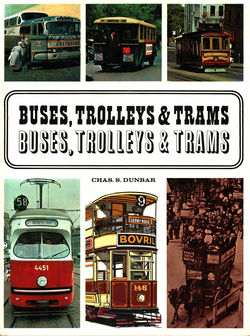
BUSES,
TROLLEYS & TRAMS HBDJ (DUNBAR) LONDON NY EUROPE COMMONWEALTH WW1
HARDBOUND BOOK with DUSTJACKET
by CHARLES S. DUNBAR (1967)
QUICKER THAN WALKING (EARLY
CARRIERS, HACKNEYS, MAIL-COACHES, OMNIBUSES IN FRANCE, SHILLIBEER IN LONDON,
EARLY TRAMWAYS AND RAILWAYS, STEAM ROAD COACHES, THE NEW YORK AND HARLEM
RAILROAD, THE LONDON ASSOCIATIONS)
THE HORSE SUPREME (THE
EXHIBITION OF 1851, LA COMPAGNIE GENERALE DES OMNIBUS, THE LONDON GENERAL, LE
CHEMIN DE FER AMERICAIN, RAILWAY OMNIBUSES IN LIVERPOOL, GEORGE FRANCIS TRAINS,
TRAMWAYS, THE LANDPORT AND SOUTHSEA TRAMWAY, CONTINENTAL EUROPE, FIRST TRAMS IN
LONDON, COMPETITION AMONG BUS OWNERS)
MECHANICAL MARVELS (STEAM TRAMS,
MUNICIPAL OPERATIONS, EUROPEAN LIGHT RAILWAYS, COMPRESSED-AIR CARS, CABLE
TRACTION, INTERNAL COMBUSTION, ELECTRICITY, BOSTON STREETCAR TUNNELS, OVERHEAD
COLLECTION, THE STUD SYSTEM, CONDUIT TRAMWAYS, STEAM-ELECTRIC, PETROL BUSES)
END OF AN ERA (THE ELECTRIC
TRACTION MANIA, AMERICAN INTERURBANS, MUNICIPAL ARGUMENTS IN BRITAIN, PLANNING
IN VIENNA, HAPHAZARD DEVELOPMENT IN PARIS, THOMAS TILLING MOTORBUSES, COUNTRY
BUSES, THE COMBINE, ARTICULATED CARS IN THE US, THE 1914-1918 WAR, JITNEYS IN
LOS ANGELES)
THE ROARING TWENTIES
(CONSERVATISM IN LONDON, THE INDEPENDENTS, L.C.C. CHEAP FARES, THE FELTHAM
TRAMS, COMPETITION IN THE PROVINCES, GROWTH OF THE BIG GROUPS, THE “SHARRA”,
FIRST TROLLEY-BUSES, TRAMWAY REPLACEMENTS, THE S.T.C.R.P, THE B.V.G., AMERICAN
RURAL BUSES, TRANSCONTINENTAL LINES)
THE TROUBLED THIRTIES (DECLINE
OF THE INTERURBANS, THE P.C.C. CAR, DEVELOPMENT OF DIESEL ENGINES, LEGISLATIVE
CONTROL IN BRITAIN, THE “LOW-BRIDGE” BUS, TRAM MODERNIZATION SCHEMES, THE
LONDON PASSENGER TRANSPORT BOARD, TROLLEY-BUSES IN LONDON, END OF THE PARIS
TRAMS)
WAR – AND NO PEACE (THE BLITZ,
FUEL SHORTAGES, UTILITY MODELS, THE LAST LONDON TRAM, RECESSION IN TRAFFIC,
PARIS DEPENDENT ON METRO, VEHICLE LOOTING, NEW TRAMS IN EUROPE, END OF THE
AMERICAN INTERURBANS, DECLINE OF THE STREET RAILWAYS, TORONTO SUBWAY, TRAMS FOR
BUSES IN MELBOURNE)
FIGHTING FOR LIFE (INROADS OF
THE PRIVATE CAR, BANEFUL EFFECT OF POLITICS, PROBLEMS IN GLASGOW SCOTLAND,
BRITISH TRAMS AND TROLLEYBUSES ON THE WANE, MOTORBUS DIMENSIONS INCREASED,
BUSES WITHOUT CONDUCTORS, SINGLE OR DOUBLE-DECK?; TRAM TUNNELS, ARTICULATION,
NORTH AMERICAN SYSTEMS HARD HIT)
THE FUTURE AND THE PAST
(SUBSIDIES, SELF-GUIDED BUS-TRAINS, MONORAILS, HOVERCRAFT, TRAM & TROLLEY
MUSEUMS)
------------------------------
Additional Information from
Internet Encyclopedia
The world's first passenger tram
was the Swansea and Mumbles Railway, in Wales, UK. The Mumbles Railway Act was
passed by the British Parliament in 1804, and this first horse-drawn passenger
tramway started operating in 1807. It was worked by steam from 1877, and then,
from 1929, by very large (106-seater) electric tramcars, until closure in 1961.
In 1860, Birkenhead on the
Wirral Peninsula had become the first town in Europe to operate a street
tramway. It was started by George Francis Train, an American when he laid track
from Woodside Ferry to Birkenhead Park Main Entrance and ran a horse drawn car
service. On 4 February 1901, the Corporation of Birkenhead owned Birkenhead
Corporation Tramways commenced operating, first to New Ferry and later around
the town. It closed on 17 July 1937.
The first streetcar in America,
developed by John Stephenson, began service in the year 1832. This was the New
York and Harlem Railroad's Fourth Avenue Line which ran along the Bowery and
Fourth Avenue in New York City. These trams were an animal railway, usually
using horses and sometimes mules to haul the cars, usually two as a team.
Rarely, other animals were tried, including humans in emergency circumstances.
It was followed in 1835 by New Orleans, Louisiana, which is the oldest
continuously operating street railway system in the world, according to the
American Society of Mechanical Engineers.
The first tram in Continental
Europe opened in France in 1839 between Montbrison and Montrond, on the streets
inside the towns, and on the roadside outside town. It had permission for steam
traction but was entirely run with horse traction. In 1848, it was closed down
after repeated economic failure. The tram developed in numerous cities of
Europe (some of the most extensive systems were found in Berlin, Budapest,
Birmingham, Leningrad, Lisbon, London, Manchester, Paris).
The first tram in South America
opened in 10 June 1858 in Santiago, Chile. The first trams in Australia opened
in 1860 in Sydney. Africa's first tram service started in Alexandria on 8
January 1863. The first trams in Asia opened in 1869 in Batavia (now Jakarta),
Netherlands East Indies (now Indonesia).
Problems with horsecars included
the fact that any given animal could only work so many hours on a given day,
had to be housed, groomed, fed and cared for day in and day out, and produced
prodigious amounts of manure, which the streetcar company was charged with
storing and then disposing of. Since a typical horse pulled a streetcar for
about a dozen miles a day and worked for four or five hours, many systems
needed ten or more horses in stable for each horsecar.
Horsecars were largely replaced
by electric-powered trams following the improvement of an overhead trolley
system on trams for collecting electricity from overhead wires by Frank J.
Sprague. His spring-loaded trolley pole used a wheel to travel along the wire.
In late 1887 and early 1888, using his trolley system, Sprague installed the
first successful large electric street railway system in Richmond, Virginia.
Within a year, the economy of electric power had replaced more costly horsecars
in many cities. By 1889, 110 electric railways incorporating Sprague's
equipment had been begun or planned on several continents.
Horses continued to be used for
light shunting well into the 20th century. Many large metropolitan lines lasted
well into the early twentieth century. New York City had a regular horsecar
service on the Bleecker Street Line until its closure in 1917.[5] Pittsburgh,
had its Sarah Street line drawn by horses until 1923. The last regular
mule-drawn cars in the US ran in Sulphur Rock, Arkansas, until 1926 and were
commemorated by a U.S. postage stamp issued in 1983.[6] The last mule tram
service in Mexico City ended in 1932, and a mule tram in Celaya, Mexico,
survived until 1954.[7] The last horse-drawn tram to be withdrawn from public
service in the UK took passengers from Fintona railway station to Fintona
Junction one mile away on the main Omagh to Enniskillen railway in Northern
Ireland. The tram made its last journey on 30 September 1957 when the Omagh to
Enniskillen line closed. The van now lies at the Ulster Folk and Transport
Museum.
Horse-drawn trams still operate
on the 1876-built Douglas Bay Horse Tramway on the Isle of Man, and at the
1894-built Victor Harbor Horse Drawn Tram, in Adelaide, South Australia. New
horse-drawn systems have been established at the Hokkaidō Museum in Japan and
also in Disneyland.
Steam
The first mechanical trams were
powered by steam. Generally, there were two types of steam tram. The first and
most common had a small steam locomotive (called a tram engine in the UK) at
the head of a line of one or more carriages, similar to a small train. Systems
with such steam trams included Christchurch, New Zealand; Adelaide, South
Australia; Sydney, Australia and other city systems in New South Wales; Munich,
Germany (from August 1883 on),[8] British India (Pakistan) (from 1885) and the
Dublin & Blessington Steam Tramway (from 1888) in Ireland. Steam tramways
also were used on the suburban tramway lines around Milan and Padua; the last
Gamba de Legn ("Peg-Leg") tramway ran on the Milan-Magenta-Castano
Primo route in late 1958.
The other style of steam tram
had the steam engine in the body of the tram, referred to as a tram engine (UK)
or steam dummy (US). The most notable system to adopt such trams was in Paris.
French-designed steam trams also operated in Rockhampton, in the Australian
state of Queensland between 1909 and 1939. Stockholm, Sweden, had a steam tram
line at the island of Södermalm between 1887 and 1901.
Tram engines usually had
modifications to make them suitable for street running in residential areas.
The wheels, and other moving parts of the machinery, were usually enclosed for
safety reasons and to make the engines quieter. Measures were often taken to
prevent the engines from emitting visible smoke or steam. Usually, the engines
used coke rather than coal as fuel to avoid emitting smoke; condensers or
superheating were used to avoid emitting visible steam. A major drawback of
this style of the tram was the limited space for the engine so that these trams
were usually underpowered. Steam tram engines faded out around the 1890s to the
1900s, being replaced by electric trams.
Cable-hauled
Another motive system for trams
was the cable car, which was pulled along a fixed track by a moving steel
cable. The power to move the cable was normally provided at a
"powerhouse" site a distance away from the actual vehicle.
The London and Blackwall Railway,
which opened for passengers in East London, England, in 1840 used such a
system.
The first practical cable car
line was tested in San Francisco, in 1873. Part of its success is attributed to
the development of an effective and reliable cable grip mechanism, to grab and
release the moving cable without damage. The second city to operate cable trams
was Dunedin in New Zealand, from 1881 to 1957.
The most extensive cable system
in the US was built in Chicago between 1882 and 1906.New York City developed at
least seven cable car lines. Los Angeles also had several cable car lines,
including the Second Street Cable Railroad, which operated from 1885 to 1889,
and the Temple Street Cable Railway, which operated from 1886 to 1898.
From 1885 to 1940, the city of
Melbourne, Victoria, Australia operated one of the largest cable systems in the
world, at its peak running 592 trams on 75 kilometres (47 mi) of track, though
during its heyday, Sydney's network was larger,[11] with about 1,600 cars in
service at any one time at its peak during the 1930s (cf. about 500 trams in
Melbourne today). There were also two isolated cable lines in Sydney, the North
Sydney line from 1886 to 1900,[12] and the King Street line from 1892 to 1905.
Sydney's tram network ceased to serve the city population by the 1960s, with
all tracks being removed, in lieu of a bus service. Melbourne's tram network,
however, continues to run to this day.
In Dresden, Germany, in 1901 an
elevated suspended cable car following the Eugen Langen one-railed floating
tram system started operating. Cable cars operated on Highgate Hill in North
London and Kennington to Brixton Hill in South London. They also worked around
"Upper Douglas" in the Isle of Man from 1897 to 1929 (cable car 72/73
is the sole survivor of the fleet).
Cable cars suffered from high
infrastructure costs, since an expensive system of cables, pulleys, stationary
engines and lengthy underground vault structures beneath the rails had to be
provided. They also required physical strength and skill to operate, and alert
operators to avoid obstructions and other cable cars. The cable had to be
disconnected ("dropped") at designated locations to allow the cars to
coast by inertia, for example when crossing another cable line. The cable would
then have to be "picked up" to resume progress, the whole operation
requiring precise timing to avoid damage to the cable and the grip mechanism.
Breaks and frays in the cable, which occurred frequently, required the complete
cessation of services over a cable route while the cable was repaired. Due to
overall wear, the entire length of cable (typically several kilometres) would
have to be replaced on a regular schedule. After the development of reliable
electrically powered trams, the costly high-maintenance cable car systems were
rapidly replaced in most locations.
Cable cars remained especially
effective in hilly cities since their nondriven wheels would not lose traction
as they climbed or descended a steep hill. The moving cable would physically
pull the car up the hill at a steady pace, unlike a low-powered steam or
horse-drawn car. Cable cars do have wheel brakes and track brakes, but the
cable also helps restrain the car to going downhill at a constant speed.
Performance in steep terrain partially explains the survival of cable cars in
San Francisco.
The San Francisco cable cars,
though significantly reduced in number, continue to perform a regular
transportation function, in addition to being a well-known tourist attraction.
A single cable line also survives in Wellington, New Zealand (rebuilt in 1979
as a funicular but still called the Wellington Cable Car). Another system,
actually two separate cable lines with a shared power station in the middle,
operates from the Welsh town of Llandudno up to the top of the Great Orme hill
in North Wales, UK.
Gas
In the late 19th and early 20th
centuries, a number of systems in various parts of the world employed trams
powered by gas, naphtha gas or coal gas in particular. Gas trams are known to
have operated between Alphington and Clifton Hill in the northern suburbs of
Melbourne, Australia (1886–1888); in Berlin and Dresden, Germany; between
Jelenia Góra, Cieplice, and Sobieszów in Poland (from 1897); and in the UK at
Lytham St Annes, Neath (1896–1920), and Trafford Park, Manchester (1897–1908).
On 29 December 1886 the
Melbourne newspaper The Argus reprinted a report from the San Francisco
Bulletin that Mr Noble had demonstrated a new 'motor car' for tramways 'with
success'. The tramcar 'exactly similar in size, shape, and capacity to a cable
grip car' had the 'motive power' of gas 'with which the reservoir is to be
charged once a day at power stations by means of a rubber hose'. The car also
carried an electricity generator for 'lighting up the tram and also for driving
the engine on steep grades and effecting a start'.
Comparatively little has been
published about gas trams. However, research on the subject was carried out for
an article in the October 2011 edition of "The Times", the historical
journal of the Australian Association of Timetable Collectors, now the
Australian Timetable Association.
A tram system powered by
compressed natural gas was due to open in Malaysia in 2012,[18] but the news
about the project appears to have dried up.
Electric
The world's first experimental
electric tramway was built by Ukrainian inventor Fedir Pirotsky near St
Petersburg, Russian Empire, in 1875. The first commercially successful electric
tram line operated in Lichterfelde near Berlin, Germany, in 1881. It was built
by Werner von Siemens (see Berlin Straßenbahn). It initially drew current from
the rails, with the overhead wire being installed in 1883.
In Britain, the Volk's Electric
Railway was opened in 1883 in Brighton. This two kilometer line, re-gauged to 2
feet 9 inches (840 mm) in 1884, remains in service to this day, and is the
oldest operating electric tramway in the world. Also in 1883, Mödling and
Hinterbrühl Tram was opened near Vienna in Austria. It was the first tram in
the world in regular service that was run with electricity served by an
overhead line with pantograph current collectors. The Blackpool Tramway, was
opened in Blackpool, England on 29 September 1885 using conduit collection
along Blackpool Promenade. This system is still in operation in a modernised
form.
The earliest tram system in
Canada was by John Joseph Wright, brother of the famous mining entrepreneur
Whitaker Wright, in Toronto in 1883. In the US, multiple functioning
experimental electric trams were exhibited at the 1884 World Cotton Centennial
World's Fair in New Orleans, Louisiana, but they were not deemed good enough to
replace the Lamm fireless engines then propelling the St Charles Streetcar in
that city. The first commercial installation of an electric streetcar in the
United States was built in 1884 in Cleveland, Ohio and operated for a period of
one year by the East Cleveland Street Railway Company.[20] Trams were operated
in Richmond, Virginia, in 1888, on the Richmond Union Passenger Railway built
by Frank J. Sprague. Sprague later developed multiple unit control, first
demonstrated in Chicago in 1897, allowing multiple cars to be coupled together
and operated by a single motorman. This gave birth to the modern subway train.
Following the improvement of an overhead trolley system on streetcars for
collecting electricity from overhead wires by Frank J. Sprague, electric tram
systems were rapidly adopted across the world.
Earlier installations proved
difficult or unreliable. Siemens' line, for example, provided power through a
live rail and a return rail, like a model train, limiting the voltage that
could be used, and providing electric shocks to people and animals crossing the
tracks.[21] Siemens later designed his own version of overhead current
collection, called the bow collector, and Thorold, Ontario, opened in 1887, and
was considered quite successful at the time. While this line proved quite
versatile as one of the earliest fully functional electric streetcar
installations, it required horse-drawn support while climbing the Niagara
Escarpment and for two months of the winter when hydroelectricity was not
available. It continued in service in its original form into the 1950s.
Sidney Howe Short designed and
produced the first electric motor that operated a streetcar without gears. The
motor had its armature direct-connected to the streetcar's axle for the driving
force. Short pioneered "use of a conduit system of concealed feed"
thereby eliminating the necessity of overhead wire, trolley poles and a trolley
for street cars and railways. While at the University of Denver he conducted
important experiments which established that multiple unit powered cars were a
better way to operate trains and trolleys.
Sarajevo built a citywide system
of electric trams in 1885. Budapest established its tramway system in 1887, and
its ring line has grown to be the busiest tram line in Europe, with a tram
running every 60 seconds at rush hour. Bucharest and Belgrade ran a regular
service from 1894. Ljubljana introduced its tram system in 1901 – it closed in
1958.
The first electric tramway in
Australia was a Sprague system demonstrated at the 1888 Melbourne Centennial
Exhibition in Melbourne; afterwards, this was installed as a commercial venture
operating between the outer Melbourne suburbs of Box Hill and Doncaster from
1889 to 1896.[33] As well, electric systems were built in Adelaide, Ballarat,
Bendigo, Brisbane, Fremantle, Geelong, Hobart, Kalgoorlie, Launceston, Leonora,
Newcastle, Perth and Sydney. By the 1970s, the only tramway system remaining in
Australia was the Melbourne tram system other than a few single lines remaining
elsewhere: the Glenelg tram line, connecting Adelaide to the beachside suburb
of Glenelg, and tourist trams in the Victorian Goldfields cities of Ballarat
and Bendigo. In recent years the Melbourne system, generally recognised as one
of the largest in the world, has been considerably modernised and expanded. The
Adelaide line has also been extended to the Entertainment Centre, and there are
plans to expand further.
In Japan, the Kyoto Electric
railroad was the first tram system, starting operation in 1895.[34] By 1932,
the network had grown to 82 railway companies in 65 cities, with a total
network length of 1,479 km (919 mi).[35] By the 1960s the tram had generally
died out in Japan.
Two rare but significant
alternatives were conduit current collection, which was widely used in London,
Washington, D.C. and New York City, and the surface contact collection method,
used in Wolverhampton (the Lorain system), Torquay and Hastings in the UK (the
Dolter stud system), and currently in Bordeaux, France (the ground-level power
supply system).
The convenience and economy of
electricity resulted in its rapid adoption once the technical problems of
production and transmission of electricity were solved. Electric trams largely
replaced animal power and other forms of motive power including cable and
steam, in the late 19th and early 20th centuries.
There is one particular hazard
associated with trams powered from a trolley off an overhead line. Since the
tram relies on contact with the rails for the current return path, a problem
arises if the tram is derailed or (more usually) if it halts on a section of
track that has been particularly heavily sanded by a previous tram, and the
tram loses electrical contact with the rails. In this event, the underframe of the
tram, by virtue of a circuit path through ancillary loads (such as saloon
lighting), is life at the full supply voltage, typically 600 volts. In British
terminology, such a tram was said to be 'grounded'—not to be confused with the
US English use of the term, which means the exact opposite. Any person stepping
off the tram completed the earth return circuit and could receive a nasty
electric shock. In such an event the driver was required to jump off the tram
(avoiding simultaneous contact with the tram and the ground) and pull down the
trolley before allowing passengers off the tram. Unless derailed, the tram
could usually be recovered by running water down the running rails from a point
higher than the tram. The water providing a conducting bridge between the tram
and the rails.
--------------------------------------
The trolleybus dates back to 29
April 1882, when Dr. Ernst Werner Siemens demonstrated his
"Elektromote" in a Berlin suburb. This experiment continued until 13
June 1882, after which there were few developments in Europe, although separate
experiments were conducted in the U.S.[7] In 1899, another vehicle which could
run either on or off rails was demonstrated in Berlin.[8] The next development
was when Louis Lombard-Gérin operated an experimental line at the Paris
Exhibition of 1900 after four years of trials, with a circular route around
Lake Daumesnil that carried passengers. Routes followed in six places including
Eberswalde and Fontainebleau.[9] Max Schiemann on 10 July 1901 opened the
world's fourth passenger-carrying trolleybus system, which operated at Bielatal
(Biela Valley, near Dresden), in Germany. Schiemann built and operated the
Bielatal system, and is credited with developing the under-running trolley
current collection system, with two horizontally parallel overhead wires and
rigid trolleypoles spring-loaded to hold them up to the wires. Although this
system operated only until 1904, Schiemann had developed what is now the standard
trolleybus current collection system. In the early days there were many other
methods of current collection.[7] The Cédès-Stoll (Mercédès-Électrique-Stoll)
system was first operated near Dresden between 1902 and 1904, and 18 systems
followed. The Lloyd-Köhler or Bremen system was tried out in Bremen with 5
further installations, and the Cantono Frigerio system was used in Italy.
Leeds and Bradford became the
first cities to put trolleybuses into service in Great Britain on 20 June
1911.[8] Supposedly, though it was opened on 20 June, the public was not
admitted to the Bradford route until the 24th. Bradford was also the last city to
operate trolleybuses in the UK; the system closed on 26 March 1972. The last
rear-entrance trolleybus in service in Britain was also in Bradford and is now
owned by the Bradford Trolleybus Association. Birmingham was the first UK city
to replace a tram route with trolleybuses, while Wolverhampton, under the
direction of Charles Owen Silvers, became world-famous for its trolleybus
designs.[10] There were 50 trolleybus systems in the UK, London's being the
largest. By the time trolleybuses arrived in Britain in 1911, the Schiemann
system was well established and was the most common, although the Cédès-Stoll
(Mercédès-Électrique-Stoll) system was tried in West Ham (in 1912) and in
Keighley (in 1913).
Smaller trackless trolley
systems were built in the US early as well. The first non-experimental system
was a seasonal municipal line installed near Nantasket Beach in 1904; the first
year-round commercial line was built to open a hilly property to development
just outside Los Angeles in 1910. The trackless trolley was often seen as an
interim step, leading to streetcars. In the US, some systems subscribed to the
all-four concept of using buses, trolleybuses, streetcars (trams, trolleys),
and rapid transit subway and/or elevated lines (metros), as appropriate, for
routes ranging from the lightly used to the heaviest trunk line. Buses and
trolleybuses in particular were seen as entry systems that could later be
upgraded to rail as appropriate. In a similar fashion, many cities in Britain
originally viewed trolleybus routes as extensions to tram (streetcar) routes
where the cost of constructing or restoring track could not be justified at the
time, though this attitude changed markedly (to viewing them as outright
replacements for tram routes) in the years after 1918.[13] Trackless trolleys
were the dominant form of new post-World War I [[electric traction, with
extensive systems in among others, Los Angeles, Chicago, Rhode Island, and
Atlanta; Boston, San Francisco, and Philadelphia still maintain an "all-four"
fleet. Some trolleybus lines in the United States (and in Britain, as noted
above) came into existence when a trolley or tram route did not have sufficient
ridership to warrant track maintenance or reconstruction. In a similar manner,
a proposed tram scheme in Leeds, United Kingdom, was changed to a trolleybus
scheme to cut costs.
Trolleybuses are uncommon today
in North America, but their use is widespread in Europe and Russia. They remain
common in many countries which were part of the Soviet Union.[15] Generally
trolleybuses occupy a position in usage between street railways (trams) and
motorbuses. Worldwide, around 300 cities or metropolitan areas on 5 continents
are served by trolleybuses.
This mode of transport operates
in large cities, including Athens, Belgrade, Bratislava, Bucharest, Budapest,
Chisinau, Geneva, Kyiv, Lyon, Minsk, Pyongyang, Riga, Rome, San Francisco, São
Paulo, Sofia, St. Petersburg, Sarajevo, Tallinn, Vilnius and Zurich, as well as
in smaller ones such as Arnhem, Bergen, Coimbra, Dayton, Gdynia, Kaunas,
Lausanne, Limoges, Lucerne, Modena, Plzeň, Prešov, Salzburg, Solingen, Szeged,
and Yalta. As of 2020 Kyiv has, due to its history in the former Soviet Union,
the largest trolleybus system in the world in terms of route length while
another formerly Soviet city, Minsk, has the largest system in terms of number
of routes (which also date back to the Soviet era). Landskrona has the smallest
system in terms of route length while Marianske Lazne is the smallest city to
be served by trolleybuses. Opened in 1914, Shanghai's trolleybus system is the
oldest operating system in the world. With a length of 86 km, route #52 of
Crimean Trolleybus is the longest trolleybus line in the world.