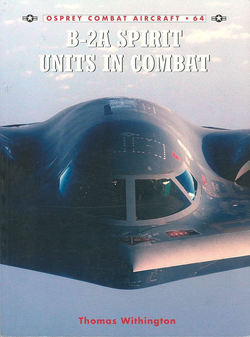
OSPREY COMBAT AIRCRAFT 64 NORTHROP B-2A SPIRIT STEALTH
BOMBER SERBIA AFGHANISTAN IRAQ
SOFTBOUND BOOK ***LIKE
NEW CONDITION***
-----------------------------------------------------------------------------------------------------
Additional Information from Internet Encyclopedia
The Northrop Grumman B-2 Spirit, also known as the Stealth Bomber, is an American strategic bomber, featuring low observable stealth technology designed for penetrating dense anti-aircraft
defenses; it is able to deploy both conventional and nuclear weapons. The bomber has a crew of two and can drop up to
eighty 500 lb (230 kg)-class JDAM GPS-guided bombs, or sixteen
2,400 lb (1,100 kg) B83 nuclear bombs. The B-2 is the only aircraft that can carry
large air-to-surface standoff weapons in a stealth configuration.
Development originally
started under the "Advanced Technology Bomber" (ATB) project during
the Carter
administration, and its performance was one of the reasons for his
cancellation of the B-1 Lancer. ATB continued during the Reagan
administration, but worries about delays in its introduction led to the
reinstatement of the B-1 program as well. Program costs rose throughout
development. Designed and manufactured by Northrop Grumman with assistance from Boeing, the cost of each aircraft
averaged US$737 million (in 1997 dollars). Total procurement costs averaged $929 million per aircraft,
which includes spare parts, equipment, retrofitting, and software support. The
total program cost including development, engineering and testing, averaged
$2.1 billion per aircraft in 1997.
Because of its considerable capital and operating costs, the project was controversial in the U.S. Congress and among the Joint Chiefs of
Staff. The winding-down of the Cold War in the latter portion of the 1980s dramatically
reduced the need for the aircraft, which was designed with the intention of
penetrating Soviet airspace and attacking high-value targets. During the late
1980s and 1990s, Congress slashed plans to purchase 132 bombers to 21. In 2008,
a B-2 was destroyed in a crash
shortly after takeoff, and the crew ejected safely. A total of 20 B-2s remain
in service with the United States
Air Force.
The B-2 is capable of all-altitude
attack missions up to 50,000 ft, with a range of more than 6,000 nautical
miles unrefuelled and over 10,000 nautical miles with one refueling. Though
originally designed primarily as a nuclear bomber, it was first used in combat
to drop conventional bombs on Serbia during the Kosovo War in 1999, and saw continued use during the wars in
Iraq and Afghanistan.
The first operational
aircraft, christened Spirit of
Missouri, was delivered to Whiteman Air
Force Base, Missouri, where the fleet is based, on 17 December 1993.
The B-2 reached initial operational capability (IOC) on 1 January 1997. Depot
maintenance for the B-2 is accomplished by U.S. Air Force contractor support
and managed at Oklahoma City
Air Logistics Center at Tinker Air Force
Base. Originally designed to deliver nuclear weapons, modern
usage has shifted towards a flexible role with conventional and nuclear
capability.
The B-2's combat debut was in
1999, during the Kosovo War. It was responsible for destroying 33% of
selected Serbian bombing targets in the first eight weeks of U.S. involvement in
the War. During this war, B-2s flew non-stop to Kosovo from their home base in
Missouri and back. The B-2 was the first aircraft to deploy GPS
satellite-guided JDAM "smart
bombs" in combat use in Kosovo. The use of JDAMs and
precision-guided munitions effectively replaced the controversial tactic of
carpet-bombing, which had been harshly criticised due to it causing
indiscriminate civilian casualties in prior conflicts, such as the 1991 Gulf War. On 7 May 1999, a B-2 accidentally dropped five
JDAMs on a target building that was actually the Chinese
Embassy, killing several staff.
The B-2 saw service in Afghanistan, striking ground targets in support of Operation
Enduring Freedom. With aerial refueling support, the B-2 flew one of its
longest missions to date from Whiteman Air Force Base, Missouri to Afghanistan
and back. B-2s would be stationed in the Middle East as apart of a US military
buildup in the region from 2003.
The B-2's combat use preceded
a U.S. Air Force declaration of "full operational capability" in
December 2003. The Pentagon's Operational Test and Evaluation 2003 Annual
Report noted that the B-2's serviceability for Fiscal Year 2003 was still
inadequate, mainly due to the maintainability of the B-2's low observable
coatings. The evaluation also noted that the Defensive Avionics suite also had
shortcomings with "pop-up threats".
During the Iraq War (Operation Iraqi Freedom), B-2s operated from Diego Garcia and an undisclosed "forward operating
location". Other sorties in Iraq have launched from
Whiteman AFB. This resulted in missions lasting over 30 hours and one mission
of over 50 hours. "Forward operating locations" have been previously
designated as Andersen Air
Force Base in Guam and RAF Fairford in the United Kingdom, where new climate
controlled hangars have been constructed. B-2s have conducted 27 sorties from
Whiteman AFB and 22 sorties from a forward operating location, releasing more
than 1.5 million pounds of munitions, including 583 JDAM "smart
bombs" in 2003.
In response to organizational
issues and high-profile mistakes made within the Air Force, all of the B-2s, along with the nuclear-capable
B-52s and the Air Force's intercontinental
ballistic missiles (ICBMs), were transferred to the newly-formed Air Force Global
Strike Command on 1 February 2010.
In March 2011, B-2s were the
first U.S. aircraft into action in Operation
Odyssey Dawn, the UN mandated enforcement of the Libyan no-fly
zone. Three B-2s dropped 40 bombs on a Libyan airfield in
support of the UN no-fly zone. The B-2s flew directly from the U.S. mainland,
being refueled by allied tanker aircraft twice on the inbound journey and twice
again on the way back across the Atlantic.
509th Bomb Wing, Whiteman Air Force Base (13th Bomb Squadron, 393d Bomb Squadron, 394th Combat Training Squadron).