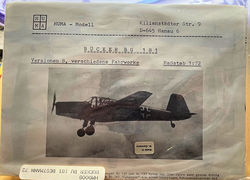
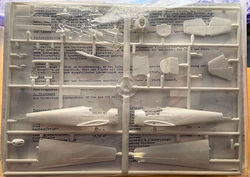
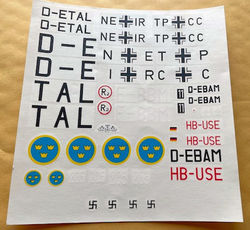
HUMA 1/72 BUCKER Bu181 BESTMANN WW2 GERMAN LUFTWAFFE AEROBATIC
MONOPLANE BAG KIT
OPEN UNBUILT
PLASTIC MODEL KIT – INVENTORIED 100% COMPLETE
IF YOU HAVE ANY
QUESTIONS OR CONCERNS PLEASE ASK ME BEFORE BIDDING / PURCHASING – I WANT
EVERYONE TO BE 100% SATISFIED WITH NO SURPRISES OR MIS-UNDERSTANDINGS
-------------------------------------------------------------
Additional
Information from Internet Encyclopedia
The Bücker Bü 181
Bestmann was a two-seater, single-engine aerobatic monoplane aircraft built by
Bücker Flugzeugbau GmbH in Rangsdorf, near Berlin and extensively used by the
Luftwaffe in World War II.
The Bücker Bü 181
was named Bestmann after a German maritime term designating a member of the
deck crew on coastal or fishing vessels. The prototype Bü 181 (D-ERBV) made its
maiden flight in February 1939 with Chief Pilot Arthur Benitz at the controls.
After thorough works and official flight testing by the
Reichsluftfahrtministerium (RLM) the Bü 181 was nominated to be the standard
primary trainer for the Luftwaffe. Series production of the Bü 181 commenced in
1940. The production types were designated B to C with only slight variations
between each, and could be powered by the Hirth HM 500 A or B.
The Bü 181
aircraft was a single-engine low-wing monoplane with fixed undercarriage, split
flap, twin controls and two adjustable seats arranged side-by-side. The cabin
section of the fuselage was of a tubular steel frame construction whereas the
rear of the fuselage had a wooden shell. The wing assembly and tail unit were
also of wooden shell construction. All the rudders, elevators and ailerons had
wooden ribs and are covered in fabric. The flaps were metallic on the B types
and wood on the C types. The Bü 181 Bestmann was powered by a 105 hp
four-cylinder Hirth HM 500A or B piston engine. The aircraft was designed for
training flights, pleasure trips and aerobatics. Its strength corresponded to Stress
Group 5 with a limited load (single occupancy) and Stress Group 4 fully laden.
The Bücker factory
at Rangsdorf built most of the Bü 181's, but because of demand was forced to
license the design to the Fokker Company in the Netherlands, who subsequently
built 373 of the type for the Luftwaffe all of which were delivered by the end
of 1943. Production of both the Bü 181B and the slightly modified Bü 181C was
begun by Fokker in Amsterdam in 1942 and its total wartime production was 708
aircraft.
The Bü 181 was
also built by Zliner Flugzeugwerke AG plant at Zlin, in the Bohemia &
Moravia Protectorate and after the German withdrawal the production continued
after the war in the same Zlin works, now denominated as the C.6 and C.106 for
the Czechoslovak Air Force and as the Zlín Z.281 and Z.381 in various versions
for civil use. 783 aircraft were built. Between 1943 and 1945, Hägglund &
Söner AB in Sweden built 120 Bü 181's under license with the Swedish military
designation Sk 25.
During the 1950s
the Heliopolis Aircraft Works of Egypt acquired a Czechoslovakian licence to
produce the Zlín Z-381 with a 105 hp Walter-Minor engine. It was produced for
the Egyptian Air Force as the Heliopolis Gomhouria (meaning
"Republic") and subsequent versions were supplied to other Arab air
forces. At least 300 Gomhourias were built.[1] In all, 3,400 aircraft were
built but only a handful survives today.
Although built
primarily as a trainer for the Luftwaffe, the type also performed other duties
such as courier & liaison. From March 1945 an order was issued to
concentrate all the available Bü 181s to be converted either to the "tank
busting" role carrying four Panzerfaust anti-tank grenade launchers from
wing-mounted launchers (C-3 subtype), with the launchers mounted on short pylons
around halfway out from the wing roots, one below and one above the wing panel
on each side anchoring the launchers' firing tubes near their forward ends,
with the launchers remotely fired from the cockpit, or to the night harassment
role carrying three 50 kg bombs (B-3 subtype), most likely inspired by the
Soviet female nocturnal Nochnye Vedmy units' campaigns from 1942 to V-E Day.
These units saw very limited use in the final days of the war due to the war
situation. However, some missions were carried out, achieving moderate success
but at the price of severe losses. One restored Bestmann on the tank buster
configuration is on display at the Deutsches Technikmuseum Berlin.
Test pilot and
sister-in-law of Claus von Stauffenberg Melitta Schenk Gräfin von Stauffenberg
was flying a Bücker Bü 181 when she was shot down and fatally wounded in 1945.
The Bü 181 evolved
very little during the war, the differences between the B type and the C types
were minimal, the most important being the increased autonomy of the C types.
The main difference between the B-1 & C-1 and the B-2 and C-2 sub-types was
the presence of pitot heating and position & cabin lights while the B-2 and
C-2 types lacked any electrical system.
Bu 181V Prototype.
Bü 181 B-0
Pre-production series with Hirth HM 504 A-2 engine
Bü 181 B-1 With
Hirth HM 500 A engine
Bü 181 B-2 As B-1
but no electrics
Bü 181 B-3
(Schlachtflugzeug): Night harassment version made from converted B-1s and C-1s
carrying improved instrumentation, Revi gunsights and three ETC 50 bomb racks.
Bomb loads; either three SC50 or three SD50 or three SD70 or three AB70
droppable clusters. Max. Bomb load 210 kg.
Bü 181 C-1
Increased range and Hirth HM 500B engine.
Bü 181 C-2 As C-1
but no electrics
Bü 181 C-3 (Panzerjäger):
B-2 or C-2 subtypes modified for the antitank role carrying four wing mounted
Panzerfaust 100 single-use antitank grenade launchers in pairs, two on each
wing.[7].
Post war license
built & developments
Zlín Z.181
Two-seat primary
trainer aircraft. Czech production version of the Bu 181, built by Zlín in
Czechoslovakia after the war.
Zlín Z.281
Two-seat primary
trainer aircraft, powered by a Toma 4 piston engine.
Zlín Z.381
Two-seat primary
trainer aircraft, powered by a 105 hp (78 kW) Walter Minor piston engine. Czech
Air Force designation C-106.
Gomhouria Mk 1
Two-seat primary
trainer aircraft, powered by a Walter Minor piston engine. Egyptian production
version of the Zlín 381, built under licence in Egypt by the Heliopolis
Aircraft Works.
Gomhouria Mk 2
Two-seat primary
trainer aircraft, powered by a 145 hp (108 kW) Continental C-145 piston engine.
Gomhouria Mk 3
As Mk. 2, but with
improved undercarriage.
Gomhouria Mk 4
Increased fuel
capacity.
Gomhouria Mk 5
Similar to Mk 1,
powered by Walter Minor, but with different engine mounting.
Gomhouria Mk 6
Continental O-300
engine.
Sk 25
Swedish
Air Force designation of the license-built Bestmann.