HASEGAWA
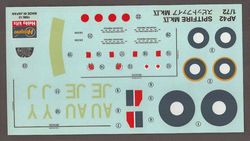
1/72-SCALE DECALS ONLY WW2 RAF SUPERMARINE SPITFIRE Mk.IX JOHNNIE JOHNSON EN398
RCAF NO.421 SQUADRON (ORIGINALLY INCLUDED WITH KIT AP42 51342 1996)
---------------------------
Additional Information from
Internet Encyclopedia
Air Vice Marshal James Edgar
Johnson, CB, CBE, DSO & Two Bars, DFC & Bar, DL (9 March 1915 – 30
January 2001), nicknamed "Johnnie", was an English Royal Air Force
(RAF) pilot and flying ace who flew and fought during the Second World War.
Johnson took command of No. 127
Wing RCAF based at RAF Kenley after Christmas and they received the new
Spitfire IX: the answer to the Fw 190. After gaining a probable against a Fw
190 in February 1943, Johnnie selected Spitfire EN398 after a 50-minute test
flight on 22 March 1943. It became his regular mount. Being a wing commander
now meant his initials could be painted on the machine. His Spitfires now
carried JE-J. He was also allotted the call sign "Greycap".
Johnson set about changing the
wing's tactical approach. He quickly forced the wing to abandon the line-astern
tactics for the finger-four formation which offered much more safety in combat;
enabling multiple pilots to participate in scanning the skies for enemy
aircraft so as to avoid an attack, and also being better able to spot and
position their unit for a surprise attack upon the enemy. Johnson made another
alteration to his units operations. He loathed ground-attack missions which
highly trained fighter pilots were forced to participate in. He abandoned
ground attack missions whenever he could.[54] During these weeks, Johnson's
wing escorted United States Army Air Forces (USAAF) bombers to targets in
France. On a fighter sweep, Ramrod 49, Johnson destroyed an Fw 190 for his
eighth victory. Unteroffizier Hans Hiess from 6. Staffel bailed out, but his
parachute failed to open.
The spring proved to be a busy
one; Johnson claimed three Fw 190s damaged two days later. On 11 and 13 May he
destroyed an Fw 190 to reach ten individual air victories while sharing in the
destruction of another on the later date and a Bf 109 on 1 June. A further five
victories against Fw 190s were achieved in June. Two were claimed on 15 June.
On 17 June while leading the wing over Calais Johnson bounced one of JG 26's
Gruppen led by Wilhelm-Ferdinand Galland. He shot down Unteroffizier Gunther
Freitag, 8./JG 26 who was killed. On 24 June he claimed one destroyed and one
damaged on and another victory on the 27th to bring his total to 15.
Johnson scored more success in
July. The USAAF began Blitz Week; a concentrated effort against German targets.
Escorting American bombers, Johnson destroyed three Bf 109s and damaged
another, the last being shot down on 30 July; his tally stood at 18. There was
still no standard formation procedure in Fighter Command, and Johnson's use of
the finger-four made the wing distinct in the air. It earned 144 Wing the
nickname "Wolfpack". The name remained until 144 Wing was moved to an
Advanced Landing Ground (ALG) at Lashenden and was renamed No. 127 Wing RCAF,
part of the RAF Second Tactical Air Force under the command of No. 83 Group
RAF.
The tactics proved successful in
the Canadian wing. Johnson scored his 19th to 21st victories on 23 and 26
August, whilst claiming yet another Fw 190 on 4 September 1943. Johnson's 19th
victory was gained against Oberfeldwebel (First-Sergeant) Erich Borounik 10./JG
26, who was killed. Johnson's 21st victim, Oberfeldwebel Walter Grunlinger
10./JG 26, was also killed.
During 1942 RAF No.421 squadron
was under 10 Group and flew its mission from RAF Warmwell, RAF Bolt Head, RAF Ibsley,
RAF Zeals and RAF Charmy Down. In January 1943 the squadron joined the 127
(Canadian) Wing and moved to Redhill Aerodrome airfield. Late in spring of 1943
the squadron received Spitfire Mk IX and flew under the command of Wing
Commander Johnnie Johnson.
In
preparation for the Normandy landings the 127 Wing was assigned to RAF Second
Tactical Air Force. On June 16 the squadron was along with the other squadrons
of 127 Wing the first to be moved to Normandy and flew air superiority
missions. After the allied breakout and quick advance towards the Reich 421
squadron was based in Evere in Belgium by October 1944. During December 1944
the squadron received Spitfire XVI. In 1945 the unit participated in the
liberation of the Netherlands, before moving into Germany. At the end of the
war the unit had achieved over 90 aerial victories.