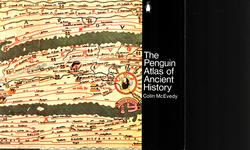
THE
PENGUIN ATLAS OF ANCIENT HISTORY GREECE ROME MIDDLE EAST NORTH AFRICA EUROPE
SOFTBOUND BOOK in ENGLISH by COLIN McEVEDY WITH
MAPS DRAWN BY JOHN WOODCOCK
--------------------------------------------------------
Excerpt from online book review by Chad M
This book focuses has maps which provide a
snapshot of the territories, cities, trade routes, and fortresses that states,
empires, and tribes controlled during various eras. Starts in the Ice Age and
prehistory, goes through the early civilizations circa 8500 BCE to 2000 BCE,
and then to the Greek and Roman eras. Numerous societies and cultures existed
then which are now barely recognizable to the general public (ex. Chalcolithic
cultures, Dacia, Aerolian League, and Thraco-Cimmerians but others are still widely
known, ex. Berbers, Macedonia, Celts, Balts, Finns, Frisians, and Slavs).
The central role of coastal cities, ocean trade,
rivers, and deltas is clear. In
contrast, the Roman Empire contrasts with the Greeks with the former's heavy
investment in land power and fortresses (though still indirectly linked with
sea power, as eastern and northern fortresses supported access to the Silk Road
and trade with England).
Finally, this book is nicely complemented by the
"Great Courses" lectures, including "A Brief History of the
World" by Prof. Peter N. Stearns. The Roman Empire and Han China are
discussed in detail and several similarities and distinguishing factors are
covered, with surprising modern relevance.
--------------------------------------------------
Excerpt from online book review by Colin McLarty
This is a cultural geography of Europe, North
Africa, and the Middle East. It has far fewer place names than I wanted from an
atlas and much of it is pre-history beginning some 40,000 years ago.
It starts with a brisk and entertaining account of
the author's methods for interpreting scanty archaeological and linguistic
evidence. This is at once accessible, learned, detailed, acerbic, and engaging.
There is a funny bit about how archaeologists will say "a major new
civilization" when they mean "a particularly disappointing dig",
or will say "earliest known" when they mean "undated", and
more. There is a terrific account of what it took to re-settle humans in Europe
as the last ice age retreated. The effects were strong on Northern Europe into
historical times (indeed Scandinavia and some of Russia is still rising and
drying out today). The author estimates the human population of all of Europe
and the Middle East was only about 100,000 in 9,000 BC.
The book describes movements of peoples,
languages, technologies, and writing systems. It maps out the earliest known
trade relations. It includes many maps but with few place names. Rather they
indicate where various ethnic groups lived and what technologies were used
where. As it enters historical times the book describes the campaigns of rulers
and empires. It is a beautiful piece of work and beautifully concise.
On the other hand, if you are reading Euripides
and you want to know where Lemnos was, you won't find it here. You will find
the most famous places: In Greece, besides Athens and Sparta, are Mycenea, Lesbos,
Argos. That is like finding Chicago and San Francisco in an atlas of the US.
But you will not find general Meno's birthplace of Larissa--which you would
read about in either Plato or Xenophon. It is like not finding St. Louis in a
US atlas. Those places are found in the Atlas of the Greek World (Cultural
Atlas of) by Peter Levi. And they are found in another book you should read
anyway, namely the Landmark Thucydides. It is a terrific edition available in
paperback and it shows these places in detailed maps.