BEE-HIVE WIN 69 APOLLO 8_AIR
NEW ZEALAND_RCMP CANADA_CH-54 SKYCRANE_P&W RL10
QUARTERLY PUBLICATION OF UNITED AIRCRAFT
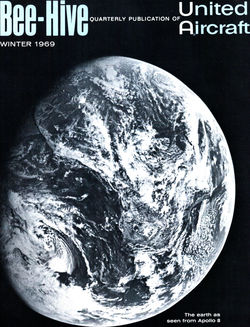
VOYAGE TO THE MOON - APOLLO 8
McDONNELL DOUGLAS DC-10 SERIES 20 AIRCRAFT / PRATT
& WHITNEY AIRCRAFT JT9D ENGINE
THE GREEN GROCER EXPRESS – AIR NEW ZEALAND &
NAC NATIONAL AIRWAYS
CANADA’S FLYING MOUNTIES (RCMP: ROYAL CANADIAN
MOUNTED POLICE AIR DIVISION) de HAVILLAND CANADA DHC-1 BEAVER
THE SPREADING SKILLS – HAMILTON STANDARD
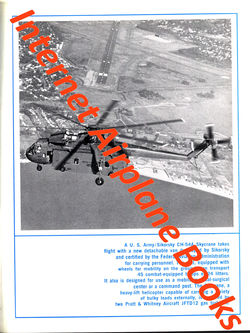
US ARMY SIKORSKY CH-54A TARHE SKYCRANE / P&W
JFTD12 GAS TURBINE ENGINE
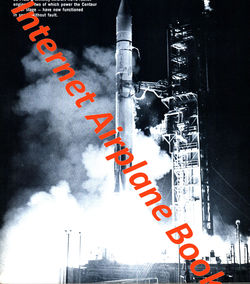
NASA ATLAS-CENTAUR ROCKET – CAPE KENNEDY – ORBITING
ASTRONOMICAL LABORATORY – PRATT & WHITNEY RL10 ROCKET ENGINES
MODELS AND ANSWERS
ANTIQUES BY AIR
MARS!, ARE YOU THERE?
---------------------------------------------------------------------------------------------------
Additional Information from Internet Encyclopedia
Apollo 8, the second manned spaceflight mission
flown in the United States Apollo space program, was launched on December 21,
1968, and became the first manned spacecraft to leave low Earth orbit, reach
the Moon, orbit it, and return. The three-astronaut crew—Frank Borman, James
Lovell, and William Anders—were the first humans to fly to the Moon, to witness
and photograph an Earthrise, and to escape the gravity of a celestial body.
Apollo 8 was the third flight and the first crewed launch of the Saturn V
rocket and was the first human spaceflight from the Kennedy Space Center,
located adjacent to Cape Canaveral Air Force Station in Florida.
Originally planned as the second crewed Apollo
Lunar Module and command module test, to be flown in an elliptical medium Earth
orbit in early 1969, the mission profile was changed in August 1968 to a more
ambitious command-module-only lunar orbital flight to be flown in December, as the
lunar module was not yet ready to make its first flight. Astronaut Jim
McDivitt's crew, who were training to fly the first lunar module flight in low
Earth orbit, became the crew for the Apollo 9 mission, and Borman's crew were
moved to the Apollo 8 mission. This left Borman's crew with two to three
months' less training and preparation time than originally planned, and
replaced the planned lunar module training with translunar navigation training.
Apollo 8 took 68 hours (almost three days) to
travel the distance to the Moon. The crew orbited the Moon ten times over the
course of twenty hours, during which they made a Christmas Eve television
broadcast in which they read the first ten verses from the Book of Genesis. At
the time, the broadcast was the most watched TV program ever. Apollo 8's
successful mission paved the way for Apollo 11 to fulfill U.S. president John
F. Kennedy's goal of landing a man on the Moon before the end of the 1960s. The
Apollo 8 astronauts returned to Earth on December 27, 1968, when their
spacecraft splashed down in the northern Pacific Ocean. The crew members were
named Time magazine's "Men of the Year" for 1968 upon their return.