
Three strands of reconsistuted turquoise and lapis lazuli beads compliments casual or elegant occasions.
Lapis lazuli, mined in the mountainous regions of Afghanistan for over 6,000 years, was regarded by the ancient Egyptians as a symbol of truth. Reconstituted turquoise, a mix of recycled turquoise dust and pieces, is more earth-friendly than working with pure turqouise, for it doesn't require distrupting the earth.
- Measures 22" in length and secures with a hook and eye clasp
- Additional styles available
- Lapis earrings and necklaces available
Handmade in Afghanistan and fair trade imported.
Khabar-e-Khosh Artisan Story
Afghanistan
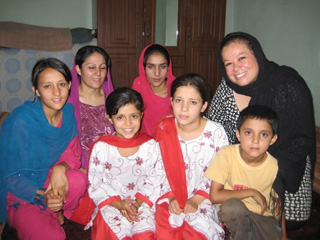
Before the war, Afghanistan was famous for its crafts, including calligraphy, woodwork, ceramics, jewelry, carpets and embroidery. Sadly, 30 years of war has brought devastation and destruction to this once prosperous region, leaving large portions of its population unemployed, illiterate and barely surviving on less than $1 per day.
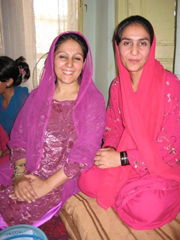
Today, many small business owners, including those at locally-owned Khaber-e-Khosh, work hard to preserve Afganistan's rich jewelry-making and embroidery traditions and help disadvantaged artisans become finacially independent through fair trade. Many of these artisans are women and as such, uneducated and discouraged from working outside the home. Thanks to their work at Khaber-e-Khosh, these women are able to enjoy solidarity and fellowship in a community environment while they work together to cut, shape, sand, polish and assemble stylish jewelry made from recycled glass, fluorite, lapis, carnelian, quartz, turquoise, and other semiprecious stones.
Thanks to the income they receive at Khaber-e-Khosh, many women are
choosing to continue their education. Your purchase of fair trade
jewelry, scarves and shawls from Khaber-e-Khosh helps Afghan artisans
rebuild their lives, community and economy, a necessary factor for
peace.
 The
artisans at Khaber-e-Khosh are very poor and live in remote villages of
eastern parts of Afghanistan, in and around Kabul. The devastation of
the war is felt even more in these areas, as little development takes
place and the area recieves little attention. On average, one artisan’s
income feeds 11 to 12 people. However, artisans are only paid per order.
When orders are slow, the artisans do not receive a steady income and
feeding their families becomes an impossible task.
The
artisans at Khaber-e-Khosh are very poor and live in remote villages of
eastern parts of Afghanistan, in and around Kabul. The devastation of
the war is felt even more in these areas, as little development takes
place and the area recieves little attention. On average, one artisan’s
income feeds 11 to 12 people. However, artisans are only paid per order.
When orders are slow, the artisans do not receive a steady income and
feeding their families becomes an impossible task.
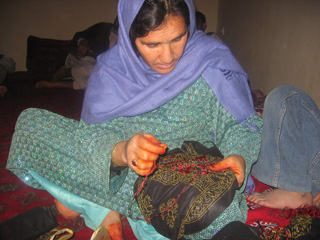
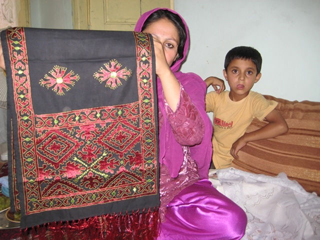
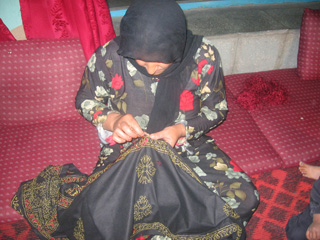
Many of Khaber-e-Khosh’s artisans are female and live in restricted areas where women aren’t allowed to work outside the home. Embroidery and tailoring are the only skills that these women have, and can do from inside the house. To further complicate matters, most of the women are widowed after 30 years of war, which makes them the sole providers for their families and makes their work at Khabar-e-khosh that much more important.
According to Afghanistan's crafts-making traditions, men do the embroidery and sewing while women polish and fire semiprecious stones for making jewelry. The company provides its artisans, who have been practicing these trades their entire lives, with the materials and tools they’ll need to work from home, in accordance with rules concerning women working outside the house and allowing female artisans to care for their children. The group buys all its raw materials from government-registered businesses to ensure they are managed in a sustainable manner, thus supporting the local economy. The finished jewelry and embroidery are sold in Afghanistan and abroad in crafts shops, exhibitions, and online stores.
Khaber-e-kosh also provides a literacy program for artisans seeking to learn to read and write, although many come from families that don’t not allow women out of the house for education. However, those who are able to attend are eager to learn to read and write on their own.