DIESEL ENGINE BASICS
(This diesel engine guide is brought to you by Ian
McQueen)
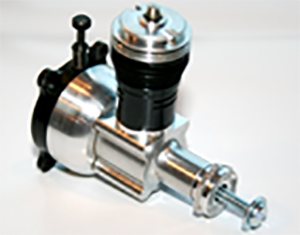
A model diesel engine is a "compression ignition" engine,
physically the same as a glow two-stroke engine apart
from the design of the cylinder head, and we'll get
to that part later.
One of the facts of physics is that if a gas is compressed
quickly, its temperature rises. If the compression ratio
is high enough and the compression rapid enough that
very little heat is lost from the gas, the temperature
achieved is high enough to ignite an air-ether mixture.
This ether (di-ethyl ether, once used as an anaesthetic)
is a critical component of model diesel fuel because
of its low ignition temperature. Typically it makes
up 32% or more of the mixture.
The main power ingredient is kerosene (or jet fuel,
which is more highly refined). It has more energy per
unit volume than ether. The ether is required to ignite
it. The rest of the fuel is lubricant, usually castor
oil. It is much better if there is also 1.5 - 2% of
an ignition improver like the amyl/hexyl/octyl/iso-propyl
nitrate. This makes starting easier, makes the engine
run more smoothly, and reduces loads on internal parts
by reducing the compression ratio required to run the
engine.
Those are the fundamentals, but they don't begin to
explain the advantages of a diesel engine. I consider
the biggest feature of a diesel to be its great flexibility,
its ability to turn a large variety of propellers. Why
this is important leads first to a discussion of propellers.
Propellers
A given engine can drive a propeller of large diameter
and low pitch or one of small diameter and high pitch.
A large-diameter, low-pitch prop moves a large volume
of air at moderate speed and provides high thrust.
It is like low gear in a car: lots of pulling power,
but not able to move the vehicle very fast. And a small-diameter
prop turning at high speed provides a high-speed blast
of a relatively small volume of air. It is like high
gear: it doesn't have the thrust to get the car moving
from a standstill, but can drive it to high speed once
the car is moving.
On a racing plane, a large, low-pitch prop would scarcely
get the model flying. On a slow-flying model, a small
prop turning at very high speed would generate very
little thrust and would have difficulty getting the
model moving.
For a slow-flying model, the optimum large prop will
be turning at a relatively leisurely pace, say 6,000
- 11,000 rpm, while the smaller prop of a fast model
will be going a zillion rpm. Converted from metric,
a zillion might be 11,000 up to more than 30,000 for
racing. In any case, the pitch must be high enough to
move the plane at the intended speed when it is turning
at the speed that the engine is able to turn it.
Glow engines are usually designed to develop their
power at quite high rpm, say 11,000 to 15,000 rpm or
more. They are happiest with relatively low loads, in
the form of props with relatively small diameters. If
loaded down with a large prop, they may overheat due
to pre-ignition. Here's a brief description of why.
In a glow engine, the fuel will begin to burn at a
fixed point on the upstroke (with some caveats). With
a suitable, relatively small, propeller, this point
will be such that the engine fires at just the right
time so that the maximum pressure is reached just at
TDC.
If you put a large prop on that engine, it will still
fire at exactly the same point on the upstroke. However,
the higher drag of the prop is causing the crankshaft
to turn more slowly and prevents the piston from moving
as quickly. The result is that maximum pressure will
be reached before the piston reaches TDC.
This is pre-ignition and puts a strain on all moving
parts of the engine: the piston crown, piston pin, con
rod, and crankpin. It can often be heard as a pinging
or cackling, and the effect is that the engine will
overheat. It can be seriously damaged. (Note that the
fuel in a properly-operating engine "burns" very rapidly,
but it is still burning. It does not "explode" or "detonate".
Those words describe undesirable pre-ignition.)
A diesel, on the other hand, can turn the ordinary
props used on glow engines at very respectable speeds,
but it can also swing larger props because the ignition
timing can be varied so that the fuel begins burning
at just the right point on the upstroke, just as the
spark is timed precisely in an automotive engine. How
is this done?
A model diesel has a screw of some kind in the head.
(There are a few exceptions, but they're not important.)
It pushes against a contra-piston, a movable "plug"
inside the top of the cylinder that forms the top of
the combustion chamber. Pushing the contra-piston down
with the screw decreases the volume and thus increases
the CR, so the point on the piston upstroke where the
required temperature is produced is lowered. This advances
the timing.
Conversely, turning the screw out allows the contra-piston
to be pushed farther up the cylinder when the piston
rises and the trapped gas presses against the bottom
of the contra-piston. (Sometimes it sticks, but that's
one of the things that make diesels so interesting!)
Raising the contra-piston lowers the CR and retards
the timing so that a larger prop can be driven with
no risk to the engine.
To show the effectiveness of this control, the people
at PAW once put a huge 18-6 prop on a PAW 35 engine
and started it. It could turn only 3500 rpm, but it
ran for five hours straight with no damage to the engine!
The test was stopped just because the people wanted
to go home.
To vary the ignition point of a glow engine it is necessary
to try different glow plugs, install or remove head
shims to reduce or raise the compression ratio (in effect,
a glow-engine is a glow-assisted diesel!), and play
around with the percentage of nitromethane in the fuel.
Compare this with merely turning the compression-adjusting
screw of the diesel engine.
Other advantages:
In addition to the greater flexibility of a diesel
engine vis- -vis glow, a diesel offers the following
other advantages:
- lower noise level
- more pleasing, more "masculine" sound quality
- longer running time on the same volume of fuel
- no need to buy glow plugs or batteries
- a certain aroma that is guaranteed to identify the
modeller as a real "diesel man"
STARTING AND ADJUSTING FUEL
The fuel consists of kerosene for power, ether to ignite
the kerosene, lubricant, and an ignition improver. Here
are some notes about the ingredients.
Lubricant
There have been many fuel formulas, with oil content
ranging from 12% (for racing in ABC engines) to 33%
(old "British" formula). Recently I saw up to 40% for
breaking in the MP Jet engine, but that seems really
high!
In the typical diesel, with an iron (Meehanite) piston
and hardened steel cylinder, the minimum oil content
recommended is 23%. It's a characteristic for proper
lubrication of those two materials. A safe bet is 25%
oil for any engine. That way there's lots of lubrication
for the connecting rod. PAW recommends 30% for break-in,
and it isn't going to do any harm to run higher oil
(over 25%) all the time, but the surplus is going to
go out the exhaust and may not contribute much to lubrication
beyond 25%.
"Oil" is taken to mean castor oil, the best lubricant
for model engines.?
There is greater force on the con rod bearings of a
diesel than of a glow engine, so the insurance of the
castor oil is well worth the added mess from the exhaust
spray.
Ether
Typical ether content is 32%. This assures good atomization,
and also gives a safety margin for loss due to evaporation,
for the ether will evaporate quickly if the container
is left unsealed (especially when the air is hot).
Engines will run on lower percentages; apparently 25%
is no problem, and probably one can go lower yet. But
at some point the fuel will not atomize as finely and
power can be expected to drop. There might also be some
effect on combustion, and possibly it would be necessary
to increase the compression to get the fuel to ignite
early enough on the upstroke. This is not a good idea,
for it will impose heavier loads on the moving parts.
Some fuels are even higher than 32% in ether. They
will burn cooler than "standard" fuel and will produce
less power, but there may be some times when this is
an advantage, as with a Cox International head for a
Cox engine; the lower temperature is not as likely to
melt the Teflon disc that seals the top of the cylinder.
This disc melts when "normal" fuel is used and the
engine is tuned for full power. It is my understanding
that fuel for the Cox International-converted Cox engines
should have about 40% ether. Higher ether content can
apparently be used if an ignition improver chemical
is not available, but I have no real information on
this.
Ether used to be easy to obtain when it was still being
used as an anaesthetic. But it is not used for that
purpose any more, so there is little incentive for drug
stores to carry it. And ether is also used in processing
some illegal drugs, which has made it difficult for
legitimate users to obtain it.
Starting spray for full-size engines contains ether.
One source is John Deere dealers. One freezes the container
and punctures it to release the ether, but I have never
done this, and these instructions are not enough to
teach you how to do it safely!
Ignition improver
The ignition improver, like Ethyl's DII(3) (octyl nitrate),
causes the ether to ignite at a lower compression ratio,
and also smoothes the combustion process. Without it,
a diesel has a cackly, rattly sound, and compression
has to be set higher, which puts more load on the moving
parts.
With it, a diesel runs smoothly and purrs like a tiger.
A typical formulation is 2% for engines up to about
.19 and 1.5% for larger engines.?
Kerosene
Kerosene or jet fuel makes up the balance. Kerosene
has higher energy per volume than ether, so a higher
percentage of kerosene is desirable. But this is limited
by considerations of ignition and lubrication.
Commercial fuel
The simplest way for most modellers to obtain diesel
fuel is to obtain it from one of the commercial manufacturers/suppliers.
Companies that I know of that sell diesel fuel in the
USA are:
- Aerodyne
- Red Max
- Ed Carlson
OPERATION
The following instructions begin with starting a diesel
engine, then branch to adjusting it for full power output
(for a broken-in engine) and for break-in (for a new
engine).
STARTING THE ENGINE
Probably the most difficult part of running a diesel
engine is getting it to fire the first time.
This may not seem like a particularly profound statement,
but they do have to be set within a small range of adjustments
to fire properly. One would think that it is only necessary
to crank the compression high and it should fire. But
it doesn't work that way. The engine can be just as
reluctant to start if the compression is too high as
it is if the compression is too low, maybe even more
so.
The following method of starting a diesel is my own,
which I immodestly call the "McQueen Method" since I
have never seen the key part described anywhere else.
The key part? Whereas other starting instructions always
seem to include the words "Fill the tank" at the beginning,
I emphatically say "Do not fill the tank!!" Determine
the correct starting settings by running the engine
only on a prime. Then fill the tank, get the engine
to run continuously, and adjust it for full power.?
Why this way?
The reason is because a diesel is easy to flood, and
a flooded diesel is very difficult to start. The idea
is to put a controlled amount of fuel into the engine
and to start the engine on that. But if there is fuel
in the tank, it is very likely to dribble into the engine
and interfere with your efforts to put in that right
amount of fuel.
Note that there are ways around the problem of flooding
if it occurs, and I'll include them below, but they
require a lot of unscientific fiddling and tomfoolery
that can be avoided if you follow these instructions
carefully and understand why you are doing what you
are doing. (Much of the information here can be usefully
adopted for starting glow engines.).
The most important single instruction is: DO NOT FLOOD
THE ENGINE!
PREPARATIONS
Mounting the engine
Mount the engine on a strong mount (or in a model).
It is convenient if the engine can be removed from a
mount without too much difficulty in case it is necessary
to invert it and drain out excess fuel, though this
will not be a problem if you are careful and don't flood
it. And excess fuel can be cleared if you just flip
the prop long enough. (Reduce the compression initially
to reduce load on the innards.) Do not mount the engine
inverted.
Fuel system
The fuel tank should be positioned as with any model
engine, as close as possible to the engine and with
the center line of the tank no higher than the spraybar.
(Some sources say to put the top of the tank level with
the spraybar. Partly this depends on the ability of
the engine to draw fuel.)
And, as touched on above, keep the spraybar higher
than the tank (or the supply line pinched off) when
the engine is not running, to keep fuel from dribbling
into the engine.
For flexible fuel line, use only neoprene. Silicone
tubing should not be used because it swells up in contact
with diesel fuel, though you should get by using it
for a day if you are prepared to replace the tubing.
Ordinary PVC (vinyl) tubing can be used where flexibility
is not needed. It will become stiff after prolonged
contact with fuel.
Propeller
Select a prop of suitable size from the engine manufacturer's
instructions. For break-in, a "suitable size" is one
of greater length and lower pitch within the mid-range
of sizes suggested in the instructions (so that it will
not place a heavy load on the engine). And, the heavier
the prop - such as nylon, the better for greater flywheel
action. Mount the prop so that the piston comes up against
compression at the "ten past eight" position
Compression setting
The screw in the head, and thus the position of the
contra-piston, are usually in the right ballpark when
the manufacturer packages the engine. You did resist
the temptation to turn that little screw, didn't you?
PAW test runs every engine to make sure that it will
start. Other manufacturers might, also. If it has been
moved from the initial position, try to remember where
the screw was and return it to that position.
Grasp the prop and try turning the engine over. The
engine should turn over freely, though compression should
be good. If it feels difficult to turn over TDC, compression
may be too high. Back the compression screw out at least
a quarter turn (it can be more if "little fingers" have
been playing with the comp screw) and flip the prop.
This should push the contra-piston up, and the resistance
due to compression should be reduced.
If the engine turns over freely, it should be in the
ballpark. If the engine turns over very easily, it is
possible that the compression has been set too low.
It is just as well to do nothing at this point, but
keep in mind that it may be necessary to increase the
compression later.
As noted earlier, starting is not easier when compression
is too high. It seems to make the engine actually harder
to start. Often the engine may be under-compressed but
a really hard flip will get it to fire anyway. It won't
run properly, but it will still show some life. These
uncertainties are what make diesels so much fun!
Throttle setting
Set the carb wide open.
Priming
Obtain a small squeeze bottle that you can fill with
fuel and then use to measure out fuel drop-by-drop.
This ability to measure drops accurately is very important
to avoid flooding.
I always prime an engine through the venturi or carburetor,
not into the cylinder. Some modellers are successful
with prime against the side of the raised piston. But
if there's a muffler this becomes impossible anyway.
Note that putting even a small amount of fuel into
the cylinder decreases the volume, thereby raising the
compression ratio. If the CR is just right with the
prime, what happens when the fuel burns? The volume
decreases, so does the CR, and the engine will likely
stop. Or, if the CR is just right for running, the extra
volume of fuel may be enough to raise the CR beyond
the point where the engine will fire.
A prime into the intake allows the fuel to be vaporized
and carried into the cylinder in the same way as when
the engine is running normally. A correct prime is literally
only a couple of drops. Literally!
For small engines, .06 and smaller, it should be a
single drop, or even a partial drop into the venturi.
(Make a drip on the end of the tube and then touch it
to the venturi to make it drop into the intake.) For
one over, say, .19, it could be two drops and maybe
three for a big engine.
But don't go over two drops at first. That should be
enough to get the engine to fire and run briefly.
Putting the right, small, amount of fuel into the engine
is the single most important part of getting your engine
running!
STARTING THE ENGINE
Prime the engine as just described. Hold the prop in
your hand and turn the engine over slowly. This is to
ensure that the engine is turning freely and that the
dreaded hydraulic lock has not occurred.
Bring the prop up against compression and then flip
it as hard and as quickly as you can. A sharp snap is
the key to good starting.
If you are really lucky, the engine will start and
run for about a second with a good burst of power. This
is the optimum response and your target with this exercise.
My engines usually do not fire until the second or
third flip, so don't be discouraged if you are not successful
on the first flip. Repeat the hard flip, several times
if necessary. The following responses are possible:
- If the engine starts with a good burst of power,
perfect. The compression setting is good.
- If the engine starts, but runs weakly with a "soft"
sound and/or misfires (skipping), and soon dies, it
is under-compressed. Turn the comp screw in a small
amount, about 1/16 of a turn, and flip again a few
times without re-priming in case there is still fuel
left in the crankcase. If the engine does not fire,
prime and try again.
- Repeat these steps as necessary until there is that
good burst of power, and then repeat once to make
sure that the action is repeatable. (A slight complication
is that running the engine several times will warm
it up a little, and that has the same effect as increasing
the CR a small amount.)
- If the engine starts, but runs with a harsh, metallic,
rattly, or clattery sound, and stops abruptly, it
is over-compressed. Turn the comp screw out 1/8 -
1/4 turn and flip again a few times to push up the
contra-piston and to clear out any fuel. It may start
while you are doing this. If not, re-prime and try
again.
Repeat these actions until the engine fires and runs
reliably with a good burst of power; then proceed to
"RUNNING AND ADJUSTING THE ENGINE".
Flooding
If the engine does not start after several tries of
these instructions, it may be flooded. Full instructions
for clearing a flooded engine are given at the end.
Clearing a flooded engine is a general pain, and the
fiddling necessary to clear it can get aggravating.
Try to avoid flooding it.
RUNNING AND ADJUSTING THE ENGINE
At this point the engine has run out the prime with
a good burst of power. Make a note of the position of
the comp screw. (I make a scratch on the head to match
a mark or feature on the screw.) That position is your
starting point (unavoidable pun) in future for a prop
of that size.
In colder weather, you may have to turn the screw in
slightly from that point; likewise, if you later fit
a prop of less diameter and/or pitch (reduced load).
And you may have to back the screw out slightly in hot
weather or if you fit a prop of larger diameter and/or
pitch (increased load).
At this point you are ready to run the engine.
Needle valve and throttle positions
Needle valve: The instructions with the engine should
give an indication of a suitable starting position for
the needle valve. For an unfamiliar engine being run
for the first time, especially for break-in, I usually
open the needle valve three to five turns from fully
closed.
An alternative method used by diesel expert David Larkin
is to start with the needle valve open only about half
a turn and to open it a quarter turn with each unsuccessful
attempt to keep the engine running, but the engine might
then run at quite high speed when it catches, and this
can be undesirable for an un-run engine.)
Throttle: The throttle should be wide open. (With experience
you can start at reduced settings; for engines converted
from glow with a Cox International head, set the throttle
about half-open.)
Filling the tank
Fill the tank. Be sure that your fuel is fresh. If
too much ether has evaporated from the fuel, you will
be wasting your time!
While filling the tank, clamp off or disconnect the
fuel line to the engine so that no fuel can leak into
the engine. And, when starting the engine, either pinch
off the fuel line with a finger or hold the nose of
the model high (if it's a small-enough model) so that
gravity will keep fuel from leaking into the engine.
When the engine fires, release the line or return the
nose to horizontal. The engine should run long enough
on the prime to draw in fuel and keep running.
Usually there is no need to draw fuel up to the spraybar
beforehand. Fuel will usually be drawn to the engine
when it starts.
Starting the engine
With the fuel line pinched against the engine or model
with a finger (or the nose held high), prime the engine
and flip it the same way that you did successfully above.
As soon as the engine fires, remove your finger from
the fuel line (or bring the nose to or below the horizontal).
Fuel will usually be drawn to the engine and the engine
will keep running. If the engine doesn't keep running,
immediately clamp the fuel line (or lift the nose),
open the needle valve 1/4 to 1/2 turn and repeat.
When you get the engine to keep running, congratulations!
You are well on the way now!
And if you are using the method of opening the needle
valve in steps from closed and if the engine doesn't
keep running after the prop has been flipped several
times, immediately clamp the fuel line (or lift the
nose), open the needle valve 1/4 to 1/2 turn, prime,
and flip again. Repeat as necessary.
Adjusting the engine
At this point the engine is running and needs to be
adjusted. Instructions are given first for starting
and setting an engine that has already been broken in.
Instructions for a new engine are given later.
The compression screw and needle valve settings interact
with each other. The main adjustment is the compression
screw. But when the CR has been set properly, the next
step may be to lean the fuel mixture more.
That will make the engine run hotter, which advances
the ignition point, and that in turn may require reducing
the CR to retard timing slightly. The following should
enable you to adjust the right one at the right time
and get the engine adjusted correctly. This may seem
daunting the first time, but it becomes instinctive
quickly when you understand why you are making an adjustment.
I'd like to be able to post a flowchart at this point,
for it simplifies the rest of the instructions. But
I can't, so just follow the words.
Let the engine run for half a minute to warm up, then
go through the following questions and actions.
Is it running softly, misfiring, skipping, loping,
etc? If so, CR is too low. Turn the comp screw in 1/8
turn.?
Alternatively: Is it running harshly, sounding laboured,
rattly, cackly? If so, turn the comp screw out 1/8 turn.
Repeat these evaluations and adjustments until the
engine is running smoothly then continue to adjusting
the needle valve.
Note: We got to this point by gradually adjusting the
needle valve until the engine would keep running, so
it should be in the ballpark of the correct setting.
Is the engine exhaust very oily? Is the engine four-stroking?
If so, it is running too rich. Close the needle valve
1/8 to 1/4 turn, allow a few seconds for the change
to take effect, and check again. Repeat this check until
the engine is "singing" at a good speed.
When the engine is tuned for nearly full power, it
will heat up and this advances the ignition. Has the
engine sound become laboured, harsh, rattly, or cackly?
If so, reduce the CR 1/8 to 1/4 turn and check the sound
again.
Continue to close the needle valve in small steps.
If the engine speeds up, you are going in the right
direction. Repeat the procedure. If it begins to misfire,
it is probably too lean. Open the needle valve enough
to restore smooth operation.
If misfiring occurs, the compression may be set too
low. Turn the comp screw in 1/8 to 1/4 turn. If the
engine speeds up, you are going in the right direction.
If the engine sound becomes laboured and harsh, back
the comp screw out to the former setting or even beyond.
This procedure will have you close to the full power
output. If the engine is in a model, try flying it.
NOTES:
Once the model is released and it accelerates, it is
possible that the engine will start to misfire, especially
if the engine is fitted with a large, high-load prop.
Do not try to fly if it is misfiring. It may not be
developing enough power.
The needle valve may be too lean, and probably the
CR is a little bit too low. (As the plane moves forward,
the load on the prop is reduced and the engine can turn
faster, needing more fuel. And the ignition point may
need to be advanced a little.) Turn the comp screw in
about 1/16 turn and open the needle valve a little.
Try again. Repeat the adjustments as required.
In general it will probably be necessary to richen
the mixture slightly and increase the compression slightly
from the initial settings to develop maximum power in
the air.
Miscellaneous notes
You do not have to worry about a lean setting damaging
a diesel the way it would a glow engine. If a diesel
is set too lean it will misfire or simply stop.
Once you have become familiar with your engine, particularly
if it is .19 or larger, you may be able to prime the
engine by choking the inlet and turning the prop enough
to draw fuel to the inlet. But this can be tricky, for
there is the risk of flooding, especially for small
engines.
Diesels run cool and the exhaust is much cooler than
glow-engine exhaust.
You can put a piece of ordinary PVC tubing on the outlet
of the muffler to guide exhaust away from the model.
The tubing can be up to a foot (30 cm) long without
detriment to engine operation.
Except when the engine is running very rich, the exhaust
has a color. With a light load, the exhaust will be
a light tan. But the more heavily it is loaded with
a large prop, the more the exhaust will tend toward
black. Hence the usefulness of the tubing to keep exhaust
oil off the model. (Minimize the amount of this exhaust
that gets onto your clothes, for it has a distinctive
aroma that not everyone appreciates! Especially wives.)
BREAK-IN
The instructions with your engine will probably cover
this, but here are a few tips anyway.
Iron-steel engine: The procedure is to run the engine
for a couple of minutes, stop it and let it cool, then
run it again. The engine is initially run in a very
rich four-stroke, with just enough compression to keep
it running smoothly.
I build up about 20 minutes at the richest setting,
then close the needle valve 1/4 turn for each successive
run until the engine is beginning to break into two-stroking.
I give it short bursts of moderate-speed two-stroking,
again with just enough compression for smooth running,
followed by richening it again to keep the engine from
running hot too soon. This two-stroking is gradually
increased in duration and maximum speed.
When the engine (any engine) is manufactured, the surfaces
of the piston and cylinder are like microscopic mountains
facing each other. The slow break-in allows removing
the tips of the peaks an atom or two at a time instead
of gouging out chunks of metal. The finished product
is a pair of smoothly polished surfaces to run against
each other. The reason for slow running and not letting
the engine run hot at first is to prevent metal expansion
that would push the peaks into hard contact with each
other so they break.
ABC engine: The procedure is completely different for
ABC engines. The principle here is to get the engine
reasonably hot as quickly as possible, for the fit between
cylinder and piston is usually very tight at TDC and
one wants to expand the top of the cylinder enough to
provide the normal running clearance. One should use
a relatively small propeller so the engine can turn
freely and quickly find optimal CR and needle valve
settings to run relatively rich at high speed.
(K&B, in their instructions for breaking in a glow
6.5RIRE ABC pylon engine recommended a prop cut down
so the engine would four-stroke at.....20,000 rpm! Use
this information for guidance.)
TROUBLESHOOTING
Clearing flooding
You will flood an engine at some time. Here are some
tips on clearing it. They are based on an engine in
a model so it can be inverted easily. If the engine
is in a test stand, there are ways to clear flooding,
but removing the engine for draining remains an option.
Block the fuel line. Invert the engine and drain fuel
out of the intake and the exhaust. Rock the prop back
and forth several times to ensure that the ports open.
Turn the engine upright, back off the comp screw 1/2
to 1 full turn. Hold the prop with your hand and turn
it over against compression. If it turns easily, continue.
However, if there is resistance, keep backing off the
screw until it will turn freely.
Begin flipping the prop.
The engine may start at some time. This will either
clear out all the fuel and the engine will run and then
come to a soft stop. Or it could draw up a slug of liquid
fuel if the engine was really badly flooded. In this
case the engine could stop abruptly. If this happens,
drain out any fuel possible, reduce the compression
more, and flip again.
Eventually the excess fuel will be cleared out, compression
will again feel soft, and you will need to increase
the compression a little at a time. When the engine
is somewhere around the normal starting setting, follow
the starting procedure from the beginning.
This business of clearing a flooded engine is a general
pain, and the fiddling necessary to clear it can get
aggravating. If you are careful not to flood the engine
you should be able to avoid this monkey-foolery completely.
But some time your engine is going to get flooded and
you have to know how to clear the problem.
Poor compression
The engine must have good compression if it is to start
easily. There are ways around poor compression, and
I have had to use them with several engines converted
to diesel operation. This is not a reflection on the
heads, but on the engines.
My problems came with one O.S. 25FSR and all three
of my 10FSR engines. All of the 10FSRs had poor compression
from new, as did a replacement piston-sleeve set that
I put into a 25 engine worn by fine dust at our flying
field. I don't know if O.S. was making them so loose
that users could not seize them up with lean runs as
glow engines, but the 10s were so loose that they were
very difficult to start even as glow engines.
If your engine has poor compression, it is better to
repair it (new internal parts). However, there are ways
around the problem.
If you have an electric starter, you can try using
it, but very carefully. If the CR is too high, or if
hydraulic lock occurs, you can quickly bend a con rod.
Be sure that the CR is a little on the low side, and
be sure that there is no fuel in the engine (not flooded).
Set the throttle to the maximum and the needle valve
out enough turns for running.
Then apply the starter to the prop, as lightly as possible
so the rubber cone can slip if the engine resists turning
over.
If the engine does not turn over easily, stop immediately
and reduce the CR. Also check for excessive fuel inside
the engine. I could always start the 10FSRs quickly
with a starter.
If you don't have a starter, set the CR and needle
valve to approximately the running settings. But this
time you have to get just enough liquid fuel into the
crankcase that you can invert the engine and have liquid
drain around the piston and seal it. Then turn it right-side-up
and immediately begin flipping. (Don't use a starter
this time!) With luck the fuel will give enough compression
seal to get it going.
Sometimes I have had to do the flipping inverted and
then right the model when the engine fired, but this
was with small models that I could hold in one hand.
If you have a new engine you should never need to use
these emergency methods.
|



 You will need:


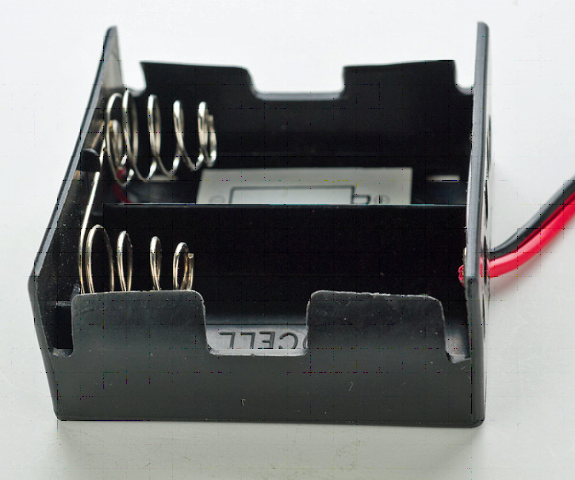

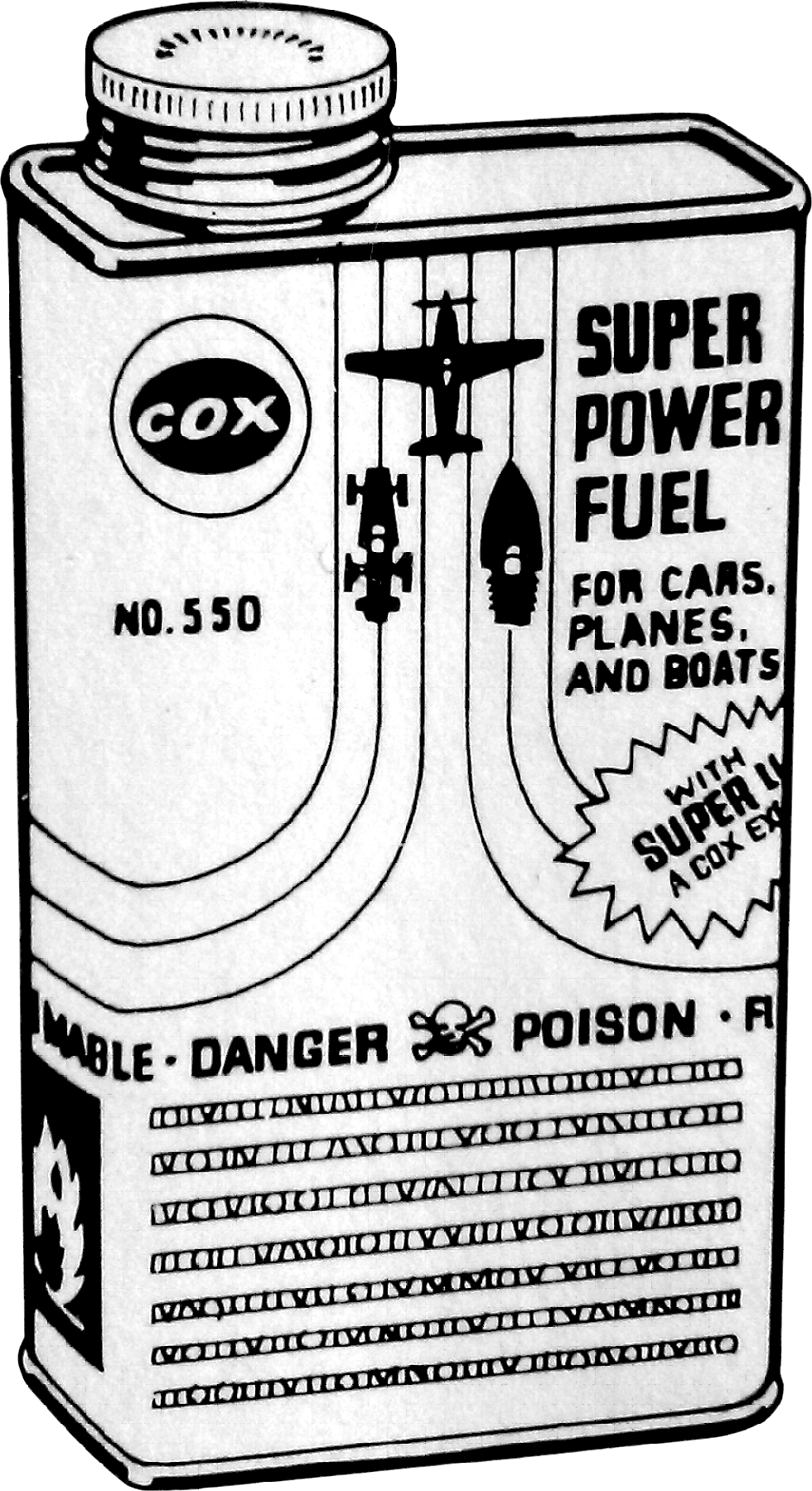 Cox
engines typically run on what is termed " A fuel", a fuel
with high nitro content and containing some castor oil
instead of synthetic oil only. This fuel mixture is
becoming increasingly difficult to obtain. Often, when referring
to " A" in hobby shops, it will elicit blank stares. A
fuel in loose terms is 15-35% nitro (a.k.a. nitromethane),
20% (castor) oil and the balance methanol (a.k.a. methyl
alcohol, carbinol, wood alcohol, wood naphtha or wood spirits).
Cox
engines typically run on what is termed " A fuel", a fuel
with high nitro content and containing some castor oil
instead of synthetic oil only. This fuel mixture is
becoming increasingly difficult to obtain. Often, when referring
to " A" in hobby shops, it will elicit blank stares. A
fuel in loose terms is 15-35% nitro (a.k.a. nitromethane),
20% (castor) oil and the balance methanol (a.k.a. methyl
alcohol, carbinol, wood alcohol, wood naphtha or wood spirits).