
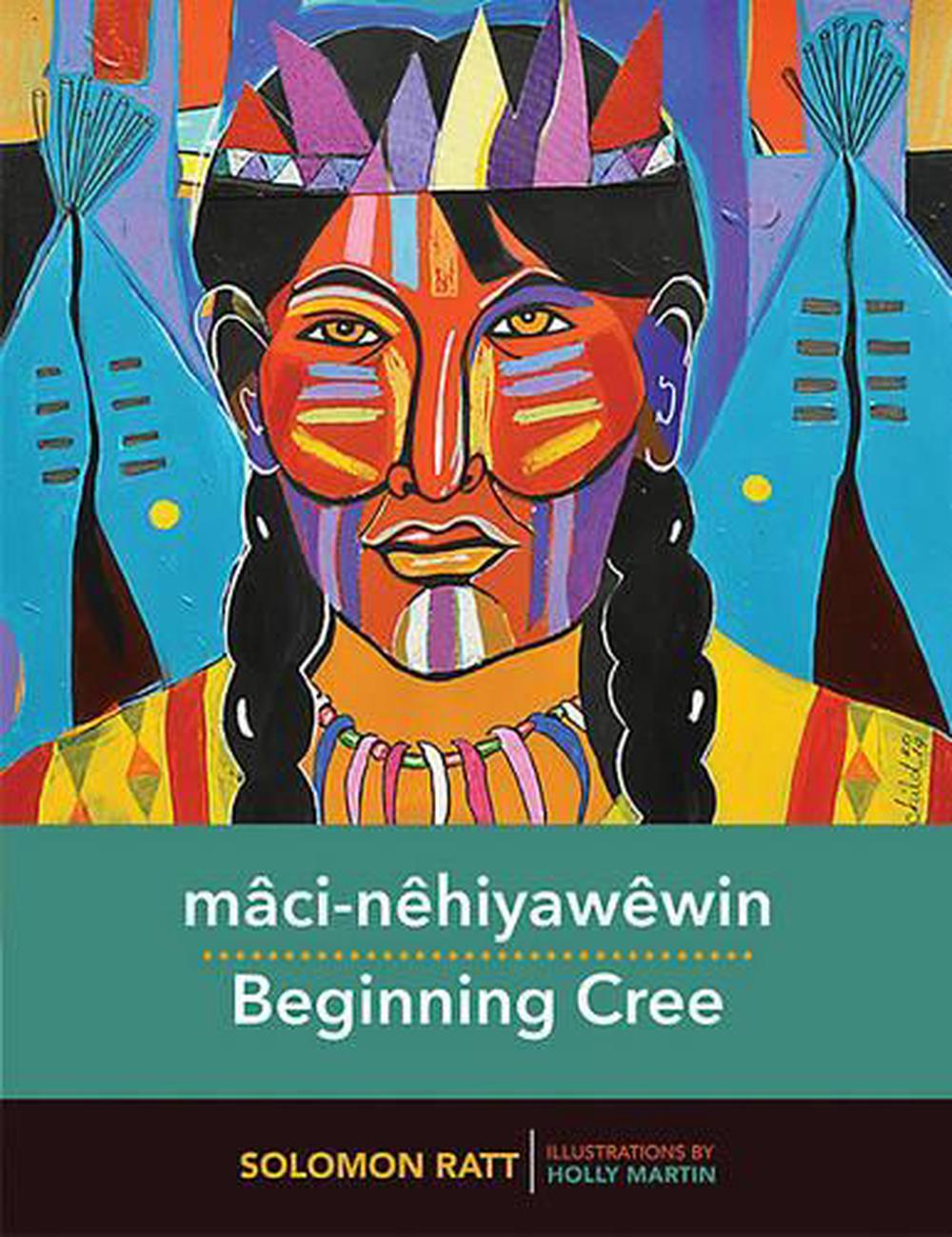
mci-nhiyawwin / Beginning Cree
by Solomon Ratt, Holly Martin
With the help of this book, you can learn to speak Cree!
Spiral
English
Brand New
Publisher Description
Designed as an introduction for Cree language learners, mâci-nêhiyawêwin / Beginning Cree acts as a self-study aid--a much-needed resource in today's world where most students cannot speak Cree fluently. Basic grammar units and everyday vocabulary items guide the student through the building blocks of the language, and expansion drills and exercises reinforce lessons and prepare the student for further study. With over 100 delightful illustrations, mâci-nêhiyawêwin / Beginning Cree grounds the language in traditional and contemporary contexts.
Table of Contents
ACKNOWLEDGEMENTS
CHAPTER ONE: INTRODUCTION
1. The Cree
1.1 The Standard Roman Orthography
1.1.A Consonants
1.1.B Vowels
1.1.C SRO: Chants
1.1.D Dictation
1.1.E Mimimal Pairs
1.2 Dialogue One
1.3 Introductory Information about Family
1.3.A Dialogue Two
1.3.B Dialogue Three
1.4 Numbers, Months, Dates
1.5 Chapter One Exercises
CHAPTER TWO: NOUNS
2. Animacy
2.1 Number
Exercises
2.1.A Questions and Answers
2.2 Diminutives
Exercises
2.3 Locatives
Exercises
2.4 Chapter Two Review
CHAPTER THREE: PREPOSITIONS AND PRONOUNS
3. Location Words
3.1 Prepositions
Exercises
3.2 Pronouns
3.2.A Demonstrative Pronouns
Exercises with Nouns and Demonstrative Pronouns
3.2.B Interrogative Pronouns
Exercises
3.2.C Personal Pronouns
3.2.D Emphatic Pronouns
Exercises
3.3 Dialogue Four
3.4 Chapter Three Review
CHAPTER FOUR: ANIMATE INTRANSITIVE VERBS
4. Animate Intransitive Verbs
4.1 Imperatives
4.1.A 2 - Second Person Singular
4.1.B 2P - Second Person Plural
4.1.C 21 - The Imperative Inclusive
4.1.D Conjugation Chart for Imperatives
4.1.E Delayed Imperatives
Exercises
4.2 Indicative Mood
4.2.A Animate Intransitive Verb Patterns
4.3 The VAI Indicative Mood and Conjunct Mood
4.3.A Indicative Third Person Subject
4.3.B Indicative Third Person Obviative Subject
4.3.C Indicative First Person Subject
4.3.D Indicative Second Person Subject
Exercises
4.4 Chapter Four Review
CHAPTER FIVE: INANIMATE INTRANSITIVE VERBS
5. Inanimate Intransitive Verbs
5.1 Weather Terms
Exercises
5.2 Future Conditionals: VIIs
Exercises
5.3 Seasons
5.3.A Vital Statistics I
5.3.B Vital Statistics II
Exercises
5.3.C Vital Statistics III
5.3.D Dialogue Five
Exercises
5.4 Likes and Dislikes
5.5 Days of the Week
Exercises
5.6 Temporal Units
5.6.A Dialogue Six
5.6.B Dialogue Seven
5.6.C Time Phrases
5.6.D Review of Temporal Units
Exercises
5.7 Review: Inanimate Intransitive Verbs
5.8 Chapter Five Exercises with VAIs and VIIs
CHAPTER SIX: POSSESSIVES: KINSHIP TERMS
6. The Nature of Possessives in Cree
6.1 Kinship Terms
6.1.A Kinship Terms: Verbs and Nouns
Exercises
6.1.B Kinship Terms: Nouns
6.2 Cree Kinship
6.2. A Cousins and Siblings
6.2.B Cree Kinship System: Seven Generations
6.3 Vital Statistics
6.4 Kinship Terms: Nouns and Verbs Overview
CHAPTER SEVEN: TRANSITIVE INANIMATE VERBS
7. Transitive Inanimate Verbs
7.1 Transitive Inanimate Verbs – Class 1 (VTI-1)
Exercises
7.2 Dialogue Eight
7.3 Dialogue Nine
7.4 Colours and Clothing
Exercises
7.5 Chapter Seven Review(VTI-1)
CHAPTER EIGHT: TRANSITIVE ANIMATE VERBS
8. Transitive Animate Verbs
Exercises
8.1 Conjugation Patterns
8.2 Obviation
8.3 Review – VTA
Exercises
8.4 Inverse Forms
8.5 VTA-Forms: Reflexives, Direct Forms and Inverse Forms
8.6 Transitive Verb Pairs: VTA and VTI-1
Exercises
8.7 Chapter Eight Review – VTA
VERB CHARTS
CONJUGATION PATTERNS (VAI, VTI-1, VTA)
VOCABULARY LIST
BIBLIOGRAPHY
NOTES
Prizes
Short-listed for Saskatchewan Book Awards Publishing in Education Award 2017
Long Description
Designed as an introduction for Cree language learners, Beginning Cree acts as a self-study aid--and much-needed resource in today's world where few can speak Cree fluently. Basic grammar units and everyday vocabulary items guide the student through the building blocks of the language, and expansion drills and exercises reinforce lessons and prepare the student for further study. With over 100 illustrations, this text grounds the language in traditional and contemporary contexts.
Promotional "Headline"
With the help of this book, you can learn to speak Cree!
Details
