
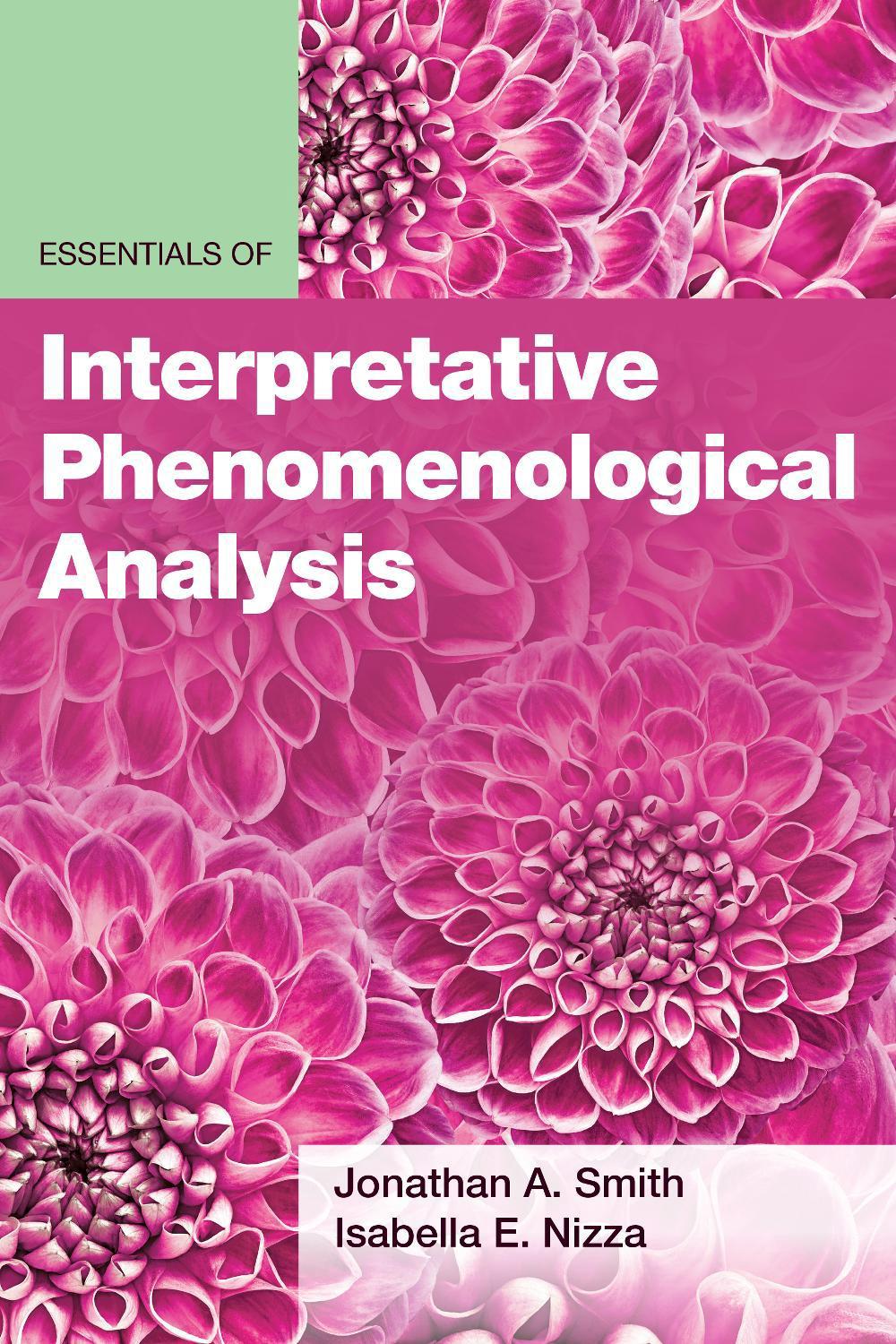
Essentials of Interpretative Phenomenological Analysis
by Jonathan A. Smith, Isabella E. Nizza
Offering practical guidance for qualitative research in social sciences and psychology, the series explores methods for delving into lived experiences. Essentials of Interpretative Phenomenological Analysis details a step-by-step approach to uncover both universal and personal meanings behind life events and emotional challenges.
Paperback
Brand New
Publisher Description
The brief, practical texts in the Essentials of Qualitative Methods series introduce social science and psychology researchers to key approaches to to qualitative methods, offering exciting opportunities to gather in-depth qualitative data and to develop rich and useful findings.
Essentials of Interpretative Phenomenological Analysis is a step-by-step guide to a research method that investigates how people make sense of their lived experience in the context of their personal and social worlds. It is especially well-suited to exploring experiences perceived as highly significant, such as major life and relationship changes, health challenges, and other emotion-laden events. IPA studies highlight convergence and divergence across participants, showing both the experiential themes that the participants share and the unique way each theme is manifested for the individual.
About the Essentials of Qualitative Methods book series: Even for experienced researchers, selecting and correctly applying the right method can be challenging. In this groundbreaking series, leading experts in qualitative methods provide clear, crisp, and comprehensive descriptions of their approach, including its methodological integrity, and its benefits and limitations. Each book includes numerous examples to enable readers to quickly and thoroughly grasp how to leverage these valuable methods.
Table of Contents
Series Foreword-Clara E. Hill and Sarah Knox
Chapter : What Is Interpretative Phenomenological Analysis?
A Note on Terminology
Theoretical Underpinnings of IPA
Chapter 2: Designing an IPA Study
Choosing a Topic and a Research Question
Determining What Type of Data to Collect
Sampling and Recruiting Participants
Practical and Ethical Considerations
Chapter 3: Collecting Data
Rationale for an Interview Guide
How to Design an Interview Guide
Conducting the Interview
Transcription
Chapter 4: Analyzing the Data: Starting With the First Case
Step . Reading and Exploratory Notes
Step 2. Formulating Experiential Statements
Step 3. Finding Connections and Clustering Experiential Statements
Step 4. Compiling the Table of Person Experiential Themes
Some More Thoughts on Clustering and Compiling
One Case or More Than One Case?
Chapter 5: Cross-Case Analysis
Chapter : Writing Up the Study
Results Section
Other Sections of an IPA Manuscript
Chapter 7: Variations on the Method and More Complex Designs
Chapter 8: Methodological Integrity
Chapter 9: Summary and Conclusions
Deciding Whether IPA Is the Right Methodology for You
Concluding Words
Appendix: Exemplar Studies
References
Index
About the Authors
About the Series Editors
Review
This is an excellent guide to the theory and practice of interpretative phenomenological analysis it is well written, carefully organized, engaging, and accessible. The authors have a remarkable knack for anticipating and effectively answering the questions that are typically raised by novice researchers as well as guiding them through the intricacies of qualitative research. - Steen Halling, PhD, Professor Emeritus, Department of Psychology, Seattle University, Seattle, WA, United States From setting the background context to interpretative phenomenological analysis (IPA) through to offering exemplar studies, this book gives a thorough introduction to the steps a novice researcher will need to follow to conduct their first study using this method. The clear and concise summary also serves as an excellent refresher for anyone returning to IPA as an analytic method after some time away. An excellent addition to qualitative methodology bookshelves. - Jane Montague, PhD, School of Psychology, University of Derby, Derby, United Kingdom
Long Description
The brief, practical texts in the Essentials of Qualitative Methods series introduce social science and psychology researchers to key approaches to to qualitative methods, offering exciting opportunities to gather in-depth qualitative data and to develop rich and useful findings. Essentials of Interpretative Phenomenological Analysis is a step-by-step guide to a research method that investigates how people make sense of their lived experience in the context of their personal and social worlds. It is especially well-suited to exploring experiences perceived as highly significant, such as major life and relationship changes, health challenges, and other emotion-laden events. IPA studies highlight convergence and divergence across participants, showing both the experiential themes that the participants share and the unique way each theme is manifested for the individual. About the Essentials of Qualitative Methods book series: Even for experienced researchers, selecting and correctly applying the right method can be challenging. In this groundbreaking series, leading experts in qualitative methods provide clear, crisp, and comprehensive descriptions of their approach, including its methodological integrity, and its benefits and limitations. Each book includes numerous examples to enable readers to quickly and thoroughly grasp how to leverage these valuable methods.
Details
