
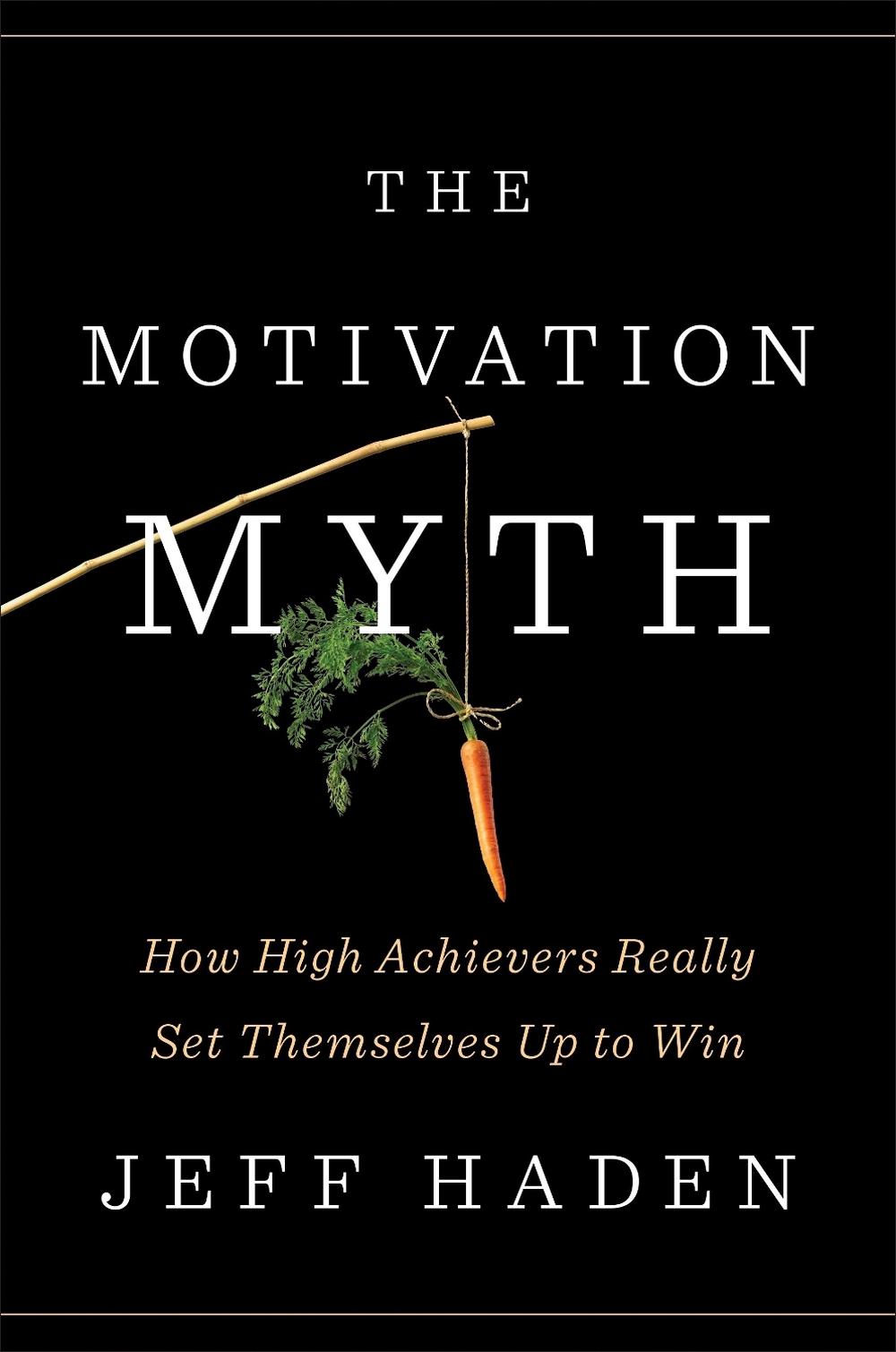
The Motivation Myth
by Jeff Haden
"Portions of this book were revised from content that was originally published on ."--Verso.
Hardcover
English
Brand New
Publisher Description
From 's most popular columnist, a counterintuitive--but highly practical--guide to finding and maintaining the motivation to achieve great 's most popular columnist, a counterintuitive--but highly practical--guide to finding and maintaining the motivation to achieve great 's comforting to imagine that superstars in their fields were just born better equipped than the rest of us. When a co-worker loses 20 pounds, or a friend runs a marathon while completing a huge project at work, we assume they have more grit, more willpower, more innate talent, and above all, more motivation to see their goals that's not at actually true, as popular columnist Jeff Haden proves. "Motivation" as we know it is a myth. Motivation isn't the special sauce that we require at the beginning of any major change. In fact, motivation is a result of process, not a cause. Understanding this will change the way you approach any obstacle or big shows us how to reframe our thinking about the relationship of motivation to success. He meets us at our level--at the beginning of any big goal we have for our lives, a little anxious and unsure about our way forward, a little burned by self help books and strategies that have failed us in the past-and offers practical advice that anyone can use to stop stalling and start working on those takes the mystery out of accomplishment, proving that success isn't about spiritual awakening or a lightning bolt of inspiration --as Tony Robbins and adherents of The Secret believe--but instead, about clear and repeatable processes. Using his own advice, Haden has consistently drawn 2 million readers a month to his posts, completed a 107-mile long mountain bike race, and lost 10 pounds in a isn't for the uniquely-qualified; it's possible for any person who understands the true nature of motivation. Jeff Haden can help you transcend average and make lasting positive change in your life.
Review
This isn't just a groundbreaking approach to making millions or melting off extra 's a life-changing mental shift toward enjoying the process. Why the f*ck not? * Sarah Knight, author of Get Your Sh*t Together *
Jeff Haden knows what many people don't: that success is less about searching for motivation and more about muddling through until you achieve something motivating. * Adam Grant, author of Give and Take, Originals, and Option B with Sheryl Sandberg *
Sometimes, your computer gets stuck, and the pros know you can press Command+Option+ESC to break out of the loop. Jeff Haden's book is like that, but for your life. Read it and learn how to break out of your negative loops without needing a complete shut-down. * Dharmesh Shah, Co-founder and CTO of HubSpot *
A must read for all entrepreneurs, company executives, managers, parents, coaches, and wellbeing hackers. * Dr. Dan Reardon, co-founder and CEO of FitnessGenes *
Promotional
From 's most popular columnist, a counterintuitive--but highly practical--guide to finding and maintaining the motivation to achieve great things.
Review Text
This isn't just a groundbreaking approach to making millions or melting off extra 's a life-changing mental shift toward enjoying the process. Why the f*ck not?
Review Quote
Advance praise for The Motivation Myth... "This isn't just a groundbreaking approach to making millions or melting off extra pounds. It's a life-changing mental shift toward enjoying the process. Why the f*ck not?" --Sarah Knight, author of Get Your Sh*t Together "Jeff Haden knows what many people don't: that success is less about searching for motivation and more about muddling through until you achieve something motivating." --Adam Grant, author of Give and Take, Originals, and Option B with Sheryl Sandberg "Sometimes, your computer gets stuck, and the pros know you can press Command+Option+ESC to break out of the loop. Jeff Haden's book is like that, but for your life. Read it and learn how to break out of your negative loops without needing a complete shut-down." --Dharmesh Shah, Co-founder and CTO of HubSpot "A must read for all entrepreneurs, company executives, managers, parents, coaches, and wellbeing hackers." --Dr. Dan Reardon, co-founder and CEO of FitnessGenes "Jeff Haden is one of the biggest writers working online today not because he's a genius but because he follows the advice in this book. It's not about motivation, it's about process--and hard work." --Ryan Holiday, author of The Obstacle is the Way and Ego is the Enemy " Jeff Haden takes everything we've been taught about goal-setting and turns it on its head, redefining success in the process." --Cara Alwill Leyba, author of Girl Code and master life coach "Jeff Haden upends a traditional trope: that motivation breeds success--by showing us that it is success that breeds motivation. Once you understand this, everything changes." --L. David Marquet, former Navy captain and author of Turn the Ship Around! "Jeff Haden's writing lives at the intersection of science, emotion, success, and irresistible story-telling. Once you read The Motivation Myth , you'll never sit around waiting for inspiration or motivation to hit, like some kind of gift from the gods. Instead, you'll go out to get it." --Eric Schurenberg, President and Editor-in-Chief of Inc. "The whole book is shockingly good. Jeff contradicts common wisdom about how to tackle big goals. He argues that if you wait for motivation to motivate you, nothing will change in your career or life. Go grab yourself a copy of this superb book." --Bruce Kasanoff, writer
Promotional "Headline"
From 's most popular columnist, a counterintuitive--but highly practical--guide to finding and maintaining the motivation to achieve great things.
Excerpt from Book
Chapter 1 Motivation Is Not the Spark A key moment in Tony Robbins''s "Unleash the Power Within" seminar occurs when participants take part in the fire walk. (Okay, it''s more like a "kinda-hot coals" walk, but "fire" sounds more dangerous and macho and Katy Perry "Roar"-y. After all, Tony does know a little something about branding.) (Actually, Tony knows a lot about branding.) (And actually, this is the last time I''ll take a shot at Tony. I think.) Robbins describes the fire walk as "a symbolic experience that proves if you can make it through the fire, you can make it through anything." The premise sounds great: Walking across kinda-hot coals gives you lasting confidence and motivation by tapping into the amazing power lying dormant within you. In fact, it doesn''t. Fire-walking is a one-off event. Fire-walking is like listening to a motivational speech: You go home inspired and excited and all jazzed up . . . but you wake up the next day the same person you were the day before, because you haven''t truly accomplished anything. (Except listen. And pay for the seminar.) Most people are confused about me source of motivation. They think motivation is the spark that automatically produces lasting eagerness to do hard work; the greater the motivation, the more effort you''re willing to put in. Actually, motivation is a result. Motivation is the pride you take in work you have already done-which fuels your willingness to do even more. That''s why tips for how to feel more motivated often fall short. Most of that advice can be boiled down to "You can be more motivated. All you have to do is dig deep into your mind and find that motivation within." (And burn your feet a little.) The same is true for confidence, confidence being closely linked to motivation. The thinking goes, "You can be more confident. All you have to do is decide to be more confident." It''s easy: Suppress negative thoughts, suppress negative perspectives, repeat some really cool self-affirmational statements, and . . . presto! I''m like Tony Robbins. Or not. The main problem in both cases is the way we''ve come to think about motivation. Most definitions of "motivation" involve some phrase like "the force or influence that causes someone to do something." Motivation is viewed as a spark, a precondition, a prerequisite, a presomething that is required before we can start. If we aren''t motivated, we can''t start. If we aren''t motivated, we can''t do. Bullshit. Real motivation comes after you start. Motivation isn''t the result of hearing a speech or watching a movie or crisping your soles. Motivation isn''t passive; motivation is active. How to Start When You''re 0 Percent Motivated The best way to get motivated is to break a sweat, literally or symbolically. Getting started is often the hardest part. Financial planners frequently recommend paying off a small debt first, even though the balance on that bill may carry the lowest interest rate of all your debts. Rationally, that approach makes no sense: If you carry a balance on three credit cards, the card you pay off first should be the one with the highest interest rate. But the thought of paying off, say, a $7,000 balance when you can spare only an extra $200 a month . . . ugh. The time horizon is too long for the payoff-literally-to seem worth it. The "irrational" approach often works better: Working to pay off the card with the smallest balance seems a lot more attainable. Once you start, you can see the difference. Knocking $200 off an $800 debt feels like you''ve accomplished something. After next month, you''re halfway done! And once you pay off that card, you''ll be motivated to keep going to pay off the next card. Think about why you sometimes procrastinate. (Don''t say you never put things off. Show me someone who doesn''t procrastinate and I''ll show you a robot. Everyone procrastinates.) I definitely procrastinate. One example: I''ve written more than seven million published words. (Please keep the jokes about long-windedness to yourself.) You might then assume it''s easy for me to sit down and write, but at times it''s anything but: I''ll make calls, take care of administrative tasks, do a little "research" (in my line of work, any reading is research, right?), play with the cats . . . I love to write, but sometimes the thought of writing seems daunting, especially at the beginning of a project, when I need to find the right voice and the best way into the material. Except for the cats, I can rationalize that I''m being productive, but usually I''m just procrastinating. Another example: I like to ride bicycles. Over the last five or six years I''ve ridden about 35,000 miles. I love riding, but sometimes I''ll do anything not to ride. Neither makes sense, right? Writing and riding are both things I love to do, yet at times I find ways to actively avoid doing them. Putting off tasks I don''t enjoy would make a lot more sense. I love to ride my bike, but sometimes the thought of riding seems daunting, especially those first few miles, when it''s cold outside and my legs are stiff and my heart has just started to pound. I pant and gasp and wonder why I''m on the stupid bike . . . but then something magical happens. Somehow my aversion to "hard" goes away once I break a sweat. The endorphins kick in. My legs warm up. I feel proud that I can do something hard, and do it reasonably well. That rush of satisfaction I always feel? (That rush of satisfaction you always feel when you start doing something you''ve put off . . . and suddenly realize it wasn''t as daunting as you anticipated?) I know that feeling will come. I''ve trained myself to anticipate that natural "high." Instead of thinking, "Ugh. This is going to be hard," I''ve taught myself to think, "I can''t wait for that little high I''ll feel when I move from inactivity to activity. I can''t wait to feel that rush I know I''ll feel when I''m actually doing what I planned to do." The key is to enjoy the feeling of success that comes from improving in some small way . . . and then rinse and repeat, over and over again. Why? Improving feels good. Improving breeds confidence. Improving creates a feeling of competence, and competence breeds self-confidence. Success-in your field or sometimes in any field-breeds motivation. It feels good to improve . . . so you naturally want to keep improving. You''ve probably put off a task, finally gotten started . . . and then, once you got started, thought, "I don''t know why I kept putting this off. It''s going really well. And it didn''t turn out to be nearly as hard as I imagined." And here''s the thing: It never is. Why? Because once you get started, once you get active and start doing something-doing not just anything but something you know will get you one step closer to your goal-the process gets easier. Motivation kicks in because you''ve gotten started. A really cool virtuous cycle-one we''ll look at in detail a little later-kicks in. You feel good because you''re engaged and involved. You feel motivated because you took action. Motivation is a result, not a precondition. You don''t need motivation to break a sweat. Break a sweat and you''ll feel motivated. The best way to get motivated is to break a sweat, literally or figuratively. Once you start, it''s easy to keep going. The act of getting out of the house to go for a jog is often harder than actually running the five miles you planned. The act of sitting down at your desk to start writing a proposal is often harder than putting together twenty pages of material. The act of picking up your phone is often harder than cold-calling twenty prospects. AU: Sentence is identical to p13 line 19 Starting is hard because "motivation" doesn''t make it easy to start. Starting provides the motivation to finish. Fire walks don''t provide lasting motivation. Breaking a sweat provides lasting motivation. Speeches don''t provide lasting motivation. Progress provides lasting motivation. Posters don''t provide lasting motivation. Success provides lasting motivation. If you aren''t achieving your goals, a lack of motivation or confidence isn''t the problem. A lack of motivation or confidence is actually the means to a solution. When you accept your weak points, when you accept your flaws, when you accept your imperfections . . . that''s when you can motivate yourself to make changes and improve. Hide from your weaknesses, and you''ll always be weak. Accept your weaknesses and work to improve them, and you''ll eventually be stronger-and more motivated to keep improving. But you have to do the right things in order to make real improvements. In upcoming chapters I''ll show you how. Before we do that, though, let''s debunk some other myths that have held you back. Shortcuts Never Get You Where You Really Want to Go You know this now, but it bears repeating: Lightning bolts of inspiration strike only in the movies-or in the minds of people who want to believe they''re capable of inspiring you (if you pay for the privilege, of course). Wait for a sudden burst of inspiration and you''ll never get started . . . and if you do manage to ride that initial sugar-rush wave, you''ll never stick with it, because sugar rushes never last. The same is true for seeking shortcuts. You can''t "hack" your way to success. I
Details
