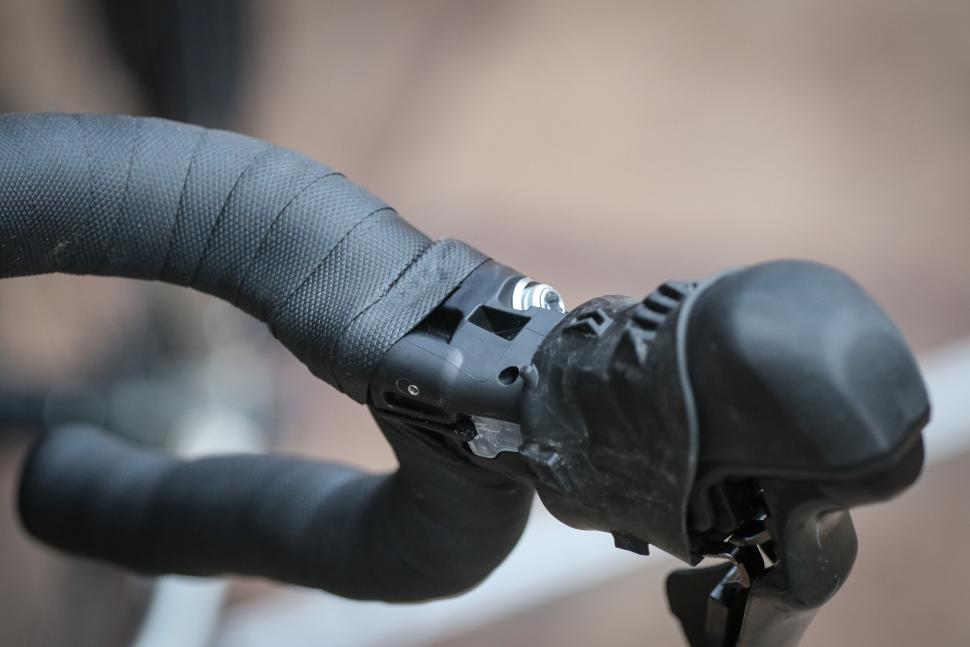
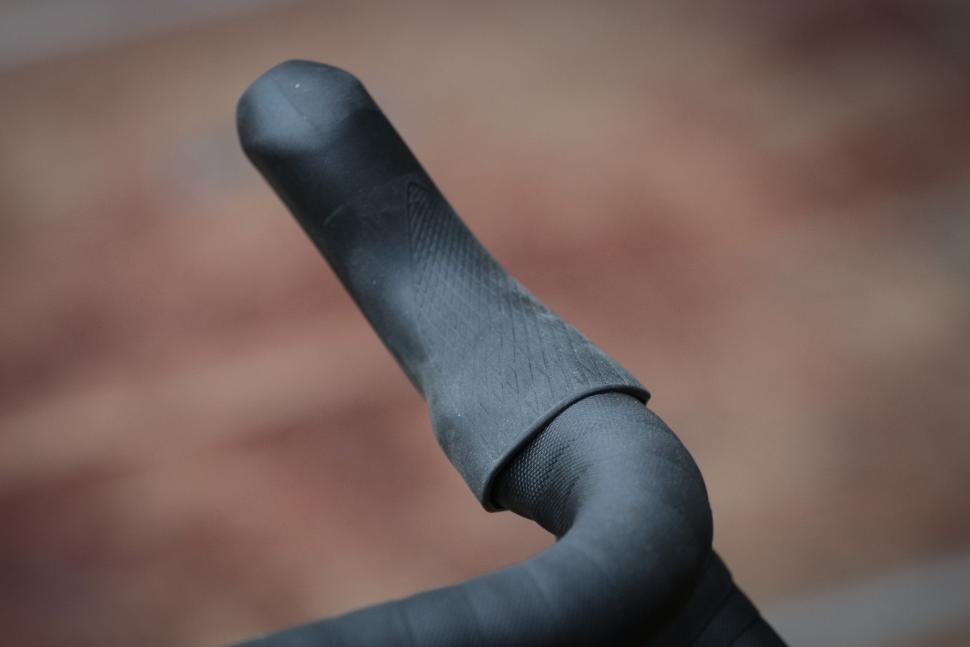
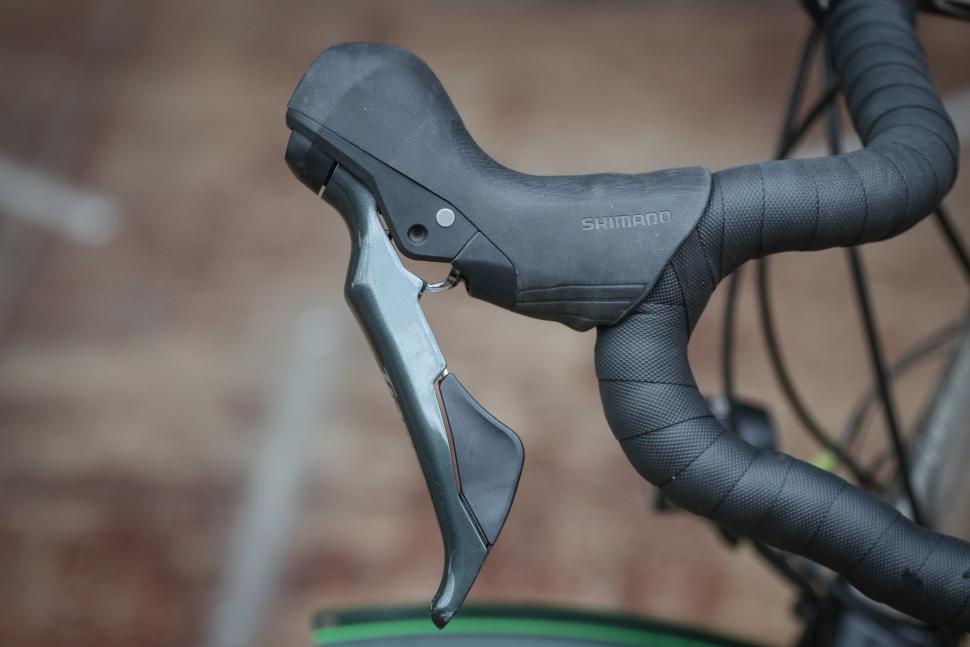
The hood shape has been refined over the last few years and I find it pretty comfortable; there's a small lump where the hose exits the lever and if you hold the handlebar in a certain way that could be an issue, though it wasn't for me.
The levers are easy to use from the hoods and drops, assuming you have nice big hands: I can grab a handful happily enough but I wouldn't want the levers to be much farther from the bar, and I've got hands like shovels. You can adjust the reach inwards, but by doing so you reduce the active stroke of the lever, and because you can't change the bite point you might find yourself running out of room between the lever and the bar if your reach is especially short. For riders with smaller hands there are the ST-4725 levers – they're pretty much exactly the same, just with a smaller lever size and slightly adjusted ergonomics.
The K03S Resin pads on this test set are a bit smoother in feel but don't last as long as the K04S Metal pads, which aren't quite as nice to use in my experience but last a lot longer. Whether the brakes come with resin or metal pads is down to whichever your country's Shimano distributor chooses – in the UK it's resin. If you want metal you'll have to buy them separately.
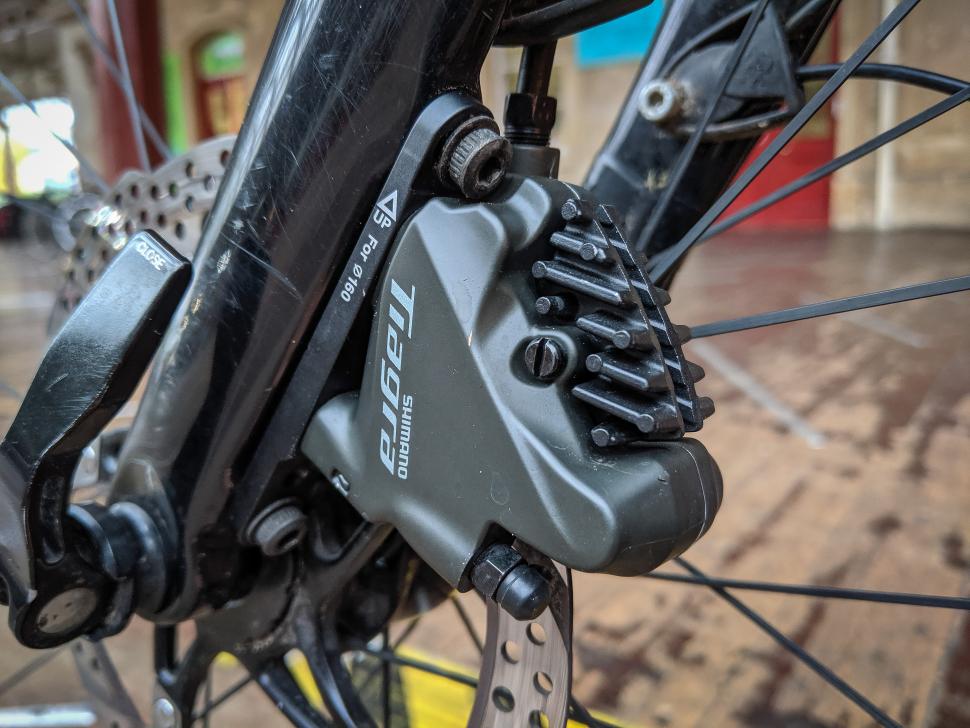
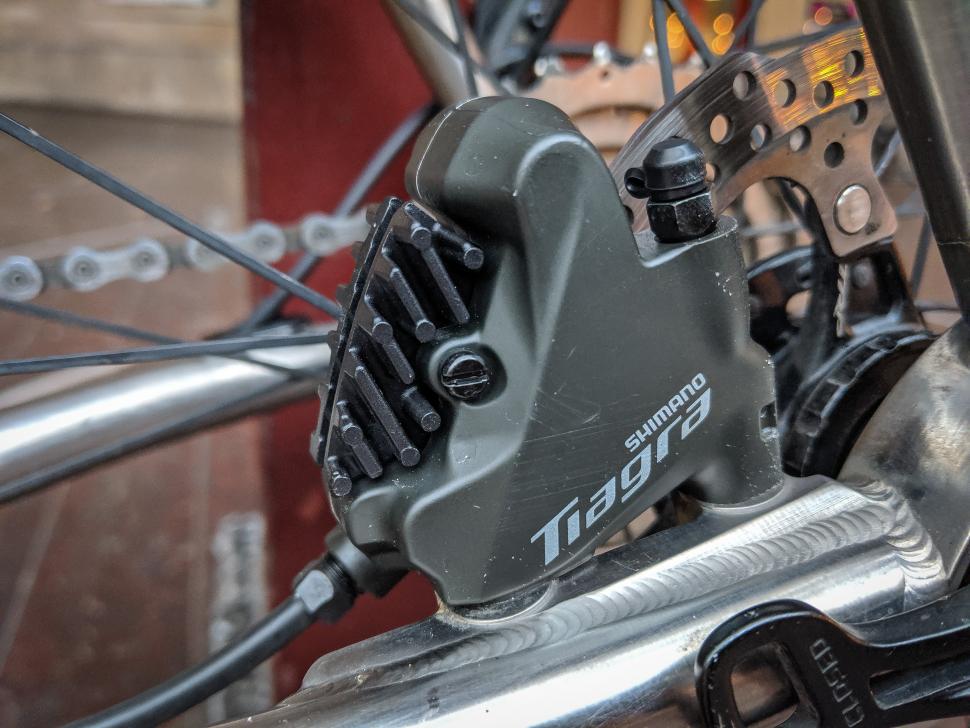
The pads self-centre very efficiently, so there's no need to constantly fiddle with the setup, although the space between the pads and the rotor is pretty minimal and requires fairly accurate setup in the first instance. If your flat mount is a bit off – and many are – then you might find that they rub and some facing off is required, even if your mechanical discs (where the pads tend to sit further from the rotor) were fine.
Derailleur-wise, the Tiagra system is 10-speed at the back but Shimano, in its infinite and benevolent wisdom, has chosen to change the pull ratio so that the new 4700-series Tiagra isn't compatible with any other 10-speed Shimano road groupset. You can in theory use these levers with an 11-speed derailleur, though, as the pull ratios are the same or near as dammit. Shimano wouldn't recommend that, of course, as it likes you to have everything the same. Life's not always like that though.
I'd been running a Shimano 105 groupset on the bike before this (I'm gradually working my way down the range, it seems) and that was with an 11-34 11-speed cassette. So the Tiagra's 11-34 10-speed cassette offers exactly the same range, and for the first seven sprockets it's exactly the same in terms of sprocket size. After that it ramps up a bit more quickly. I wasn't convinced that I'd notice the difference, but actually I did, especially the jump from 26 to 30 teeth (15%) which feels like a bit of a big step down. It's not the biggest on the cassette – the jump from 11 to 13 teeth at the other end is 18% – but it is the most noticeable, as it always comes at a time when you're working pretty hard up a hill. I stopped noticing after about a month, and now I've adjusted my filter to the bigger jumps. It's really not an issue.
Everything else about the shifting is great. The shifts at both ends of the transmission are crisp and accurate, and the lever action is light but positive. It's not as slick as the top-end groupsets, but in terms of actual functionality it's really not far off, which is impressive from a fourth-tier groupset.
Overall, the Tiagra hydraulic disc setup is easy to get on with, and easy to recommend. If you're running a winter bike or an all-purpose machine then it's hard to see how you can do better than this really: you get the ergonomics and most of the performance of the higher-end groupsets in a good value package. You're missing a speed you probably won't notice, and it's heavier than the Gucci groupsets, but that's about it.
Verdict
Great performance for braking and shifting; perfect for your winter bike or commuter