


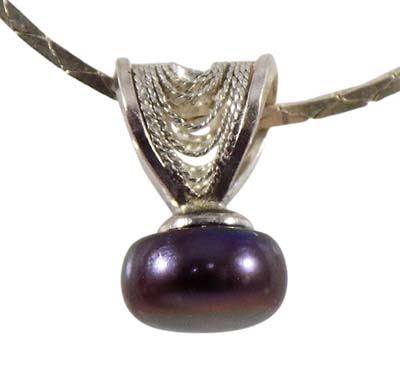
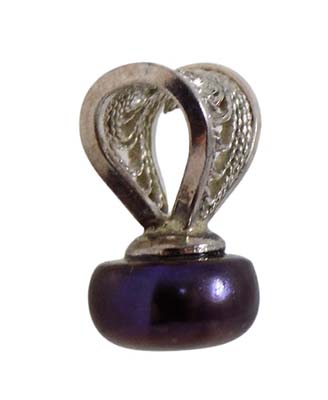
 CLASSIFICATION: Natural Black Pearl.
ORIGIN: South Pacific. Mid-20th Century.
SIZE: Diameter: 7mm. Thickness: 4mm. (Measurements approximate).
WEIGHT: Approximately 1.53 carats.
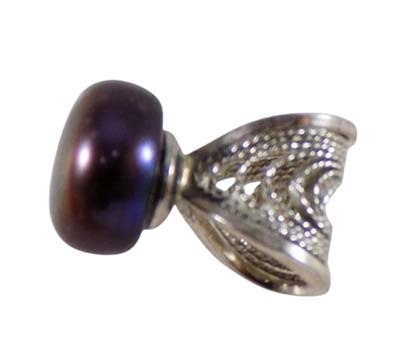
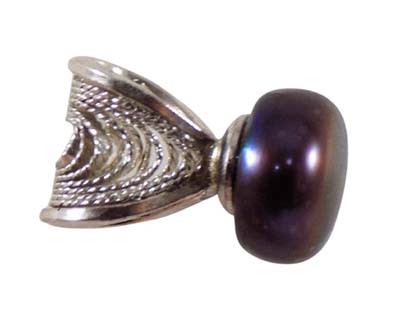
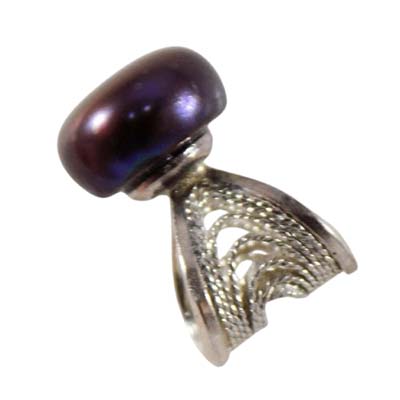
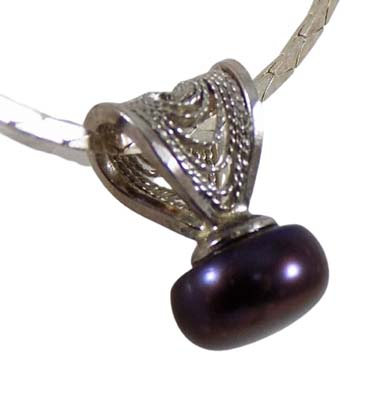
SETTING: Contemporary high-quality USA made sterling silver setting.
CHAIN: Contemporary silver electroplate in your choice of lengths; 16, 18, 20 or 24 inch (40, 45, 40 or 60cm). A wide variety of other chains are available upon request in sizes from 16 to 30 inches, and in metals ranging from silver electroplate to sterling silver. The default chain (absent contrary instructions) is silver electroplate, 24 inches. We also have available handcrafted Greek black leather cords.
DETAIL: In Islamic Scripture, the Koran specifies that the rewards of paradise include pearls. “God will admit those who believe and work righteous deeds, to gardens beneath which rivers flow. They shall be adorned therein with bracelets of gold and pearls; and their garments there will be of silk.” In some Muslim legends, the pearl is God's first act of creation. To the Ancient Persians, pearls symbolized the moon and its magical powers, the moon instilling pearls with its celestial glow and mystery. A fragment of the oldest known pearl jewelry, found in the sarcophagus of a Persian princess who died in 520 BC, is displayed in the Louvre in Paris. The spherical shape of some pearls also led many ancient cultures to associate this gem with the moon.
Here's a beautiful, iridescent, sumptuous, natural, black pearl. It is not an imitation pearl or a dyed pearl, it is a genuine black pearl. The pearl features a gorgeous, highly polished, reflective, lustrous, black surface with deep purple, blue, and green iridescent highlights. Originally produced somewhere around 1950, this is a very uncommon gemstone, difficult to acquire at any price. Black pearls have been extremely popular in Russia since the time of Catherine the Great (1729-1796), who owned a necklace of 30 black pearls, the largest weighing 19 1/2 carats.
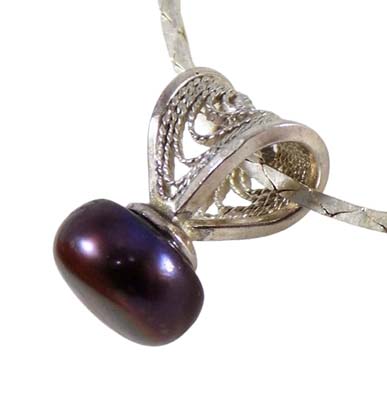
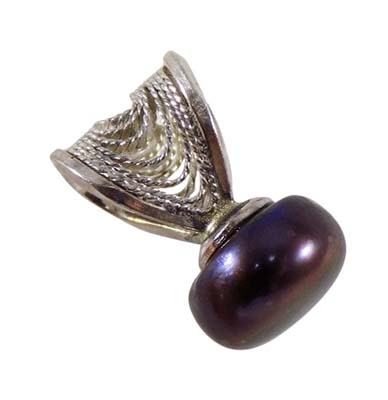
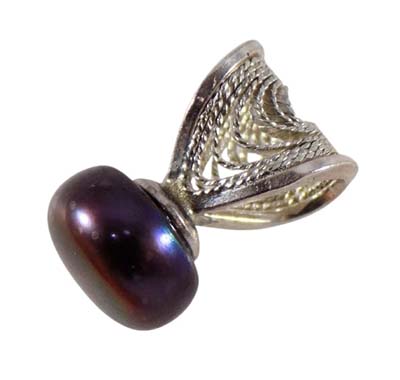
The gemstone is classified as a "button" pearl, meaning that it is a bit fatter than it is tall, it is not perfectly spherical. Of course when set it is almost impossible to tell that it is not perfectly spherical. Genuine black pearls like these are extremely costly these days, and only the most expensive jewelry shops can even afford to inventory them. The pearl is offered in and the price includes the setting shown in sterling silver. Also included is a silver electroplated chain in your choice of 16”, 18”, or 20” lengths. Other lengths and styles including sterling silver chains are also available. The pendant setting is contemporary in origin. This is a high-quality solid sterling silver pendant setting made right here in the USA. Crafted to last a lifetime, manufactured by one of the USA’s leading semi-custom mount producers. It is not cheap, imported silver electroplated nickel costume jewelry such as that flooding the USA and European market places from Asia (and oftentimes fraudulently described as "sterling silver"). This is an heirloom quality setting designed to last a lifetime. It is a first-class piece of jewelry throughout.
PEARL HISTORY: The pearl is likely the first gemstone known to prehistoric man. A fragment of the oldest known pearl jewelry, found in the sarcophagus of a Persian princess who died in 520 B.C., is displayed in the Louvre in Paris. Pearl necklaces have also been found by archaeologists within the sarcophagus of ancient Egyptian mummies. In the ancient world, natural salt-water pearls were principally harvested from the Persian Gulf, the Gulf of Manaar (Indian Ocean), and the Red Sea. Man has adorned him(her)self with pearls for at least 6,000 years. In the ancient gemstone markets of Babylon, 5,000 years ago, pearls were prized possessions believed to restore youth. Written accounts of pearl jewelry exist both in third millennium B.C. Indian and Chinese texts.
The ultimate origin of pearls in the ancient world was the source of many competing myths and legends. Ancient Chinese written accounts tell that pearls fell from the skies when dragons above fight (the pearls droplets of dragon saliva). Alternate ancient Chinese legends stated that pearls were found in the brains of dragons. As early as the Han Dynasty (200 B.C.) the ancient Chinese hunted extensively for seawater pearls in the South China Sea. The ancient Hindus believed that pearls were dewdrops that fell at night into the sea and collected in oysters. The pearl (“mukta” in Sanskrit) was associated with many Hindu deities, the most famous being the Koustubha which Lord Vishnu wore on his chest. According to the accounts of Marco Polo, the kings of Malabar (near present-day Calicut, Kerala, India) wore a necklace of 108 rubies and 108 precious pearls which was given from one generation of kings to the next.
The spherical shape of some pearls also led many ancient cultures to associate this gem with the moon. To the Ancient Persians, pearls symbolized the moon and its magical powers, the moon instilling pearls with its celestial glow and mystery. In some Muslim legends, the pearl is God's first act of creation. Many ancient Mediterranean cultures believed pearls were formed when an angel's tears fell into the open oyster shell, or alternatively were the tears of gods. However according to one ancient Greek legend, pearls were formed by lightning striking the ocean. Another ancient Greek legend posited that pearls were dew from the moon collected by oysters that opened their shells as they floated on the sea at night. To the ancient Greeks, pearls held the essence of love and beauty.
Even the Bible referred to the high value of pearls when Christ said, "the kingdom of Heaven is like a merchant searching for beautiful pearls, who, finding one of great cost, sells all his possessions to buy it.” Also according to biblical accounts, the twelve gates of the (post-apocalyptic) New Jerusalem are each made of a single pearl (the “pearly gates” of heaven). "And the twelve gates were twelve pearls; every gate was of one pearl: and the streets of the city were pure gold, as if transparent glass." Likewise in Islamic Scripture, the Koran specifies that the rewards of paradise include pearls. “God will admit those who believe and work righteous deeds, to gardens beneath which rivers flow. They shall be adorned therein with bracelets of gold and pearls; and their garments there will be of silk.”
A pair of pearl earrings owned by Cleopatra were estimated by the ancient Roman Historian Pliny to have a value of about 60 million sesterces (equivalent to 10,000 pounds of gold, $40 million in today’s value). Who can forget the tale of Cleopatra dissolving one of these two pearls in the presence of Marc Antony, so she could “taste” the essence of pearl. Throughout ancient Rome and into medieval Europe, pearls always decorated crowns and robes of kings and queens. In fact, all of Rome and the entire Roman Mediterranean were “pearl crazy”. According to the first century historian and naturalist “Pliny the Elder” (who wrote that pearls were created from the morning dew), the craze started when a portrait of Pompey the Great was rendered in pearls to mark the occasion of his third triumph (celebratory parade) over the defeat of Mithridates, King of Pontus (present day Turkey on the Black Sea).
As well, amongst the spoils of the war displayed during the parade were numerous pearls set in crowns and other jewelry. In the following fashion frenzy, the women of Rome preferred to wear two or three pearls dangling from their ears, so they would rattle as they moved, attracting attention to the fact that they were wearing pearls. Roman matrons had pearls woven into their garments, and even used pearls to decorate their couches. The third wife of the Roman Emperor Caligula reportedly owned pearl jewelry with a value of 40 million sesterces ($25 million in today’s dollars). In fact it was rumored within Rome itself that the real purpose of Julius Caesar’s invasion of Britain was to gain control of the fresh water pearls that were found there, and that "in comparing their size he sometimes weighed them with his own hand". In 46 B.C., when Caesar returned from Egypt to Rome where he was joined by Cleopatra and their infant son, he dedicated a cuirass made completely of British pearls in the Temple of Venus Genetrix.
In the ancient world, shamans used pearls to help enhance their psychic and divination powers, and to connect with lunar gods and gods of the oceans and seas. During the Middle Ages it was believed that pearls possessed the power to protect the wearer in battle, and so it was not uncommon to find suits of armor for the nobility encrusted with pearls. In Renaissance Europe the appetite for pearls became so great that laws forbade anyone other than royalty or the very privileged classes from even wearing pearls. Pearls were the exclusive domain of the crown and select nobility! The appetite for pearls was enormous, and the natural salt water pearl beds of Central and South America were ravaged.
The principal salt-water oyster beds remaining which still produce solid pearls today lay in Australia, the Persian Gulf, along the coasts of India, Sri Lanka, and in the Red Sea. The principle sources for cultured saltwater pearls today are Australia, Indonesia, Tahiti, the Philippines, and Burma. China, the USA, and Bavaria are the principle sources for freshwater pearls. Unknown today to most, America exported to Victorian Europe large numbers of very high quality freshwater pearls from the Ohio, Mississippi, and Tennessee River basins. So many gems were exported to Europe that the New World quickly gained the appellation "Land of Pearls." Today, except for the freshwater production of small specimens, genuine solid pearls are by and large only obtainable as antiques. From the 1930’s to present day, cultured pearls from Japan have predominated the marketplace.
Most people generally credit the “invention” of cultured pearls with Kokichi Mikimoto in Japan at the turn of the twentieth century. However eight hundred years ago in China, monks planted carvings of Buddhist deities into river mollusks in order to be coated with pearl-like layers, the first recorded cultured “pearls”. Since the 1990’s, with the decline of Japanese cultured pearl production due to pollution and disease, China has increasingly been the dominant supplier of cultured pearls, both freshwater and saltwater. However it is still generally believed that the finest cultured pearls ever produced, with the exception of limited quantities produced in Tahiti, were produced in Japan between 1930 and 1970.
Pearls are found in a wide variety of colors and shades, the most highly valued being white, black, rose, and cream. Black pearls are very rare and highly prized, and are typically found only in Tahiti and the Cook Islands. If you would like to learn more about black pearls, there is a great article done in Fortune Magazine not too long ago; you can still look it up on the internet. Also especially prized are rose-colored pearls found in India, Sri Lanka (Ceylon), and the South Pacific. Pearls are formed as lustrous concretion produced principally by certain bivalve mollusks (as well as scallops, abalone, conchs, and even snails). A pearl consists almost entirely of nacre (also known as “mother-of-pearl”), which is the substance forming the inner layers of the mollusk shells. Both marine and freshwater mollusks produce pearls.
In nature a pearl starts when an irritant or parasite has managed to get inside the mollusk’s shell. The irritant or parasite serves as the nucleus of the pearl which results when nacre is deposited layer-upon-layer by the mollusk around the irritant or parasite as a defense mechanism. A natural pearl is very rare in nature, and occurs only once in 15,000 mollusks. Cultured pearls are formed when man intercedes, depositing the nucleus of a new pearl inside the tissue of the mollusk, thus “artificially” inducing the mollusk to create pearl. Freshwater pearls are produced by mussels in various parts of the world, though China is the principal producer of freshwater pearls. However pearl production is a carefully fostered industry in central Europe, and the forest streams of Bavaria, in particular, are a source of choice freshwater pearls. Gem-quality freshwater pearls are also produced in the Mississippi River.
Throughout the history of the ancient world, gemstones were believed capable of curing illness, possessed of valuable metaphysical properties, and to provide protection. Found in Egypt dated 1500 B. C., the "Papyrus Ebers" offered one of most complete therapeutic manuscripts containing prescriptions using gemstones and minerals. Gemstones were not only valued for their medicinal and protective properties, but also for educational and spiritual enhancement. In the ancient world pearls were thought to signify charity, faith and innocence. They were believed to help to provide a focus to ones attention, and enhance personal integrity. The pearl was known as a stone of sincerity. Pearls were believed to inhibit rowdy behavior. The luster was thought to provide a reflection of the inner self, so that one could perceive oneself as others did. In the ancient cultures of Asia pearls were thought to quicken the laws of karma and to cement engagements and love relationships. They were also used as a talisman to keep children safe. Pearls were also powdered and used as a medicine to promote mental health, as well as an aid for stomach, stomach ulcer, spleen, and intestinal tract problems.
HISTORY OF SILVER: After gold, silver is the metal most widely used in jewelry and the most malleable. The oldest silver artifacts found by archaeologists date from ancient Sumeria about 4,000 B.C. At many points in the ancient world, it was actually more costly than gold, particularly in ancient Egypt. Silver is found in native form (i.e., in nuggets), as an alloy with gold (electrum), and in ores containing sulfur, arsenic, antimony or chlorine. Much of the silver originally found in the ancient world was actually a natural alloy of gold and silver (in nugget form) known as “electrum”.
The first large-scale silver mines were in Anatolia (ancient Turkey) and Armenia, where as early as 4,000 B.C. silver was extracted from lead ores by means of a complicated process known as “smelting”. Even then the process was not perfect, as ancient silver does contain trace elements, typically lead, gold, bismuth and other metals, and as much as a third of the silver was left behind in the slag. However measuring the concentrations of the “impurities” in ancient silver can help the forensic jewelry historian in determining the authenticity of classical items. From Turkey and Armenia silver refining technology spread to the rest of Asia Minor and Europe.
By about 2,500 B.C. the Babylonians were one of the major refiners of silver. Silver “treasures” recovered by archaeologists from the second and third millenniums demonstrate the high value the ancient Mediterranean and Near East placed upon silver. Some of the richest burials in history uncovered by archaeologists have been from this time frame, that of Queen Puabi of Ur, Sumeria (26th century B.C.); Tutankhamun (14th century B.C.), and the rich Trojan (25th century B.C.) and Mycenaean (18th century B.C.) treasures uncovered by Heinrich Schliemann.
 The ancient Egyptians believed that the skin of their gods was composed of gold, and their bones were thought to be of silver. When silver was introduced into Egypt, it probably was more valuable than gold (silver was rarer and more valuable than gold in many Mesoamerican cultures as well). In surviving inventories of valuables, items of silver were listed above those of gold during the Old Kingdom. Jewelry made of silver was almost always thinner than gold pieces, as indicated by the bracelets of the 4th Dynasty (about 2,500 B.C.) Queen Hetephere I, in marked contrast to the extravagance of her heavy gold jewelry.
A silver treasure excavated by archaeologists and attributable to the reign of Amenemhat II who ruled during the 12th Dynasty (about 1900 B.C.), contained fine silver items which were actually produced in Crete, by the ancient Minoans. When the price of silver finally did fall due to more readily available supplies, for at least another thousand years (through at least the 19th dynasty, about 1,200 B.C.) the price of silver seems to have been fixed at half that of gold. Several royal mummies attributable to about 1,000 B.C. were even entombed in solid silver coffins.
Around 1,000 B.C. Greek Athenians began producing silver from the Laurium mines, and would supply much of the ancient Mediterranean world with its silver for almost 1,000 years. This ancient source was eventually supplemented around 800 B.C. (and then eventually supplanted) by the massive silver mines found in Spain by the Phoenicians and their colony (and ultimate successors) the Carthaginians (operated in part by Hannibal’s family). With the defeat of Carthage by Rome, the Romans gained control of these vast deposits, and mined massive amounts of silver from Spain, stripping entire forests regions for timber to fuel smelting operations. In fact, it was not until the Middle Ages that Spain’s silver mines (and her forests) were finally exhausted.
Although known during the Copper Age, silver made only rare appearances in jewelry before the classical age. Despite its infrequent use as jewelry however, silver was widely used as coinage due to its softness, brilliant color, and resistance to oxidation. Silver alloyed with gold in the form of “electrum” was coined to produce money around 700 B.C. by the Lydians of present-day Turkey. Having access to silver deposits and being able to mine them played a big role in the classical world. Actual silver coins were first produced in Lydia about 610 B.C., and subsequently in Athens in about 580 B.C.
Many historians have argued that it was the possession and exploitation of the Laurium mines by the Athenians that allowed them to become the most powerful city state in Greece. The Athenians were well aware of the significance of the mining operations to the prosperity of their city, as every citizen had shares in the mines. Enough silver was mined and refined at Laurium to finance the expansion of Athens as a trading and naval power. One estimate is that Laurium produced 160 million ounces of silver, worth six billion dollars today (when silver is by comparison relatively cheap and abundant). As the production of silver from the Laurium mines ultimately diminished, Greek silver production shifted to mines in Macedonia.
Silver coinage played a significant role in the ancient world. Macedonia’s coinage during the reign of Philip II (359-336 B.C.) circulated widely throughout the Hellenic world. His famous son, Alexander the Great (336-323 B.C.), spread the concept of coinage throughout the lands he conquered. For both Philip II and Alexander silver coins became an essential way of paying their armies and meeting other military expenses. They also used coins to make a realistic portrait of the ruler of the country. The Romans also used silver coins to pay their legions. These coins were used for most daily transactions by administrators and traders throughout the empire.
Roman silver coins also served as an important means of political propaganda, extolling the virtues of Rome and her emperors, and continued in the Greek tradition of realistic portraiture. As well, many public works and architectural achievements were also depicted (among them the Coliseum, the Circus Maximus). In addition many important political events were recorded on the coinage. Roman coins depicted the assassination of Julius Caesar, alliances between cities, between emperors, between armies, etc. And many contenders for the throne of Rome are known only through their coinage.
Silver was also widely used as ornamental work and in other metal wares. In ancient cultures, especially in Rome, silver was highly prized for the making of plate ware, household utensils, and ornamental work. The stability of Rome’s economy and currency depended primarily on the output of the silver mines in Spain which they had wrested from the Carthaginians. In fact many historians would say that it was the control of the wealth of these silver mines which enabled Rome to conquer most of the Mediterranean world. When in 55 B.C. the Romans invaded Britain they were quick to discover and exploit the lead-silver deposits there as well.
Only six years later they had established many mines and Britain became another major source of silver for the Roman Empire. It is estimated that by the second century A.D., 10,000 tons of Roman silver coins were in circulation within the empire. That’s about 3½ billion silver coins (at the height of the empire, there were over 400 mints throughout the empire producing coinage). That’s ten times the total amount of silver available to Medieval Europe and the Islamic world combined as of about 800 A.D. Silver later lost its position of dominance to gold, particularly in the chaos following the fall of Rome. Large-scale mining in Spain petered out, and when large-scale silver mining finally resumed four centuries after the fall of Rome, most of the mining activity was in Central Europe.
By the time of the European High Middle Ages, silver once again became the principal material used for metal artwork. Huge quantities of silver from the New World also encouraged eager buyers in Europe, and enabled the Spanish to become major players in the late Medieval and Renaissance periods. Unlike the ores in Europe which required laborious extraction and refining methods to result in pure silver, solid silver was frequently found as placer deposits in stream beds in Spain’s “New World” colonies, reportedly in some instances solid slabs weighing as much as 2,500 pounds. Prior to the discovery of massive silver deposits in the New World, silver had been valued during the Middle Ages at about 10%-15% of the value of gold.
In 15th century the price of silver is estimated to have been around $1200 per ounce, based on 2010 dollars. The discovery of massive silver deposits in the New World during the succeeding centuries has caused the price to diminish greatly, falling to only 1-2% of the value of gold. The art of silver work flourished in the Renaissance, finding expression in virtually every imaginable form. Silver was often plated with gold and other decorative materials. Although silver sheets had been used to overlay wood and other metals since ancient Greece, an 18th-century technique of fusing thin silver sheets to copper brought silver goods called Sheffield plate within the reach of most people.
At the same time the use of silver in jewelry making had also started gaining popularity in the 17th century. It was often as support in settings for diamonds and other transparent precious stones, in order to encourage the reflection of light. Silver continued to gain in popularity throughout the 18th and 19th centuries, and by the 20th century competed with gold as the principal metal used in the manufacture of jewelry. Silver has the highest thermal and electrical conductivity of any metal, and one of the highest optical reflectivity values. It has a brilliant metallic luster, is very ductile and malleable, only slightly harder than gold, and is easily worked and polished.
When used in jewelry, silver is commonly alloyed to include 7.5% copper, known as “sterling silver”, to increase the hardness and reduce the melting temperature. Silver jewelry may be plated with 99.9% pure ‘Fine Silver’ to increase the shine when polished. It may also be plated with rhodium to prevent tarnish. Virtually all gold, with the exception of 24 carat gold, includes silver. Most gold alloys are primarily composed of only gold and silver. Throughout the history of the ancient world, gemstones were believed capable of curing illness, possessed of valuable metaphysical properties, and to provide protection. Found in Egypt dated 1500 B. C., the "Papyrus Ebers" offered one of most complete therapeutic manuscripts containing prescriptions using gemstones and minerals.
Gemstones were not only valued for their medicinal and protective properties, but also for educational and spiritual enhancement. Precious minerals were likewise considered to have medicinal and “magical” properties in the ancient world. In its pure form silver is non toxic, and when mixed with other elements is used in a wide variety of medicines. Silver ions and silver compounds show a toxic effect on some bacteria, viruses, algae and fungi. Silver was widely used before the advent of antibiotics to prevent and treat infections, silver nitrate being the prevalent form. Silver Iodide was used in babies' eyes upon birth to prevent blinding as the result of bacterial contamination.
Silver is still widely used in topical gels and impregnated into bandages because of its wide-spectrum antimicrobial activity. The recorded use of silver to prevent infection dates to ancient Greece and Rome. Hippocrates, the ancient (5th century B.C.) Greek "father of medicine" wrote that silver had beneficial healing and anti-disease properties. The ancient Phoenicians stored water, wine, and vinegar in silver bottles to prevent spoiling. These uses were “rediscovered” in the Middle Ages, when silver was used for several purposes; such as to disinfect water and food during storage, and also for the treatment of burns and wounds as a wound dressing.
The ingestion of colloidal silver was also believed to help restore the body's “electromagnetic balance” to a state of equilibrium, and it was believed to detoxify the liver and spleen. In the 19th century sailors on long ocean voyages would put silver coins in barrels of water and wine to keep the liquid potable. Silver (and gold) foil is also used through the world as a food decoration. Traditional Indian dishes sometimes include the use of decorative silver foil, and in various cultures silver dragée (silver coated sugar balls) are used to decorate cakes, cookies, and other dessert items.
SHIPPING & RETURNS/REFUNDS: Your purchase will ordinarily be shipped within 48 hours of payment. We package as well as anyone in the business, with lots of protective padding and containers. All of our shipments are fully insured against loss, and our shipping rates include the cost of this coverage (through stamps.com, Shipsaver.com, the USPS, UPS, or Fed-Ex). Please be aware that postal rates are routinely hiked three times each year by the USPS, and have increased exponentially over the past decade. We set shipping rates as low as possible. However eBay charges steep commissions on shipping charges. And we have no control over the draconian rate increases the USPS levies multiple times every year (FOUR TIMES in the past 12 months as of April of 2026). International tracking is provided free by the USPS for almost all countries. Please note that with respect to international shipments, eBay/DHL shipping is typically less expensive than what the US Postal Service charges. But please be aware that DHL shipments generally offer very limited tracking, and inasmuch as shipments go to eBay first, then are consolidated before finally being transferred to DHL, they tend to be pretty slow.
ADDITIONAL PURCHASES do receive a VERY LARGE discount, typically about $5 per item so as to reward you for the economies of combined shipping/insurance costs. We do offer U.S. Postal Service Priority Mail, Registered Mail, and Express Mail for both international and domestic shipments, as well United Parcel Service (UPS) and Federal Express (Fed-Ex). Please ask for a rate quotation. Please note for international purchasers we will do everything we can to minimize your liability for VAT and/or duties. But we cannot assume any responsibility or liability for whatever taxes or duties may be levied on your purchase by the country of your residence. If you don’t like the tax and duty schemes your government imposes, please complain to them. We have no ability to influence or moderate your country’s tax/duty schemes.
If upon receipt of the item you are disappointed for any reason whatever, I offer a no questions asked 30-day return policy. Send it back, I will give you a complete refund of the purchase price; 1) less our original shipping/insurance costs, 2) less any non-refundable eBay fees. Please note that though they generally do, eBay may not always refund payment processing fees on returns beyond a 30-day purchase window. So except for shipping costs and any payment processing fees not refunded by eBay, we will refund all proceeds from the sale of a return item. Obviously we have no ability to influence, modify or waive eBay policies.
ABOUT US: Prior to our retirement we used to travel to Eastern Europe and Central Asia several times a year seeking antique gemstones and jewelry from the globe’s most prolific gemstone producing and cutting centers. Most of the items we offer came from acquisitions we made in Eastern Europe, India, and from the Levant (Eastern Mediterranean/Near East) during these years from various institutions and dealers. Much of what we generate on Etsy, Amazon and Ebay goes to support worthy institutions in Europe and Asia connected with Anthropology and Archaeology. Though we have a collection of ancient coins numbering in the tens of thousands, our primary interests are ancient/antique jewelry and gemstones, a reflection of our academic backgrounds.
Though perhaps difficult to find in the USA, in Eastern Europe and Central Asia antique gemstones are commonly dismounted from old, broken settings – the gold reused – the gemstones recut and reset. Before these gorgeous antique gemstones are recut, we try to acquire the best of them in their original, antique, hand-finished state – most of them originally crafted a century or more ago. We believe that the work created by these long-gone master artisans is worth protecting and preserving rather than destroying this heritage of antique gemstones by recutting the original work out of existence. That by preserving their work, in a sense, we are preserving their lives and the legacy they left for modern times. Far better to appreciate their craft than to destroy it with modern cutting.
Not everyone agrees – fully 95% or more of the antique gemstones which come into these marketplaces are recut, and the heritage of the past lost. But if you agree with us that the past is worth protecting, and that past lives and the produce of those lives still matters today, consider buying an antique, hand cut, natural gemstone rather than one of the mass-produced machine cut (often synthetic or “lab produced”) gemstones which dominate the market today. We can set most any antique gemstone you purchase from us in your choice of styles and metals ranging from rings to pendants to earrings and bracelets; in sterling silver, 14kt solid gold, and 14kt gold fill. When you purchase from us, you can count on quick shipping and careful, secure packaging. We would be happy to provide you with a certificate/guarantee of authenticity for any item you purchase from us. There is a $3 fee for mailing under separate cover. I will always respond to every inquiry whether via email or eBay message, so please feel free to write.