Peter Paul Rubens
Descent from the Cross (1614)
36" x 24"
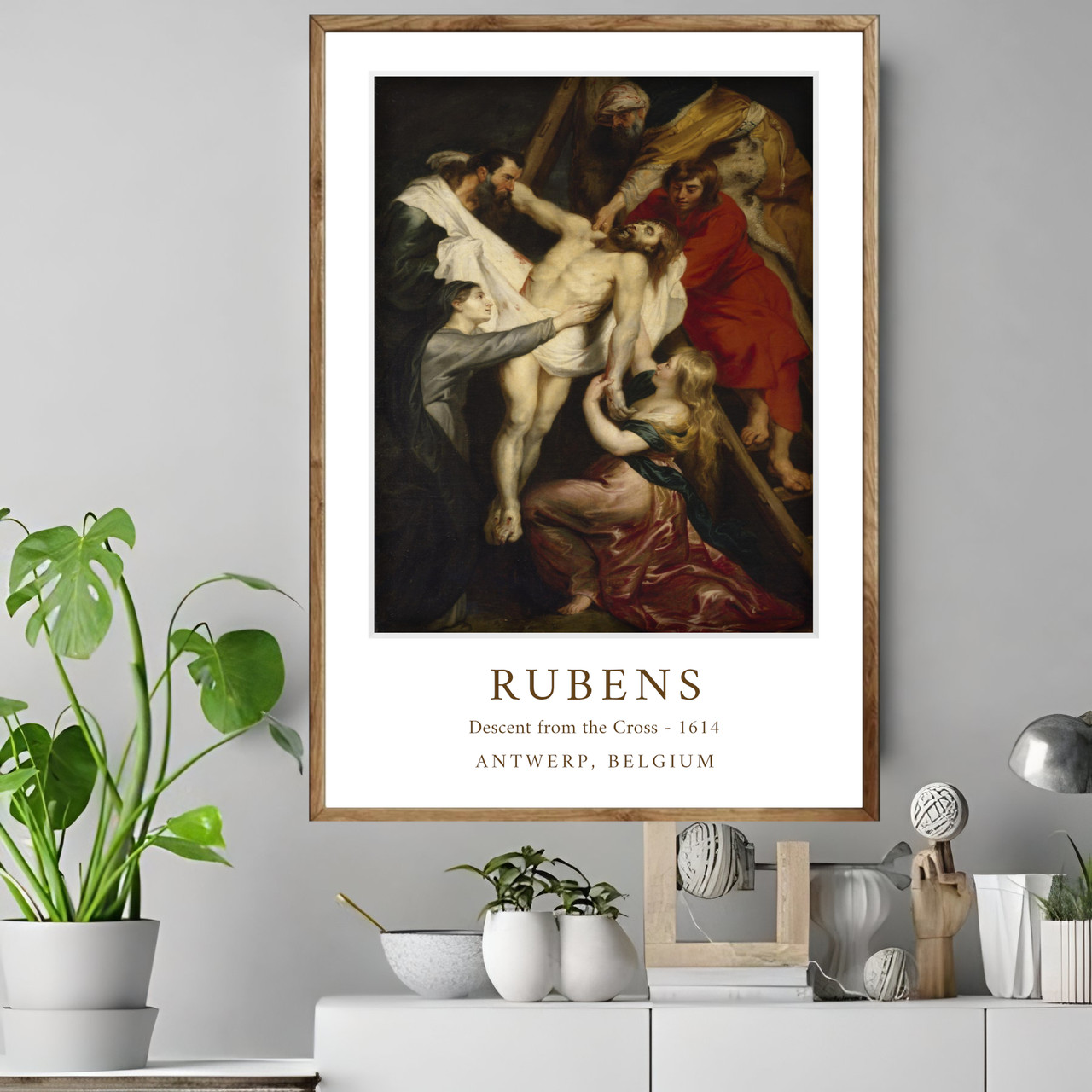
The Descent from the Cross is the central panel of a triptych painting by Peter Paul Rubens in 1612–1614. It is still in its original place, the Cathedral of Our Lady, Antwerp, Belgium, along with another great altarpiece The Elevation of the Cross. The subject was one Rubens returned to again and again in his career. This particular work was commissioned on September 7, 1611, by the Confraternity of the Arquebusiers, whose Patron Saint was St. Christopher.
Although essentially Baroque, the oil on panel piece is rooted in the Venetian tradition, and likely influenced by the work of Daniele da Volterra, Federico Barocci and Cigoli, amongst others. In its composition and use of light, the triptych recalls Caravaggio's Roman period.
Theophile Silvestre wrote, in his "On Rubens' Descent from the Cross – 1868":
“The principal subject is composed of nine figures: at the top of two ladders, workers are lowering the body of Christ with the aid of a shroud which one of them holds in his teeth, the other in the left hand. Bracing themselves firmly against the arms of the cross, each bends forward to guide the Christ with the hand that is left free while St. John, with one foot on the ladder and his back arched, supports him most energetically. One of Savior’s feet comes to rest on the beautiful shoulder of the Magdalene, grazing her golden hair. Joseph of Arimathea and Nicodemus, placed midway on ladders so as to face each other, form, together with the two workmen in the upper part of the picture, a square of vigorous but plebeian figures. The Virgin, standing at the foot of the sacrificial tree, extends her arms towards her Son; Salome (properly, Mary Cleophas), kneeling, gathers up her robe. On the ground are seen the superscription and a copper basin where the crown of thorns and the nails of the Crucifixion lie in the congealed blood. The crowd, always elated by the spectacle of torture, has departed from Golgotha as daylight fades. After the sacrifice of Calvary, as it is called in Scripture, the sad, dark sky is crossed by a light that illumines the shoulders of the workmen, whose bold posture recalls the composition by Daniele da Volterra".
In 1794, Napoleon removed this painting and The Elevation of the Cross and sent them to the Louvre. After his defeat, they were returned to the cathedral in 1815.
We accept payment via eBay payment with all major credit cards or Paypal.
If you are not 100% satisfied with your purchase, please contact us immediately so we can resolve any issues, exchange the product for another one (be it similar or not) or process a full refund.
If you are missing any parts, or need replacements, we will gladly provide those items upon request.
Any product you return must be in the same condition you received it and in the original packaging. Please keep the receipt.
All the items will be sent out to your Ebay Address within 1-2 business days after receiving your cleared payment. Orders made on Saturday, Sundays and holidays will be processed on the next business day and will be shipped within 24 hours.
Most items will ship to Alaska, Hawaii, U.S. territories, and internationally for an additional fee, but please refer to the Shipping and Payments tab to view our shipping rates.
International Buyers:
Import duties, taxes, and charges are not included in the item price or shipping charges. These charges are on buyer responsibility.
If you are dissatisfied for any reason, please do not be quick to leave negative/neutral feedback. We work hard to make sure EVERY CUSTOMER 100% SATISFIED and resolve any problem for you.