 |
|
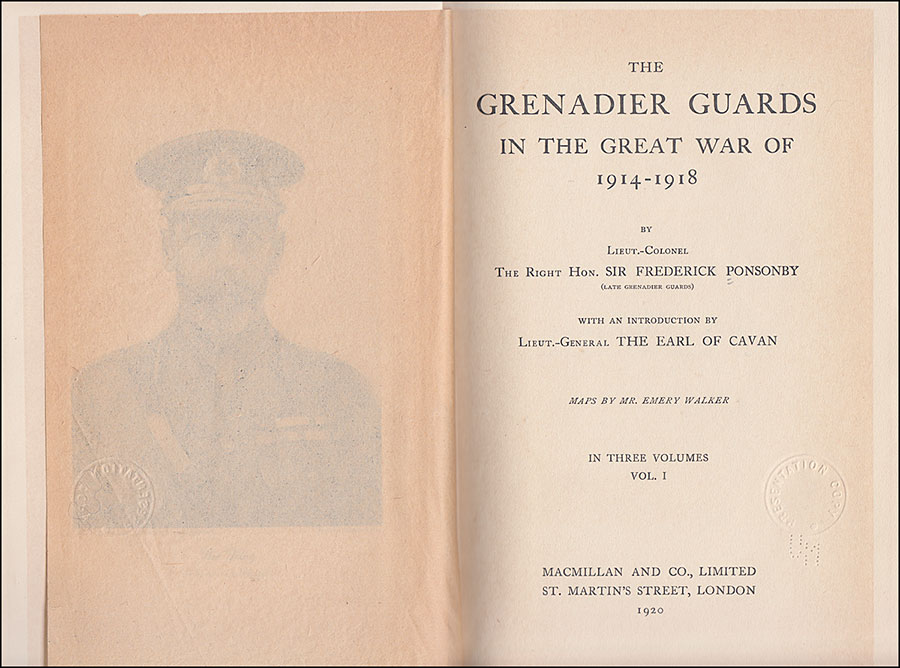
The Grenadier Guards
in the Great War of
1914-1918
(Complete Three Volume Set)
by
Lieut.-Colonel The Right Hon.
Sir Frederick Ponsonby
(Late Grenadier Guards)
With an Introduction by Lieut.-General The Earl of Cavan;
Maps by Mr Emery Walker
|
|
 |
|
This is
the 1920 First Edition Three Volume set (ex-University Library)
This
is the standard history of the Regiment's service in the Great War
and includes a Nominal Roll, Roll
of Honour, Decorations and Awards, and Index of Officers. “This
finely-produced history of the most famous of British regiments
is written with dignity and good taste. There were only four
battalions of this regiment on active service, but they were all
in different brigades of the Guards Division after that had been
formed." (War Books by Cyril Falls).
At
the outbreak of the First World War in August 1914, the Regiment
consisted of three Battalions. With the commencement of
hostilities, the Regiment raised a Service Battalion, the 4th
Battalion, and a reserve Battalion, known as the 5th (Reserve)
Battalion, which was used to carry out ceremonial duties in
London and Windsor during the war. The 2nd Battalion of the
Regiment was sent to France in August and the 1st Battalion
followed to Belgium in October. They took part in the early
stages of the fighting and were involved significantly at the
First Battle of Ypres.
Please be aware that
this is a large and particularly heavy set, making
international postage expensive (also, the set is
too heavy to be posted to Canada).
|
|
|
|
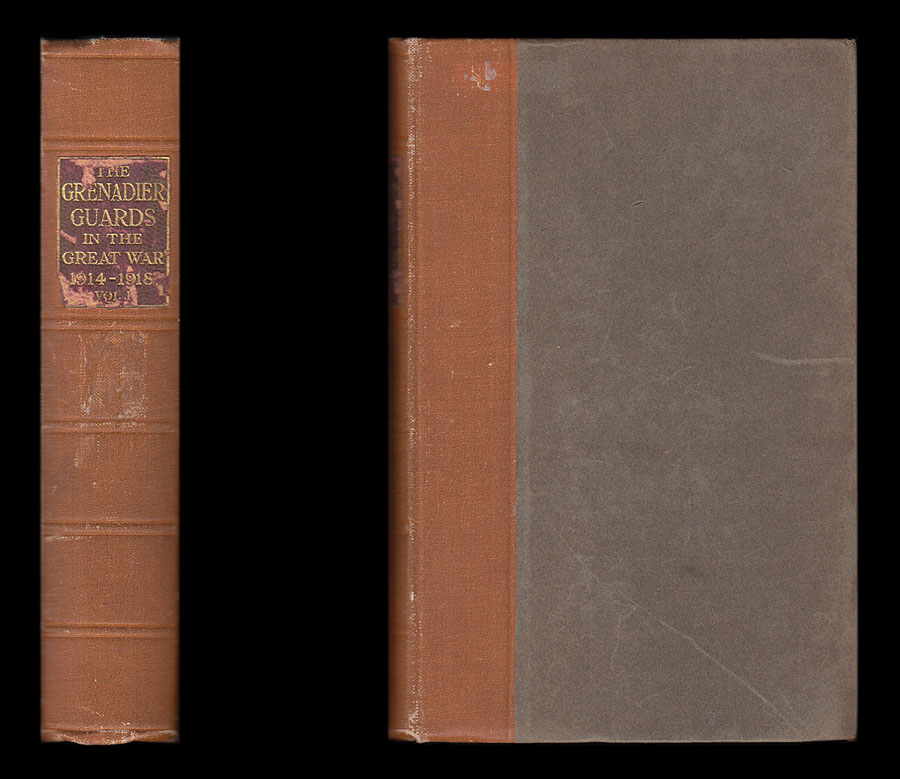
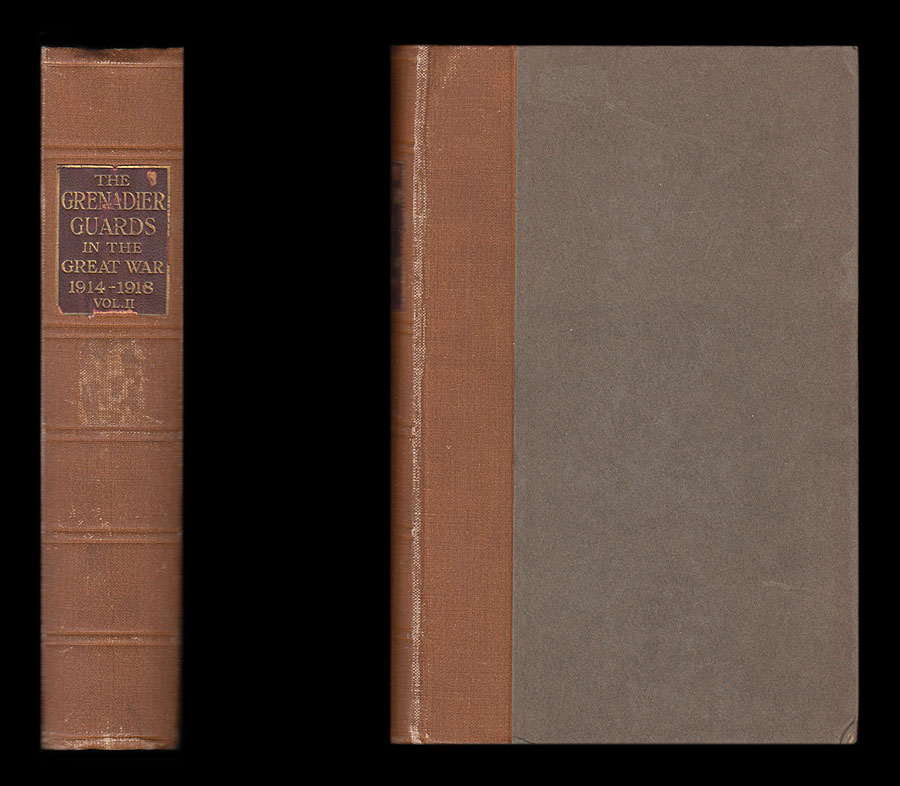
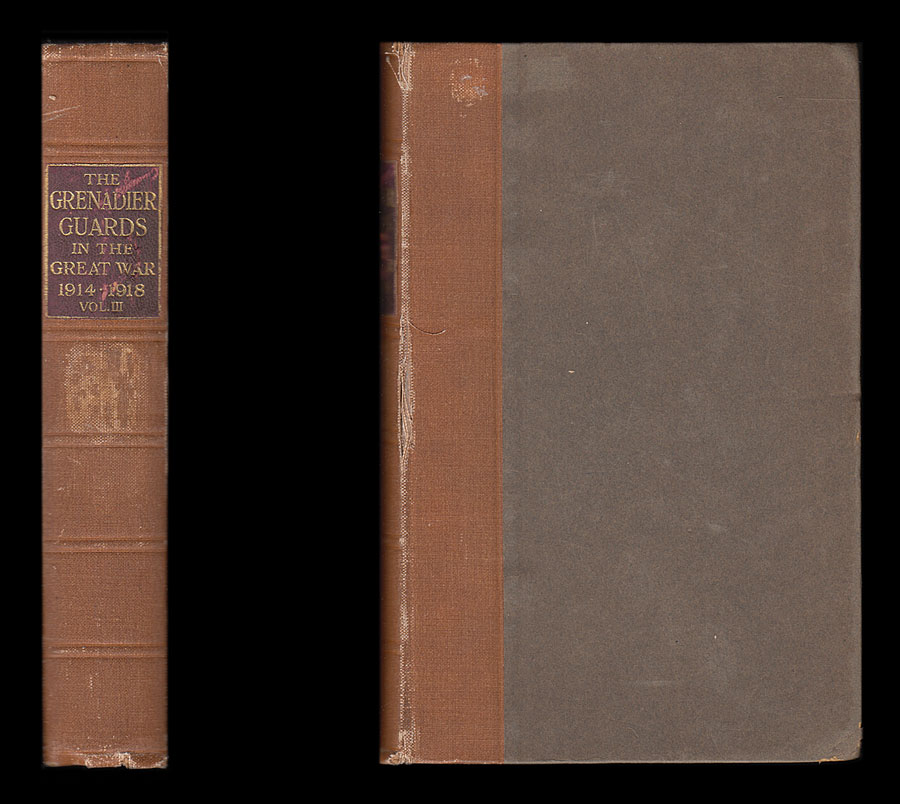
Front covers and spines
Further images of this set are
shown below
|
|
|
|
|
 |
|
|
|
|
|
Publisher and place of
publication |
|
Dimensions in inches (to
the nearest quarter-inch) |
|
London: Macmillan & Co., Limited |
|
5¾ inches wide x 9 inches tall |
| |
|
|
|
Edition |
|
Length |
|
1920 First Editions |
|
Volume I: [xviii] + 378 pages, Publisher’s
Advertisement
Volume II: [vii] + 383 pages
Volume III: [ix] + 352 pages |
| |
|
|
|
Condition of covers |
|
Internal condition |
|
This set is ex-University Library. Each volume
is bound in the original grey paper-covered boards, with a brown cloth
backstrip and leather spine label. In each, the boards are scuffed and
rubbed and the corners are quite heavily bumped, with splits in the paper
covering, while the spine ends are also heavily bumped. Each has a
discoloured patch in the centre of the spine from the removal of a Library
label. There are some indentations along the edges of the boards. Individual
defects are noted below: Volume I:
There is a small discoloured patch near the front top corner; the rear spine
gutter is heavily rubbed; the leather spine label is chipped and torn with
some loss.
Volume II: There is a small discoloured patch near the front top
corner; the rear spine gutter is heavily rubbed and starting to fray in two
places; the leather spine label is chipped with some loss.
Volume III: There is a small discoloured patch near the front
top corner; the front spine gutter is heavily rubbed and is frayed in the
centre and at both ends; the spine ends are frayed with splits to the cloth;
the leather spine label is chipped with some loss. |
|
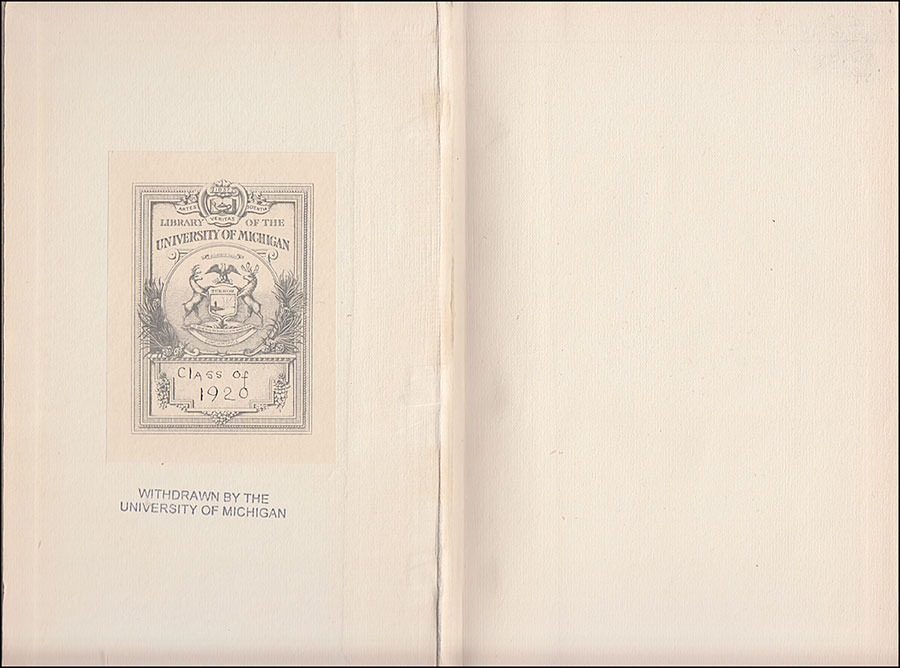
This set is ex-University Library. Each volume
has a Library bookplate on the front pastedown: "Library of the University
of Michigan Class of 1920", with a "Withdrawn" stamp directly underneath.
The bookplate is intact in Volumes II & III but an attempt (only partly
successful) has been made to remove it in Volume I. In each the edge of the
text block is not uniformly trimmed and is a little ragged in places. The
text is clean throughout on tanned paper with the very occasional pencil
marking. The edges of the text blocks are dust-stained and lightly foxed.
The illustrations have acquired a yellowish tinge. Individual defects are
noted below: Volume I: As
noted, the Library bookplate has been partially removed and there are some
erased pencil markings on the front end-papers, and a small abraded patch.
The tissue guard has tanned the Title-Page, on which also there is
"Presentation Copy" stamp in blind and a small perforated mark ("UM"). One
other tissue guard is missing and the other three (one of which is torn)
have also tanned the facing page.
Volume II: There are some erased pencil markings and a small tear on
the outside edge of the front free end-paper. There is a small stamp on the
reverse of the portrait frontispiece and some of the other plates and maps.
The tissue guard has tanned the Title-Page, on which also there is
"Presentation Copy" stamp in blind and a small perforated mark ("UM"). Two
other tissue guards are missing and the others have also tanned the facing
page.
Volume III: There are some erased pencil markings on the front
free end-paper. There is a small stamp on the reverse of the portrait
frontispiece and some of the other plates and maps. The tissue guard has
tanned the Title-Page, on which also there is "Presentation Copy" stamp in
blind and a small perforated mark ("UM"). The other tissue guards (one of
which is torn) have also tanned the facing page. |
| |
|
|
|
Dust-jacket present? |
|
Other
comments |
|
No |
|
Although ex-Library, this set of First
Editions remains in quite reasonable condition internally with clean text
and minimal markings. The covers are heavily bumped and are scuffed and
frayed in places, but holding firm. |
| |
|
|
|
Illustrations,
maps, etc |
|
Contents |
|
Please see below for details |
|
Please see below for details |
| |
|
|
|
Post & shipping
information |
|
Payment options |
|
The packed weight is approximately
3,000 grams.
Full shipping/postage information is
provided in a panel
at the end of this listing.
 |
|
Payment options
:
-
UK buyers: cheque (in
GBP), debit card, credit card (Visa, MasterCard but
not Amex), PayPal
Full payment information is provided in a
panel at the end of this listing. |
|
|
|
|
|
 |
|
 |
|
|
|
The Grenadier Guards in the
Great War of 1914 - 1918
Contents
Volume I
Chapter I
The Situation before the War
Chapter II
Arrival of the 2nd Battalion in France
Chapter III
The Retreat from Mons (2nd Battalion)
Chapter IV
The Battle of the Marne (2nd Battalion)
Chapter V
The Passage of the Aisne (2nd Battalion)
Chapter VI
The First Battle of Ypres (1st Battalion)
Chapter VII
The First Battle of Ypres (2nd Battalion)
Chapter VIII
November 1914 to March 1915 (1st Battalion)
Chapter IX
November 1914 to March 1915 (2nd Battalion)
Chapter X
The Battle of Neuve Chapelle (1st Battalion)
Chapter XI
The Battle of Festubert (1st and 2nd Battalions)
Chapter XII
May to September 1915 (1st Battalion)
Chapter XIII
May to September 1915 (2nd Battalion)
Chapter XIV
Formation of the Guards Division
Chapter XV
The Battle of Loos (1st, 2nd, 3rd, and 4th Battalions)
Chapter XVI
October to December 1915 (1st, 2nd, 3rd, and 4th
Battalions)
Chapter XVII
January 1 to September 1, 1916 (1st and 2nd Batts.)
Illustrations
The King,
Colonel-in-Chief Frontispiece
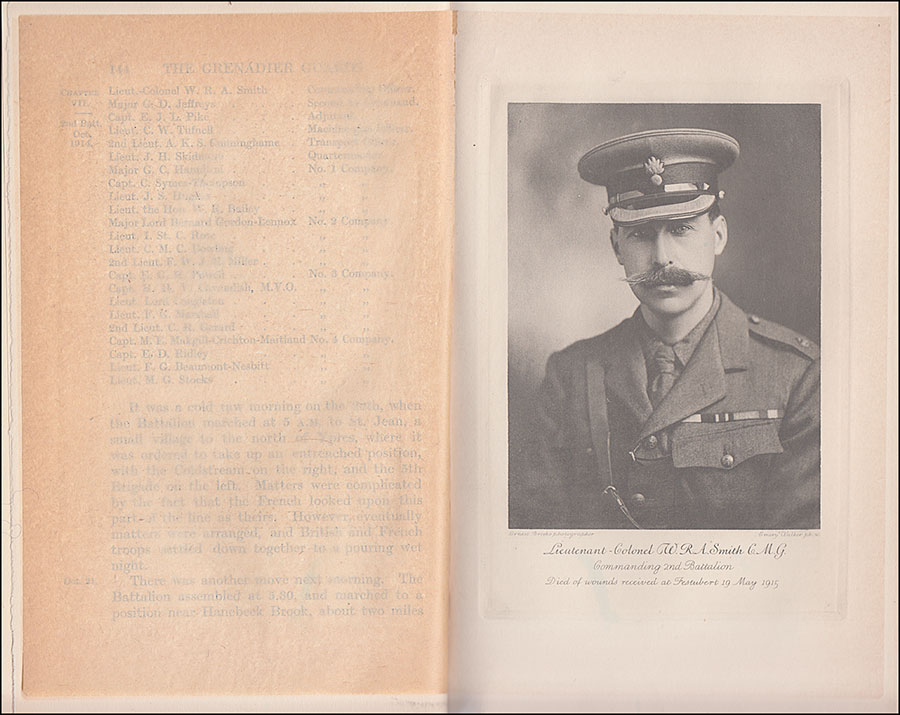
Lieutenant-Colonel W. R. A. Smith, C.M.G., Commanding
2nd Battalion
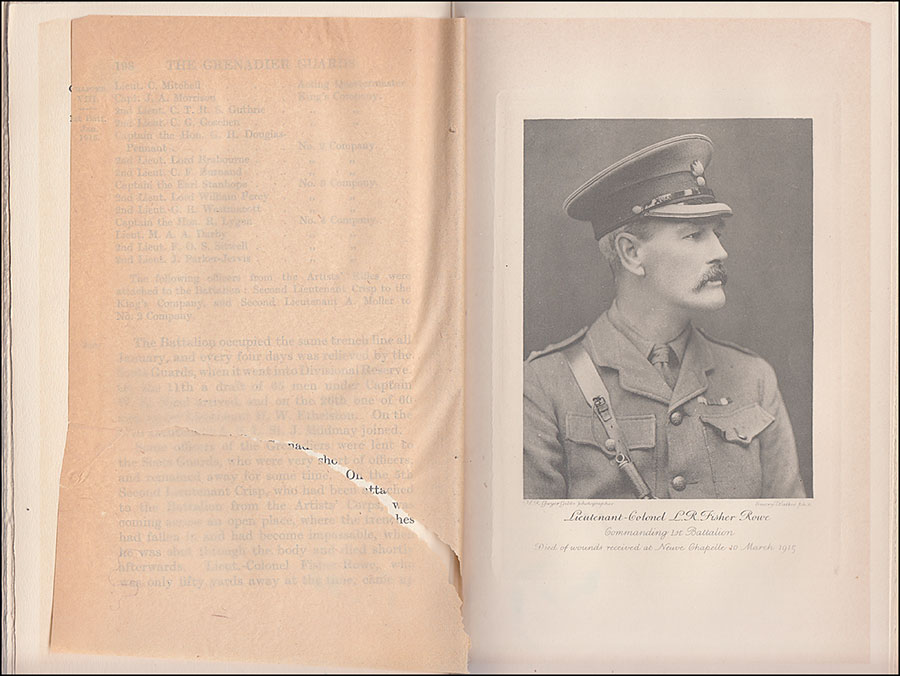
Lieutenant-Colonel L. R. Fisher-Rowe, Commanding 1st
Battalion
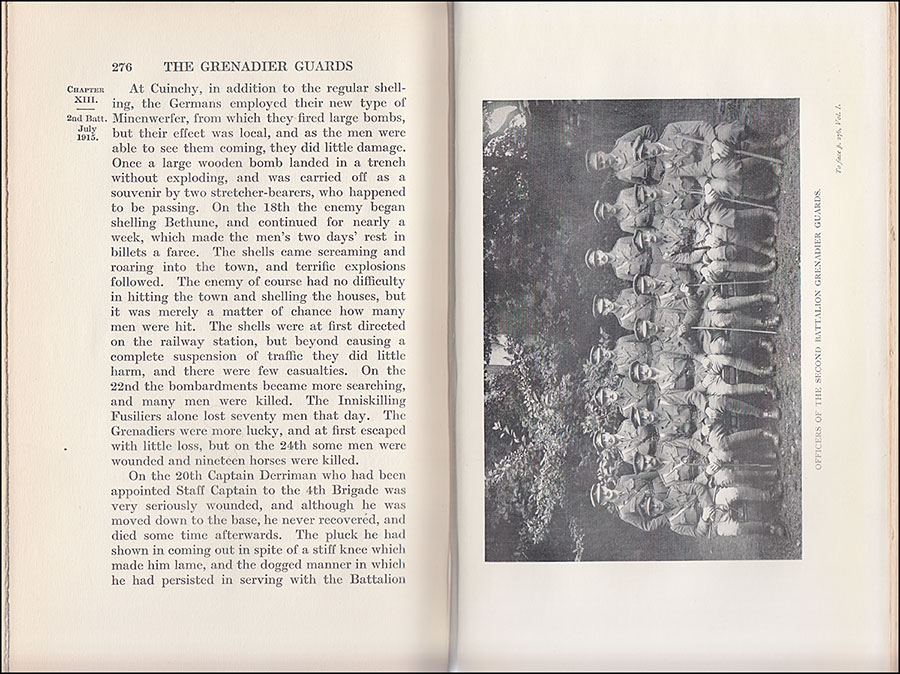
Officers of the Second Battalion Grenadier Guards
Colonel Sir Henry Streatfeild, K.C.V.O., Commanding the
Regiment
Maps
Route of the Second
Battalion, 1914, and the Mons Area, 1914
Route taken by the Second Battalion Grenadier Guards
during the Retreat from Mons, and subsequent advance to
the Marne and the Aisne, 1914
Sketch plan of Landrecies, August 25, 1914
Engagement at Villers-Cotterêts, September 1, 1914
Battle of the Marne—Position of the British Army on
September 8, 1914
The Passage of the Aisne, September 14, 1914
Ypres and the neighbouring country where the First
Battle of Ypres was fought, October and November 1914
Route taken by the First Battalion Grenadier Guards
through Belgium in October 1914
The Grenadier Guards at Ypres
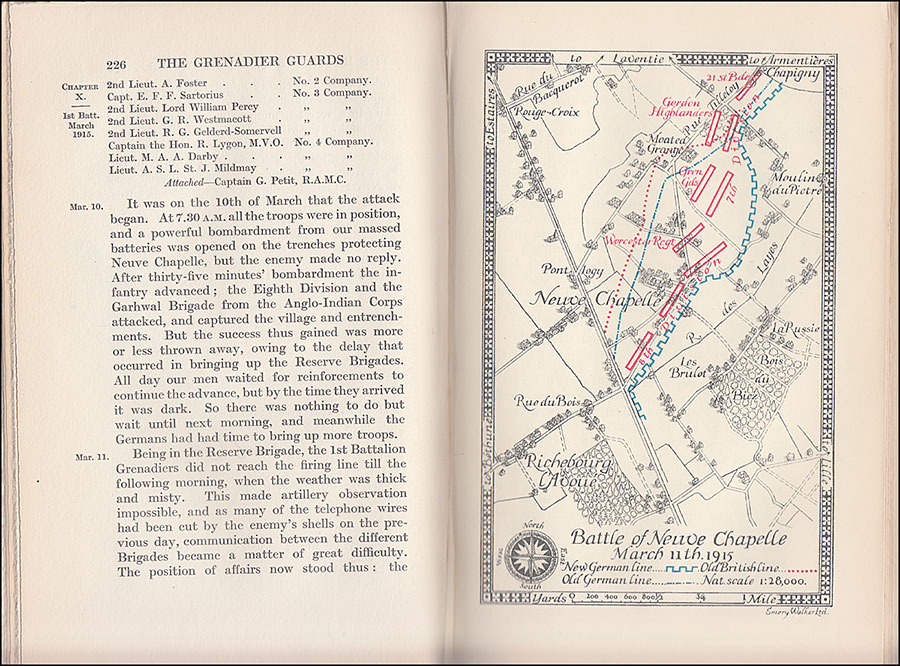
Battle of Neuve Chapelle, March 11, 1915
Neuve Chapelle, March 12, 1915
Neuve Chapelle, March 13, 1915
Festubert—Position on the evening of May 17, 1915
Battle of Loos, September 26, 1915
Volume II
Chapter XVIII
January 1 to September 1, 1916 (3rd and 4th Batts.)
Chapter XIX
The Battle of the Somme (1st, 2nd, 3rd, and 4th Batts.)
Chapter XX
October, November, December 1916 (1st, 2nd, 3rd, and 4th
Battalions)
Chapter XXI
January, February, March 1917 (1st, 2nd, 3rd, and 4th
Battalions)
Chapter XXII
April, May, June, July 1917 (1st, 2nd, 3rd, and 4th
Battalions)
Chapter XXIII
Boesinghe (1st, 2nd, 3rd, and 4th Battalions)
Chapter XXIV
August, September 1917 (1st, 2nd, 3rd, and 4th Batts.)
Chapter XXV
The Crossing of the Broembeek (1st, 2nd, 3rd, and 4th
Battalions)
Chapter XXVI
Cambrai and Gouzeaucourt (1st, 2nd, 3rd, and 4th
Battalions)
Chapter XXVII
January, February, March 1918 (1st, 2nd, 3rd, and 4th
Battalions)
Illustrations
Field-Marshal H.R.H. The Duke of Connaught, K.G., G.C.B.,
etc., Colonel of the Regiment Frontispiece
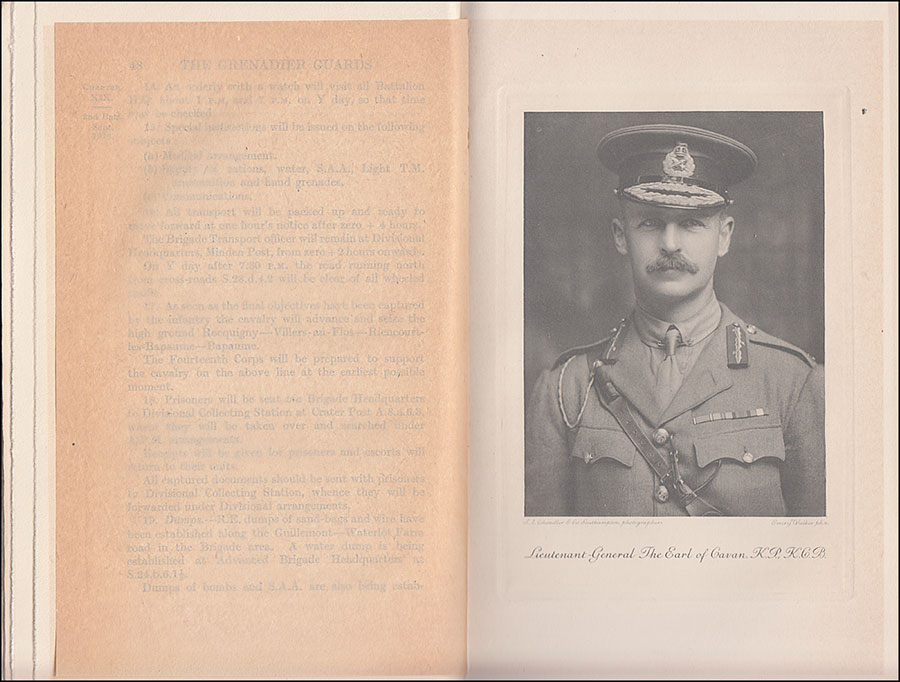
Lieutenant-General The Earl of Cavan, K.P., K.C.B.
Major-General G. D. Jeffreys, C.M.G.
Brigadier-General C. E. Corkran, C.M.G.
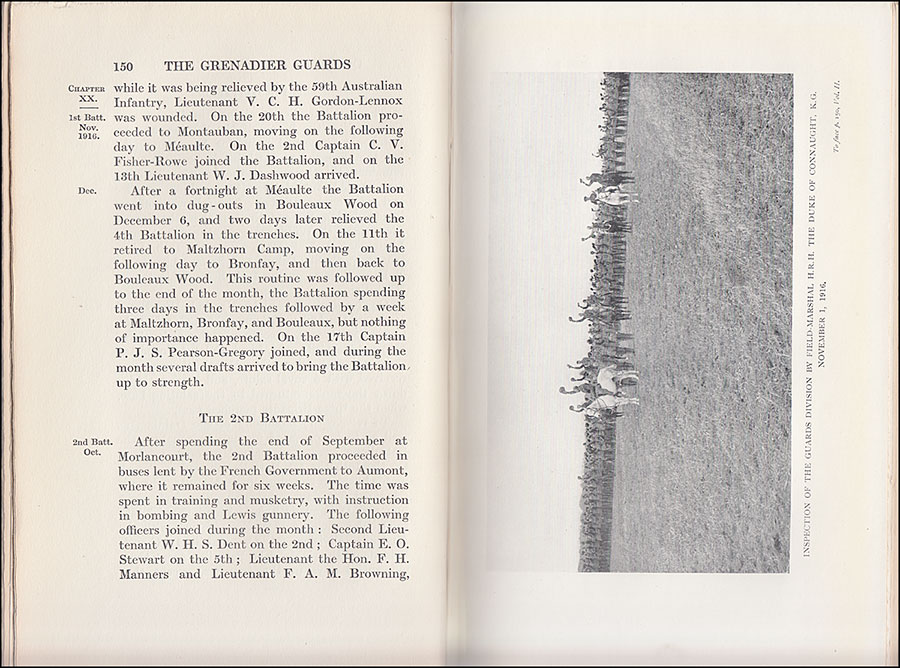
Inspection of the Guards Division by Field-Marshal H.R.H.
the Duke of Connaught, K.G., November 1, 1916
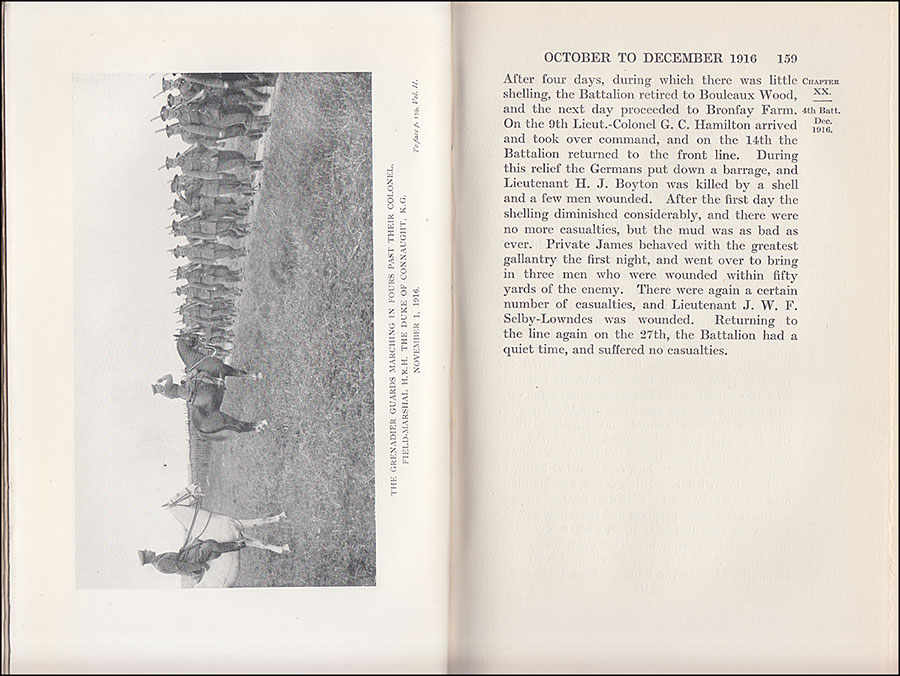
The Grenadier Guards marching in Fours past their
Colonel, Field-Marshal H.R.H. the Duke of Connaught, K.G.,
November 1, 1916
Brigadier-General G. F. Trotter, C.B., C.M.G., D.S.O.
Maps
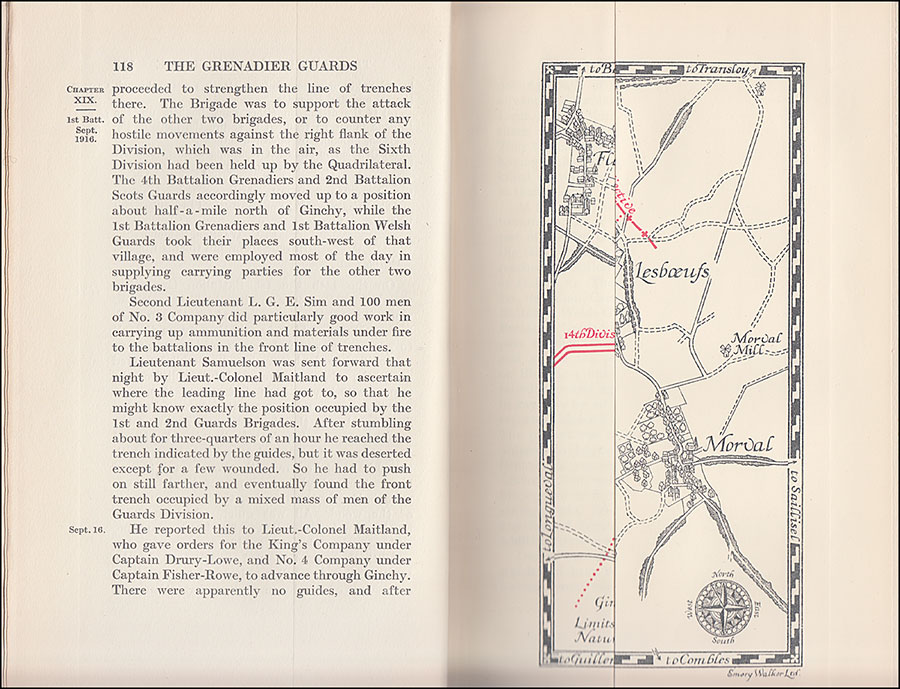
Battle of the Somme, the evening of September 15, 1916
Battle of the Somme, the night of September 25, 1916
Boesinghe, July 31, 1917
Broembeek, October 10, 1917
Attack on Fontaine, November 27, 1917
Attack on Gonnelieu and Gauche Wood, December 1, 1917
Volume III
Chapter XXVIII
February, March 1918 (4th Battalion)
Chapter XXIX
April, May, June 1918 (1st, 2nd, and 3rd Battalions)
Chapter XXX
April 1-14 (4th Battalion)
Chapter XXXI
April 14 to November 11 (4th Battalion)
Chapter XXXII
July and August (1st, 2nd, and 3rd Battalions)
Chapter XXXIII
September (1st, 2nd, and 3rd Battalions)
Chapter XXXIV
October (1st, 2nd, and 3rd) Battalions)
Chapter XXXV
November (1st, 2nd, and 3rd Battalions)
Chapter XXXVI
March into Germany (Guards Division)
Chapter XXXVII
The 7th (Guards) Entrenching Battalion
Chapter XXXVIII
The Reserve Battalion
Chapter XXXIX
The Band
Chapter XL
Regimental Funds and Associations
APPENDICES
I. The Casualties
in the Guards Division II. The Title " Grenadiers "
III. Officers Killed in Action or Died of Wounds
IV. Nominal Roll of W.O.'s, N.C.O.'s, and Men who have
been Killed in Action, or who have Died of Wounds or
Disease in the European War of 1914-1918
V. Officers Wounded
VI. Rewards—Officers
VII. Rewards — Warrant and Non - Commissioned Officers
and Men
VIII. " Mentioned in Despatches "
IX. " Certificates for Gallantry "
X. Promotions to Commissioned Rank
INDEX TO NAMES OF
OFFICERS
Illustrations
Captain H. R. H.
The Prince of Wales, K.G., M.C., etc.
Frontispiece
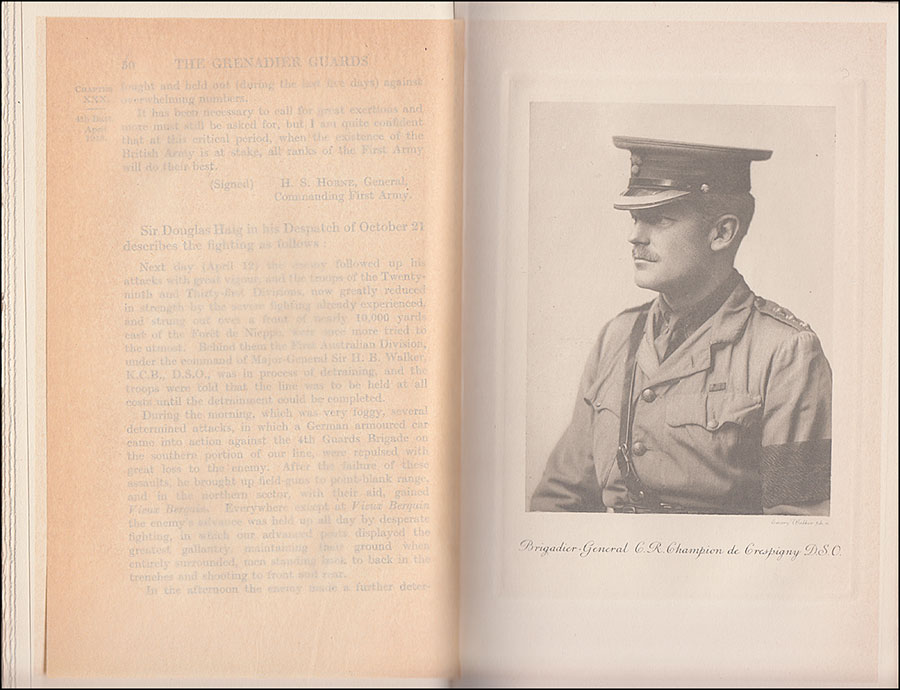
Brigadier-General C. R. Champion de Crespigny, D.S.O.
Brigadier-General B. N. Sergison-Brooke, D.S.O.
Brigadier-General Lord Henry Seymour, D.S.O.
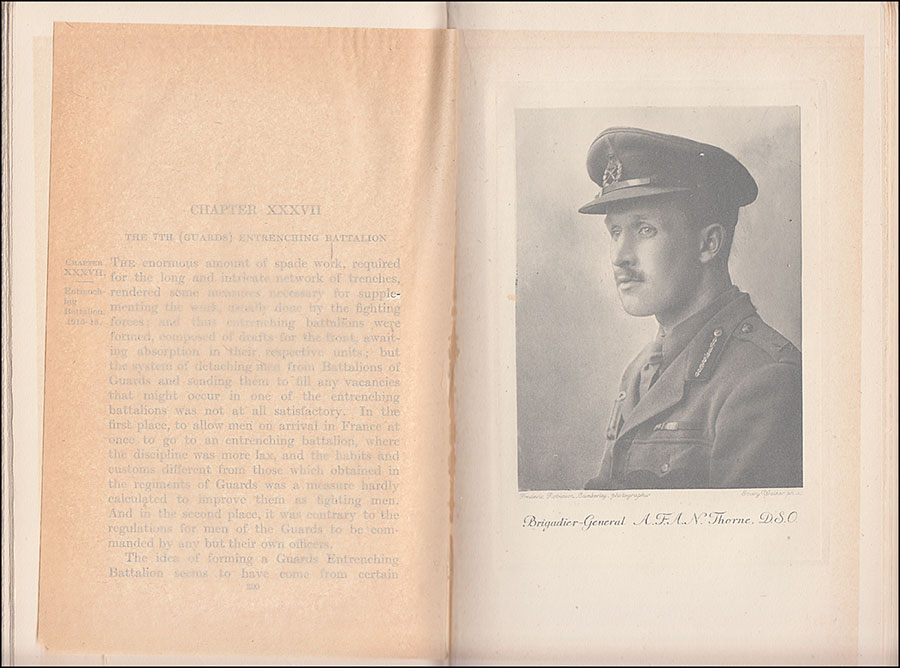
Brigadier-General A. F. A. N. Thorne, D.S.O.
Maps
Fourth Battalion at
La Couronne —Position on April 13, 1918
Attack on Premy Chapel, September 27, 1918
Operations, October 11-14, 1918
Operations, October 20,
1918
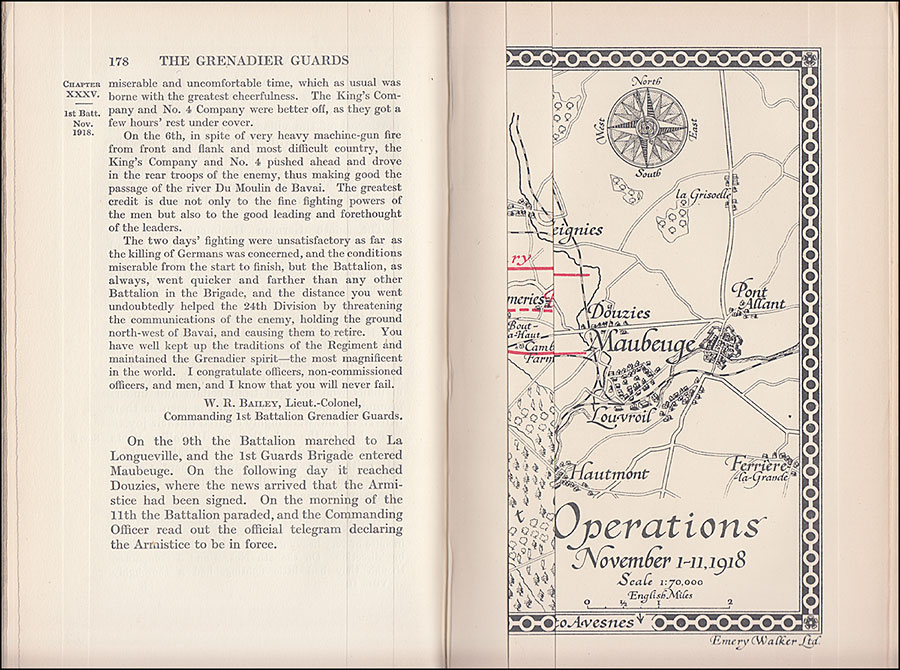
Operations, November
1-11,1918
|
|
|
|
|
|
|
The Grenadier Guards in the
Great War of 1914 - 1918
Preface
This account of the part taken by the
Grenadier Guards in the European War is, substantially, the work of
the officers of the Regiment themselves. Letters and diaries full of
interesting detail have been sent to me, and a vast amount of
information collected by Colonel Sir H. Streatfeild at the
Regimental Orderly Room has been placed at my disposal.
The military historian who writes of past centuries has in some ways
an easier task than one who attempts to put contemporary events into
their historical perspective. In the first place, with every desire
to be accurate, the latter finds that the accounts of eye-witnesses
differ so much that he is forced to form his own conclusions, and to
adopt what, according to his judgment, is the most probable version.
In the second place, after reading a private letter giving a graphic
account of a particular part of a battle, he may easily derive a
totally false impression of the whole. Moreover, he writes in the
constant presence of the criticism of eye-witnesses.
A special difficulty also arises from the unequal quality of the
material placed at his disposal. There is sometimes a wealth of
information on unimportant incidents and no material for the history
of important or dramatic events, in which the principal actors were
almost invariably killed. Even the Battalion diaries, which were
kept with meticulous accuracy during the early days of the war,
contain less and less material as the fighting became more and more
serious.
With a war of such astounding magnitude, when millions of men are
fighting on a front of hundreds of miles, any attempt to give an
intelligible picture of what is going on in a modern battle becomes
practically impossible. Even if such a course were desirable in a
regimental history, the material supplied, which consists for the
most part of letters and diaries of regimental officers, would be
totally inadequate, since regimental officers know little of what is
going on except in their immediate neighbourhood. A tactical study
was out of the question, since a battalion plays such a small part
in modern battles, and to describe the movements of corps and armies
appeared to be beyond the scope of a regimental history.
I therefore decided to depart from tradition, and to write a
narrative giving, as far as I was able, details about companies, and
even platoons. It seemed to me that this was what the officers
themselves would prefer.
The absence of information concerning the German Army necessarily
takes some of the life and colour out of such a record as this. In
all military histories the account of the enemy's movements adds
enormously to the interest of the narrative; but at present, beyond
a few accounts from neutral journalists inspired by the Germans,
there is no authentic information as to the movements of the German
Army, and the motives which actuated the German General Staff can
only be inferred.
Time will of course rectify this, and after the war detailed
accounts of the German Army will be available, though it will
inevitably be some years before anything worth reading about the
enemy can be published. It has therefore been suggested that it
might be best to defer the publication of this history for some
years. But it is doubtful whether with the lapse of time any
valuable additions could be made to a regimental history, though for
a national history some knowledge of the enemy's plans will be
essential.
The long periods of monotonous trench life, in which practically the
same incidents recur daily, have been particularly difficult to deal
with; and, although the greatest care has been taken to chronicle
every event of importance, I am conscious that many acts of bravery
and devotion to duty which have been omitted in the letters and
diaries must go unrecorded.
The terrible list of casualties has made it impossible to do more
than simply record the deaths of the officers of the Regiment who
fell during the war. Had more space been available, fuller accounts
of the circumstances under which they met their deaths and some
personal appreciation of each officer would have been possible, but
in a history which has necessarily to be restricted to three
volumes, all this was out of the question.
The Regiment is indebted to Colonel Sir H. Streatfeild, not only for
the scrupulous care with which he gathered together information from
every possible source, but also for his foresight in realising in
the early stages of the war the importance of all documents
connected with the movements of the different battalions.
The maps are the work of Mr. Emery Walker, who has succeeded in
producing not only artistic pictures in the style that was prevalent
among cartographers of the seventeenth century, but also perfectly
clear and accurate maps. To Sergeant West I am indebted for the
military detail.
To many officers I am indebted for suggestions, especially to
Lieut.-General the Earl of Cavan and Major-General Jeffreys, who
found time, during their few days' leave, to make many interesting
additions to this history; and to Major H. L. Aubrey-Fletcher, whose
knowledge and experience both as a staff and regimental officer have
been invaluable.
In conclusion, I wish to take this opportunity of thanking Captain
G. R. Westmacott, Lieutenant M. H. Macmillan, Lieutenant B.
Samuelson, Lieutenant L. R. Abel-Smith, and Lieutenant A. C. Knollys
for the excellent work they did in preparing accurate diaries for
each battalion, with extracts from the officers' letters. Without
their aid I should never have had the time or the energy to complete
this book.
F. E. G. PONSONBY.
|
|
|
|
|
|
|
The Grenadier Guards in the
Great War of 1914 - 1918
Excerpt:
. . . For an hour a constant
stream of shrapnel and high explosive poured over our trenches.
There was one short lull, when our R.H.A. Battery ran short of
ammunition, and the Germans, thinking they had knocked the battery
out, also ceased fire. On realising their mistake, 109they began
again with renewed energy. High-explosive shells were bursting all
down the trenches, back and front, but luckily none landed actually
in them; and though a cottage by the side of the road caught fire,
the removal of the wood and straw lying near the trench averted all
danger. Very grateful the Grenadiers were for the close touch which
F Battery under Major Head managed to keep with them during these
anxious days' fighting. It was a perfect example of how artillery
and infantry should co-operate.
In the afternoon the enemy launched his infantry attack, preceded by
scouts and snipers, and covered by artillery and machine-gun fire.
Almost for the first time the Germans were now distinctly seen, and
there was something almost reassuring in the fact that they looked
like ordinary beings. Hitherto they had seemed a sort of mysterious
bogey, something far away on the black horizon, an evil force
associated with burning houses and fleeing inhabitants. Though their
attack was all according to the book, they never succeeded in
reaching our trenches. In many places they managed to advance under
cover to within 200 yards of our position, but the attack was
half-hearted and therefore failed.
The machine-guns under Lord Claud Hamilton were posted on the right
of the Battalion, and remained there for seven days, day and night,
without relief, under continual fire from the enemy's artillery and
machine-guns. During this strenuous time they fired 56,000 rounds,
and inflicted considerable loss on the enemy.
By dusk the Germans had established a considerable force within
striking distance, and the whole British line stood to arms till
about 9 P.M., expecting an assault any moment. Why with such
enormous advantages the enemy did not make a more determined attack
it is difficult to understand. They outnumbered our troops by four
to one, and had an overwhelming superiority in artillery. But while
the Seventh Division were all seasoned professional soldiers, the
German Corps consisted mostly of Landwehr, that is, second-line
troops or men retired from the active army.
Nothing happened till midnight, when the enemy suddenly opened a
heavy fire, and in places began half-hearted assaults, which were
easily repulsed. He kept up a continuous and comparatively useless
fire for an hour, but with our men the control of fire was
excellent. During these spasmodic attacks the R.H.A. Battery, which
was just behind the village of Kruiseik, did most effective work,
bursting groups of shrapnel with great accuracy and rapidity over
the German lines, at a range of only eight hundred yards. The
Seventh Division was occupying more ground than it could properly
hold, but with so few troops General Capper had no alternative. Two
platoons of No. 2 Company were furnished during the night to support
the King's Company in the fire trenches, but even with their help it
found the greatest difficulty in filling its part of the line.
Oct. 21.
There was some shelling in the early morning of the 21st, but
nothing serious happened till the afternoon, when the enemy at last
attacked, apparently, all along the line. So long was the line
General Capper was now holding that he found it impossible to keep
any reserves. At first the 2nd Battalion Scots Guards was in
Divisional Reserve, but it was soon wanted, and was sent up into the
firing line in the morning. When appeals for help came afterwards
from various quarters, General Capper had only the cavalry to send.
The Northumberland Hussars were despatched to fill the gap between
the 20th Brigade and the Third Cavalry Division, and when the right
flank of the Division needed strengthening the Divisional Cyclist
Company was sent thither.
By this time the First Corps had arrived, and had been sent up to
the north of Ypres. As it turned out, that spirit of dash which won
Sir John French his reputation in South Africa proved the saving of
the situation. Had he been of a more cautious disposition, he would
undoubtedly have sent the First Corps to reinforce General Smith-Dorrien,
who was in great difficulties farther south. Its despatch north of
Ypres, originally with the idea of a general advance, saved the
Seventh Division from utter destruction.
The position of the line was now as follows: the First Corps from
Bixschoote to Zonnebeke; the Seventh Division from Zonnebeke to
Zandvoorde; then Byng's Cavalry and Allenby's Cavalry up to the left
of the Third Corps.
About mid-day the 21st Brigade was heavily attacked, and
Brigadier-General Watts sent back for reinforcements. There were
none. Some companies had to be sent in support, and General
Ruggles-Brise ordered No. 2 and No. 3 Companies of the Grenadiers to
go to its help. Two companies of Scots Guards had already been sent
to Zandvoorde to fill up a gap on the right, occasioned by the
withdrawal of the 5th Cavalry Brigade, while the remaining two
companies were with the Divisional Reserve at Gheluvelt. These
continual demands for reinforcements naturally weakened the 20th
Brigade considerably. Under heavy shell-fire the Scots Guards
started off, but the attack on the 21st Brigade died away, and after
they had gone about a mile they were ordered to return, as they
might be wanted any moment to support their own Brigade.
Meanwhile the line held by the Grenadiers was heavily shelled, not
only by the Germans but by our own guns, which were firing short.
The men naturally were infuriated by this, but fortunately the
mistake did not last long, as the artillery was soon able to correct
its own distance. During the night the German machine-guns had been
brought up close, one at least being placed in a house 150 yards
from our trenches, and the covering fire from these was most
disconcerting. It was generally oblique, and enabled the German
infantry to approach with far fewer losses than on the previous day.
An infantry attack was made, but was not pressed home, and except
for spasmodic bursts of rifle-fire the night was again fairly quiet.
Oct. 22.
Having been in the trenches for four days and nights, the King's and
No. 4 Companies were relieved by No. 2 and No. 3 Companies. Aircraft
reports that the enemy was massing troops near America seemed to
presage an attack, but except for the inevitable sniping nothing
happened in that part of the line, the attack that day being
directed against the 22nd Brigade and also against the First and
Second Divisions farther north. The relieved companies had not been
long in their dug-outs, however, before two platoons of No. 4
Company under 2nd Lieutenant Walter and 2nd Lieutenant Somerset were
ordered to occupy some trenches vacated by the 21st Brigade on the
left, while the King's Company was sent up to Kruiseik to reinforce
No. 2 Company.
Oct. 23.
The position of the Seventh Division was now becoming most
precarious, holding doggedly on as it was to a line seven miles
long, with every man in the trenches. General Lawford's 22nd Brigade
had been attacked by a large force and obliged to give ground; this
made an ugly dent in the line, and placed the 21st Brigade in an
acute and perilous salient. To help the hard-pressed Seventh
Division Sir Douglas Haig now sent along the Second Division, which
had been relieved by the French Ninth Corps.
Owing to the heavy mist on the 23rd neither side could use artillery
till 9 A.M., when the enemy began to bombard the Kruiseik salient.
The day's attack was directed against the 21st Brigade, and the
Wiltshire Regiment had some desperate fighting. The two platoons of
the Grenadiers which had been sent up the night before were attacked
by two battalions of Germans, but they held their ground and never
gave an inch. They suffered severely, however, and 2nd Lieutenant
Walter and 2nd Lieutenant Somerset were both killed before these
platoons were withdrawn. The whole line of trenches was bombarded
incessantly, and all day the German guns swept the rear of the line
so as to catch the supports as they came up.
A message was sent to the Grenadiers about 2.30 from the Border
Regiment on the right to say that their trenches had been blown in,
and they might want help. Accordingly the King's and No. 4 Companies
were ordered to move across to a position in rear of the Border
Regiment, so as to support them if necessary. No sooner had they
left their dug-outs and fallen in than they were heavily shelled,
though they were well out of sight of the German gunners.
Incidents like this gave rise to stories of spies behind the British
lines, who could telephone to the enemy's gunners the exact position
of bodies of our troops. But had the Germans had any means whatever
of obtaining information they could hardly have failed to know that,
instead of the large forces they imagined to be opposed to them,
there was nothing to bar their way to Calais but a single
unsupported British Division.
When the leading platoons of the two companies of the Grenadiers
reached the position indicated, which was the ridge in rear of the
Borderers' trenches, they came under the concentrated fire of
batteries from three different directions, and suffered some loss.
So heavy was the fire that they found it impossible to remain on the
ridge, and as the Border Regiment had not definitely asked for
support the King's Company was ordered to retire. It retired in good
order and in slow time, though under heavy fire all the way.
Lieutenant H. L. Aubrey Fletcher and several men were wounded, but
the casualties were not so heavy as might have been expected.
Fortunately the enemy burst their shrapnel too high, and the ground
was so soft that the high-explosive shells did little damage except
when they got a direct hit.
Oct. 24.
A violent attack was made next day on the salient formed by the
British line, which at last began to show signs of giving way. After
some desperate fighting the Wiltshire Regiment was driven in, and
the Germans got possession of Polygon Wood. Ruggles-Brise's Brigade
was heavily engaged, as the enemy's attack was being pressed home
with great vigour, especially on the left of the Battalion, where
the Germans were trying to break through between the Grenadiers and
the Yorkshire Regiment. No. 4 Company, under Major Colby, was
therefore ordered to counter-attack. Great difficulties were added
to its task by the tobacco-drying grounds—ready-made wire
entanglements on which the men's packs and accoutrements caught
while the German machine-guns were practically enfilading them. But,
in spite of everything, Major Colby succeeded in driving back a much
larger body of the enemy, and thus making that part of the line
secure.
It was a brilliant bit of work, and was specially mentioned by
General Capper in his report. But it was very costly: Major Colby,
Lieutenant Antrobus, and a hundred men were killed, and Captain
Leatham was wounded. The only officer of this company who escaped
unhurt was Lieutenant Sir G. Duckworth-King.
In the evening news arrived that the First Corps was attacking the
enemy on the left, and this somewhat relieved the situation. The
reserve trenches came in for severe shelling during the night, but,
as it happened, there was only a platoon of No. 2 in reserve at the
time. It had a curious experience, which might have had serious
results. Two companies of the Queen's had been sent up to the
reserve dug-outs. Somehow the report was spread that the Germans had
got into Kruiseik, and an alarm was raised. The platoon from the
Grenadiers stood to arms, and as it waited saw in the moonlight a
line of men with fixed bayonets advancing on their flank. They were
preparing to meet them with the bayonet when they suddenly realised
that they were friends. Major Stucley leaped from the trench, and
went himself to explain matters to the two companies, which returned
to their original position.
Oct. 25.
The Germans were reported next day to be entrenching all along our
southern front and opposite Zandvoorde. About sunset the Grenadiers
were attacked, and one platoon from No. 2 Company under Lieutenant
Lambert became isolated, the enemy having taken the trench on its
right and also the houses behind it. Three messengers were sent back
to Battalion Headquarters for help, but only one got through, and he
was wounded. Lieut.-Colonel Earle sent up a platoon of No. 3, and
the houses in the rear of the line were partially cleared.
A determined attack developed later that night, and a mass of men
was seen advancing on the left. A voice called out, "Don't shoot! We
are the South Staffords." But the German helmets could be distinctly
seen against the glow from a burning farm; a heavy fire was opened
on them, and slowly they disappeared. As a matter of fact two
companies of the South Staffords had come up to the Battalion as a
reserve that night, and the Germans must have known it. In the
morning forty or fifty dead Germans were counted in front of the
platoon under Lieutenant Lambert, and 200 prisoners were captured by
the Scots Guards in a house in rear of the line. Viscount Dalrymple
and Captain Fox, with two companies of the Scots Guards, cleared all
the Germans out of the village, and restored the line.
During the night Lord Claud Hamilton, whose guns were in action all
night, saw a body of men moving in fours down the road behind him,
and naturally thought they were men of the Brigade. But as they
passed a burning house he saw the German helmets, and turned one of
his guns on them, while the other gun continued to engage the enemy
in front. He was relieved before dawn by Lieutenant Gladwin of the
Scots Guards with a fresh team of men, who took over the Grenadier
machine-guns. Soon after he took charge Lieutenant Gladwin was
killed.
Oct. 26.
The First Division had now taken over the line from Reutel to the
Menin road, so that the Seventh Division held only the section from
the Menin road through Kruiseik to Zandvoorde. But this salient had
become more and more acute and dangerous, and General Capper decided
to readjust the line and reduce the salient as far as he could. To
withdraw from a position when at close grips with the enemy was a
task requiring careful staff work, but it was successfully carried
out that night.
Before dawn the King's Company took over the fire trenches with a
platoon of No. 3 under Lieutenant Van Neck, while a platoon from No.
2 under Sergeant Boyles occupied a trench about 200 yards to the
left. One platoon of the King's Company was 300 yards to the right
of the rest of the company, and another 300 yards farther to the
right were the Scots Guards.
A terrific shelling of our trenches began early in the morning, and
reached such a pitch that the men counted as many as sixty shells a
minute on each small trench. The whole of the enemy's artillery fire
was concentrated on Kruiseik. Gallantly our men held on, in spite of
the fact that again and again the shells blew in the trenches and
buried half-a-dozen men at a time, all of whom had to be dug out
with shovels. Some of them had as much as three feet of earth on top
of them, and many were suffocated before they could be rescued.
So violent were these attacks that by mid-day the Germans had broken
through the line held by two companies of the South Staffords, which
had been sent to relieve the Border Regiment. By 2.30 P.M. the enemy
had gone through the gap, and had managed to get in rear of two
companies of the Scots Guards, which suddenly found themselves
surrounded and fired at from all directions. Although the Scots
Guards still fought on, they were captured by degrees in small
parties, and the survivors were finally made prisoners, including
Lieut.-Colonel Bolton, Major Viscount Dalrymple, and Captain Fox.
Finding his flank exposed, Lieut.-Colonel Earle at once gave orders
to the Grenadiers to retire, but this order did not reach the fire
trenches for a long time, and was never received by the King's
Company at all. Meanwhile, General Ruggles-Brise ordered the guns
back to their old position on the Zandvoorde Ridge, and having
collected the remainder of the Scots Guards, the Gordons, and the
Borderers, he returned to the hollow west of Zandvoorde.
|
|
|
|
|
|
|
|
|

Please note: to avoid opening the book out, with the
risk of damaging the spine, some of the pages were slightly raised on the
inner edge when being scanned, which has resulted in some blurring to the
text and a
shadow on the inside edge of the final images. Colour reproduction is shown
as accurately as possible but please be aware that some colours
are difficult to scan and may result in a slight variation from
the colour shown below to the actual colour.
In line with eBay guidelines on picture sizes, some of the illustrations may
be shown enlarged for greater detail and clarity.
Volume I



Volume II

Volume III

|
|
|
|
|

|
|
|
|
U.K. buyers:
|
To estimate the
“packed
weight” each book is first weighed and then
an additional amount of 150 grams is added to allow for the packaging
material (all
books are securely wrapped and posted in a cardboard book-mailer).
The weight of the book and packaging is then rounded up to the
nearest hundred grams to arrive at the postage figure. I make no charge for packaging materials and
do not seek to profit
from postage and packaging. Postage can be combined for multiple purchases. |
Packed weight of this item : approximately 3,000 grams
|
Postage and payment options to U.K. addresses: |
-
Details of the various postage options can be obtained by selecting
the “Postage and payments” option at the head of this
listing (above).
-
Payment can be made by: debit card, credit
card (Visa or MasterCard, but not Amex), cheque (payable to
"G Miller", please), or PayPal.
-
Please contact me with name,
address and payment details within seven days of the end of the
listing;
otherwise I reserve the right to cancel the sale and re-list the item.
-
Finally, this should be an
enjoyable experience for both the buyer and seller and I hope
you will find me very easy to deal with. If you have a question
or query about any aspect (postage, payment, delivery options
and so on), please do not hesitate to contact me.
|
|
|
|
|
|
|
International
buyers:
|
Unfortunately this is a large and particularly heavy set, ruling out international postage |
|
|
|
|
|
|
|

(please note that the
book shown is for illustrative purposes only and forms no part of this
listing)
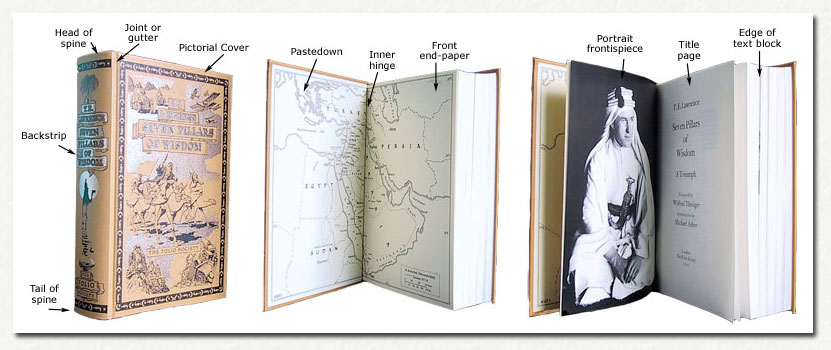
Book dimensions are given in
inches, to the nearest quarter-inch, in the format width x height.
Please
note that, to differentiate them from soft-covers and paperbacks, modern
hardbacks are still invariably described as being ‘cloth’ when they are, in
fact, predominantly bound in paper-covered boards pressed to resemble cloth. |
|
|
|
|
|
|

Fine Books for Fine Minds |
I value your custom (and my
feedback rating) but I am also a bibliophile : I want books to arrive in the
same condition in which they were dispatched. For this reason, all books are
securely wrapped in tissue and a protective covering and are
then posted in a cardboard container. If any book is
significantly not as
described, I will offer a full refund. Unless the
size of the book precludes this, hardback books with a dust-jacket are
usually provided with a clear film protective cover, while
hardback books without a dust-jacket are usually provided with a rigid clear cover.
The Royal Mail, in my experience, offers an excellent service, but things
can occasionally go wrong.
However, I believe it is my responsibility to guarantee delivery.
If any book is lost or damaged in transit, I will offer a full refund.
Thank you for looking.
|
|
|
|
|
|
|
Please also
view my other listings for
a range of interesting books
and feel free to contact me if you require any additional information


Design and content © Geoffrey Miller |
|
|
|
|
|
|