













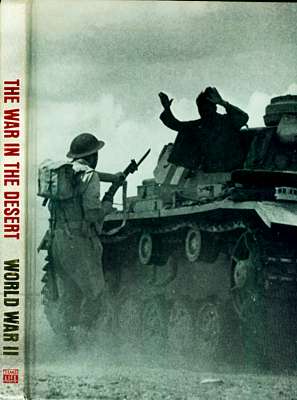
Time Life Books World War II “The War in the Desert”.
NOTE: We have 100,000 books in our library, over 10,800 different titles. Odds are we have other copies of this same title in varying conditions, some less expensive, some better condition. We might also have different editions as well (some paperback, some hardcover, oftentimes international editions). If you don’t see what you want, please contact us and ask. We’re happy to send you a summary of the differing conditions and prices we may have for the same title.
DESCRIPTION: Oversized pictorial hardcover w/printed laminate covers (208 pages). Publisher: Time-Life Books Inc. (1979). Size: 11¼ x 9¼ inches; 2¼ pounds.
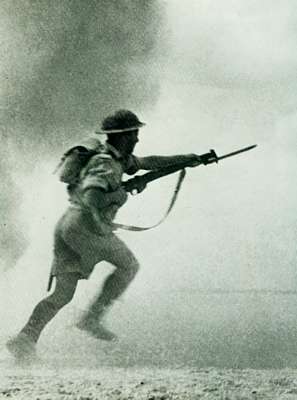
SUMMARY: The World War II series was produced in the period of the mid 1970’s through the early 1980’s, and is widely considered to be one of the best photo-documentary/histories of World War II. Each volume undertakes to describe the major events that happened in one specific time period and/or in relation to one specific theme in the history of the world’s greatest armed conflict. The volumes are richly illustrated and the photos are simply stunning – a collection of the greatest photos taken during this conflict. This is as close as you can be to actually having been there.
If you could have just one book (or series of books) to introduce the history of World War II, this would have to be it. The overviews are concise and well-written. Together with the illustration and pictures they impart a thorough and concise history of the particular thematic subject matter. Done in a style so wonderfully characteristic of Time-Life’s publications, these are over-sized “coffee table” type books full of impressive imagery. But don’t get the impression that these volumes are “fluff”. While a particular volume might not quite take the place as a university degree, the material is well-written, informative, and immensely intellectually gratifying, overview though it might be.
CONDITION: LIKE NEW to VERY GOOD. Light shelf wear, otherwise in Very Good to Like New condition. Seemingly unread, merely flipped through a few times, at worst perhaps read once. Inside the pages are pristine; clean, unmarked, unmutilated, tightly bound. I would only note that Time-Life books of the era will sometimes evidence mild “shelf sag”, i.e., the binding/pages slide down (perhaps 1/8 inch – 3mm) within the covers over the years so they end up resting on the shelf. Also, the top surface of the closed page edges (sometimes referred to as the “page block”) will evidence faint tan-colored age spotting – not to the individual opened pages, just to the top surface of the massed closed page edges. If either is pronounced, we do not offer the book – so we’re describing at worst a very mildly age-blemished state. Illustrated covers evidence only very mild edge and corner shelfwear. There are no significant blemishes to the book, inside or out. Satisfaction unconditionally guaranteed. In stock, ready to ship. No disappointments, no excuses. PROMPT SHIPPING! HEAVILY PADDED, DAMAGE-FREE PACKAGING! Meticulous and accurate descriptions! Selling rare and out-of-print ancient history books on-line since 1997. We accept returns for any reason within 30 days!
PLEASE SEE IMAGES BELOW FOR JACKET DESCRIPTION(S) AND FOR PAGES OF PICTURES FROM INSIDE OF BOOK.
 This particular volume is entitled, “The War in the Desert”. The topics covered include:
CHAPTER ONE: “A Gamble for High Stakes“. (Mussolini gambles on a grand scale. A reluctant warrior’s stalling tactics. The deceptive lull at Sidi Braani. Perils of a parched terrain. A sideswipe at Italy’s Naval battle fleet. Portents of trouble from Greece. Churchill versus his own general. A sudden British drive to victory. Hitler decides to intervene. The Duke of Aosta, Cousin of King Emmanuel III: The Royal Duke’s East African Debacle. Map of the North African Theater: 2,000 miles from El Alamein to Casablanca in Morocco (Algeria, Tunisia, Safi, Rabat, Atlas Mountains, Oran, Tangier, Gibraltar, Philippeville, Constantine, Bone, Tebessa, Tunis, Bizerte, Kasserine, Mareth, Tripoli, Sirte, Tripolitania, El Agheila, Soluch, Benghazi, Derna, Cyrenaica, Tobruk, Bardia, Bir Hachiueim, Sollum, Sidi Barrani, Mersa Matruh, Qattara Depression, Alexandria, Cairo, Port Said, Suez Canal). Italo Balbo receiving his military pilot’s wings from Il Duce in 1927. A Savio-Marchett Seaplane: a 43-Day Round Trip Air Journey to Chicago. Balbo and King Victor Emmanuel III reviewing troops in Libya in 1938. A Magnificent Flier’s Fall from Grace: Wreckage of the Flier’s Plane Mysteriously Downed by Italian Antiaircraft Fire. Fort Capuzzo to Sidi Barrani: The Italians Advance, Retreat, and the Nibeiwa-Rabia Gap (a map; Gulf of Sidra, El Agheila, Beda Fomm, Benghazi, Cyrene, Derna, Mechili, Tobruk, Cyrenaica, Halfaya Pass, Bardia, Sollum, Buq Buq, Sofafi, Rabia, Maktila, Tummar East, Tummar West, Nibeiwa, Mersa Matruh). Tonruk falls to Australian Forces using captured Italian tanks on January 22, 1941. Lieutenant General Richard O’Conner and General Sir Archibald Wavell engineer the fall of the Italian stronghold of Bardia.)
 CHAPTER TWO: “Rommel’s Stunning Blow”. (A German master of audacity and deception. British defenses stripped to the bone. An attack by a cardboard division. A German bid for all Cyrenaica. An ignominious British retreat. The Axis bags a treasure in British brass. The Desert Fox: a legend in the making. Embattled and battered Tobruk. Britain’s dull-bladed “battleaxe”. A form Axis stand at a critical pass. Churchill summons a new commander. The Desert Fox as a Camera Buff: Snapping a camouflaged 150mm gun alongside his Leica; on his first reconnaissance flight over the Libyan Desert observing an Italian anti-tank ditch; the escarpment separating Tripoli’s coastal plain from the Libyan Plateau. German dummy tanks built of wood and canvas. Driving the British out of Libya: Rommel’s first offensive from Mersa Brega; a map; Zuetina, Agedabia, Maaten el Grara, Ben Gania, Antelat, Msus, Beda Fomm, Benghazi, Barce. Derna, Charruba, Tmimi, Mechili, Tengender, Ben Gania, Tobruk, Fort Capuzzo, Sidi Azeiz, Bardia, Sollum, Sidi Omar, Sidi Suleiman, Hafid Range, Halfaya Pass. The British “Rats of Tobruk”: a kitchen in a cave (protection from diving Stuka bombers); bathing in an abandoned bath tub.)
CHAPTER THREE: “Triumph Eludes the British.” (A crusade to trap a fox. Grim encounter on the Sunday of the dead. Rommel retraces his Cyrenaican footsteps. Battle for the British boxes. A gallant stand by the Free French. The Eighth Army’s flight into Egypt. Time runs out on the Rats of Tobruk. Cairo under the German threat. Auchlinleck draws the line at El Alamein. Churchill pins his hopes on two new leaders. Britain’s Crusader Offensive of November 1941 (a map: El Agheila, Agedabia, Beda Fomm, Benghazi, Gazala, Bir Hacheim, Tobruk, Sidi Rezegh, Bir el Gubi, Gabr Saleh, Fort Maddalena, Sidi Omar, Halfaya Pass, Bardia, Sollum, Mersa Matruh. General Sir Clauda Auchinleck, the Crusader Offensive and Indian Mechanized troops. Italian Underwater Raiders and midget sub frogmen. French infantrymen near Bir Hacheim in June, 1942, in the defense of Tobruk. German gunners position 88mm artillery during the siege of Tobruk.)
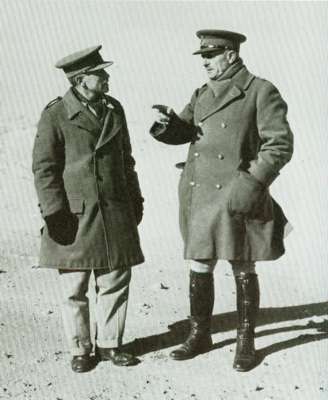
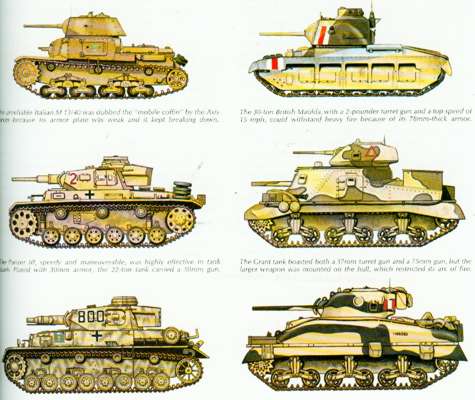
 CHAPTER FOUR: “The Crucible of Victory.” (Montgomery to the rescue. Lessons in fighting for a battle-tested army. An elaborate hoax to mislead the Axis. A murderous British barrage. A pathway through half a million Axis mines. Monty’s “Supercharge” breaks a bloody stalemate. An impossible order from the Fuhrer. Retreat to the west for the Axis. British Prime Minister touring the Egyptian desert near El Alamein in August 1942. The British Eighth Army’s Intrepid Desert Commandos: The “Long Range Desert Group” and the “Special Air Service”. The Battle of El Alamein, October 23, 1942 (a map): Sidi Abd Rahman, Rahman Track, Miteirya Ridge, Alam el Halfa Ridge. Survival of the Fittest in Armored Warfare: The unreliable Italian M13/40, the “mobile coffin”; The 30-ton British Matilda; the Grant Tank; The Panzer III; the 25 ton Panzer IV; the 36-ton M4 Sherman Tank.)
CHAPTER FIVE: “An Ally Joins the War“. (Testing-time for a mighty armada. Hitler makes a wrong guess. A blistering response from the French. Roosevelt’s secret messenger. A French admiral hedges his bets. Americans join the North African war. An unfinished battleship in a dockside duel. General Patton’s toast to a free France. Allies and Axis race for Tunisia. Gunners aboard the U.S.S. Augusta duels with the French Battleship Jean Bart in Casablanca during “Operation Torch”. Casablanca’s Hotel Miramar (Patton’s Headquarters): GI’s in combat fatigues mingle with Moroccans dressed in djellabahs. Paying the price for cooperation with the Allies: the murder and funeral of French Admiral Jean Francois Darlan. High-Level Matchmaking at Casablanca: Roosevelt, Churchill, General Henri Giraud (High Commissioner of French North Africa) and leader of the Free French, General Charles de Gaulle.)
 CHAPTER SIX: “Americans Taste the Fire“. (Eisenhower worries about green American troops. A sudden Axis lunge to the west. GI castaways on islands of resistance. The Allies’ desperate defense of Kasserine Pass. The Desert Fox hesitates, then withdraws, A new flamboyant commander for American troops. U.S. Rangers on a daring raid. Montgomery scores with his strong “left hook”. A symbolic meeting of two Allied armies. Bagpipers herald the crossing of the Libyan border into Tunisia leading the Eighth Army’s (Gordon) Highland Division across the desert sand. General Sir Harold Alexander, Commander Allied Ground Forces in North Africa in a final offensive against Rommel’s forces. Mountainous Tunisia: The last North African stronghold of the Axis (map): Tabarka, Bizerte, Mateur, Tunis, Hamman Lif, Cape Bon, Hammamet, Enfidavit, Pont du Fahs, Medjez al Bab, Hill 609, Longstop Hill, Tine River, Thala, Tebessa, Feriana, Kasserine, Sbeitla, Sidi Bou Zid, Faid Pass, Maknassy, El Guettar, Gafsa, Sfax, Medenine, Mareth Line, Tebaga Gap, El Hamma, Gabes, Wadi Akarit, Disarming the Deadly Mementos of a Retreating Army. A turbaned Sikh gingerly defusing a mine. Sappers scanning a minefield with metal detectors. Sappers of the 4th Indian Division of the Eighth Army probing with bayonets for wooden or plastic mines.)
CHAPTER SEVEN: “The Knockout Punch“. (A gloomy assessment of Axis chances. Preparing for a last-ditch stand. Jostling for position among the Allies. The high cost of taking the high ground. An American division regains its honor. “Strike”: a plan for the last big push. A torrential rain of Allied bombs. Dashing for Tunis and Bizerte. Germans caught with their faces lathered. Dignified surrender of a proud army. Hill 609, an Axis stronghold: British Lieutenant General Kenneth Anderson and U.S. Major General Omar Bradley. An 80 mile procession of surrendering Axis troops: a victorious Montgomery consulting with captured Italian Marshal Giovanni Messe and German Major General Frecken regarding assembly points for thousands of Axis prisoners.)
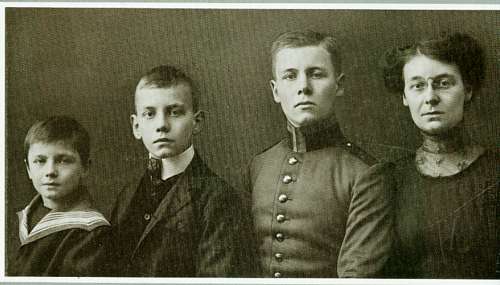
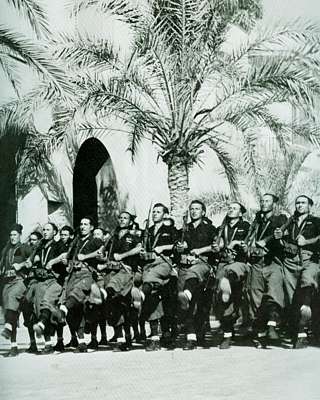
PICTURE ESSAY ONE: “Italy’s Reach for Glory“. (A smartly uniformed Italian antiaircraft crew in Libya, September 1940. The Duce’s Plan for a Roman Empire. Mussolini’s Office in Rome’s Palazzo Venezia. A billboard map illustrating Italy’s successes in North Africa. Italian Blackshirts in Benghazi, Libya on August 14, 1940, reviewed by Marshal Rodolio Graziani. Setting forth on the road to disaster: sun-helmeted Italian foot soldiers trudging across the desert; a phalanx of Lancia trucks with Italian artillerymen, lead by an officer in a Fiat convertible. Sidi Barrani and Bardia, Italian Infantrymen charging British positions, December, 1940. The Fall of Bardia and 80,000 Italian prisoners-of-war.) PICTURE ESSAY TWO: “The Desert Fox“. (Lieutenant General Erwin Rommel leading panzer troops through the North African desert. A legendary soldier with a sixth sense. Rommel’s official portrait by Hitler’s chief photographer Heinrich Hoffmann: Rommel holding the Field Marshal’s Baton awarded by Hitler in September, 1942. A portrait of Lieutenant Rommel, circa 1912, instructor of Army recruits. A portrait of Rommel and his siblings, circa 1910. Quiet Moments on the Rise to Fame: Rommel’s book on infantry tactics. A portrait of newly decorated Rommel and his Wife, Lucie, in 1917. Rommel and his wife Lucie at home in Wiener Neustadt, on leave from WWII campaigning. The Ghost Division Stalks Northern Europe: Hitler Gifts Rommel the Seventh Panzer Division, France, 1940. From Victory in France to Palm-Studded Sands: Germany’s Afrika Corps in Tripoli. A Motorized Procession in Tripoli with the Italian Commander of Italian Forces in North Africa, General Italo Gariboldi. Rommel reviewing troops in Sollum, 1941. Rommel pushing a staff car stuck in desert sand. Rommel personally flying desert reconnaissance missions. Rommel during the siege of Tobruk, 1942.)
PICTURE ESSAY THREE: “Hell’s Own Background“. (An Italian Command Post near Sidi Barrani in a howling desert wind storm. A German forward observer using a periscopic instrument to adjust artillery fire. Afrika Corps troops wearing sand goggles. A Stinging Menace Borne by the Wind: A Sandstorm (90 mile an hour hot winds known as “Khamsin” in Arabic, or “Ghibli” in German) near El Alamein in September, 1942. Making Do in a Land of Extremes: Using gasoline and sand to wash clothes; striping naked for a bath in a cistern. Wearing head nets for protection from swarms of flies. Surviving the desert’s chilling night airs: sleeping in slit trenches for warmth. Frying eggs for breakfast on the sun-heated hull of a tank.)
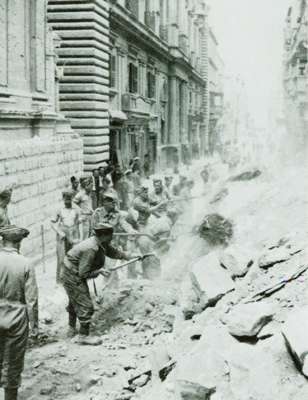
PICTURE ESSAY FOUR: “Embattled Malta“. (Malta’s Capital of Valletta enduring the Spring Blitz of 1942. Heroic Ordeal of a Rock-Bound Island. Bomb shelters carved into limestone caves. The bombed out Governor’s Palace in central Valetta’s “Queen’s Square”. Maltese children playing in the burned out wreckage of a German Stuka Dive Bomber. Soldiers with shovels clearing rubble from Kingsway, Valletta’s main thoroughfare. The ruins of Valletta’s Royal Opera House, one of 37,000 buildings destroyed or damaged. Malta’s Triumph and King George VI’s victory motorcade of June 20, 1943.)
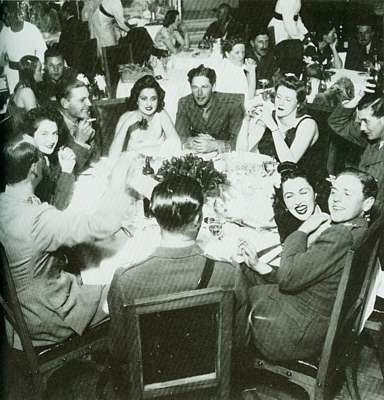
PICTURE ESSAY FIVE: “Light Relief in Cairo“. (British officers relaxing on the terrace of Cairo’s Shepheard’s Hotel. South African soldiers on a camelback tour of Cheops Pyramid. A Social Whirl Untroubled by War: Cairo Nightlife and dancing at the roof garden of the Continental Hotel. Hekmet, the Melody Club’s Belly Dancer. An amputee Free French Soldier at the Shepheard’s Hotel. Unclaimed trunks and bags in the Shepheard’s Hotel storeroom.)
PICTURE ESSAY SIX: “A Brutal Pounding of the Axis“. (A 900-gun British Barrage of Axis positions at El Alamein. Bloody El Alamain: The Turning Point. Hand-to-hand combat with tough Australian infantrymen. A LINE OF British Crusader Tanks hounding Rommel’s retreat westward from El Alamein across Egypt and Libya. British soldiers using an abandoned German tank for cover from shellfire. British Soldiers of the Middlesex Regiment under an Axis artillery barrage. A near-miss on a British heavy tank advancing on Axis positions at El Alamein. Limping Away to Safety in the Hills to the West. Australian troops helping a wounded German soldier. A German Casualty: German soldiers carrying a stretched with one of an estimated 25,000 German casualties (10,000 dead, 15,000 wounded) at the Battle of El Alamein. A 40 mile traffic jam: a bomber’s-eye view of the Egyptian coastal road chocked with German and Italian mechanized vehicles fleeing El Alamein. Discarded clothing and abandoned vehicles marking the frenzied Axis retreat from El Alamein. A bicycle-mounted German soldier killed by a British sniper laying along the coastal road outside El Alamein.)
PICTURE ESSAY SEVEN: “Monty at the Helm“. (Lieutenant General Montgomery discussing tactics with his staff on August 15, 1942, the occasion of his first encounter with Rommel’s forces. A Man to Turn the Tide. Photo of Montgomery at age 14 shooting rabbits in Tasmania. Montgomery in his trademark black beret leaning against an American-made Grant tank. Montgomery on horseback as a cadet at the Royal Military College at Sandhurst. Brigade-Major Montgomery tours the trenches in France near the Arras front in 1916. Major Montgomery at age 39 marries Betty Carver. Montgomery as a widowed father poses with his son, David, in 1941. Monty taking tea with the tank men of the 6th Royal Tank Regiment. Monty congratulating New Zealand and English armored troops after Rommel’s abandonment of the Mareth Line in Southern Tunisia. Montgomery dines with the (captured) Commander of Afrika Korps, General Riter von Thoma, on the final day of fighting at El Alamein. Montgomery examining the outskirts of Tripoli from the turret of his Grant tank.)
PICTURE ESSAY EIGHT: “Tipping the Balance“. (American Infantrymen coming ashore near the Algerian Port of Oran on November 8, 1942. Torch: A Massive Invasion of Africa. Loading a 1,000 pound bomb onto a U.S. Navy SBD Dive Bomber on the aircraft carrier U.S.S. Ranger. Climbing from a troop transport into an assault boat for the run to Algeria’s shore. A wrecked jeep which slipped from a swamped landing craft: huge waves on the landing beaches of Morocco’s Atlantic coast. Wading ashore: a 2½ ton Army truck disembarks from a landing craft. American Antiaircraft guns on an Algerian beach duel with French Vichy American-made P-36’s. U.S. Assault Infantrymen searching buildings in Algeria. The Enemy that Became a Friend: Vichy French fighting American troops at Oran, Algeria. A General Lee Tank Crew in Tunisia shortly after the Operation Torch landings. The wreckage of a U.S. Army Air Corp camp hit by Axis bombers at Youks les Bains, in Tunisia, in December 1942. )
PICTURE ESSAY NINE: “One Man’s Focus on the War“. (Lieutenant General George S. Patton watching the advance of American tanks at El Guettar. An American M3 light tank probing German defenses at El Guettar. U.S. Signal Corps soldiers stringing telephone lines along a Tunisian road. Combat Photographer “Hellzapoppin” Elisofon. A Two-Fisted Assault on an Entrenched Enemy. U.S. Artilleryman firing a 155mm gun near El Guettar, Tunisia. American tanks driving across the Valley of El Guettar. In Praise of Unsung Heroes. GI’s at a lonely observation post directing artillery fire. U.S. Signal Corpsman tracking down a break in a field telephone wire broken by German fire. A Valley Littered with the Wreckage of War. The charred hulk of a German Panzer IV abandoned at El Guettar. Covering the Aftermath of a Lost Cause. Near a grainfield, wooden crosses mark a common grave for dead German soldiers. Italian soldiers in an Allied POW camp playing cards. An overturned armored vehicle ablaze hours after a battle. A German 150mm gun amongst a vast array of captured enemy weapons. )
PICTURE ESSAY TEN: “Grand Finale in Tunis“. (Rome and Berlin via Tunis: a liberated population of Tunisians. Jubilant Weeks of Victory and Liberation: The official victory review parading past British, French, and American commanders in Tunis. A smiling soldier marching down a boulevard in Tunisia. French and native Tunisians cheering the end of Axis occupation of Tunis. French Tunisians celebrating around a truckful of impassive Gurkha “knife fighters” soldiers of the 4th Indian Division. Tunisian women waving to truckbound Free French soldiers. French civilians riding on a British armored car as it enters Tunis. Mateur, Tunis POW camp with 275,000 German and Italian prisoners.)
ADDITIONAL BACKGROUND:
History of Germany:
Germany is bounded by the North Sea, the Baltic Sea; Denmark, Poland, the Czech Republic, Austria, Switzerland, France, Luxembourg, Belgium, and the Netherlands. It is important to understand that "Germany" was not a unified country until the 19th century. When reference is made to "German History", reference is generally being made to a collection of various "Germanic States", sometimes loosely affiliated, sometimes fiercely independent and antagonistic.
During the “Old Stone Age”, about 400,000 years ago, the German forests were thinly populated by wandering bands of hunters and gatherers. During the New Stone Age the indigenous hunters settled in villages to raise crops and breed livestock. Villagers lived with their animals in large, gabled wooden houses. They produced pottery and traded with Mediterranean peoples for fine stone and flint axes and shells. At the beginning of the Bronze Age (around 2,500 BC) new waves of migrating peoples arrived, probably from southern Russia. These battle-ax-wielding Indo-Europeans were the ancestors of the Germanic peoples that settled in northern and central Germany, the Baltic and Slavic peoples in the east, and the Celts in the south and west.
From 1,800 to 400 BC Celtic peoples in southern Germany and Austria introduced the use of iron for tools and weapons, and used ox-drawn plows and wheeled vehicles. From the 2nd century BC to the 5th century AD the Germanic and Celtic tribes were in constant conflict with the Roman Empire. The Teutons were defeated by the Roman general Gaius Marius in 101 BC. The tribes in Gaul (modern-day France), west of the Rhine, were subdued by Julius Caesar around 50 BC. The Romans tried unsuccessfully to extend their rule to the Elbe. However the best the Roman Empire was able to accomplish was to hold back the Germans with a line of fortifications at the Rhine and the Danube.
Throughout the 2nd and 3rd centuries AD the Romans prevented confederations of Franks and Burgundians from crossing the Rhine. But by the 4th and 5th centuries the constant pressure proved too much for the weakened Roman Empire. Sweeping in from Asia the Huns set off waves of migration. Consequently the Ostrogoths, Visigoths, Vandals, Franks, Lombards, and other Germanic tribes overran the Roman Empire. In the late 5th century the Franks conclusively defeated the Romans and established a kingdom that included most of Gaul and southwestern Germany.
In the 8th century “Charlemagne the Great” fought the Slavs south of the Danube. He annexed southern Germany and conquered the Saxons in the northwest. As champion of Christianity and supporter of the papacy (the "Holy Roman Empire") Charlemagne was crowned “Emperor of the Romans” by Pope Leo III in Rome in 800. However Charlemagne's Empire did not long survive his death in 814. Ultimately the empire was divided among his three grandsons in 843. One grandson received West Francia (modern-day France). Another inherited East Francia (modern-day Germany). The third grandson’s inheritance was the "Middle Kingdom" running from the North Sea through modern-day Lorraine and Burgundy to Italy.
Theoretically vassals of the king the feudal Lords often usurped royal rights to build castles and administer justice. These conditions delayed for centuries the consolidation of a strong German state. The vast majority of common people lived on country manors belonging to nobles or churchmen. The few cities, such as Trier and Cologne, were chiefly of Roman foundations or imperial fortifications. Monasteries such as Reichenau, Regensburg, Fulda, Echternach, and Saint Gall became centers of scholarship.
By the early 10th century East Francia (Germany) was being buffeted by new waves of invading Danes, Hungarians, and Moravians. Internally the land was virtually torn apart by rival tribes. Completely fragmented the largest remnants of Charlemagne's once great empire were the tribal duchies. These included Franconia, Swabia, Bavaria, Saxony, and Lorraine. However by the close of the 10th century Germany had expanded to their influence to Lorraine and Burgundy (Arles), defeated the Danes to the North, the Slavs to the East, and permanently broke the power of the Magyars at the Battle of the Lechfeld in 955.
Germany tried to continue supporting the papacy during the 11th century. However they were defeated by the Saracens in their efforts to secure southern Italy. Closer to home Germany seized Burgundy, strengthened their hold on northern Italy, and added Poland to the Empire. However subsequently in a series of defeats under Henry V, Germany lost control of Poland, Hungary, and Bohemia. In the 12th and 13th centuries Germany and Italy were torn apart by rivalry between two princely families. As a result, even as Germany armies were participating in the Christian Crusades, back home civil wars erupted twice in the 12th century.
In 1197 Northern Italy reasserted its independence and for a third time in the century civil war raged. After King Frederick II died in 1237 Italy and Germany were never united again. Allied with the French the papacy ousted the Germans from Sicily. By the late 13th century the empire had lost Poland and Hungary and effective control of Burgundy and Italy. Germany was fragmented and weakened both politically and militarily. However economically Germany was flourishing. Trade increased, Cologne and Frankfurt gave access to the fairs of Champagne, Mainz lay on the route across the Alps to Italy, Lubeck and Hamburg dominated North Sea and Baltic trade, and Leipzig was in contact with Russia.
Trade associations formed between the cities contributed to the development of agriculture and industrial arts, constructed canals and highways. They became so powerful they even declared wars. At their height rich merchants built city walls, cathedrals, and elaborate town halls and guildhalls as expressions of civic pride. However the Black Death (Bubonic Plague) swept through Europe in the mid 14th century, decimating perhaps as much as one-third of Europe's population. Civil war raged again in the early 14th century as yet again different princely monarchs supported different candidates as successors to the crown.
Finally in 1338 the Princes made the momentous declaration that henceforth the king of the Germans would be the majority electoral choice, thus avoiding civil wars. Further they decided that their election would automatically be emperor without the necessity of being crowned by the pope. Thus the possibility of papal veto was eliminated, which in past had been another leading cause of civil wars. This was reflected in the title, official in the 15th century, “Holy Roman Emperor of the German Nation”.
When the great King Sigismund died without an heir the princes unanimously chose his Habsburg son-in-law Albert of Austria, who became emperor as Albert II. Although perhaps not in theory in practice from that time on the imperial crown became hereditarily vested in the Habsburg line. Nonetheless the 15th century was tumultuous. A civil war raged in Bohemia. The Ottomans invaded Hungary which was lost along with Bohemia. Luxembourg was sold to France.
Economically the 15th century was a time of transition from the land economy of the Middle Ages to the money economy of modern times. As centers of commerce the cities became increasingly important in a money economy. In the south Nuremberg and Augsburg, home of the Fugger bank, thrived on mining and trade with Italy. In the north Lubeck and Hamburg carried on brisk trade with Britain and Scandinavia. The increasingly widespread need for cash led to criticism of the church's wealth. People objected that the church-owned much land and demanded much output from their agricultural tenants, but paid no taxes. Economic and political concerns came together in the form of growing resentment at the necessity of having to support the pope in Rome.
At this early stage a break with Rome did not seem inevitable. If non-biblical practices such as selling "indulgences" (pardons for sins) had been eliminated it is possible that the populace would have been appeased. The invention of printing from movable type by Johann Gutenberg made it possible to produce Bibles, other books, and pamphlets in great quantity at low cost. As a result the new learning could circulate widely. This prepared the intellectual ground for the Protestant Reformation. The spiritual concerns of Martin Luther combined with secular ambitions of the German princes produced the movement for church reform.
This may have created religious liberty, but at the cost of Western Christian unity. Religious strife, Holy Roman Catholic versus Protestant Reformer, intensified European political wars for 100 years. While the emperors Ferdinand I and his son Maximilian II were occupied with the threat of Turkish invasion, Protestantism in Germany grew. Tension mounted between Protestants and Catholics. Taking advantage of the quarreling German states, France, England, Denmark, Sweden, and the Netherlands all intervened and made Germany the scene of a devastating European War.
In 1618 Protestant Bohemia refused to accept the Catholic Ferdinand as King, and the Czechs set up their own Protestant government. Ferdinand crushed the Bohemian forces at the Battle of Weisserberg (1620). The new Czech King was exiled and Catholicism was restored by force. Bohemian nobles were killed or stripped of their lands. As a result of the war the population declined by more than one-half. Emboldened by Germany's internal dissension and financed by the Dutch and English Denmark invaded Germany in 1625. In 1629 Ferdinand issued the Edict of Restitution, which ordered the return of all Catholic church property seized by Protestants since 1552.
Anxious to extend Swedish control of the Baltic Sweden invaded Pomerania under the pretense of being the champion of the Protestant princes. The French paid subsidies to the Swedish army to keep it fighting, and French troops crossed the Rhine. After another 13 years, the long war ended in a draw, finalized by the Peace of Westphalia in 1648. By the terms of the treaty the sovereignty and independence of each state of the Holy Roman Empire was fully recognized. This rendered making the Holy Roman Emperor virtually powerless.
In addition the religion of each German state was to be determined by its prince. Politically the Holy Roman Empire continued in name, but it had lost all claim to universality or effective centralized government. Economically and socially Germany had lost about one-third of its people to war, famine, and plague. As well Germany had lost much of its livestock, capital, and trade. Bands of refugees and mercenaries roamed the countryside seizing what they could. It was indeed a dark time for the princely German States.
Badly weakened, Germany was overshadowed by France and England in the 17th and 18th centuries. The western German States were involved in four wars by which Louis XIV strove to extend French territory to the Rhine. The War of the Spanish Succession (1701-1714) was fought over the right of Louis XIV's grandson, Philip V, to inherit the Spanish throne. Prussia and most other European states wanted to block unification of France and Spain. Large, well-trained, well-equipped armies fought in Bavaria and western Germany, wreaking havoc and ruin.
The Germans also had to reckon with the Ottoman Turks who were vigorously expanding into southeastern Europe. The Turks invaded Hungary in 1663 and besieged Vienna in 1683. However in the Great Northern War of 1700-1721, Saxony, Poland, Prussia, Denmark, and Russia joined forces against Sweden. Sweden eventually lost Poland, Stettin, West Pomerania, and their eastern Baltic lands to Prussia and Russia. Benefiting by this by 1740 Austria and Prussia were leaving the other German states behind. This left Austria and Prussia as the principal rivals for dominance in central Europe.
The emergence of Prussia as a major power led to a radical shift of alliances and to new hostilities. Prussia invaded Saxony and Bohemia in 1756. Austria invaded Silesia, the Russians marched into Prussia, and the French attacked Hannover. Chaos prevailed for the better part of a decade until the rivals had exhausted themselves. Though most hostilities had ended by about 1764, Prussia and Austria both coveted Polish territories. Both also feared the growing strength of Russia. In 1772 Austria, Prussia, and Russia agreed to a partition of militarily weak Poland. By 1795 Poland entirely disappeared.
Despite constant military conflict as it drew to a close the 18th century had witnessed a flowering of German culture and the awakening of a German cultural identity. The princes of the various Germanic states had made themselves absolute monarchs. They had centralized their governments and established mercantile economies. Engaging artisans and artists alike the princes had made their capital cities artistic and intellectual centers. The cities were resplendent with palaces, churches, museums, theaters, gardens, and universities.
In a cultural explosion, the princely states vied with one another to sponsor artists such as Heinrich Schutz and Johann Sebastian Bach; Joseph Haydn, Wolfgang Amadeus Mozart, Ludwig van Beethoven; J. S. Bach and George Frideric Handel. Together with the conquests of Napoleon this cultural awakening aroused a sense of national identity within the Germanic States, and an awakening of a desire for national unification.
For 18 years the German states had endured five defensive wars against the well-trained, unified armies of revolutionary and Napoleonic France. In the first two wars the French took the left bank of the Rhine. In the third, Napoleon conquered Vienna and Stuttgart. In 1806 to compensate for their left-bank losses he reorganized the western German states into the Confederation of the Rhine. Austria and Prussia were excluded and lost much territory. In 1809 Austria led a fourth war against France while Napoleon was occupied in Spain. However in the process Austria lost more land.
In 1812 Napoleon's disastrous retreat from Moscow encouraged Russia, Prussia, and Austria to wage a War of Liberation. Napoleon was defeated at Leipzig in 1813 and Paris itself fell in 1814. In 1815 at the Congress of Vienna the map of Europe was redrawn by the victorious allies. The contemporary states of Austria and Prussia were redefined and delineated. Austria gained part of Italy, Salzburg, Lombardy, and Illyria and Dalmatia on the Adriatic Sea. Prussia gained much of Saxony and Swedish Pomerania as well as land in the Rhineland and Westphalia. This included the undeveloped iron and coal resources of the Ruhr and Saar.
Popular with all but the princely monarchs the move toward a unified Germany gained momentum thereafter. Prussia instituted a customs union of most German states except Austria. Liberal revolutions in Paris in 1830 and 1848 created waves of sympathetic uprisings washing through Germany and Europe. Nationalist groups revolted in Hungary, Bohemia, Moravia, Galicia, Lombardy, Bavaria, Prussia, and southwestern Germany. The frightened princely rulers agreed to send delegates to an assembly in Frankfurt. However the rebellions were instead crushed by the various princely states. A liberal constitution for a unified Germany never survived outside the walls of the Frankfurt Assembly.
After the failure of the liberal Frankfurt Assembly both Prussia and Austria put forth more conservative, though conflicting, plans for union. In order to eliminate Austrian influence and bring about unification on Prussian terms Otto von Bismark, Chief Minister of Prussia, masterminded an effort which combined diplomacy and "blood-and-iron" militarism. Austria and Prussia jointly attacked and defeated the Danish controlled states of Schleswig and Holstein in 1864. In 1866 after a contrived disagreement over their control, Prussia attacked and defeated Austria in a battle at Koniggratz.
In 1870 the wily Bismark contrived to have France declare war on Prussia. Stirred by national loyalty the southern German states joined forces behind Prussia. Together they conquered the French at Sedan and took Paris in 1871. Satiated by victory Bismarck was then able to convince the southern German states that Prussian control was inevitable. He thus persuaded to the southern states to unify within the Prussian Empire. Bismarck motivated various Slavic groups to keep rising against the decaying Ottoman Empire, and founded colonies in Africa and the Pacific.
Bismarck encouraged the Industrial Revolution. This developed rapidly after 1850 as Germans applied advanced industrial technology to the iron and coal resources of the Ruhr and Saar. Population grew, factories boomed, and rural farmers were transformed into urban producers of steel for machinery, railways, and ships. An era of relative peace and prosperity followed reaching well into the 20th century. The empire did not function democratically however, and any thought of parliamentary government was actively discouraged by Bismarck. Ultimately the nationalism that created Germany in the 19th century led it into two disastrous wars.
None of the European powers wanted World War I, but they all, France, Great Britain, Austria, and Russia, feared the newly unified Germany. Germany was rapidly outstripping these opther countries in population and industry, and was aggressively self-assertive. Surrounded by antagonists from the German perspective there was the recurring nightmare of the possibility of a war on two fronts. All these powers sought protection in huge, peacetime, standing armies and in an intricate system of international alliances. Europe was divided into two armed camps, and antagonisms intensified.
In 1914 a Serbian conspiracy arranged the assassination of the Austrian Archduke Ferdinand. Germany rashly assured Austria of full support, resulting in an Austrian ultimatum that Serbia could not accept and Austria declared war on Serbia. Russia, to defend Serbia, mobilized against Austria and Germany. Germany gave Russia 12 hours to demobilize and called up its own troops. Receiving no response to their ultimatum, Germany declared war on Russia. Assuming that France would aid Russia, Germany also declared war on France. World War I was on.
German armies moved through neutral Belgium, hoping to take Paris by surprise. However their violation of international law brought Britain into the war on the side of France. German forces nearly reached Paris. However the British and French miraculously turned back the overstretched German lines at the Battle of the Marne. The two sides then dug trenches for a ferocious war of attrition that would last for four years. Meanwhile, the Russians attacked on the east, plunging Germany into precisely the two-front war they feared.
The Germans soundly defeated the ill-equipped Russians, but they could make no headway in the west. The Allies blockaded Germany to cut off food and raw materials. Desperate to break the blockade the Germans declared unrestricted submarine warfare. After several U.S. ships were sunk the United States entered the war in 1917. Badly mauled and in the throes of two revolutions that brought Communists to power, the next year Russia sued for peace. Thus freed in the east in 1918 the Germans launched a final, all-out offensive in the west. However the belated entry of America into the war slowly turned the tide against them.
Recognizing the situation as hopeless, the German high command created a new civil government and sued for peace. While negotiating with Woodrow Wilson, U.S. President from 1913 to 1921, fighting continued, sailors mutinied, socialists staged strikes, workers and the military formed Communist councils, revolution broke out in Bavaria, and Social Democrats proclaimed Germany a republic. Germany had surrendered and changed its government. They had not been defeated on the battlefield. Thus Germany expected a negotiated peace rather than the harsh terms imposed by the Treaty of Versailles in 1919.
The Allies on the other hand were determined to receive reparation for their losses and to see that their enemy was never again in a position to endanger them. Germany consequentially lost territory to France and Poland, lost its colonies, and had to give up most of its coal, trains, and merchant ships, as well as its navy. Germany was required to limit its army and submit to Allied occupation of the Rhineland for 15 years. Worst of all, the Germans had to accept full responsibility for causing the war and, consequently, pay its total cost.
This was particularly insulting as Germans did not consider themselves any more guilty than anyone else. Furthermore it was simply impossible for Germany to pay all the monetary reparations that were demanded. Forced to accept the treaty the new German government, the Weimar Republic, gained a bad name among its citizens. Though democratic in nature, the treaty demands crippled its chances of success. Despite its democratic constitution for most Germans the government only bore the stigma of military defeat and the Versailles treaty.
The financial restitution imposed by The Treaty of Versailles created a catastrophic economic burden. Because Germany could not meet reparations requirements, France invaded the Ruhr in 1923 to take over the coal mines. The worldwide depression of 1929 plunged the country into deepening economic despair. Millions of unemployed, disillusioned by capitalist democracy, turned to communism or to the party of National Socialism led by Adolf Hitler. In the depths of the depression of 1932 this was the largest party in the Reichstag.
Hitler set out to make the Third Reich, as he called the new totalitarian Germany, and proceeded with frightening efficiency. As Chancellor he consolidated legislative, executive, judicial, and military authority in himself. Hitler became head of state after the death of Paul von Hindenburg. All political parties except the National Socialists were banned. Strikes were forbidden. The unemployed were enrolled in labor camps or the army as Germany strove to be economically self-sufficient.
Many Germans did not take Hitler seriously, but outspoken dissenters left the country or disappeared. Jews were targeted for discriminatory laws and directives. The Jews were deprived of citizenship and barred from civil service and professions. Jewish firms were liquidated or purchased for less than full value by companies owned by non-Jews. Hundreds of thousands of Jews fled the country.
Many of Europe's problems were left unresolved by World War I. Germany demonstrated clear willingness to seek a solution by force. Other European countries wanted to avoid violence at all costs. Ultimately the aversion to confrontation led to World War II. Hitler had initially only planned to threaten and bluff the European powers into allowing him gradually to revise Germany's boundaries. His goal to unite all Germans and give them living space did not seem unreasonable to some statesmen who realized that the Versailles treaty had been unjust. At the time no single demand of Hitler's seemed worth risking war to resist.
Germany left the League of Nations in 1933 and began to rearm in 1935. They reoccupied the Rhineland in 1936, signed an anti-Communist pact with Japan, made an alliance with Fascist Italy, and in 1938 another with Austria. Britain, France, and Italy, terrified, timidly accepted Hitler's demand for the German-populated Sudetenland of Czechoslovakia. Hitler had assured them that he had no further territorial ambitions.
Less than a year later, emboldened by the evident unwillingness to confront him, Hitler broke is promise and occupied the remainder of Czechoslovakia. Germany made a nonaggression pact with the USSR in 1939, and then promptly invaded Poland. Britain and France immediately declared war on Germany, and World War II had begun. Within a few weeks Germany’s mechanized German divisions in a “blitzkrieg” overwhelmed the ill-equipped Poles. The Germans took western Poland, and the Soviets seized the eastern remainder.
In 1940 Germany swallowed Denmark, Norway, and the Low Countries and invaded France, which rapidly collapsed. British and French forces were hastily evacuated from Dunkirk to England. Hitler then blockaded Britain with submarines and bombed the country with his new air force. To aid his faltering allied Italian forces in 1941 Germany sent troops to North Africa, Greece, and Yugoslavia. To block Soviet ambitions in agricultural Eastern Europe, which industrial Germany needed, Germany suddenly invaded the USSR. As the Soviets retreated eastward, German armies engulfed the rich Ukraine. At this point Germany was master of continental Europe.
In 1942 however Britain was still resisting. The United States had entered the war after an attack by Japan, and was sending supplies to Britain and the USSR. In 1943 the tide began to turn. German forces in the USSR were gradually driven west. Axis forces were defeated in North Africa, and Italy was invaded by Allied forces. Although defeat was inevitable, a deranged Hitler refused to surrender. Allied forces invaded Normandy in 1944 and swept inexorably east while the Soviets marched west.
Hitler committed suicide just before Soviet tanks rolled into Berlin in April 1945, and Germany's unconditional surrender ended the Third Reich. The Allies reduced Germany to its prewar western boundaries and assigned a large portion on the east to Poland. Initially four occupation zones were established, but policies diverged, and Germany was split into two parts. Britain, the United States, and, eventually, France wanted to rebuild Germany into a major Western European power capable of countering the expansionist tendencies of the USSR. In 1948 they merged their zones into one region, supplied U.S. aid, and encouraged the Germans to form a democratic government.
The USSR on the other hand imposed upon East Germany a Communist German government under Soviet domination. In 1949 this practical polarization of Germany was legalized by the creation of two German states; the Federal Republic of Germany, or West Germany, and the German Democratic Republic, or East Germany. And it was not until 1989, when East Germany's Communist government fell, that Germany was once again a unified country. In August of 1994, as the last Russian troops left Berlin, the final 200 allied troops also left Stuttgart, marking the first time since World War II that the city had not been host to foreign troops.
SHIPPING & RETURNS/REFUNDS: We always ship books domestically (within the USA) via USPS INSURED media mail (“book rate”). Most international orders cost an additional $23.49 to $59.99 for an insured shipment in a heavily padded mailer. However this book is quite large and heavy, too large to fit into a flat rate mailer. Therefore the shipping costs are somewhat higher than what is otherwise ordinary. There is also a discount program which can cut postage costs by 50% to 75% if you’re buying about half-a-dozen books or more (5 kilos+). Our postage charges are as reasonable as USPS rates allow. ADDITIONAL PURCHASES do receive a VERY LARGE discount, typically about $5 per book (for each additional book after the first) so as to reward you for the economies of combined shipping/insurance costs.
Please note for international purchasers we will do everything we can to minimize your liability for VAT and/or duties. But we cannot assume any responsibility or liability for whatever taxes or duties may be levied on your purchase by the country of your residence. If you don’t like the tax and duty schemes your government imposes, please complain to them. We have no ability to influence or moderate your country’s tax/duty schemes. Your purchase will ordinarily be shipped within 48 hours of payment. We package as well as anyone in the business, with lots of protective padding and containers. All of our shipments are fully insured against loss, and our shipping rates include the cost of this coverage (through stamps.com, Shipsaver.com, the USPS, UPS, or Fed-Ex).
Please note that eBay/DHL shipping is typically less expensive than what the US Postal Service charges. But please be aware that DHL shipments generally offer very limited tracking, and inasmuch as shipments go to eBay first, then are consolidated, they tend to be pretty slow. International tracking is provided free by the USPS for almost all countries. We do offer U.S. Postal Service Priority Mail, Registered Mail, and Express Mail for both international and domestic shipments, as well United Parcel Service (UPS) and Federal Express (Fed-Ex). Please ask for a rate quotation. We will accept whatever payment method you are most comfortable with.
If upon receipt of the item you are disappointed for any reason whatever, I offer a no questions asked 30-day return policy. Send it back, I will give you a complete refund of the purchase price; 1) less our original shipping/insurance costs, 2) less any non-refundable fees imposed by eBay. Please note that though they generally do, eBay may not always refund payment processing fees on returns beyond a 30-day purchase window. So except for shipping costs and any payment processing fees not refunded by eBay, we will refund all proceeds from the sale of a return item. Obviously we have no ability to influence, modify or waive eBay policies.
ABOUT US: Prior to our retirement we used to travel to Eastern Europe and Central Asia several times a year seeking antique gemstones and jewelry from the globe’s most prolific gemstone producing and cutting centers. Most of the items we offer came from acquisitions we made in Eastern Europe, India, and from the Levant (Eastern Mediterranean/Near East) during these years from various institutions and dealers. Much of what we generate on Etsy, Amazon and Ebay goes to support worthy institutions in Europe and Asia connected with Anthropology and Archaeology. Though we have a collection of ancient coins numbering in the tens of thousands, our primary interests are ancient/antique jewelry and gemstones, a reflection of our academic backgrounds.
Though perhaps difficult to find in the USA, in Eastern Europe and Central Asia antique gemstones are commonly dismounted from old, broken settings – the gold reused – the gemstones recut and reset. Before these gorgeous antique gemstones are recut, we try to acquire the best of them in their original, antique, hand-finished state – most of them originally crafted a century or more ago. We believe that the work created by these long-gone master artisans is worth protecting and preserving rather than destroying this heritage of antique gemstones by recutting the original work out of existence. That by preserving their work, in a sense, we are preserving their lives and the legacy they left for modern times. Far better to appreciate their craft than to destroy it with modern cutting.
Not everyone agrees – fully 95% or more of the antique gemstones which come into these marketplaces are recut, and the heritage of the past lost. But if you agree with us that the past is worth protecting, and that past lives and the produce of those lives still matters today, consider buying an antique, hand cut, natural gemstone rather than one of the mass-produced machine cut (often synthetic or “lab produced”) gemstones which dominate the market today. We can set most any antique gemstone you purchase from us in your choice of styles and metals ranging from rings to pendants to earrings and bracelets; in sterling silver, 14kt solid gold, and 14kt gold fill. When you purchase from us, you can count on quick shipping and careful, secure packaging. We would be happy to provide you with a certificate/guarantee of authenticity for any item you purchase from us. There is a $3 fee for mailing under separate cover. I will always respond to every inquiry whether via email or eBay message, so please feel free to write.