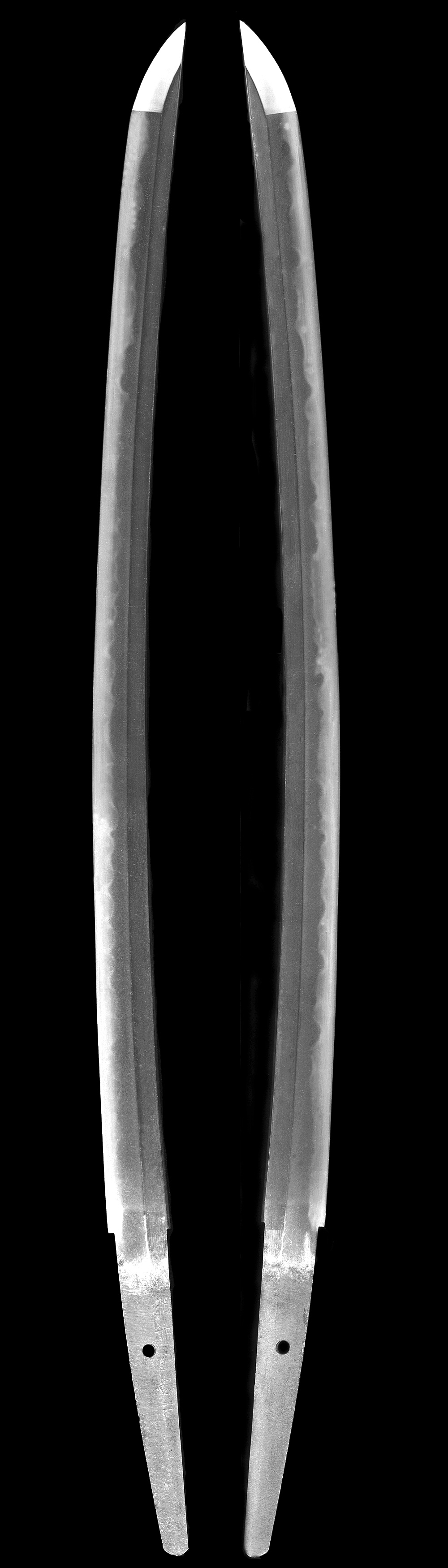
This blade has been certified as Hozon Tōken (保存刀剣) by the NBTHK (Nihon Bijutsu Token Hozon Kyokai), Japan's foremost sword preservation society. The Hozon certificate attests to the blade's authentic historical value and quality as a genuine antique Japanese sword worthy of preservation.
Certificate issued: February 16, Reiwa 8 (2026)
| Mei (Signature) | Hizen no Kuni Tadayoshi (肥前国忠吉) — 6th Generation |
| Smith's Name | Hashimoto Shinzaemon (橋本新左衛門), later Ōmi no Kami |
| Era | Mid Edo Period (born 1736, received title 1790) |
| Province (Kuni) | Hizen (present-day Saga Prefecture) |
| Shape (Sugata) | Shinogizukuri, Iorimune, extended kissaki |
| Material | Tamahagane |
| Jihada (Grain) | Ko-nuka-hada (fine "rice-bran" grain — the signature Hizen jihada) |
| Hamon (Temper Line) | Gunome-midare — abundant ko-nie with yō (leaf-shaped activity) and sunagashi |
| Blade Length | 55.6 cm (21.9 inches) |
| Curvature (Sori) | 1.5 cm |
| Moto-haba (Width at base) | 2.7 cm |
| Saki-haba (Width at tip) | 2.1 cm |
| Kasane (Thickness) | 0.6 cm |
| Weight (blade only) | 566 g |
| Mekugiana (Rivet holes) | 1 |
| Koshirae | Kuro-roiro-nuri Saya Han-Dachi Koshirae (black roiro lacquered half-tachi mounting) |
| Certificate | NBTHK Hozon Tōken — February 16, Reiwa 8 (2026) |
This wakizashi bears the signature "Hizen no Kuni Tadayoshi" (肥前国忠吉) — one of the most illustrious names in the entire history of Japanese swordsmithing. It is the work of the 6th generation Tadayoshi, a smith of the legendary Hizen Tadayoshi house, official swordsmiths to the powerful Nabeshima domain.
The Tadayoshi lineage was founded by the 1st generation Hizen no Kuni Tadayoshi — one of the most famous swordsmiths in all of Japan and a defining master of the early Edo Shinto period. Under the patronage of the Nabeshima clan, he was sent to Kyoto by domain order to study under the great Umetada Myōju, and upon his return laid the foundation for a distinguished house that would continue for nine generations. The Hizen Tadayoshi smiths became renowned above all for their ko-nuka-hada (小糠肌) — an extraordinarily fine, tight "rice-bran" jihada of almost porcelain-like smoothness, a technical achievement so distinctive it became the hallmark of the entire school.
The 6th generation Tadayoshi, whose personal name was Hashimoto Shinzaemon (橋本新左衛門), was the second son of the 5th generation Tadayoshi. He was born in Genbun 1 (1736) and received the honorary title of Ōmi no Kami on the 24th day of the 6th month of Kansei 2 (1790).
What makes this particular wakizashi exceptional is its hamon. The vast majority of the 6th generation's work is in the classic Hizen suguha (straight temper line) style — quiet, refined, and restrained. This blade, by striking contrast, displays a large, flamboyant gunome-midare — an undulating temper line of bold, showy character that is genuinely rare for this smith. Such a departure from house convention strongly suggests that this sword was made to fulfill a special commission, a particular request from a discerning patron who wanted something more dramatic than the usual Hizen suguha. The temper is rich in ko-nie and enlivened by yō (葉) — detached leaf-shaped islands of activity floating within the temper zone — and sunagashi flowing streaks, giving the hamon tremendous depth and movement.
The jihada is the signature Hizen ko-nuka-hada, beautifully fine and tight. The somewhat large, extended kissaki (point) gives the blade a spirited, imposing profile with real visual impact and presence. The blade is in good condition throughout.
The koshirae is a handsome Kuro-roiro-nuri Saya Han-Dachi Koshirae — a half-tachi mounting with the saya in deep black roiro lacquer, a dignified and formal style befitting a blade of this distinguished lineage.
Blade: In good condition. The fine ko-nuka-hada jihada and the rare, flamboyant gunome-midare hamon with yō and sunagashi are clearly and beautifully displayed. No significant issues.
Koshirae: The Kuro-roiro-nuri Saya Han-Dachi Koshirae presents with the dignified appearance of a formal black lacquered half-tachi mounting.
- ✅ NBTHK Hozon Tōken certified — authenticated antique of historical value (issued 2026)
- ✅ 6th generation Hizen no Kuni Tadayoshi — one of the most illustrious names in sword history, Nabeshima domain smith
- ✅ Legendary nine-generation Tadayoshi house, founded by a student of Umetada Myōju
- ✅ Signature Hizen ko-nuka-hada — the school's famous fine, tight jihada
- ✅ Rare flamboyant gunome-midare — unusual for this smith, likely a special commission
- ✅ Rich ko-nie with yō and sunagashi — deep, active, dramatic hamon
- ✅ Spirited extended kissaki — commanding visual presence
- ✅ Complete with dignified Kuro-roiro-nuri Han-Dachi Koshirae
Exporting Japanese swords requires an official export inspection certificate issued by the Agency for Cultural Affairs (Bunkacho).
After confirming your payment, we will apply for this permit and legally export the item.
The paperwork usually takes about four weeks to complete.
Once the export permission is granted, we will notify you by email and ship your item immediately.
Please confirm with your country's customs office in advance that you are allowed to import Japanese swords.
Some countries may restrict or prohibit their import.
From October 2025, all items under USD 2,500 shipped from Japan to the U.S. will be sent under DDP (Delivered Duty Paid) terms.
This means that import duties and taxes are already included in the total amount paid at checkout, and no additional charges will occur upon delivery.
Import duties, taxes, and other charges are not included in the item price or shipping cost. These charges are the buyer's responsibility.
Please check with your country's customs office to determine what additional costs may apply before bidding or buying.
We do not undervalue items or mark them as gifts. International government regulations prohibit such behavior.
Thank you very much for your understanding and cooperation.
This sword will be shipped via EMS (Express Mail Service) or equivalent international express carrier, fully insured and securely packaged.
All sales are final (non-refundable and non-returnable).
Please review all photographs and ask any questions before purchasing. We are happy to provide additional images or information upon request.
We do not undervalue items or mark them as gifts. International government regulations prohibit such practices.