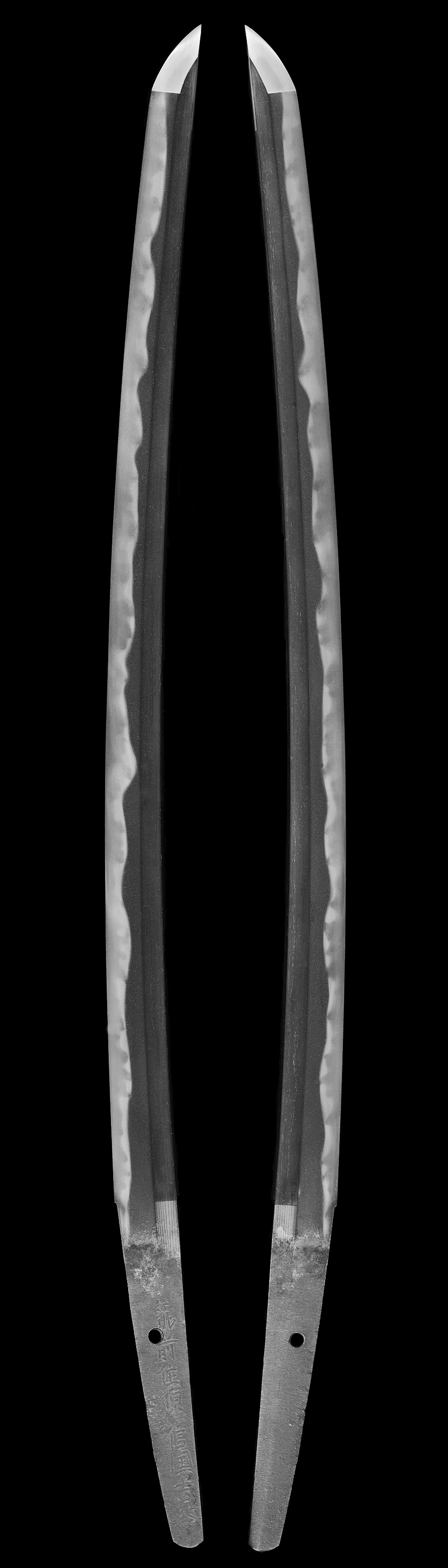
This blade has been awarded Tokubetsu Hozon Tōken (特別保存刀剣) — the highest level of regular certification issued by the NBTHK (Nihon Bijutsu Token Hozon Kyokai), Japan's foremost sword preservation society. Tokubetsu Hozon is granted only to swords of exceptional quality and historical significance that demonstrate outstanding workmanship.
Certificate issued: December 1, Reiwa 7 (2025)
| Mei (Signature) | Chikuzen-jū Minamoto Nobukuni Yoshimasa (筑前住源信国吉政) — 2nd Generation |
| School | Chikushi Nobukuni (筑紫信国) — Kuroda Domain smith |
| Era | Early Edo Period |
| Province (Kuni) | Chikuzen (present-day Fukuoka Prefecture) |
| Shape (Sugata) | Shinogizukuri, Iorimune |
| Material | Tamahagane |
| Jihada (Grain) | Itame-hada |
| Hamon (Temper Line) | Saka-chōji (reverse-slanting clove pattern) — abundant ko-nie with sunagashi |
| Blade Length | 53.0 cm (20.9 inches) |
| Curvature (Sori) | 1.2 cm |
| Moto-haba (Width at base) | 2.9 cm |
| Saki-haba (Width at tip) | 2.1 cm |
| Kasane (Thickness) | 0.6 cm |
| Weight (blade only) | 542 g |
| Mekugiana (Rivet holes) | 1 |
| Koshirae | Kuro Ishime-ji Nuri Han-Dachi Koshirae (black stone-textured lacquered half-tachi mounting) |
| Certificate | NBTHK Tokubetsu Hozon Tōken — December 1, Reiwa 7 (2025) |
This wakizashi bears the signature "Chikuzen-jū Minamoto Nobukuni Yoshimasa" (筑前住源信国吉政) and has been awarded the prestigious NBTHK Tokubetsu Hozon certification. It is the work of the 2nd generation Yoshimasa of the celebrated Chikushi Nobukuni (筑紫信国) school — swordsmiths to the powerful Kuroda domain of Chikuzen Province.
The Nobukuni lineage of Kyushu traces its origins to the early Muromachi period, around the Ōei era (c. 1394–1428), when members of the distinguished Kyoto Nobukuni school migrated to Usa in Chikuzen Province. From these beginnings the school flourished, and by the early Shinto period it had expanded across the whole of northern Kyushu to become a dominant force, its many smiths all signing "Nobukuni."
The Chikushi Nobukuni line proper begins with Nobukuni Yoshisada, who styled himself the 12th generation of the Kyoto Nobukuni and, in Keichō 7 (1602), was summoned into the service of the Kuroda clan. His eldest son, the 1st generation Yoshimasa, became an official Kuroda domain swordsmith. Intriguingly, the 1st generation departed from his family's traditional nie-based style to pursue instead the Bizen tradition (Bizen-den) — a decision so at odds with house convention that he was disinherited, and the headship of the family passed to the second son, Yoshitsugu.
This blade is the work of the 2nd generation Yoshimasa, son of the 1st generation, who died in Jōkyō 5 (1688). He inherited and refined his father's distinctive Bizen-influenced approach, and this wakizashi is a superb expression of it. The hamon is a rare and dramatic saka-chōji (逆丁子) — a "reverse-slanting clove" pattern in which the clove-shaped elements of the temper line lean backward toward the base of the blade, creating a rhythmic, flame-like movement across the surface. Saka-chōji is a demanding and visually spectacular hamon, historically associated with the finest Bizen work, and it is beautifully realized here. The temper is rich in ko-nie (fine martensite crystals), with sunagashi (flowing streaks of nie) adding further depth and energy.
The jihada is a well-forged Itame-hada. The blade is flawless and free of defects, of excellent workmanship throughout, and has been freshly and professionally re-polished to present the jihada and the flamboyant saka-chōji hamon at their absolute finest.
The koshirae is a handsome Kuro Ishime-ji Nuri Han-Dachi Koshirae — a half-tachi mounting with the saya finished in deep black stone-textured lacquer. The han-dachi style, blending tachi-style fittings with a katana-length wearing method, was favored by samurai of standing and lends the sword a dignified, formal presence.
Blade: Flawless and free of defects. Freshly and professionally re-polished — beautiful condition. The Itame-hada jihada and the flamboyant saka-chōji hamon are clearly and brilliantly displayed. No issues.
Koshirae: The Kuro Ishime-ji Nuri Han-Dachi Koshirae presents with the dignified appearance of a formal black stone-textured lacquered half-tachi mounting.
- ✅ NBTHK Tokubetsu Hozon Tōken — highest level of regular NBTHK certification (issued 2025)
- ✅ 2nd generation Chikushi Nobukuni Yoshimasa — official swordsmith to the powerful Kuroda domain
- ✅ Distinguished Nobukuni lineage tracing back to the Kyoto Nobukuni school
- ✅ Rare and dramatic saka-chōji (reverse clove) hamon — a flamboyant, demanding Bizen-style temper
- ✅ Rich ko-nie with sunagashi — vivid, energetic hamon
- ✅ Flawless, free of defects — excellent workmanship throughout
- ✅ Freshly re-polished — jihada and hamon at their absolute finest
- ✅ Complete with dignified Kuro Ishime-ji Nuri Han-Dachi Koshirae
Exporting Japanese swords requires an official export inspection certificate issued by the Agency for Cultural Affairs (Bunkacho).
After confirming your payment, we will apply for this permit and legally export the item.
The paperwork usually takes about four weeks to complete.
Once the export permission is granted, we will notify you by email and ship your item immediately.
Please confirm with your country's customs office in advance that you are allowed to import Japanese swords.
Some countries may restrict or prohibit their import.
From October 2025, all items under USD 2,500 shipped from Japan to the U.S. will be sent under DDP (Delivered Duty Paid) terms.
This means that import duties and taxes are already included in the total amount paid at checkout, and no additional charges will occur upon delivery.
Import duties, taxes, and other charges are not included in the item price or shipping cost. These charges are the buyer's responsibility.
Please check with your country's customs office to determine what additional costs may apply before bidding or buying.
We do not undervalue items or mark them as gifts. International government regulations prohibit such behavior.
Thank you very much for your understanding and cooperation.
This sword will be shipped via EMS (Express Mail Service) or equivalent international express carrier, fully insured and securely packaged.
All sales are final (non-refundable and non-returnable).
Please review all photographs and ask any questions before purchasing. We are happy to provide additional images or information upon request.
We do not undervalue items or mark them as gifts. International government regulations prohibit such practices.