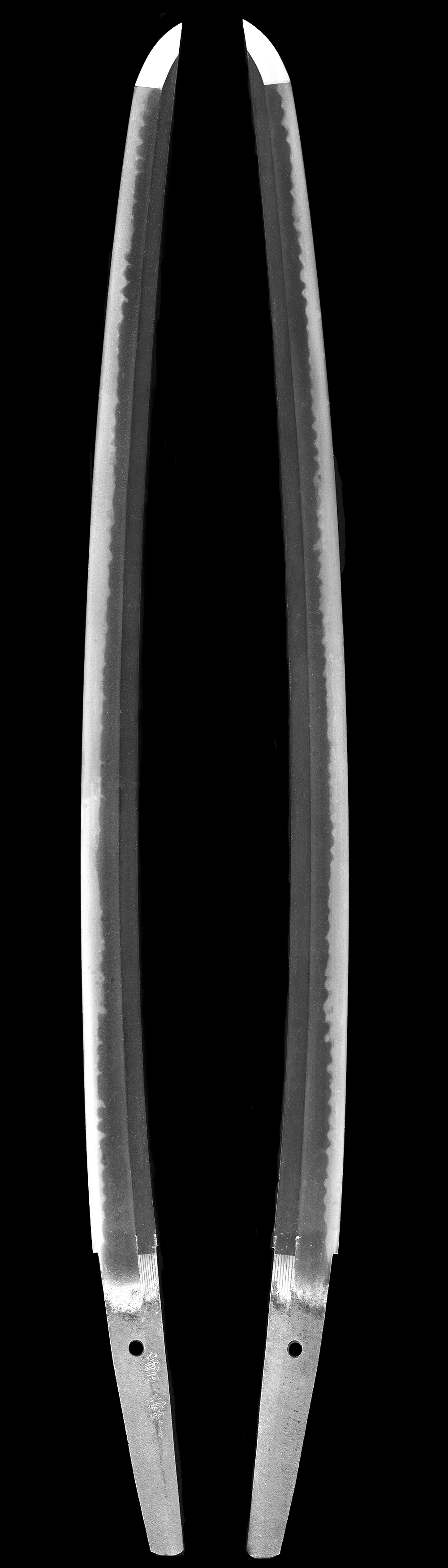
This blade is accompanied by an appraisal certificate issued by the Japan Sword & Fittings Art Museum (日本刀装具美術館), dated September 30, Heisei 9 (1997), identifying the blade as "Kanetsune — Later Generation" (兼常・後代).
The certificate was issued under the authority of Ikeda Suematsu (池田末松) — one of the most celebrated sword connoisseurs and collectors of the Shōwa era, and the author of numerous authoritative works on Japanese swords and fittings. An appraisal bearing his name carries significant weight among serious collectors.
| Mei (Signature) | Kanetsune (兼常) — Later Generation |
| School | Sue-Seki (末関), Seki, Mino Province |
| Era | Mid Edo Period — Genroku era (c. 1688–1704) |
| Province (Kuni) | Mino (present-day Gifu Prefecture) |
| Shape (Sugata) | Shinogizukuri, Iorimune |
| Material | Tamahagane |
| Jihada (Grain) | Itame-hada with masame near the edge |
| Hamon (Temper Line) | Gunome-midare with togariba (pointed elements) — rich sunagashi throughout, nioi-based; perfectly matched on both sides |
| Blade Length | 53.8 cm (21.2 inches) |
| Curvature (Sori) | 1.8 cm |
| Moto-haba (Width at base) | 2.9 cm |
| Saki-haba (Width at tip) | 1.8 cm |
| Kasane (Thickness) | 0.7 cm |
| Weight (blade only) | 499 g |
| Mekugiana (Rivet holes) | 1 |
| Koshirae | Aogai Mijin-nuri Saya Wakizashi Koshirae with unified dragon-theme fittings and shakudō nanako tsuba — good condition |
| Certificate | Japan Sword & Fittings Art Museum (Ikeda Suematsu) — September 30, Heisei 9 (1997) |
This wakizashi bears the signature "Kanetsune" (兼常) — one of the three great names of the Sue-Seki (末関) tradition, alongside the legendary Kanemoto (兼元) and Kanetsada (兼定). Together, these three lineages defined the highest achievements of the Seki school, the dominant sword-producing tradition of Mino Province, and the Kanetsune name endured across generations all the way through the Shinshinto period — a testament to the sustained excellence of this line.
Assigning a precise generation number to a "Kanetsune" blade is notoriously difficult — the signature alone rarely provides enough information, and scholars rely instead on style, condition, and overall form. The appraisal certificate from the Japan Sword & Fittings Art Museum, under the authority of Ikeda Suematsu, identifies this blade as a later-generation Kanetsune, and its style, health, and proportions point convincingly to the Genroku era (c. 1688–1704) — placing it in the creative high-tide of the mid-Edo period, when Seki smiths were producing some of their most confident and technically assured work.
The hamon is a superb example of the Seki school's defining style: gunome-midare with togariba (尖り刃) — the sharply pointed elements within the undulating temper line that are a true hallmark of the Mino tradition and rarely seen in schools from other provinces. Sunagashi (砂流し) — flowing streaks of fine nie that run through the hamon like wind-driven sand — appear abundantly throughout, adding tremendous visual energy and depth. The hamon is executed in refined nioi, clear and bright. Most impressively, the hamon on the omote and ura sides of the blade are perfectly matched — a demanding technical achievement over the full length of the blade, and a quiet but unmistakable mark of a smith with complete command of his craft.
The jihada is Itame-hada with a distinctive character: near the edge, the grain shifts toward masame (柾目 — straight wood-grain), a refined and intentional forging choice that reflects the Yamato-influenced technical heritage of the Seki tradition. The overall condition of the steel is excellent.
The koshirae is a remarkable Aogai Mijin-nuri mounting — the saya lacquered with finely crushed aogai (青貝 — blue-green abalone shell) sprinkled through the lacquer, giving it a shimmering, iridescent surface that catches the light in constantly shifting tones. Every fitting — the fuchi, kashira, and koiguchi — is unified in a dragon (ryū) design, creating a coherent and powerful thematic set of unusual quality. The tsuba (guard) is a fine shakudō nanako piece — the shakudō (a traditional Japanese alloy of copper and gold) surface worked with the characteristic tiny punched-dot texture of the nanako technique, giving it a deep, rich, velvety appearance. The entire koshirae is in excellent condition with no significant damage — a rare and beautiful survival.
Blade: In excellent polish condition. The Itame-hada jihada with masame near the edge and the gunome-midare hamon with togariba and rich sunagashi are clearly and beautifully displayed. No significant issues.
Koshirae: The Aogai Mijin-nuri Saya Wakizashi Koshirae is in excellent condition with no notable damage. The iridescent aogai lacquer saya, unified dragon-theme metal fittings, and shakudō nanako tsuba are all well-preserved and present as a cohesive, high-quality set.
- ✅ Kanetsune — Sue-Seki, one of the three great names of Mino sword tradition alongside Kanemoto and Kanetsada
- ✅ Expert appraisal by Ikeda Suematsu — the most celebrated sword connoisseur and author of the Shōwa era
- ✅ Classic Seki togariba (pointed elements) in gunome-midare — a defining Mino hallmark
- ✅ Perfectly matched hamon on both sides — master-level technical control
- ✅ Rich sunagashi throughout — dynamic, energetic hamon of great visual depth
- ✅ Excellent polish condition — jihada and hamon at their finest
- ✅ Exceptional Aogai Mijin-nuri Koshirae with unified dragon fittings and shakudō nanako tsuba — all in excellent condition
Exporting Japanese swords requires an official export inspection certificate issued by the Agency for Cultural Affairs (Bunkacho).
After confirming your payment, we will apply for this permit and legally export the item.
The paperwork usually takes about four weeks to complete.
Once the export permission is granted, we will notify you by email and ship your item immediately.
Please confirm with your country's customs office in advance that you are allowed to import Japanese swords.
Some countries may restrict or prohibit their import.
From October 2025, all items under USD 2,500 shipped from Japan to the U.S. will be sent under DDP (Delivered Duty Paid) terms.
This means that import duties and taxes are already included in the total amount paid at checkout, and no additional charges will occur upon delivery.
Import duties, taxes, and other charges are not included in the item price or shipping cost. These charges are the buyer's responsibility.
Please check with your country's customs office to determine what additional costs may apply before bidding or buying.
We do not undervalue items or mark them as gifts. International government regulations prohibit such behavior.
Thank you very much for your understanding and cooperation.
This sword will be shipped via EMS (Express Mail Service) or equivalent international express carrier, fully insured and securely packaged.
All sales are final (non-refundable and non-returnable).
Please review all photographs and ask any questions before purchasing. We are happy to provide additional images or information upon request.
We do not undervalue items or mark them as gifts. International government regulations prohibit such practices.