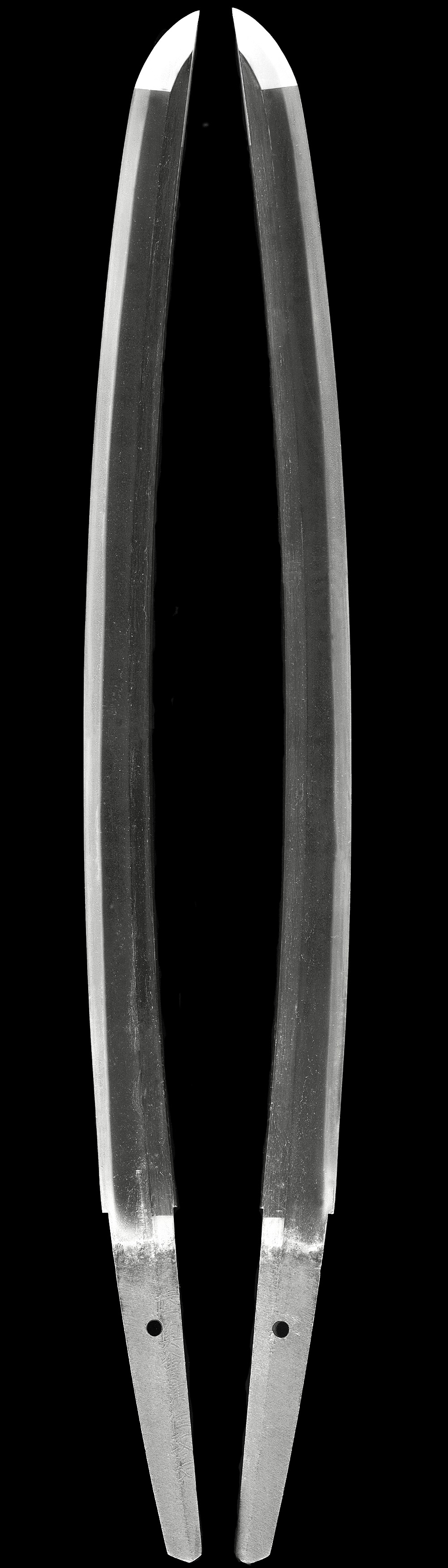
This blade has been certified as Hozon Tōken (保存刀剣) by the NBTHK (Nihon Bijutsu Token Hozon Kyokai), Japan's foremost sword preservation society. The Hozon certificate attests to the blade's authentic historical value and quality as a genuine antique Japanese sword worthy of preservation.
Certificate issued: June 28, Heisei 25 (2013)
| Mei (Signature) | Mutsu Aizu-jū Masanaga (陸奥会津住政長) |
| Era | Early Edo Period |
| Province (Kuni) | Mutsu — Aizu (present-day Fukushima Prefecture) |
| Shape (Sugata) | Shinogizukuri, Iorimune |
| Material | Tamahagane |
| Jihada (Grain) | Ko-itame-hada with masame-hada appearing throughout |
| Hamon (Temper Line) | Suguha-chō (predominantly straight) with ko-ashi, occasional nijūba — nioi-based |
| Blade Length | 48.7 cm (19.2 inches) |
| Curvature (Sori) | 1.5 cm |
| Moto-haba (Width at base) | 3.0 cm |
| Saki-haba (Width at tip) | 2.2 cm |
| Kasane (Thickness) | 0.6 cm |
| Weight (blade only) | 504 g |
| Mekugiana (Rivet holes) | 1 |
| Koshirae | Ishime-nuri Nijūwa ni Sagari-fuji Mon-chiri Wakizashi Koshirae — good condition |
| Certificate | NBTHK Hozon Tōken — June 28, Heisei 25 (2013) |
This wakizashi is signed "Mutsu Aizu-jū Masanaga" (陸奥会津住政長) — a swordsmith of remarkable lineage who stands at a fascinating intersection of some of the most celebrated names in early Edo-period sword history.
Masanaga was born in Iyo Matsuyama and trained under the legendary Umetada Myōju (埋忠明寿) — the Kyoto master who is credited with founding the Shinto (新刀) tradition of sword-making and whose other students include none other than Hizen Tadayoshi (肥前忠吉), one of the most revered names in all of Japanese sword history. To have trained under Myōju alongside Tadayoshi places Masanaga in extraordinarily distinguished company.
In Kan'ei 4 (1627), the lord of Matsuyama domain — for whom Masanaga's father Naganori served as official swordsmith — was transferred to Aizu as its new domain lord. Father and son moved together to Aizu, where Masanaga established himself and founded what would become a flourishing tradition. He worked alongside the Kanetsada family, who had migrated to Aizu from Mino, and together these smiths shaped the sword culture of Aizu through to the end of the Edo period.
Masanaga's most famous legacy, however, is his son: Mitsuyoshi Nagamichi (三善長道), celebrated throughout Japan as "Aizu Kotetsū" (会津虎徹) — a direct reference to the great Nagasone Kotetsu of Edo, the highest compliment that could be paid to a swordsmith's cutting ability.
This wakizashi embodies Masanaga's philosophy of the sword as a martial instrument above all else. The hamon is a disciplined suguha-chō (predominantly straight temper line) — seemingly simple at first glance, but revealing on closer inspection ko-ashi (short feet of activity extending into the blade) and nijūba (二重刃) — a rare and striking feature in which a secondary temper line runs parallel to the main hamon, like a shadow or echo within the steel. This is not decorative showmanship; it is the hamon of a smith who prioritized cutting performance and practical excellence over visual flourish.
The Ko-itame-hada jihada is beautifully refined, with masame (柾目 — straight wood-grain pattern) running through at intervals — a characteristic of certain Yamato-influenced traditions and a sign of careful, intentional forging choices. The blade is in sound, healthy condition with no notable flaws.
The koshirae is an elegant Ishime-nuri (stone-textured lacquer) mounting decorated throughout with the Nijūwa ni Sagari-fuji (二重輪に下り藤) clan crest — a double-ring enclosing a drooping wisteria design historically associated with clans including the Fujiwara, Ōno, and Itami. The crests are beautifully applied and the mounting is in excellent, well-preserved condition — a rare survival of a complete, historically meaningful koshirae.
Blade: Sound and healthy condition with no notable flaws. The Ko-itame-hada with masame and the suguha-chō hamon with ko-ashi and nijūba are clearly visible and appreciable.
Koshirae: The Ishime-nuri Nijūwa ni Sagari-fuji Wakizashi Koshirae is in good condition. The clan-crested fittings and stone-textured lacquer saya are well-preserved.
- ✅ NBTHK Hozon Tōken certified — authenticated antique of historical value
- ✅ Trained under Umetada Myōju alongside Hizen Tadayoshi — the most prestigious lineage of early Shinto sword-making
- ✅ Father of "Aizu Kotetsū" Mitsuyoshi Nagamichi — one of Edo Japan's most celebrated cutting swords
- ✅ Rare nijūba (double temper line) — a distinctive and striking feature within the suguha-chō hamon
- ✅ Ko-itame-hada with masame — beautifully forged, intentionally crafted jihada
- ✅ A sword built for cutting excellence, not decorative show
- ✅ Complete with rare clan-crested Ishime-nuri Koshirae in good condition — historically meaningful mounting
Exporting Japanese swords requires an official export inspection certificate issued by the Agency for Cultural Affairs (Bunkacho).
After confirming your payment, we will apply for this permit and legally export the item.
The paperwork usually takes about four weeks to complete.
Once the export permission is granted, we will notify you by email and ship your item immediately.
Please confirm with your country's customs office in advance that you are allowed to import Japanese swords.
Some countries may restrict or prohibit their import.
From October 2025, all items under USD 2,500 shipped from Japan to the U.S. will be sent under DDP (Delivered Duty Paid) terms.
This means that import duties and taxes are already included in the total amount paid at checkout, and no additional charges will occur upon delivery.
Import duties, taxes, and other charges are not included in the item price or shipping cost. These charges are the buyer's responsibility.
Please check with your country's customs office to determine what additional costs may apply before bidding or buying.
We do not undervalue items or mark them as gifts. International government regulations prohibit such behavior.
Thank you very much for your understanding and cooperation.
This sword will be shipped via EMS (Express Mail Service) or equivalent international express carrier, fully insured and securely packaged.
All sales are final (non-refundable and non-returnable).
Please review all photographs and ask any questions before purchasing. We are happy to provide additional images or information upon request.
We do not undervalue items or mark them as gifts. International government regulations prohibit such practices.