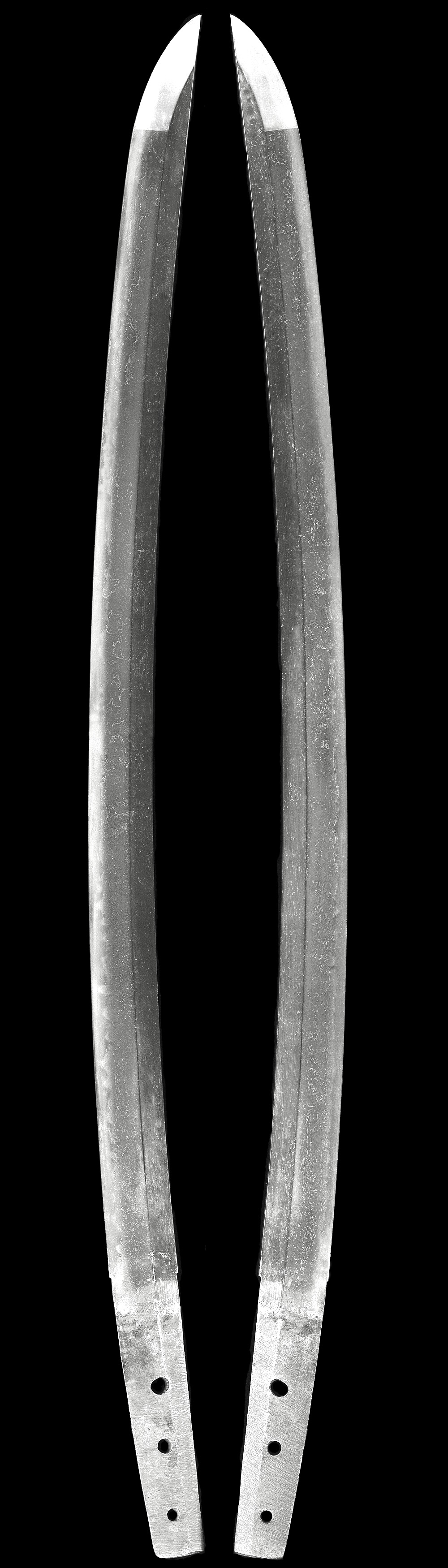
| Mei (Signature) | Mumei (unsigned) — O-suriage (greatly shortened, original signature removed) |
| Attribution | Bungo Takada School, Kyushu |
| Era | Late Muromachi – Early Edo Period (c. late 16th to early 17th century) |
| Province (Kuni) | Bungo (present-day Oita Prefecture, Kyushu) |
| Shape (Sugata) | Shinogizukuri, Iorimune, O-kissaki (large point) |
| Material | Tamahagane |
| Jihada (Grain) | Itame-hada |
| Hamon (Temper Line) | Gunome-midare with togariba — nioi-based, rich ko-ashi |
| Blade Length | 51.4 cm (20.2 inches) |
| Curvature (Sori) | 1.5 cm |
| Moto-haba (Width at base) | 2.9 cm |
| Saki-haba (Width at tip) | 2.4 cm |
| Kasane (Thickness) | 0.5 cm |
| Weight (blade only) | 523 g |
| Mekugiana (Rivet holes) | 3 |
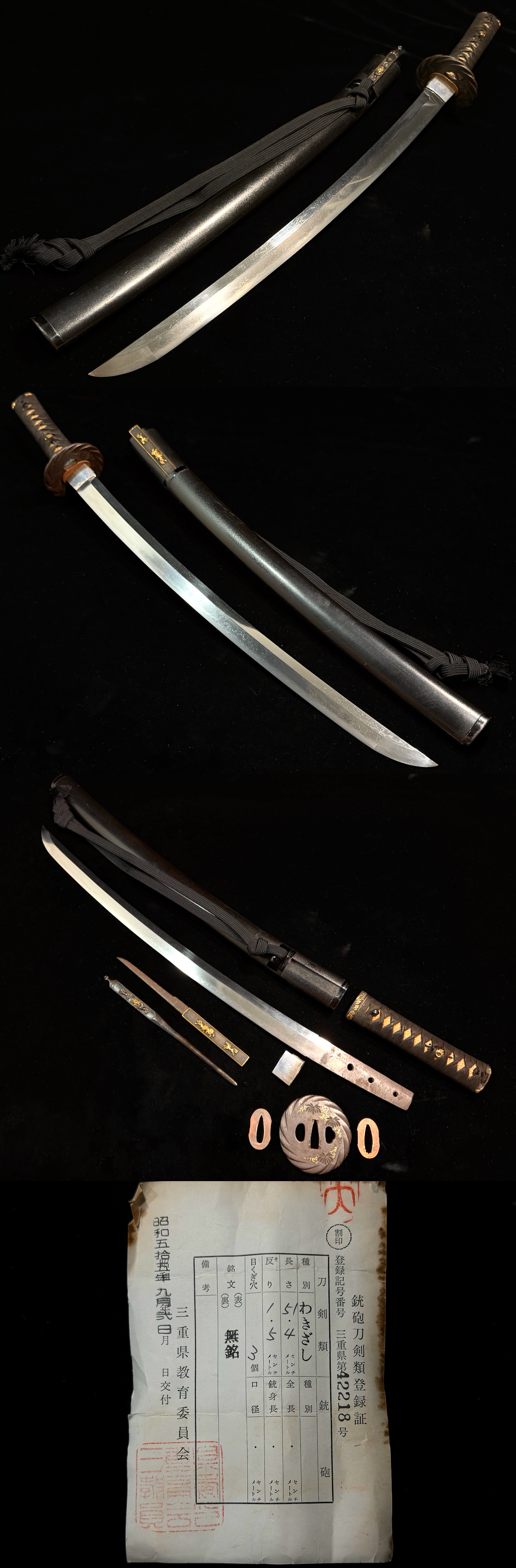
| Koshirae | Kuro-roiro Ishime-ji Nuri Wakizashi Koshirae (black roiro stone-textured lacquered mounting) |
| Certificate | None |
This wakizashi is an O-suriage Mumei — a blade that was significantly shortened in a later period, with the original smith's signature removed in the process. This was a common practice when long katana were reduced to a more practical length for daily carry. Based on the character of the jihada and hamon, the blade clearly originates from the Kotō (古刀) era, and its O-kissaki (large point) places its manufacture in the late Muromachi to early Edo period — a transitional era when blade shapes were shifting toward grander proportions.
The style of the hamon is highly characteristic of the Bungo Takada school (豊後高田派) of Kyushu. The gunome-midare (undulating temper line) is punctuated by togariba — sharply pointed elements within the hamon — and the overall pattern carries a degree of lively irregularity that is a hallmark of Takada work. The hamon is nioi-based with rich ko-ashi (short feet of activity extending into the blade) throughout, giving it depth and motion.
The Bungo Takada school was one of the most prolific and important sword-producing centers in Kyushu. Based in the Takada region of Bungo Province (present-day Oita Prefecture), the school flourished under the patronage of powerful Kyushu lords and was known for producing robust, powerful blades suited for actual combat. The school's tradition continued across generations from the Nanbokuchō period well into the Edo era, and their swords are prized today for their honest, vigorous character.
This blade has generous width (Mi-haba) throughout — the Moto-haba of 2.9 cm and the notably wide Saki-haba of 2.4 cm give it an impressively powerful, imposing silhouette. Combined with the O-kissaki, this is a blade of real visual presence and commanding authority — a bold and martial aesthetic entirely fitting for the turbulent age in which it was made.
The Itame-hada jihada is well-forged and clearly visible.
The koshirae is in good condition and presents as a well-coordinated, refined mounting. The Kuro-roiro Ishime-ji Nuri saya (stone-textured black lacquer) has a quiet elegance, and the fittings include a matching pair of horse-motif menuki — a coherent, harmonious set that suggests this sword belonged to a mid-ranking samurai of means and taste.
The blade is in old polish. While not a fresh re-polish, the condition is fully presentable and the jihada and hamon can be appreciated without difficulty.
Blade: Old polish. The jihada and hamon are clearly visible and can be appreciated without difficulty. No significant issues affecting enjoyment of the sword.
Koshirae: The Kuro-roiro Ishime-ji Nuri Wakizashi Koshirae is in good condition. The stone-textured black lacquer saya and matching horse-motif fittings are well-preserved and present as a cohesive, quality mounting.
- ✅ Authentic Kotō-era blade attributed to the Bungo Takada school — a major Kyushu tradition
- ✅ O-kissaki (large point) — rare and dramatic on a wakizashi, marking the late Muromachi transitional style
- ✅ Powerful, wide blade — Saki-haba 2.4 cm gives an exceptionally bold silhouette
- ✅ Lively gunome-midare with togariba and rich ko-ashi — active, characterful hamon
- ✅ Good presentable condition — old polish, jihada and hamon clearly visible
- ✅ Complete with Kuro-roiro Ishime-ji Nuri Koshirae in good condition, including matching horse-motif fittings
- ✅ A genuine piece of Sengoku-era Kyushu sword history
Exporting Japanese swords requires an official export inspection certificate issued by the Agency for Cultural Affairs (Bunkacho).
After confirming your payment, we will apply for this permit and legally export the item.
The paperwork usually takes about four weeks to complete.
Once the export permission is granted, we will notify you by email and ship your item immediately.
Please confirm with your country's customs office in advance that you are allowed to import Japanese swords.
Some countries may restrict or prohibit their import.
From October 2025, all items under USD 2,500 shipped from Japan to the U.S. will be sent under DDP (Delivered Duty Paid) terms.
This means that import duties and taxes are already included in the total amount paid at checkout, and no additional charges will occur upon delivery.
Import duties, taxes, and other charges are not included in the item price or shipping cost. These charges are the buyer's responsibility.
Please check with your country's customs office to determine what additional costs may apply before bidding or buying.
We do not undervalue items or mark them as gifts. International government regulations prohibit such behavior.
Thank you very much for your understanding and cooperation.
This sword will be shipped via EMS (Express Mail Service) or equivalent international express carrier, fully insured and securely packaged.
All sales are final (non-refundable and non-returnable).
Please review all photographs and ask any questions before purchasing. We are happy to provide additional images or information upon request.
We do not undervalue items or mark them as gifts. International government regulations prohibit such practices.