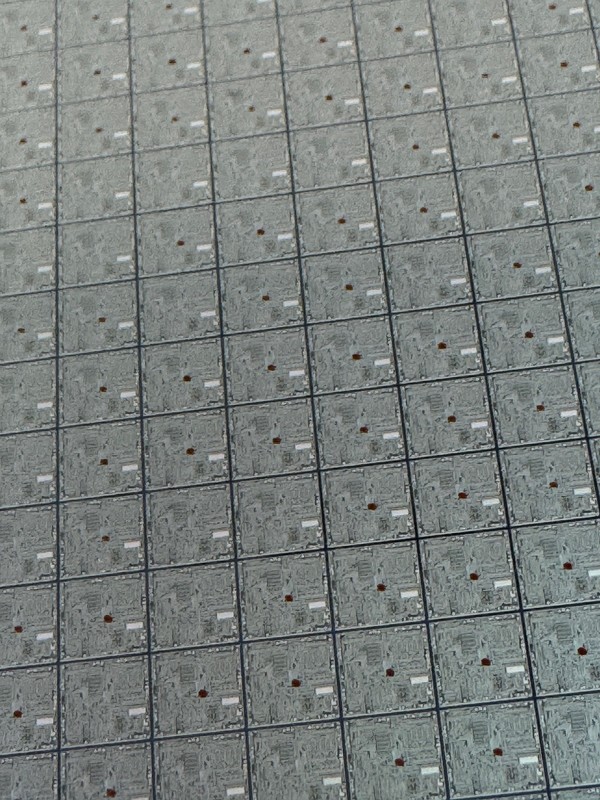
Own a piece of vintage USSR technology.
KR1506HL2 (often written K(R)1506ХЛ2, sometimes labeled “UPT-2”) is a Soviet remote-control command decoder IC, used mainly in color TVs and similar consumer electronics. It was typically designed to work together with KR1506HL1 (that one is the encoder/transmitter side; this one is the decoder/receiver side).
What it does
According to datasheets and reference notes, the KR1506HL2 decodes remote-control commands and produces outputs for typical TV functions such as:
-
mains power on/off
-
channel/program up/down
-
mute
-
“continuous” control of volume / brightness / contrast / color (saturation) via built-in DAC output channels
Supply voltage (the “weird” ~18 V / negative supply)
The official data sheet commonly specifies a supply around −16.5…−19.5 V (with the “common (+)” on pin 1 and “supply (−)” on pin 24).
In practice, hobbyists often report that many chips also work from about 12…18 V, and that they run cooler at ~12–15 V.
Crystal / clock frequency
The IC uses a quartz crystal resonator (pin 23). One published spec lists 4.4336 MHz.
DIY circuits sometimes mention other frequencies depending on the exact remote-code implementation and the surrounding circuit.
Pinout highlights (DIP-24, main signals)
From the brief datasheet (KM/KR/KF1506HL2 family):
-
1 — common (+)
-
2–5 — DAC1…DAC4 outputs (analog control channels)
-
6 — auxiliary memory switch output
-
7 — direct data input
-
8–11 — 4-bit parallel output (program/channel number code)
-
12–15 — direct data inputs
-
16 — remote-control signal input (from a photoreceiver/demodulator)
-
17 — data-input register output
-
18 — mode select input
-
19 — “mains power switch” output (power latch)
-
20 — control-signal output
-
21–22 — clock outputs
-
23 — crystal resonator
-
24 — supply (−)