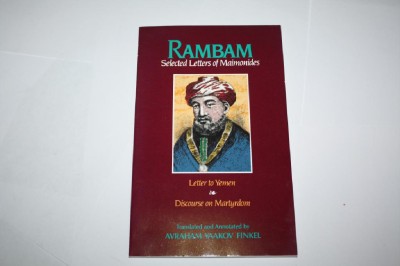
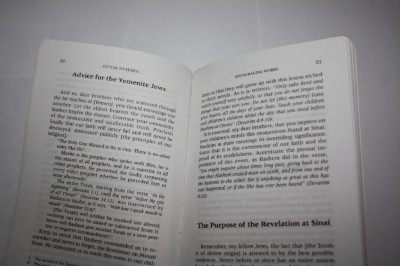
If one did not know that Maimonides was the name of a man, Abraham Joshua Heschel wrote, one would assume it was the name of a university. The writings and achievements of this twelfthcentury Jewish sage seem to cover an impossibly large number of activities. Maimonides was the first person to write a systematic code of all Jewish law, the Mishneh Torah; he produced one of the great philosophic statements of Judaism, The Guide to the Perplexed; published a commentary on the entire Mishna; served as physician to the sultan of Egypt; wrote numerous books on medicine; and, in his "spare time," served as leader of Cairo's Jewish community. It is hardly surprising that when Shmuel ibn Tibbon, the Hebrew translator of The Guide to the Perplexed (which had been written in Arabic), wrote Maimonides that he wished to visit him to discuss some difficult points in the translation, Maimonides discouraged him from coming:
I dwell at Fostat, and the sultan resides at Cairo [about a mileandahalf away].... My duties to the sultan are very heavy. I am obliged to visit him every day, early in the morning, and when he or any of his children or any of the inmates of his harem are indisposed, I dare not quit Cairo, but must stay during the greater part of the day in the palace. It also frequently happens that one of the two royal officers fall sick, and I must attend to their healing. Hence, as a rule, I leave for Cairo very early in the day, and even if nothing unusual happens, I do not return to Fostat until the afternoon. Then I am almost dying with hunger. . . I find the antechamber filled with people, both Jews and gentiles, nobles and common people, judges and bailiffs, friends and foes-a mixed multitude who await the time of my return.
I dismount from my animal, wash my hands, go forth to my patients and entreat them to bear with me while I partake of some slight refreshment, the only meal I take in the twentyfour hours. Then I go forth to attend to my patients, and write prescriptions and directions for their various ailments. Patients go in and out until nightfall, and sometimes even, I solemnly assure you, until two hours or more in the night. I converse with and prescribe for them while lying down from sheer fatigue; and when night falls I am so exhausted that I can scarcely speak.
In consequence of this, no Israelite can have any private interview with me, except on the Sabbath. On that day the whole congregation, or at least the majority of the members, come to me after the morning service, when I instruct them as to their proceedings during the whole week; we study together a little until noon, when they depart. Some of them return, and read with me after the afternoon service until evening prayers. In this manner I spend that day.
Maimonides's full name was Moses ben Maimon; in Hebrew he is known by the acronym of Rabbi Moses ben Maimon, Rambam. He was born in Spain shortly before the fanatical Muslim Almohades came to power there. To avoid persecution by the Muslim sect — which was wont to offer Jews and Christians the choice of conversion to Islam or death — Maimonides fled with his family, first to Morocco, later to Israel, and finally to Egypt. He apparently hoped to continue his studies for several years more, but when his brother David, a jewelry merchant, perished in the Indian Ocean with much of the family's fortune, he had to begin earning money. He probably started practicing medicine at this time.
Maimonides's major contribution to Jewish life remains the Mishneh Torah, his code of Jewish law. His intention was to compose a book that would guide Jews on how to behave in all situations just by reading the Torah and his code, without having to expend large amounts of time searching through the Talmud. Needless to say, this provocative rationale did not endear Maimonides to many traditional Jews, who feared that people would rely on his code and no longer study the Talmud. Despite sometimes intense opposition, the Mishneh Torah became a standard guide to Jewish practice: It later served as the model for the Shulkhan Arukh, the sixteenthcentury code of Jewish law that is still regarded as authoritative by Orthodox Jews.
Philosophically, Maimonides was a religious rationalist. His damning attacks on people who held ideas he regarded as primitive — those, for example, who understood literally such biblical expressions as “the finger of God” so infuriated his opponents that they proscribed parts of his code and all of The Guide to the Perplexed. Other, more liberal, spirits forbade study of the Guide to anyone not of mature years. An old joke has it that these rabbis feared that a Jew would start reading a section in the Guide in which Maimonides summarizes a rationalist attack on religion, and fall asleep before reading Maimonides's counterattack-thereby spending the night as a heretic.
How Maimonides's opponents reacted to his works was no joke, however. Three leading rabbis in France denounced his books to the Dominicans, who headed the French Inquisition. The Inquisitors were only too happy to intervene and burn the books. Eight years later, when the Dominicans started burning the Talmud, one of the rabbis involved, Jonah Gerondi, concluded that God was punishing him and French Jewry for their unjust condemnation of Maimonides. He resolved to travel to Maimonides's grave in Tiberias, in Israel, to request forgiveness.
Throughout most of the Jewish world, Maimonides remained a hero, of course. When he died, Egyptian Jews observed three full days of mourning, and applied to his death the biblical verse "The ark of the Lord has been taken" (I Samuel 4:11).
To this day, Maimonides and the FrenchJewish sage Rashi are the most widely studied Jewish scholars. Contemporary yeshiva students generally focus on the Mishneh Torah, and his Book of Commandments (Sefer haMitzvot) a compilation of the Torah's 613 commandments. Maimonides also formulated a credo of Judaism expressed in thirteen articles of faith, a popular reworking of which (the Yigdal prayer) appears in most Jewish prayerbooks. Among other things, this credo affirms belief in the oneness of God, the divine origins of the Torah, and the afterlife. Its twelfth statement of faith — “I believe with a full heart in the coming of the Messiah, and even though he may tarry I will still wait for him” — was often among the last words said by Jews being marched into Nazi gas chambers.
Maimonides was one of the few Jewish thinkers whose teachings also influenced the nonJewish world; much of his philosophical writings in the Guide were about God and other theological issues of general, not exclusively Jewish, interest. Thomas Aquinas refers in his writings to “Rabbi Moses,” and shows considerable familiarity with the Guide. In 1985, on the 850th anniversary of Maimonides's birth, Pakistan and Cuba — which do not recognize Israel — were among the cosponsors of a UNESCO conference in Paris on Maimonides. Vitali Naumkin, a Soviet scholar, observed on this occasion: “;Maimonides is perhaps the only philosopher in the Middle Ages, perhaps even now, who symbolizes a confluence of four cultures: GrecoRoman, Arab, Jewish, and Western.” More remarkably, Abderrahmane Badawi, a Muslim professor from Kuwait University, declared: “I regard him first and foremost as an Arab thinker.” This sentiment was echoed by Saudi Arabian professor Huseyin Atay, who claimed that “if you didn't know he was Jewish, you might easily make the mistake of saying that a Muslim was writing.” That is, if you didn't read any of his Jewish writings. Maimonides scholar Shlomo Pines delivered perhaps the most accurate assessment at the conference: “Maimonides is the most influential Jewish thinker of the Middle Ages, and quite possibly of all time” (Time magazine, December 23, 1985). As a popular Jewish expression of the Middle Ages declares: “From Moses [of the Torah] to Moses [Maimonides] there was none like Moses.”
We have over 500,000 books of Jewish interest in Stock, please make sure to check out our Our eBay Store
Questions, comments, Requests?
WE CAN BE REACHED AT 347ll78G492!!14G6508!14
Our storefront location is at Mizrahi Book Store
3108 Quentin Rd
Brooklyn NY 11234
Visitors welcome during business hours
COMBINED SHIPPING DISCOUNTS: There is $4 off each additional item paid for and shipped together, which makes the shipping just .99 for almost all additional items. Please note that purchases must be paid for at once, not individually to qualify for the discount. If you plan on adding additional items, please hold off payment until done purchasing. This discount should be deducted automatically, please contact us if for some reason it does not.
STORE HOURS: Our storefront is located at 3108 Quentin Rd, Brooklyn, NY, 11234. Visitors are welcome during business hours. Store hours are: Sunday-Thursday 10 am - 6:30 pm and Friday 10 am - 2 pm. We are closed on Saturday and Jewish Holidays. For assistance in processing hours, we can be reached at our listed Mizrahi Bookstore phone number.
INTERNATIONAL BUYERS: For most individual books, we ship first class mail via USPS. Price is by weight, and this service is tracked. For multiple purchases, we can combine postage manually and charge at cost. Please reach out to us for a quote if interested in shipping multiple items together internationally.
RETURN CUSTOMERS: Return customers get 7% off every order, from the second shipment and on. This is not deducted automatically, please message us for a discount code to be able to apply it to the order.
REFUNDS: We offer full refunds within 30 days of purchase.
QUESTIONS: We are here for you and usually respond immediately, feel free to contact us with any questions or concerns you may have.
1ST EDITIONS: We try to be precise when marking the edition, but if you are looking for first editions only, please ask us to verify the edition before purchasing, to prevent any misunderstandings. First Edition can have multiple definitions unfortunately and best to clarify in advance.
WANT LIST: Looking for something and don't see it? Let us know and we'll look out for you. We have an additional hundreds of thousands of books of Jewish interest in stock, that are not listed online.
SELL US YOUR BOOKS: We purchase Jewish books and books of Jewish interest, used, rare and antiquarian books and collections. Languages we specialize in are English, Hebrew, Yiddish, German, Spanish, Ladino, Russian and French. We purchase over 200,000 Jewish books a year and will travel to purchase libraries. Please contact us for details
DISCLAIMER: The descriptions we use for our books offered, may come from a variety of sources, such as standard reference books, auction catalogs, the Publishers' descriptions, online resources and customer reviews.... If you feel any specific description violated third part rights, please contact us and we will have it removed immediately.