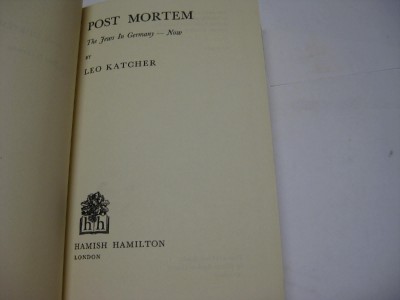
When the federal republic of West Germany came into being, John J. McCloy, Military Governor and first High Commissioner of the fledgling democracy, admonished the German people that the world would judge the degree of their moral improvement by the manner in which they treated the Jews still resident in their country.
Germans ever since have taken this admonition seriously, if not to heart, certainly to mind. In West Germany today, anti-Semitism is a crime punishable by imprisonment; only a few months ago a man was sentenced in Berlin for telling a rather sick anti-Semitic joke. Leaders of the neo-Nazi NPD have for the most part been very careful to stay away from any hint of anti-Semitism, and have seized every opportunity to stress their opposition to racism. Even old Nazis, who still question the truth behind the “tendentious allegations” that six million Jews were exterminated in the camps, will usually admit that one of Hitler's “worst mistakes” was his treatment of the Jews.
In terms of law, the 40,000 Jews living in West Germany today are among the best protected in the world. Twenty years after its establishment, the Bonn republic still persists in its efforts to appear particularly considerate toward Jews. Jewish cultural endeavors, from encyclopedias and memorial exhibitions to research foundations and courses on the Talmud, are almost guaranteed some form of public aid, be it federal, state, or municipal. Government funds have helped to reconstruct dozens of great synagogues for nonexistent Jewish communities throughout Germany. (One of these palatial structures, erected in Bonn at the entrance to West Germany's foreign ministry, is said to have caused one newly-appointed African ambassador to inquire whether Judaism was now the official religion of West Germany.) The federal republic has also paid huge sums in reparations to victims of Nazism and their heirs. Since so few Jews actually live in Germany, an anxious government has undertaken, by paying full travel expenses to Israel, to enable thousands of young people and students to view at close hand the former Untermenschen. In recent years there has sprung up a profusion of societies for Jewish-Christian cooperation; under the auspices of these societies annual brotherhood weeks—with special television and radio programs and solemn ceremonies at town hall-are celebrated in the major cities.
German literature of the postwar period, similarly, has been marked by a philo-Semitism that is often as obsessive as the anti-Semitism of former years. Indeed, until Günther Grass, a member of the younger, more relaxed generation, came out with the superb characterizations of Markus and Fajngold in The Tin Drum, German fiction was peopled with Jewish types invariably so good, so beautiful, and so virtuous that some readers might be led to wonder if Jews did not belong to an angelic order of being.
_____________
If, then, the extent to which the Germans have changed were to be judged solely by their current attitude toward Jews, surely they would by now appear to have gained high marks. But although the attitude of Germans toward Jews will always be of great interest, it is necessarily only a part of the general picture. For in fact the Germans under Hitler were at odds not only—if most spectacularly—with the Jews, but with the entire human race. Now that the Jews are a completely marginal group in Germany, officially protected for a variety of reasons (public relations being one of them), it is perhaps more to the point to examine current German attitudes toward minorities in general, dissenters in politics and in intellectual life, or foreign workers (there are over one million Italian, Greek, Spanish, Turkish, and other Gastarbeiter in West Germany today). From this point of view one would look for a change in the traditional authoritarian structures of German society, and a resolution of the age-old tension between unity and liberty which has plagued German nationalism ever since it sprang into birth in reaction to Napoleonic rule. The rejection of France and the Napoleonic Empire led, as Nietzsche saw clearly, to the “enmity of the Germans against the Enlightenment,” with all its horrible consequences in the 20th century.
We have over 500,000 books of Jewish interest in Stock, please make sure to check out our Our eBay Store
Questions, comments, Requests?
WE CAN BE REACHED AT 347ll78G492!!14G6508!14
Our storefront location is at Mizrahi Book Store
3108 Quentin Rd
Brooklyn NY 11234
Visitors welcome during business hours
COMBINED SHIPPING DISCOUNTS: There is $4 off each additional item paid for and shipped together, which makes the shipping just .99 for almost all additional items. Please note that purchases must be paid for at once, not individually to qualify for the discount. If you plan on adding additional items, please hold off payment until done purchasing. This discount should be deducted automatically, please contact us if for some reason it does not.
STORE HOURS: Our storefront is located at 3108 Quentin Rd, Brooklyn, NY, 11234. Visitors are welcome during business hours. Store hours are: Sunday-Thursday 10 am - 6:30 pm and Friday 10 am - 2 pm. We are closed on Saturday and Jewish Holidays. For assistance in processing hours, we can be reached at our listed Mizrahi Bookstore phone number.
INTERNATIONAL BUYERS: For most individual books, we ship first class mail via USPS. Price is by weight, and this service is tracked. For multiple purchases, we can combine postage manually and charge at cost. Please reach out to us for a quote if interested in shipping multiple items together internationally.
RETURN CUSTOMERS: Return customers get 7% off every order, from the second shipment and on. This is not deducted automatically, please message us for a discount code to be able to apply it to the order.
REFUNDS: We offer full refunds within 30 days of purchase.
QUESTIONS: We are here for you and usually respond immediately, feel free to contact us with any questions or concerns you may have.
1ST EDITIONS: We try to be precise when marking the edition, but if you are looking for first editions only, please ask us to verify the edition before purchasing, to prevent any misunderstandings. First Edition can have multiple definitions unfortunately and best to clarify in advance.
WANT LIST: Looking for something and don't see it? Let us know and we'll look out for you. We have an additional hundreds of thousands of books of Jewish interest in stock, that are not listed online.
SELL US YOUR BOOKS: We purchase Jewish books and books of Jewish interest, used, rare and antiquarian books and collections. Languages we specialize in are English, Hebrew, Yiddish, German, Spanish, Ladino, Russian and French. We purchase over 200,000 Jewish books a year and will travel to purchase libraries. Please contact us for details
DISCLAIMER: The descriptions we use for our books offered, may come from a variety of sources, such as standard reference books, auction catalogs, the Publishers' descriptions, online resources and customer reviews.... If you feel any specific description violated third part rights, please contact us and we will have it removed immediately.