|
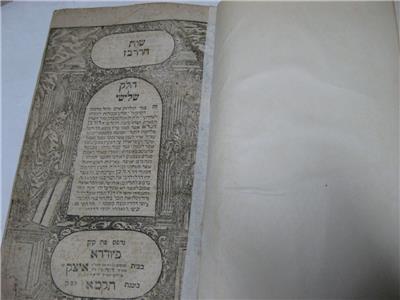
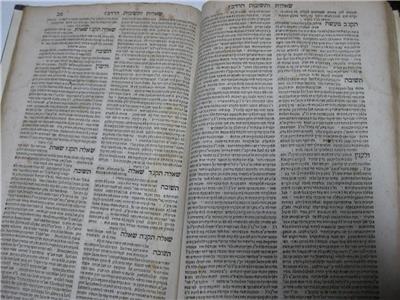
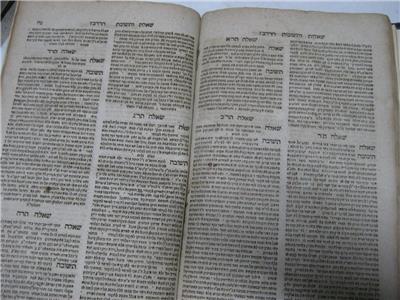
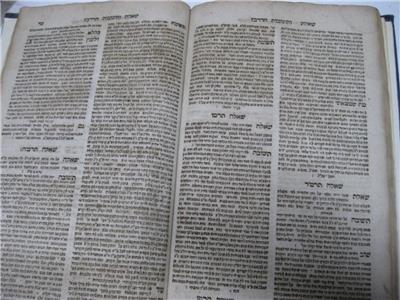
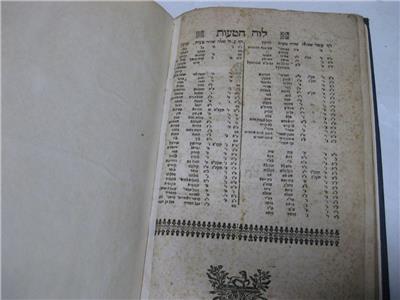
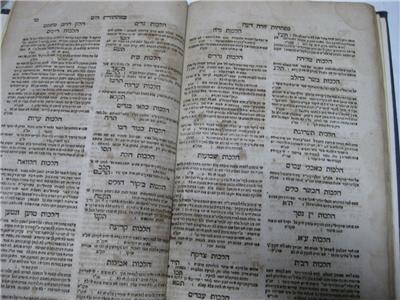
1781 Fuerth SHU"T HARADBAZ שאלות ותשובות רדב"ז Responsa of R. David Ibn Zimra
LANGUAGE: HEBREW
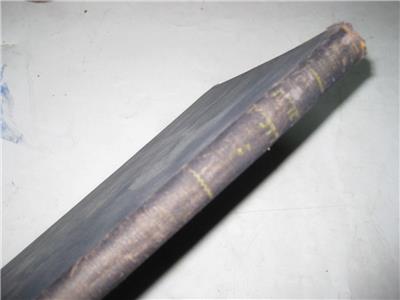
VG CONDITION, CLOTH COVERS, COMPLETE, FIRST EDITION
First edition.
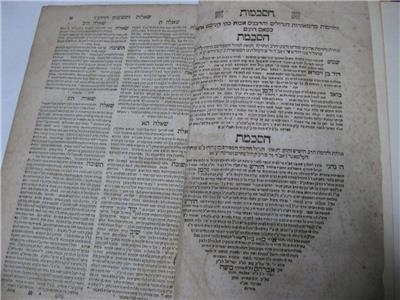
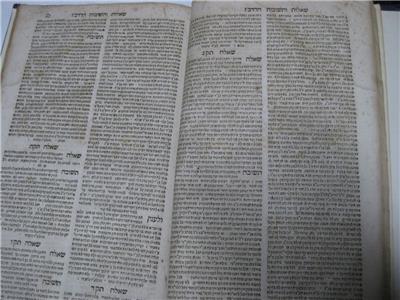
Responsa by R. David ben Solomon ibn Abi Zimra (Radbaz). Radbaz wrote Magen David at an early age. There are introductions from R. Jonathon ben Isaac Aaron, who brought the book to press, and from the renowned R. Moses Hagiz, who was the editor. The text is organized alphabetically, in a single column, but for the first introduction which is in two columns, in rabbinic type, excepting headers and initial words, which are in square letters. Based on the fonts it appears that the first four leaves only were printed by Anshel and the remainder of the work at the Foa press. A variant edition also has the first leaves with the Foa fonts and a title page that name the printer as Foa.
R. David ben Solomon Ibn Abi Zimra (Radbaz, 1479–1573), talmudic scholar, halakhic authority, and kabbalist. Abi Zimra was born in Spain into a wealthy family, but by the age of 13 was in Safed (possibly going via Fez). The most eminent of his teachers was R. Joseph Saragossi of Sicily who left Spain in 1492 and eventually settled in Safed. R. Abi Zimra moved to Jerusalem but shortly before 1513 emigrated to Egypt, apparently due to bad economic conditions in Palestine. There he stayed for 40 years, first in Alexandria, then in Cairo where he joined the bet din of the nagid, R. Isaac Sholal. After the conquest of Egypt by the Turks (1517) and the decline of the office of the nagid, Radbaz became the official head of Egyptian Jewry. He was not only dayyan but also head of a yeshivah, trustee of the hekdesh, and administrator of charity collections. He held all of these offices in an honorary capacity, as he was financially independent. Apart from his inherited wealth Radbaz was apparently successful in business and as a moneylender to non-Jews. His library, containing rare manuscripts, was famous. His was an open house; R. Isaac Akrish lived there for many years and was the tutor of his children and grandchildren. Radbaz exercised a great influence upon his contemporaries which can be seen from his success in settling a quarrel between the Mustarabs (the indigenous Jewish community) and the Maghrabis (the community with origins in other parts of North Africa), and in issuing many ordinances beneficial to Egyptian Jewry. The most famous of them are: the abolition of the dating of legal documents according to the Seleucid era (minyan shetarot), and its replacement by dating according to the era of Creation; formation of a hevra kaddisha (burial society; previously the dead had to be buried secretly to avoid attacks from the non-Jews); and the prohibition of the employment of non-Jews as dancers and musicians at Jewish weddings. He also tried to reintroduce into the public liturgy the recital of the Amidah by both the congregation and the reader (from the time of Maimonides this had been said by the reader only).
His reputation extended beyond the boundaries of Egypt and legal and religious questions were sent to him from many communities. Radbaz often engaged in disputations with Muslim and Karaite scholars, and his initially lenient attitude to the Karaites became more stringent. Shortly before 1553 he decided to return to Palestine. He settled first in Jerusalem where he was dissatisfied with the local governor as well as with some of the Jews, and moved to Safed, where he remained until his death. Although Radbaz praised Jewish scholars who were versed in natural sciences and spoke with warm appreciation of the contribution of Jewish philosophers in promoting Jewish belief, he discouraged his students from studying philosophy. In Radbaz’s view, the aggadah, which he regarded as equal in holiness to other parts of the Oral Law, can bear two meanings, one literal (nigleh) and one esoteric (nistar). He strongly criticized the Bible commentary of R. Abraham ibn Ezra and R. David Kimhi who referred to a certain aggadah as irrational.
His methods were scientific. He examined texts critically, comparing the different versions and tracing them back to their original sources, investigating their authenticity, and emending them only when necessary and no other solution could be found. Abi Zimra composed a treatise on the methodology of the Talmud (Kelalei ha-Gemara, printed in Me-Harerei Nemerim, Venice, 1599; separately Zolkiew, 1749), and some of his responsa are devoted to methodological principles. Although he was a kabbalist, he introduced Kabbalah in decisions only when not in contradiction with the Talmud, or where no definite decision is laid down in the Talmud. When Kabbalah conflicted with the Talmud preference was to be given to the latter. In his kabbalistic system gematriot and the doctrine of metempsychosis played important roles, the latter being reflected even in his legal decisions (e.g., on halizah). He was one of the most open defenders of the doctrine of cosmic cycles in creation (Shemittot).
Radbaz’s most important work is his collection of responsa (Teshuvot ha-Radbaz, 1882) in seven parts. Other of his responsa appear in the works of his contemporaries. Various individual responsa have been published from manuscript. Radbaz’s novellae are quoted by his pupil R. Bezalel Ashkenazi in his Shitah Mekubbezet and he himself refers to his novellae to tractate Shabbat (Magen David, Introd.). His other works Yekar Tiferet (Smyrna, 1757), a commentary on those portions of Maimonides' Mishneh Torah on which there is no Maggid Mishneh commentary, i.e., on the sections Hafla'ah, Zera'im, Kedushah, and Shofetim, were published in the Romm (Vilna) editions of the Mishneh Torah, and on Sheluhin ve-Shuttafin, and Avadim by S.B. Werner (Jerusalem, 1945); Mezudat David (written 1556, Zolkiew, 1862), an explanation of the traditional 613 commandments, both rational and kabbalistic; Migdal David (written 1560, Lemberg, 1883), a kabbalistic commentary on the Song of Songs; and Keter Malkhut, a piyyut for the Day of Atonement, which has been frequently published and is included in the Heidenheim Mahzor. His other works are still in manuscript.
We have over 500,000 books of Jewish interest in Stock, please make sure to check out our Our eBay Store
Questions, comments, Requests?
WE CAN BE REACHED AT 347ll78G492!!14G6508!14
Our storefront location is at Mizrahi Book Store
3108 Quentin Rd
Brooklyn NY 11234
Visitors welcome during business hours
COMBINED SHIPPING DISCOUNTS: There is $4 off each additional item paid for and shipped together, which makes the shipping just .99 for almost all additional items. Please note that purchases must be paid for at once, not individually to qualify for the discount. If you plan on adding additional items, please hold off payment until done purchasing. This discount should be deducted automatically, please contact us if for some reason it does not.
STORE HOURS: Our storefront is located at 3108 Quentin Rd, Brooklyn, NY, 11234. Visitors are welcome during business hours. Store hours are: Sunday-Thursday 10 am - 6:30 pm and Friday 10 am - 2 pm. We are closed on Saturday and Jewish Holidays. For assistance in processing hours, we can be reached at our listed Mizrahi Bookstore phone number.
INTERNATIONAL BUYERS: For most individual books, we ship first class mail via USPS. Price is by weight, and this service is tracked. For multiple purchases, we can combine postage manually and charge at cost. Please reach out to us for a quote if interested in shipping multiple items together internationally.
RETURN CUSTOMERS: Return customers get 7% off every order, from the second shipment and on. This is not deducted automatically, please message us for a discount code to be able to apply it to the order.
REFUNDS: We offer full refunds within 30 days of purchase.
QUESTIONS: We are here for you and usually respond immediately, feel free to contact us with any questions or concerns you may have.
1ST EDITIONS: We try to be precise when marking the edition, but if you are looking for first editions only, please ask us to verify the edition before purchasing, to prevent any misunderstandings. First Edition can have multiple definitions unfortunately and best to clarify in advance.
WANT LIST: Looking for something and don't see it? Let us know and we'll look out for you. We have an additional hundreds of thousands of books of Jewish interest in stock, that are not listed online.
SELL US YOUR BOOKS: We purchase Jewish books and books of Jewish interest, used, rare and antiquarian books and collections. Languages we specialize in are English, Hebrew, Yiddish, German, Spanish, Ladino, Russian and French. We purchase over 200,000 Jewish books a year and will travel to purchase libraries. Please contact us for details
DISCLAIMER: The descriptions we use for our books offered, may come from a variety of sources, such as standard reference books, auction catalogs, the Publishers' descriptions, online resources and customer reviews.... If you feel any specific description violated third part rights, please contact us and we will have it removed immediately.
|
|
|
|
|