| T823E-G | |
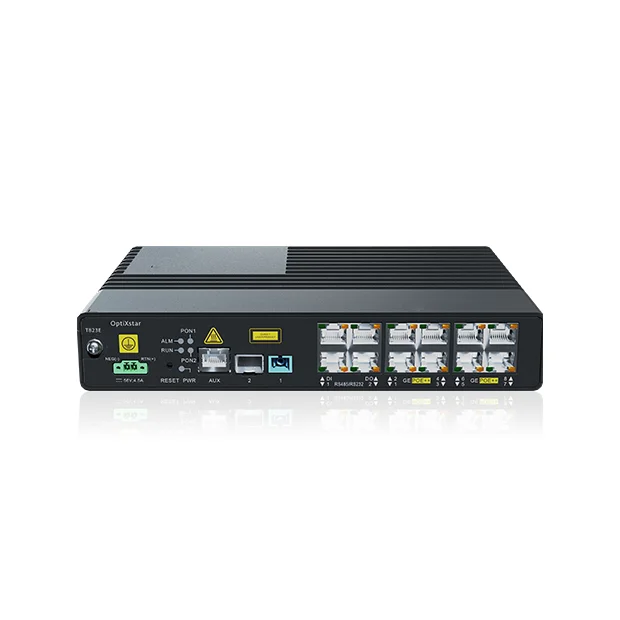
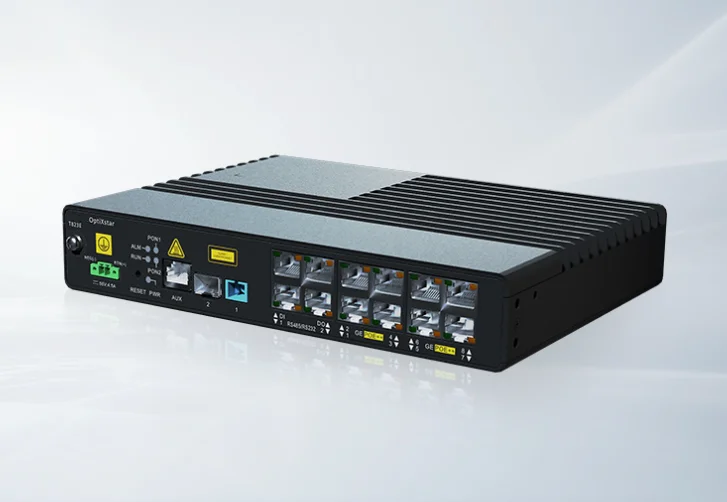
| An industrial Optical Network Unit (ONU) in Industrial Optical Network Solution, T823E-G has two Gigabit Passive Optical Network (GPON) ports on the network side, and eight GE ports, featuring Power over Ethernet Plus Plus (PoE++) support, on the user side. With high-performance forwarding capabilities, the device is an integral part of network solutions for a wide range of industrial scenarios, from transportation to public security. | |
| Specifications | |
| Parameters | T823E-G |
| Dimensions (H x W x D) | 43.6 x 250 x 180 mm (without mounting ears) |
| 43.6 x 482.6 x 180 mm (with mounting ears) | |
| Weight (Without Power Adapter) | Approximately 2.5 kg |
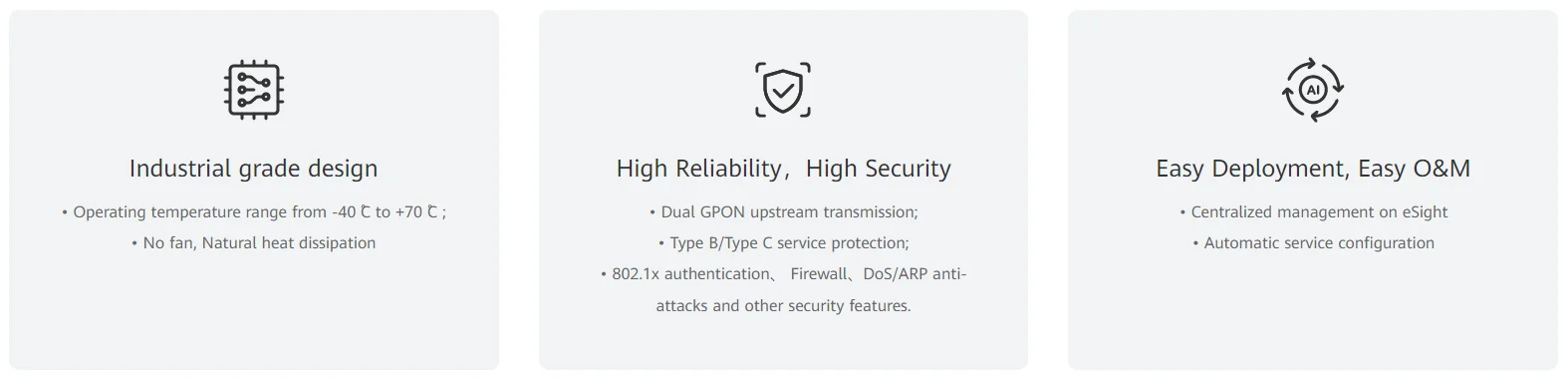
| Operating Temperature | –40°C to +70°C |
| Operating Humidity | 5–95% RH (non-condensing) |
| System Power Supply | DC 54 V to 57 V |
| Rated Voltage and Current | 56 V DC, 4.5 A |
| Maximum PoE Power | 220 W (total power consumption) |
| Consumption | 60 W (each GE port power consumption) |
| Surge Protection | Ethernet port: common mode 6 kV; differential mode 1.5 kV |
| DC power port: common mode 4 kV; differential mode 2 kV | |
| Maximum Power Consumption | Approximately 240 W |
| NNI | 1 x GPON SFP+ and 1 x GPON BOB |
| UNI | 8 x GE (PoE++) + 2 x RS485/RS232 + 1 x DI + 1 x DO |
| Installation Mode | Cabinet or network box |
| Protection Level | IP40 |
| Authentication | 802.1X |
| PON Port | • Port type: SC/UPC |
| • Standard compliance: ITU-T G.984, Class B+ | |
| • Maximum transmission distance: 20 km | |
| • Transmission rate: RX: 2.488 Gbit/s; TX: 1.244 Gbit/s | |
| • Optical receiver sensitivity: –27 dBm | |
| • Overload optical power: –8 dBm | |
| Ethernet Electrical Port | • Port type: RJ-45 |
| • PoE++, complies with IEEE 802.3af, IEEE 802.3at, IEEE 802.3bt | |
| • Auto port speeds (10/100/1000 Mbit/s) | |
| RS485 Port | • Port type: RJ-45 |
| • Complies with TIA/EIA-485, ITU-T V.24, ITU-T V.28 | |
| RS232 Port | • Port type: RJ-45 |
| • Complies with TIA/EIA-232, ITU-T V.24, ITU-T V.28 | |
| DI/DO Port | • Port type: RJ-45 |
| • The DI is connected to devices such as the door status sensor, infrared sensor or other devices | |
| • The DO is connected to the external alarm device or other devices | |