|
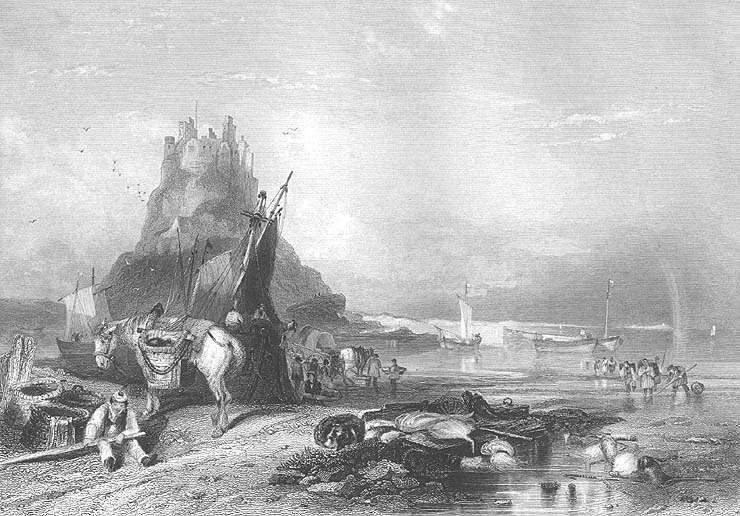
CASTLE OF HOLY ISLAND. FROM THE WESTWARD.
Artist: G. Balmer ____________ Engraver: H. Griffiths |
 Note: the title in the table above is printed below the engraving
CLICK HERE TO SEE MORE TOPOGRAPHICAL VIEWS OF ENGLISH COAST SCENERY LIKE THIS ONE!!
AN ANTIQUE STEEL ENGRAVING PRINTED IN THE EARLY 1840s!! VERY OLD WORLD! INCREDIBLE DETAIL!
 The Castle of Holy Island stands on a steep rock, about half a mile to the eastward of the Abbey. It is wholly inaccessible, except by a winding pass cut through the rock on the south side. The date of its foundation is unknown; but it is supposed to have been first built by the monks, as a place of refuge against the piratical attacks of the Danes, who frequently annoyed them, and twice burnt their abbey. The most memorable event in the meagre history of this castle is its capture for the Pretender, by two men, Launcelot Errington, and his nephew Mark, in 1715. The garrison at that time consisted of a sergeant, a corporal, and ten or twelve men. Errington, who was master of a little vessel then lying in the harbour, invited the sergeant, and such of his men as were not on duty, to drink with him on board of his ship. The invitation being accepted, he plied them so well with brandy as to render them incapable of opposition. "Framing an excuse for going ashore, he proceeded to the castle with his nephew, and succeeded in turning out the old gunner, the corporal, and two soldiers, being all that were on duty. He then shut the gates, and hoisted the Pretender's colours, but being disappointed in the succour which he expected, and a party of the king's troops arriving from Berwick, he and his nephew made their escape over the castle walls, and endeavoured to conceal themselves among the rocks and sea-weed, to the south-eastward of the castle till it was dark, when they intended to swim to the mainland. In consequence of the rising of the tide, they were obliged to swim while it was yet light, and, being perceived by the soldiers, they were taken, and conveyed to Berwick gaol, from which, however, they broke out before they were brought to trial, and escaped to France. On the suppression of the rebellion they took the benefit of the general pardon, and returned to England.
Holy Island is of an irregular form. Its greatest length, including a low sandy point, which stretches out towards the west-north-west, is about two and a half miles. Its mean breadth does not exceed a mile and a half. Holy Island harbour is a small bay or haven on the south side of the island, between the castle and the ruins of the monastery. On the bar, which is about a mile distant from the town, there is about nine feet at low water at spring-tides. The flood then sets with a strong current in the channel between the island and the mainland; and at high-water there is twenty-four feet on the bar. There is no lighthouse on Holy Island, but there is a beacon on the "Heugh"-a hill between the town and the harbour-on which, in bad weather, when pilots cannot get off, a flag is hoisted during the time of tide that ships may safely enter. In gales of wind from the eastward, coasting vessels sometimes seek shelter in Holy Island harbour, and find good anchorage before the town in three fathoms at low-water.
The Staples and Farn islands, with the rocks and shoals between them and Holy Island, render the in-shore navigation of the coast of Northumberland, from North Sunderland point to the mouth of the Tweed, extremely intricate and hazardous; and the corporation of the Trinity House, London, caution all masters of ships, and especially strangers to the coast, not to attempt sailing within those islands and shoals; more particularly on account of the various settings of the rapid tide which runs in the different sounds between the islands.
A visit to the Farn and Staple islands, from Bambrough or Holy Island, forms a pleasant excursion in fine weather, more especially when the eider ducks are sitting, which is from about the middle of May to the latter end of July. These birds, which are seldom seen, and do not breed to the southward of the Farn islands, are also known in the neighbourhood by the name of St. Guthbert's ducks. Their eggs, and the fine down with which they line their nests, are collected and sold by the person who rents the islands, which are also the haunt of several other species of water-fowl, such as the sheldrake, the cormorant, and the shag, with auks, guillemots, terns, and gulls. Solan geese also visit the Farn islands, but do not breed there, commonly making their appearance early in spring, and departing before May.
The Castle of Holy Island stands on a steep rock, about half a mile to the eastward of the Abbey. It is wholly inaccessible, except by a winding pass cut through the rock on the south side. The date of its foundation is unknown; but it is supposed to have been first built by the monks, as a place of refuge against the piratical attacks of the Danes, who frequently annoyed them, and twice burnt their abbey. The most memorable event in the meagre history of this castle is its capture for the Pretender, by two men, Launcelot Errington, and his nephew Mark, in 1715. The garrison at that time consisted of a sergeant, a corporal, and ten or twelve men. Errington, who was master of a little vessel then lying in the harbour, invited the sergeant, and such of his men as were not on duty, to drink with him on board of his ship. The invitation being accepted, he plied them so well with brandy as to render them incapable of opposition. "Framing an excuse for going ashore, he proceeded to the castle with his nephew, and succeeded in turning out the old gunner, the corporal, and two soldiers, being all that were on duty. He then shut the gates, and hoisted the Pretender's colours, but being disappointed in the succour which he expected, and a party of the king's troops arriving from Berwick, he and his nephew made their escape over the castle walls, and endeavoured to conceal themselves among the rocks and sea-weed, to the south-eastward of the castle till it was dark, when they intended to swim to the mainland. In consequence of the rising of the tide, they were obliged to swim while it was yet light, and, being perceived by the soldiers, they were taken, and conveyed to Berwick gaol, from which, however, they broke out before they were brought to trial, and escaped to France. On the suppression of the rebellion they took the benefit of the general pardon, and returned to England.
Holy Island is of an irregular form. Its greatest length, including a low sandy point, which stretches out towards the west-north-west, is about two and a half miles. Its mean breadth does not exceed a mile and a half. Holy Island harbour is a small bay or haven on the south side of the island, between the castle and the ruins of the monastery. On the bar, which is about a mile distant from the town, there is about nine feet at low water at spring-tides. The flood then sets with a strong current in the channel between the island and the mainland; and at high-water there is twenty-four feet on the bar. There is no lighthouse on Holy Island, but there is a beacon on the "Heugh"-a hill between the town and the harbour-on which, in bad weather, when pilots cannot get off, a flag is hoisted during the time of tide that ships may safely enter. In gales of wind from the eastward, coasting vessels sometimes seek shelter in Holy Island harbour, and find good anchorage before the town in three fathoms at low-water.
The Staples and Farn islands, with the rocks and shoals between them and Holy Island, render the in-shore navigation of the coast of Northumberland, from North Sunderland point to the mouth of the Tweed, extremely intricate and hazardous; and the corporation of the Trinity House, London, caution all masters of ships, and especially strangers to the coast, not to attempt sailing within those islands and shoals; more particularly on account of the various settings of the rapid tide which runs in the different sounds between the islands.
A visit to the Farn and Staple islands, from Bambrough or Holy Island, forms a pleasant excursion in fine weather, more especially when the eider ducks are sitting, which is from about the middle of May to the latter end of July. These birds, which are seldom seen, and do not breed to the southward of the Farn islands, are also known in the neighbourhood by the name of St. Guthbert's ducks. Their eggs, and the fine down with which they line their nests, are collected and sold by the person who rents the islands, which are also the haunt of several other species of water-fowl, such as the sheldrake, the cormorant, and the shag, with auks, guillemots, terns, and gulls. Solan geese also visit the Farn islands, but do not breed there, commonly making their appearance early in spring, and departing before May.
PRINT DATE: This lithograph was printed in 1840; it is not a modern reproduction in any way.
PRINT SIZE: Overall print dimensions are 7 inches by 10 inches including a white border of approximately one inch on each side (not shown).
PRINT CONDITION: Condition is fine. Bright and clean. Blank on reverse.
BIOGRAPHY OF ARTIST: George Balmer (Born Mar 1806, North Shields Northumberland, died 10 Apr 1846, Ravensworth, London) was a British north-country artist who brought a looming power to his work. He was famous for his storm scenes and did a tempestuous view of Berwick lighthouse.
SHIPPING:Buyers to pay shipping/handling, domestic orders receives priority mail, international orders receive regular mail.
We pack properly to protect your item!
Please note: the terms used in our auctions for engraving, heliogravure, lithograph, print, plate, photogravure etc. are ALL prints on paper, NOT blocks of steel or wood. "ENGRAVINGS", the term commonly used for these paper prints, were the most common method in the 1700s and 1800s for illustrating old books, and these paper prints or "engravings" were inserted into the book with a tissue guard frontis, usually on much thicker quality rag stock paper, although many were also printed and issued as loose stand alone prints. So this auction is for an antique paper print(s), probably from an old book, of very high quality and usually on very thick rag stock paper.
EXTREMELY RARE IN THIS EXCELLENT CONDITION!
|