|
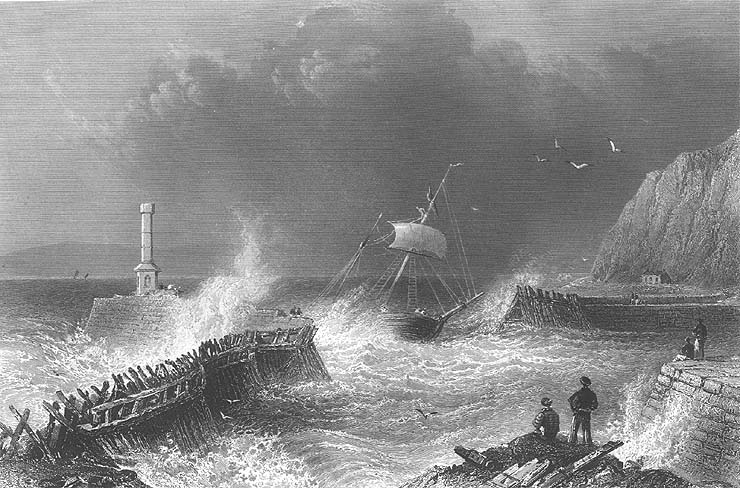
MARYPORT PIER
Artist: William Henry Bartlett ____________ Engraver: H. Griffiths |
 Note: the title in the table above is printed below the engraving
CLICK HERE TO SEE MORE TOPOGRAPHICAL VIEWS OF ENGLISH COAST SCENERY LIKE THIS ONE!!
AN ANTIQUE STEEL ENGRAVING PRINTED IN THE EARLY 1840s!! VERY OLD WORLD! INCREDIBLE DETAIL!
 The subject of our engraving is a scene but too often visible on ourcoa,sts, and by no means peculiar to Maryport. The storm is evidently exhausting its fury upon the Pier and Lighthouse in vain, they are destined to sustain the shock of many such rude assaults, and to afford that shelter and warning to mariners so requisite in the hour of Ocean's rage. The coast of Cumberland is at all times of the year rough and inhospitable to the sailor; but at the equinoxes, especially the autumnal one, its dangers are more imminent; and the trading vessels in the Solway Frith and Irish Channel, are exposed to serious risk. Owing to the numerous shoals and sand-banks lying at various points, the navigation is at all times intricate; and even to those best acquainted with its peculiarities, the passage from Ireland is frequently attended with greater hazard than many longer voyages.
The Town of Maryport is the subject of another view, and in the notice accompanying it will be found such particulars as we could glean in connection with this small but bustling port. The Pier itself, though well adapted for the purposes of illustration, is not a subject upon which we can profitably occupy the reader's attention; we shall, therefore, avail ourselves of the opportunity thus afforded us to say a few words upon one of the finest of the English lakes, situated within a few miles of Maryport, and a visit to which is a favourite excursion with its inhabitants and visitors. It is to the far-famed Derwent Water that we allude. It occupies a beautiful valley, surrounded by romantic mountains, its shores and islands, covered with luxurious wood, and towards Keswick its northern extremity opening to a spacious and fertile plain. The mountains on the eastern side of the lake are finely broken, in some places presenting precipices mingled with copse wood and verdure; the chasms of the rocks discharging a great many streams in beautiful falls. The mountains on the western side of Derwent Water are more regular in their forms, generally verdant, and adorned with a profusion of wood near the water's edge. At the southern extremity of the lake, three miles from the town, is Lowdore waterfall, the height of which is said to be not less than 200 feet. It is a very considerable stream, rushing through an immense chasm, and bounding over huge blocks of stone, with which the channel is filled. Near the fall is Gowdar Crag and Shepherd's Crag, constituting one of the finest scenes amongst the lakes.
The manor of Derwentwater belonged to a family which derived their name from it. In the reign of Henry VI., the heiress of Sir John de Derwentwater married Sir Nicholas Radcliffe, of Dilston, in Northumberland, whose descendant, Sir Francis Kadcliffe, was created by King James II. Earl of Derwentwater, &c. James, the second earl, having been engaged in the rebellion of 1715, was beheaded on Tower-hill; and the Derwentwater estates, becoming forfeited to the Crown, were granted to Greenwich Hospital, by Act of Parliament. Lords' Island, in the lake, was the residence of the earls.
The beautiful scenery of Derwent Water, said to be about ten miles in circumference, has often been described. St. Herbert's Island is named from a hermitage dedicated to that saint. Vicar's Island formerly belonged to Fountain's Abbey. Rampsholm, a small island, is covered with wood. The fish in greatest estimation in the lake is a sort of salmon trout. The celebrated mountain Skiddaw, in this vicinity, said to be about 3036 feet in height, extends to several townships; that part which is in Crossthwaite parish is within the townships of Under Skiddaw and Crossthwaite, and comprises the manor of Brundholm. The mountain is easy of access; and, standing in some measure detached, the view from the summit, particularly to the north and west, is not intercepted by other mountains: it comprehends the principal part of the county, including the coast from St. Bees Head to the head of Solway Frith, with its several bays and promontories, the Isle of Man, and a considerable portion of the southern part of Scotland. The summit of Ingleborough-hill, in Yorkshire, may be seen over the range of hills bounding the head of Ullswater; and a glimpse of the sea near Lancaster is obtained through the gap of Dunmel Raise. Derwent Water and Bassenth waite lake are the only lakes seen, and but one of these from the summit. The views from the neighbouring mountains may exceed in grandeur the view from the summit of this, but in no other ascent are the prospects equalled, which unfold themselves when overlooking the lake and vale of Keswick, with Borrowdale and Newlands mountains.
The subject of our engraving is a scene but too often visible on ourcoa,sts, and by no means peculiar to Maryport. The storm is evidently exhausting its fury upon the Pier and Lighthouse in vain, they are destined to sustain the shock of many such rude assaults, and to afford that shelter and warning to mariners so requisite in the hour of Ocean's rage. The coast of Cumberland is at all times of the year rough and inhospitable to the sailor; but at the equinoxes, especially the autumnal one, its dangers are more imminent; and the trading vessels in the Solway Frith and Irish Channel, are exposed to serious risk. Owing to the numerous shoals and sand-banks lying at various points, the navigation is at all times intricate; and even to those best acquainted with its peculiarities, the passage from Ireland is frequently attended with greater hazard than many longer voyages.
The Town of Maryport is the subject of another view, and in the notice accompanying it will be found such particulars as we could glean in connection with this small but bustling port. The Pier itself, though well adapted for the purposes of illustration, is not a subject upon which we can profitably occupy the reader's attention; we shall, therefore, avail ourselves of the opportunity thus afforded us to say a few words upon one of the finest of the English lakes, situated within a few miles of Maryport, and a visit to which is a favourite excursion with its inhabitants and visitors. It is to the far-famed Derwent Water that we allude. It occupies a beautiful valley, surrounded by romantic mountains, its shores and islands, covered with luxurious wood, and towards Keswick its northern extremity opening to a spacious and fertile plain. The mountains on the eastern side of the lake are finely broken, in some places presenting precipices mingled with copse wood and verdure; the chasms of the rocks discharging a great many streams in beautiful falls. The mountains on the western side of Derwent Water are more regular in their forms, generally verdant, and adorned with a profusion of wood near the water's edge. At the southern extremity of the lake, three miles from the town, is Lowdore waterfall, the height of which is said to be not less than 200 feet. It is a very considerable stream, rushing through an immense chasm, and bounding over huge blocks of stone, with which the channel is filled. Near the fall is Gowdar Crag and Shepherd's Crag, constituting one of the finest scenes amongst the lakes.
The manor of Derwentwater belonged to a family which derived their name from it. In the reign of Henry VI., the heiress of Sir John de Derwentwater married Sir Nicholas Radcliffe, of Dilston, in Northumberland, whose descendant, Sir Francis Kadcliffe, was created by King James II. Earl of Derwentwater, &c. James, the second earl, having been engaged in the rebellion of 1715, was beheaded on Tower-hill; and the Derwentwater estates, becoming forfeited to the Crown, were granted to Greenwich Hospital, by Act of Parliament. Lords' Island, in the lake, was the residence of the earls.
The beautiful scenery of Derwent Water, said to be about ten miles in circumference, has often been described. St. Herbert's Island is named from a hermitage dedicated to that saint. Vicar's Island formerly belonged to Fountain's Abbey. Rampsholm, a small island, is covered with wood. The fish in greatest estimation in the lake is a sort of salmon trout. The celebrated mountain Skiddaw, in this vicinity, said to be about 3036 feet in height, extends to several townships; that part which is in Crossthwaite parish is within the townships of Under Skiddaw and Crossthwaite, and comprises the manor of Brundholm. The mountain is easy of access; and, standing in some measure detached, the view from the summit, particularly to the north and west, is not intercepted by other mountains: it comprehends the principal part of the county, including the coast from St. Bees Head to the head of Solway Frith, with its several bays and promontories, the Isle of Man, and a considerable portion of the southern part of Scotland. The summit of Ingleborough-hill, in Yorkshire, may be seen over the range of hills bounding the head of Ullswater; and a glimpse of the sea near Lancaster is obtained through the gap of Dunmel Raise. Derwent Water and Bassenth waite lake are the only lakes seen, and but one of these from the summit. The views from the neighbouring mountains may exceed in grandeur the view from the summit of this, but in no other ascent are the prospects equalled, which unfold themselves when overlooking the lake and vale of Keswick, with Borrowdale and Newlands mountains.
PRINT DATE: This lithograph was printed in 1840; it is not a modern reproduction in any way.
PRINT SIZE: Overall print dimensions are 7 inches by 10 inches including a white border of approximately one inch on each side (not shown).
PRINT CONDITION: Condition is fine. Bright and clean. Blank on reverse.
BIOGRAPHY OF ARTIST: William Henry Bartlett, (born in London, 26 March 1809; died at sea off Malta, 13 Sept 1854) was an English artist most popularly known for his paintings of the Near East, Continental Europe and North America. He was a prolific artist and an intrepid traveller, with most of his work widely known through the numerous engravings made after his drawings and published in his own and other writers' topographical books. His primary concern was to extract the picturesque aspects of a place and by means of established pictorial conventions to render 'lively impressions of actual sights', as he wrote in the preface to The Nile Boat (London, 1849). His views of the major towns and coastal scenery of great britain were completed in 1840 & 1841 and show many of the resort towns, ports & harbours of the time. The interest in these engravings today is as much for the quality of the rendering and presentation of the architecture of the period as it is for the representation of the landscape & view.
SHIPPING:Buyers to pay shipping/handling, domestic orders receives priority mail, international orders receive regular mail.
We pack properly to protect your item!
Please note: the terms used in our auctions for engraving, heliogravure, lithograph, print, plate, photogravure etc. are ALL prints on paper, NOT blocks of steel or wood. "ENGRAVINGS", the term commonly used for these paper prints, were the most common method in the 1700s and 1800s for illustrating old books, and these paper prints or "engravings" were inserted into the book with a tissue guard frontis, usually on much thicker quality rag stock paper, although many were also printed and issued as loose stand alone prints. So this auction is for an antique paper print(s), probably from an old book, of very high quality and usually on very thick rag stock paper.
EXTREMELY RARE IN THIS EXCELLENT CONDITION!
|