A rare large original May 28, 1841 double broadside for Dion Boucicault's play London Assurance at the Theatre Royal, Covent Garden. Dimensions nineteen and a half by nineteen and a half inches. Edgewear otherwise good. See Dion Boucicault's extraordinary biography and the story of the Theatre Royal, Covent Garden below.
Combined shipping discounts for buyers of multiple items. Inquiries always welcome. Please visit my other eBay items--some ending soon--for more early theatre, opera, music and historical autographs, broadsides, photographs, and programs and great actor and actress cabinet photos and CDV's.
From Wikipedia:
Dionysius Lardner "Dion" Boucicault/ˈdaɪˌɒnˈbuːsɪˌkoʊ/[1] (né Boursiquot; 26 December 1820[2] – 18 September 1890) was an Irish actor and playwright famed for his melodramas. By the later part of the 19th century, Boucicault had become known on both sides of the Atlantic as one of the most successful actor-playwright-managers then in the English-speaking theatre. The New York Times hailed him in his obituary as "the most conspicuous English dramatist of the 19th century";[3] he and his second wife, Agnes Robertson Boucicault, applied for, and received, American citizenship in 1873.[4]
Life and career
Early life
Boucicault was born Dionysius Lardner Boursiquot in 1820 Dublin, where his family lived on Gardiner Street. His mother was Anne Maria Laura Beresford, sister of the poet and mathematician George Darley. The Darleys were an important Anglo-Irish Dublin family influential in many fields and related to the Guinnesses by marriage. Anne was married to Samuel Smith Boursiquot, of Huguenot ancestry,[5] but the identity of Dion's father is uncertain. He was probably Dionysius Lardner,[6] who was a lodger at Anne Boursiquot's house at a time when she had recently separated from her husband.[7] Lardner later gave Dion Boucicault financial support until about 1840.[8]
In 1828, Lardner was elected as professor of natural philosophy and astronomy at University College London ('London University' at the time), a position he held until he resigned in 1831. Anne Boursiquot followed him to London in 1828, taking all but one of her children with her.[citation needed]
Consequently, Dion Boucicault attended various schools in and around London; there is confusion about the details of his education. Richard Fawkes has addressed this in a biography. For about four years, from 1829, Boucicault seems to have attended a very small private school in Hampstead kept by a Mr Hessey; between 1833 and 1835 he was at University College School, where he began his friendship with Charles Kenney. He later recalled having boarded in Euston Square with a Rev. Henry Stebbing, a historian. There is a gap of two years in the record, when Fawkes believes Boucicault may have attended Rowland Hill's Bruce Castle School, as stated in the Dictionary of National Biography.
In 1837, he was enrolled at Wyke House, a school at Sion Hill, Brentford, kept by a Dr Alexander Jamieson. There he appeared in a school play, in the part of Rolla in Sheridan's Pizarro. He also wrote his own first play, The Old Guard, which was produced some years later.[9]
When Boucicault was in his late teens, his mother persuaded a cousin, Arthur Lee Guinness (second son of Arthur Guinness (the Second)), to give her son a job as a clerk in the Dublin brewery. He began an affair with Guinness,[10] which caused a crisis in his cousin's family. In 1840 Boucicault returned to London flush with cash, thought to be the result of blackmail or the family having paid him off. He enrolled as a student at the Dean Street Academy. He later claimed Guinness paid for his tuition and had made him his heir. The allowance was stopped and Boucicault became penniless.[11]
Work as actor and playwright
Boucicault took up an acting offer in Cheltenham, adopting the stage name of Lee Morton.[12] He joined William Charles Macready and made his first appearance on stage with Benjamin Webster at Bristol. Soon after this he began to write plays, occasionally in conjunction with his acting.
Painting by Edward Henry Corbould depicting a scene from Boucicault's The Corsican Brothers, 1852
Boucicault rapidly followed this with a number of other plays, among the most successful being The Bastile[sic], an "after-piece" (1842), Old Heads and Young Hearts (1844), The School for Scheming (1847), Confidence (1848), and The Knight Arva (1848), all produced at Her Majesty's Theatre.[14] He had further great successes with The Corsican Brothers (1852, for Charles Kean) and Louis XI (1855), both adaptations of French plays.
In his The Vampire (1852), Boucicault made his début as a leading actor, appearing as the vampire Sir Alan Raby. Although the play received mixed reviews, Boucicault's characterisation was praised as "a dreadful and weird thing played with immortal genius".[15] In 1854 he wrote Andy Blake; or, The Irish Diamond and also played the title character.[16]
From 1854 to 1860, Boucicault resided in the United States, where he was always a popular favourite. Boucicault and his actress wife, Agnes Robertson, toured America. He also wrote many successful plays there, acting in most of them. These included the popular Jessie Brown; or, The Relief of Lucknow in 1858.[16]
Work as theatre manager and producer
From around 1855 his business manager and partner in New York was William Stuart, an expatriate Irish MP and adventurer. Together they leased Wallack's Theatre in 1855–1856, and put on a short season at the Washington Theatre in Washington D.C.[17][18]
In late 1855, while his wife was performing in St. Louis, Boucicault leased the Varieties Theatre in New Orleans. He quickly renamed it the Gaity and was set to open its doors on 28 November. A short delay pushed the opening night back to 1 December with his play Used Up. During his stay in New Orleans, a false report of his death began to circulate. This rumor was proven false when days later on 20 December he presented The Chameleon at the Gaiety. This was the first appearance of Agnes Robertson at the Gaiety. Shortly after, on 26 February of 1856 Boucicualt was in the market to sell his lease. By 8 March he was out and heading to New York.[19]
In the summer of 1859, Boucicault and William Stuart jointly leased Burton's New Theatre (originally Tripler's Theatre) on Broadway just below Amity Street. After extensive remodeling, he renamed his new showplace the Winter Garden Theatre.[18] There on 5 December 1859, he premiered his new sensation, the anti-slavery potboiler The Octoroon, in which he also starred. This is considered the first play to explore the lives of the Black American population, the majority of whom were still enslaved.[8]
Poster for a production of Boucicault's farceContempt of Court, c. 1879. From the Library of Congress
Boucicault fell out with Stuart over money matters, and he returned to England. There he produced at the Adelphi Theatre a dramatic adaptation of a Gerald Griffin novel, The Collegians, entitled The Colleen Bawn. This play, one of the most successful of the times, was performed in almost every city of the United Kingdom and the United States. Julius Benedict used it as the basis for his opera The Lily of Killarney. Although the play earned a handsome fortune for Boucicault, he lost it while managing various London theatres.[13]
After returning to England, Boucicault was asked by noted American comedian Joseph Jefferson, who also starred in the production of Octoroon, to rework Jefferson's adaptation of Washington Irving's Rip van Winkle. Their play opened in London in 1865 and on Broadway in 1866.[20]
Boucicault's next marked success was at the Princess's Theatre, London in 1864 with Arrah-na-Pogue in which he played the part of a County Wicklow, Ireland carman. This, and his admirable creation of "Conn"[21] in his play The Shaughraun (first produced at Wallacks Theatre, New York City, in 1874, then at the Theatre Royal, Drury Lane in 1875), won him the reputation of being the best "Stage Irishman" of his time. W. S. Gilbert referred to the notable actor in the libretto of his 1881 operetta Patience in the line: "The pathos of Paddy, as rendered by Boucicault".
Again in partnership with William Stuart, he built the New Park Theatre in 1873–1874.[22][23] However, Boucicault withdrew from the business just before the theatre opened. Stuart teamed up instead with the actor, playwright and theatre manager Charles Fechter to run the house.[24]
In 1875 Boucicault returned to New York City, where he made his home; for a time his manager was Harry J. Sargent.[25] In the same year, his adaptation of Samuel Richardson's 1748 novel Clarissa premiered at Wallack's Theatre.[26] He wrote the melodrama Contempt of Court (poster, left) in 1879, but he paid occasional visits to London and elsewhere (e.g. Toronto[27]). He made his last appearance in London in his play, The Jilt, in 1885.[citation needed]
Boucicault was an excellent actor, especially in pathetic parts. His uncanny ability to play these low-status roles earned him the nickname "Little Man Dion" in theatrical circles. His plays are for the most part adaptations, but are often very ingenious in construction. They have had great popularity.[citation needed]
Dion Boucicault (date unknown)
Family life
Boucicault was married three times. He married the much older Anne Guiot at St Mary-at-Lambeth on 9 July 1845. He claimed that she died in a Swiss mountaineering accident later in the same year, though she may in fact have died as late as 1848.[28][29] In 1853, he eloped with Agnes Kelly Robertson (1833–1916) to marry in New York. She was Charles Kean's ward; the juvenile lead in his company[29] and an actress of unusual ability. She would bear Dion six children: Dion William Boucicault (1855–1876); Eva Boucicault (1857–1909); Dion Jr. (1859–1929); Patrice Boucicault (1862–1890); Nina Boucicault (1867–1950); Aubrey (1868–1913);[30] three of whom became distinguished actors in their own right. Patrice became a society singer, marrying George Pitman in 1885 but died in childbirth in 1890.[31] His granddaughter Rene Boucicault (1898–1935), Aubrey's daughter, became an actress and acted in silent films. His eldest son Dion William was killed in the Abbots Ripton rail accident on the East Coast Main Line in England on 21 January 1876.[32]
Between 11 July and 8 October 1885, Boucicault toured Australia, where his brother Arthur lived.[33] Towards the end of this tour, he suddenly left Agnes to marry Josephine Louise Thorndyke (c. 1864–1956), a young actress, on 9 September 1885, in Sydney.[33] This aroused scandal on both sides of the Atlantic Ocean, as his marriage to Agnes was not finally dissolved until 21 June 1888, by reason of "bigamy with adultery". The rights to many of his plays were later sold to finance alimony payments to his second wife.[34]
His last play, A Tale of a Coat, opened at Daly's Theatre in New York on 14 August 1890, and closed on 13 September 1890.[35]
Boucicault died in 1890 in New York City, and was buried in Mount Hope Cemetery, Hastings, Westchester County, New York.[3][36][37]
The Royal Opera House (ROH) is a theatre in Covent Garden, central London. The building is often referred to as simply Covent Garden, after a previous use of the site. The ROH is the main home of The Royal Opera, The Royal Ballet, and the Orchestra of the Royal Opera House, which are known collectively as the Royal Ballet and Opera.
The first theatre on the site, the Theatre Royal (1732), served primarily as a playhouse for the first hundred years of its history. In 1734, the first ballet was presented. A year later, the first season of operas, by George Frideric Handel, began. Many of his operas and oratorios were specifically written for Covent Garden and had their premieres there.
The current building is the third theatre on the site, following disastrous fires in 1808 and 1856 to previous buildings.[2] The façade, foyer, and auditorium date from 1858, but almost every other element of the present complex dates from an extensive reconstruction in the 1990s.
The main auditorium seats 2,256 people, making it the third largest in London, and consists of four tiers of boxes and balconies and the amphitheatre gallery. The proscenium is 14.80 metres (48 ft 7 in) wide, with the stage of the same depth and 12.20 metres (40 ft 0 in) high. The main auditorium is a Grade I listed building.[3]
The Royal Opera House companies were rebranded as the Royal Ballet and Opera in 2024, but the building retains the title of The Royal Opera House.[4][5]
History
Davenant patent
"Rich's Glory": John Rich seemingly invades his new Covent Garden Theatre. (caricature by William Hogarth)
The foundation of the Theatre Royal, Covent Garden lies in the letters patent awarded by Charles II to Sir William Davenant in 1662, allowing Davenant to operate one of only two patent theatre companies (The Duke's Company) in London. The letters patent remained in the possession of the patentees' heirs until the 19th century. Their whereabouts were unknown for some time, but as of 2019 they are held in the Rosenbach Museum & Library, Philadelphia.[6][7]
First theatre
The first theatre before the fire of 1808
In 1728, John Rich, actor-manager of the Duke's Company at Lincoln's Inn Fields Theatre, commissioned The Beggar's Opera from John Gay. The success of this venture provided him with the capital to build the Theatre Royal (designed by Edward Shepherd) at the site of an ancient convent garden. Inigo Jones had developed part of this property in the 1630s with a piazza and St Paul's church (now known colloquially as the actors' church). In addition, a royal charter had created a fruit and vegetable market in the area, a market which survived in that location until 1974.
At the opening of the theatre on 7 December 1732, Rich was carried by his actors in procession into the building for its inaugural production of William Congreve's The Way of the World.[8]
During its first century, the theatre was operated primarily as a playhouse, with the Letters Patent granted by Charles II giving the Theatre Royal, Covent Garden and Theatre Royal, Drury Lane exclusive rights to present spoken drama in London. Despite the frequent interchangeability between the two companies, competition was intense, and the companies often presented the same plays at the same time. Rich introduced pantomime to the repertoire, performing himself, under the stage name John Lun, as Harlequin. A tradition of seasonal pantomime continued at the modern theatre until 1939.[9]
In 1734, the theatre presented its first ballet, Pygmalion.[2]Marie Sallé discarded tradition and her corset and danced in diaphanous robes.[10] Around the same time, the auditorium ceiling was painted by Jacopo Amigoni as The Muses presenting Shakespeare to Apollo, which prompted a brief press dispute: The Weekly Register criticised the work as obscure and over-ornamented, while the rival Grub Street Journal printed point-by-point replies defending Amigoni.[11]George Frideric Handel was named musical director of the company at Lincoln's Inn Fields in 1719, but his first season of opera for the theatre was not presented until 1734. His first opera was Il pastor fido, followed by Ariodante (1735), and the première of Alcina, and Atalanta the following year. In 1743 there was a royal performance of Messiah; its success resulted in a tradition of Lentenoratorio performances. From 1735 until his death in 1759, Handel gave regular seasons at the theatre; many of his operas and oratorios were written for that venue or had their first London performances there. He bequeathed his organ to John Rich, and it was placed in a prominent position on the stage. It was among many valuable items lost in a fire that destroyed the theatre on 20 September 1808. In 1792 the architect Henry Holland rebuilt the auditorium; he expanded its capacity within the existing shell of the building.[12]
Second theatre
Satirical drawing, 1811, of the "Pigeon Holes" flanking the upper galleryAuditorium of the second theatre, 1810Joseph Grimaldi, as Clown
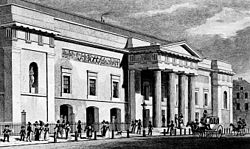
Rebuilding began in December 1808, and the second Theatre Royal, Covent Garden (designed by Robert Smirke) opened on 18 September 1809 with a performance of Macbeth followed by a musical entertainment called The Quaker.[13] The actor-manager John Philip Kemble, raised seat prices to help recoup the cost of rebuilding and the cost of an increased ground rent introduced by the landowner, the Duke of Bedford, but the move was so unpopular that audiences disrupted performances by beating sticks, hissing, booing and dancing. The Old Price Riots lasted over two months, and the management was finally forced to accede to the audience's demands.[14]
During this time, entertainment was varied; opera and ballet were presented, but not exclusively. Kemble engaged in a variety of acts, including the child performer Master Betty; the great clownJoseph Grimaldi made his name at Covent Garden. Many famous actors of the day appeared at the theatre, including the tragediennes Sarah Siddons and Eliza O'Neill, the Shakespearean actors William Macready, Edmund Kean and his son Charles. On 25 March 1833 Edmund Kean collapsed on stage while playing Othello, and died two months later.[15][2]
In 1806, the pantomime clown Joseph Grimaldi (The Garrick of Clowns) had performed his greatest success in Harlequin and Mother Goose; or the Golden Egg at Covent Garden, and this was subsequently revived, at the new theatre. Grimaldi was an innovator: his performance as Joey introduced the clown to the world, building on the existing role of Harlequin derived from the Commedia dell'arte. His father had been ballet-master at Drury Lane, and his physical comedy, his ability to invent visual tricks and buffoonery, and his ability to poke fun at the audience were extraordinary.[16]
Early pantomimes were performed as mimes accompanied by music, but as Music hall became popular, Grimaldi introduced the pantomime dame to the theatre and was responsible for the tradition of audience singing. By 1821 dance and clowning had taken such a physical toll on Grimaldi that he could barely walk, and he retired from the theatre.[17] By 1828, he was penniless; Drury Lane held a benefit concert for him after Covent Garden refused.[18]
The theatre in the 1820sHarlequin's escape into the bottle (print)
In 1817, bare flame gaslight had replaced the former candles and oil lamps that lighted the Covent Garden stage.[19] This was an improvement, but in 1837 Macready employed limelight in the theatre for the first time, during a performance of a pantomime, Peeping Tom of Coventry. Limelight used a block of quicklime heated by an oxygen and hydrogen flame. This allowed the use of spotlights to highlight performers on the stage.[20]
The Theatres Act 1843 broke the patent theatres' monopoly of drama. At that time Her Majesty's Theatre in the Haymarket was the main centre of ballet and opera but after a dispute with the management in 1846 Michael Costa, conductor at Her Majesty's, transferred his allegiance to Covent Garden, bringing most of the company with him. The auditorium was completely remodeled after an 1856 fire, during the following 1856–57 seasons, the company performed at the Lyceum Theatre.[21] The theatre reopened as the Royal Italian Opera on 6 April 1857 with a performance of Rossini's Semiramide.[22]
In 1852, Louis Antoine Jullien, the French eccentric composer of light music and conductor presented an opera of his own composition, Pietro il Grande. Five performances were given of the 'spectacular', including live horses on the stage and very loud music. Critics considered it a complete failure and Jullien was ruined and fled to America.[23][24]
Queen Victoria and Napoleon III at the second (1809–1856) Royal Opera House (18 or 19 April 1855)The fire of 5 March 1856
Costa and his successors presented all operas in Italian, even those originally written in French, German or English, until 1892, when Gustav Mahler presented the debut of Wagner's Ring cycle at Covent Garden.[25][26] The word "Italian" was then quietly dropped from the name of the opera house.[27]
The conjuror John Henry Anderson, who had exposed the Davenport brothers, leased the theatre to stage his shows which were critical of mediums and spiritualism. After a gala performance and bal masqué organised by Anderson, the theatre caught fire in the early hours of 5 March 1856 and was destroyed.[28][29]
The Royal English Opera company under the management of Louisa Pyne and William Harrison, made their last performance at Theatre Royal, Drury Lane, on 11 December 1858 and took up residence at Covent Garden on 20 December 1858 with the premiere of Michael Balfe's Satanella[31] – the first opera to have its world premiere at the new theatre – and continued there until 1865.[32]
The theatre became the Royal Opera House (ROH) in 1892, and the number of French and German works offered increased. Winter and summer seasons of opera and ballet were given, and the building was also used for pantomime, recitals and political meetings.




.jpg)