A rare large original January 25, 1864 Civil War theatre double broadside featuring E. A. Sothern in Our American Cousin, the play that Abraham Lincoln was watching when he was assassinated by John Wilkes Booth fifteen months later. Dimensions nineteen a half by nineteen inches. Edgewear otherwise good.
Combined shipping discounts for multiple purchases. Inquiries always welcome. Please visit my other eBay items--some ending soon--for more original 19th century Booth family memorabilia, early theatre, opera, film, and historical autographs, photographs, broadsides and programs, and great actor and actress cabinet photos and CDV's.
From Wikipedia:
Our American Cousin is a three-act comedy play by the English playwright Tom Taylor. It is a farce about an awkward, boorish American man named Asa Trenchard who is introduced to his aristocratic English relatives when he goes to England to claim the family estate. The play premiered with great success at Laura Keene's Theatre in New York City in 1858, with Laura Keene in the cast, the title character played by Joseph Jefferson, and Edward Askew Sothern playing Lord Dundreary. The play's long-running London production in 1861 was also successful.
The play quickly rose to great renown during its first few years and remained very popular throughout the second half of the 19th century. Despite achieving critical and audience acclaim throughout its production history, Our American Cousin became notorious as the play that U.S. President Abraham Lincoln was watching at Ford's Theatre in Washington, D.C. when he was assassinated by John Wilkes Booth, a Confederate sympathizer and stage actor who attempted to time his gunshot with the audience's laughter on a particularly famous line.
Theatrical acclaim and "Lord Dundreary"
Edward Sothern as Lord Dundreary, sporting his iconic "Dundrearies"-style sideburns
Among Our American Cousin's cast was British actor Edward Askew Sothern, playing Lord Dundreary, a good natured but brainless English aristocrat. Sothern had already achieved fame on the New York stage in the play Camille in 1856, and had been reluctant to take on the role because he felt that it was too small and unimportant.
Our American Cousin premiered in New York on 15 October 1858. After several weeks of performances, Sothern began portraying the role more broadly, as a lisping, skipping, eccentric, weak-minded fop prone to nonsensical references to sayings of his "bwother" Sam.[1] His ad-libs were a sensation, earning good notices for his physical comedy and spawning much imitation and mockery in both the United States and England. Sothern gradually expanded the role, adding gags and business until it became the central figure of the play. The most famous scene involved Dundreary reading a letter from his even sillier brother. The play ran for 150 nights, which was very successful for a New York run at the time.[2]
Sothern made his London debut when the play opened at the Haymarket Theatre on 11 November 1861. Reviews were mixed. The Morning Post praised Sothern, but said that the play could scarcely be said to be worthy of his talents;[3]The Athenaeum found the piece humorous and outrageous, and Sothern's performance "certainly the funniest thing in the world ... a vile caricature of an inane nobleman, intensely ignorant, and extremely indolent";[4]The Era thought the play "a hasty work, manufactured to suit the American market ... a sort of dramatic curiosity".[5] The play closed on 21 December 1861 after 36 performances; after this inauspicious start it was revived at the same theatre on 27 January 1862 and ran uninterruptedly until 23 December for 314 successive performances.[6] Sothern successfully revived the play many times, making Dundreary by far his most famous role.
"Dundrearyisms", twisted aphorisms in the style of Lord Dundreary (e.g. "birds of a feather gather no moss"), enjoyed a brief vogue. And the character's style of beard – long, bushy sideburns – gave the English language the word dundrearies. In his autobiography, writer George Robert Sims recalled that "we went Dundreary mad in '61. The shop windows were filled with Dundreary scarves, and Brother Sam scarves, and there were Dundreary collars and Dundreary shirts, and Dundrearyisms were on every lip."[7]
It was not long before the success of this play inspired an imitation, Charles Gayler's Our Female American Cousin, which opened in New York City in January 1859.[8] None of the characters from the original play appeared in this comedy. A number of sequel plays to Our American Cousin were written, all featuring several characters from the original, and focusing on the Lord Dundreary character. The first was Gayler's Our American Cousin at Home, or, Lord Dundreary Abroad, which premiered in Buffalo, New York, in November 1860,[9] and had its New York City debut the following May.[10] Later sequels included Henry James Byron's Dundreary Married and Done For,[2] and John Oxenford's Brother Sam (1862; revived in 1865), a play about Dundreary's brother.
Advertisement for The American Cousin (Washington Evening Star, 14 April 1865)
The play's 14 April 1865, performance at Ford's Theatre in Washington, D.C., became the most infamous in the play's history as the site of Abraham Lincoln's assassination by John Wilkes Booth. When Lincoln arrived at the theatre, the play was interrupted, and the orchestra played "Hail to the Chief" as the full house of about 1,700 rose in applause.[11] As production resumed, the cast modified a line of the play in honor of the president: when the heroine asked for a seat protected from the draft, the reply–a pun on draft evasion scripted as, "Well, you're not the only one that wants to escape the draft"–was delivered instead as, "The draft has already been stopped by order of the President!"[12] Halfway through Act III, Scene 2, the character of Asa Trenchard, played that night by Harry Hawk, utters this line, considered one of the play's funniest, to Mrs. Mountchessington:
Don't know the manners of good society, eh? Well, I guess I know enough to turn you inside out, old gal – you sockdologizing old man-trap!
1900 drawing of the assassination during the play
During the ensuing laughter, Booth, a famous actor and Confederate sympathizer who was not part of the play's cast, entered Lincoln's box and shot him in the back of the head, mortally wounding him. Familiar with the play, Booth had chosen that moment so that the audience's laughter would mask the sound of his gunshot. Booth stabbed Major Henry Rathbone as Rathbone came at him, then leapt from the box onto the stage and made his escape through the back of the theater to a horse he had left waiting in the alley, en route stabbing orchestra leader William Withers Jr.[13] That night, the remainder of the play was suspended.[14] Another performance eight days later, for the benefit of the investigation into the killing, was the last performance of any play at Ford's Theatre for 103 years. Since reopening, the theatre has not restaged Our American Cousin, and has said that it never will out of respect for the assassination.
Decades of controversy over slavery came to a head when Abraham Lincoln, a Republican who opposed slavery's expansion, won the 1860 presidential election. Seven Southern slave states responded to Lincoln's victory by seceding from the United States and forming the Confederacy. The Confederacy seized US forts and other federal assets within its borders. The war began on April 12, 1861, when the Confederacy bombarded Fort Sumter in South Carolina. A wave of enthusiasm for war swept over the North and South, as military recruitment soared. Four more Southern states seceded after the war began and, led by its president, Jefferson Davis, the Confederacy asserted control over a third of the US population in eleven states. Four years of intense combat, mostly in the South, ensued.
During 1861–1862 in the western theater, the Union made permanent gains—though in the eastern theater the conflict was inconclusive. The abolition of slavery became a Union war goal on January 1, 1863, when Lincoln issued the Emancipation Proclamation, which declared all slaves in rebel states to be free, applying to more than 3.5 million of the 4 million enslaved people in the country. To the west, the Union first destroyed the Confederacy's river navy by the summer of 1862, then much of its western armies, and seized New Orleans. The successful 1863 Union siege of Vicksburg split the Confederacy in two at the Mississippi River, while Confederate general Robert E. Lee's incursion north failed at the Battle of Gettysburg. General Ulysses S. Grant's western successes led to Lincoln's giving him command of all Union armies in 1864.
Inflicting an ever-tightening naval blockade of Confederate ports, the Union marshaled resources and manpower to attack the Confederacy from all directions. This led to the fall of Atlanta in 1864 to Union general William Tecumseh Sherman, followed by his March to the Sea, which culminated in his taking Savannah. The last significant battles raged around the ten-month Siege of Petersburg, gateway to the Confederate capital of Richmond. The Confederates abandoned Richmond, and on April 9, 1865, Lee surrendered to Grant following the Battle of Appomattox Court House, setting in motion the end of the war.[f] Lincoln lived to see this victory but was shot by an assassin on April 14, dying the next day.
By the end of the war, much of the South's infrastructure had been destroyed. The Confederacy collapsed, slavery was abolished, and four million enslaved black people were freed. The war-torn nation then entered the Reconstruction era in an attempt to rebuild the country, bring the former Confederate states back into the United States, and grant civil rights to freed slaves. The war is one of the most extensively studied and written about episodes in the history of the United States. It remains the subject of cultural and historiographical debate. Of continuing interest is the myth of the Lost Cause of the Confederacy. The war was among the first to use industrial warfare. Railroads, the electrical telegraph, steamships, the ironclad warship, and mass-produced weapons were widely used. The war left an estimated 700,000 soldiers dead, along with an undetermined number of civilian casualties, making it the deadliest in American history.[g] The technology and brutality of the Civil War foreshadowed the coming world wars.
The origins of the war were rooted in the desire of the Southern states to preserve the institution of slavery.[15] Historians in the 21st century overwhelmingly agree on the centrality of slavery in the conflict—at least for the Southern states. They disagree on the North's reasons for refusing to allow the Southern states to secede.[16] The pseudo-historical Lost Cause ideology denies that slavery was the principal cause of the secession, a view disproven by historical evidence, notably some of the seceding states' own secession documents.[17] After leaving the Union, Mississippi issued a declaration stating, "Our position is thoroughly identified with the institution of slavery—the greatest material interest of the world."[18][19]
The principal political battle leading to Southern secession was over whether slavery would expand into the Western territories destined to become states. Initially Congress had admitted new states into the Union in pairs, one slave and one free. This had kept a sectional balance in the Senate but not in the House of Representatives, as free states outstripped slave states in numbers of eligible voters.[20] Thus, at mid-19th century, the free-versus-slave status of the new territories was a critical issue, both for the North, where anti-slavery sentiment had grown, and for the South, where the fear of slavery's abolition had grown. Another factor leading to secession and the formation of the Confederacy was the development of white Southern nationalism in the preceding decades.[21] The primary reason for the North to reject secession was to preserve the Union, a cause based on American nationalism.[22]
Background factors in the run up to the Civil War were partisan politics, abolitionism, nullification versus secession, Southern and Northern nationalism, expansionism, economics, and modernization in the antebellum period. As a panel of historians emphasized in 2011, "while slavery and its various and multifaceted discontents were the primary cause of disunion, it was disunion itself that sparked the war."[23]
Portrait of Abraham Lincoln, an 1860 photograph portrait of Abraham Lincoln by Mathew Brady
Abraham Lincoln won the 1860 presidential election.[24] Southern leaders feared Lincoln would stop slavery's expansion and put it on a course toward extinction.[25] His victory triggered declarations of secession by seven slave states of the Deep South, all of whose riverfront or coastal economies were based on cotton that was cultivated by slave labor.
Lincoln was not inaugurated until March 4, 1861, four months after his 1860 election, which afforded the South time to prepare for war.[26] Nationalists in the North and "Unionists" in the South refused to accept the declarations of secession, and no foreign government ever recognized the Confederacy. The US government, under President James Buchanan, refused to relinquish the nation's forts, which the Confederacy claimed were located in their territory.
According to Lincoln, the American people had demonstrated, beginning with their victory in the American Revolution and Revolutionary War and subsequent establishment of a sovereign nation, that they could successfully establish and administer a republic. Yet, Lincoln believed, a question remained unanswered: Could the nation be maintained as a republic, with its government selected by vote of the people, in the face of internal attempts to destroy it or separate from it?[27]
Border Southern states that permitted slavery but did not secede (both KY and MO had dual competing Confederate and Unionist governments)
Union states that banned slavery
Territories
Lincoln's election provoked South Carolina's legislature to call a state convention to consider secession. South Carolina had done more than any other state to advance the notion that a state had the right to nullify federal laws and even secede. On December 20, 1860, the convention unanimously voted to secede and adopted a secession declaration. It argued for states' rights for slave owners but complained about states' rights in the North in the form of resistance to the federal Fugitive Slave Act, claiming that Northern states were not fulfilling their obligations to assist in the return of fugitive slaves. The "cotton states" of Mississippi, Florida, Alabama, Georgia, Louisiana, and Texas followed suit, seceding in January and February 1861.[26]
Division of the states during the American Civil War:
Union
Confederacy
Border states
Territories
Among the ordinances of secession, those of Texas, Alabama, and Virginia mentioned the plight of the "slaveholding states" at the hands of Northern abolitionists. The rest made no mention of slavery but were brief announcements by the legislatures of the dissolution of ties to the Union.[28] However, at least four—South Carolina,[29] Mississippi,[30] Georgia,[31] and Texas[32]—provided detailed reasons for their secession, all blaming the movement to abolish slavery and its influence over the North. Southern states believed that the Fugitive Slave Clause made slaveholding a constitutional right. These states agreed to form a new federal government, the Confederate States of America, on February 4, 1861.[33] They took control of federal forts and other properties within their boundaries, with little resistance from outgoing president James Buchanan, whose term ended on March 4. Buchanan said the Dred Scott decision was proof the Southern states had no reason to secede and that the Union "was intended to be perpetual". He added, however, that "The power by force of arms to compel a State to remain in the Union" was not among the "enumerated powers granted to Congress".[34] A quarter of the US army—the Texas garrison—was surrendered in February to state forces by its general, David E. Twiggs, who joined the Confederacy.[35]
In December 1860, the Crittenden Compromise was proposed to re-establish the Missouri Compromise line, by constitutionally banning slavery in territories to the north of it, while permitting it to the south. The Compromise would likely have prevented secession, but Lincoln and the Republicans rejected it.[39] Lincoln stated that any compromise that would extend slavery would bring down the Union.[40] A February peace conference met in Washington, proposing a solution similar to the Compromise; it was rejected by Congress. The Republicans proposed the Corwin Amendment, an alternative, not to interfere with slavery where it existed, but the South regarded it as insufficient. The remaining eight slave states rejected pleas to join the Confederacy, following a no-vote in Virginia's First Secessionist Convention on April 4.[41]
On March 4, Lincoln was sworn in as president. In his first inaugural address, he argued that the Constitution was a more perfect union than the earlier Articles of Confederation and Perpetual Union, was a binding contract, and that secession was "legally void".[42] He did not intend to invade Southern states, nor to end slavery where it existed, but he said he would use force to maintain possession of federal property,[42] including forts, arsenals, mints, and customhouses that had been seized.[43] "The mails, unless repelled, will continue to be furnished in all parts of the Union." Where conditions did not allow peaceful enforcement of federal law, US marshals and judges would be withdrawn. No mention was made of bullion lost from mints. He stated that it would be US policy "to collect the duties and imposts"; "there will be no invasion, no using of force against or among the people anywhere" that would justify an armed revolution. His speech closed with a plea for restoration of the bonds of union, famously calling on "the mystic chords of memory" binding the two regions.[42]
The Confederacy sent delegates to Washington to negotiate a peace treaty. Lincoln rejected negotiations, because he claimed that the Confederacy was not a legitimate government and to make a treaty with it would recognize it as such.[44] Lincoln instead attempted to negotiate directly with the governors of seceded states, whose administrations he continued to recognize.[45]
Complicating Lincoln's attempts to defuse the crisis was Secretary of State William H. Seward, who had been Lincoln's rival for the Republican nomination. Embittered by his defeat, Seward agreed to support Lincoln's candidacy only after he was guaranteed the executive office then considered the second most powerful. In the early stages of Lincoln's presidency Seward held little regard for him, due to his perceived inexperience. Seward viewed himself as the de facto head of government, the "prime minister" behind the throne. Seward attempted to engage in unauthorized and indirect negotiations that failed.[44] Lincoln was determined to hold all remaining Union-occupied forts in the seceded states: Fort Pickens, Fort Jefferson, and Fort Taylor in Florida, and Fort Sumter in South Carolina.[46]
The American Civil War began on April 12, 1861, when Confederate forces opened fire on the Union-held Fort Sumter. Fort Sumter is located in the harbor of Charleston, South Carolina.[47] Its status had been contentious for months. Outgoing president Buchanan had dithered in reinforcing its garrison, commanded by Major Robert Anderson. Anderson took matters into his own hands and on December 26, 1860, under the cover of darkness, sailed the garrison from the poorly placed Fort Moultrie to the stalwart island Fort Sumter.[48] Anderson's actions catapulted him to hero status in the North. An attempt to resupply the fort on January 9, 1861, failed and nearly started the war then, but an informal truce held.[49] On March 5, Lincoln was informed the fort was low on supplies.[50]
Fort Sumter proved a key challenge to Lincoln's administration.[50] Back-channel dealing by Seward with the Confederates undermined Lincoln's decision-making; Seward wanted to pull out.[51] But a firm hand by Lincoln tamed Seward, who was a staunch Lincoln ally. Lincoln decided holding the fort, which would require reinforcing it, was the only workable option. On April 6, Lincoln informed the Governor of South Carolina that a ship with food but no ammunition would attempt to supply the fort. Richard N. Current wrote:
In short, it appears that Lincoln, when he decided to send the Sumter expedition, considered hostilities to be probable. It also appears, however, that he believed an unopposed and peaceable provisioning to be at least barely possible.... He thought hostilities would be the likely result, and he was determined that, if they should be, they must clearly be initiated by the Confederates. "To say that Lincoln meant that the first shot would be fired by the other side if a first shot was fired, ... is not to say that he maneuvered to have the first shot fired."[52]
James McPherson describes this win-win approach as "the first sign of the mastery that would mark Lincoln's presidency"; the Union would win if it could resupply and hold the fort, and the South would be the aggressor if it opened fire on an unarmed ship supplying starving men.[53] An April 9 Confederate cabinet meeting resulted in Davis ordering General P. G. T. Beauregard to take the fort before supplies reached it.[54]
At 4:30 a.m. on April 12, Confederate forces fired the first of 4,000 shells at the fort; it fell the next day. The loss of Fort Sumter lit a patriotic fire under the North.[55] On April 15, Lincoln called on the states to field 75,000 militiamen for 90 days; impassioned Union states met the quotas quickly.[56] On May 3, 1861, Lincoln called for an additional 42,000 volunteers for three years.[57][58] Shortly after this, Virginia, Tennessee, Arkansas, and North Carolina seceded and joined the Confederacy. To reward Virginia, the Confederate capital was moved to Richmond.[59]
The Civil War was marked by intense and frequent battles. Over four years, 237 named battles were fought, along with many smaller actions, often characterized by their bitter intensity and high casualties. Historian John Keegan described it as "one of the most ferocious wars ever fought", where in many cases the only target was the enemy's soldiers.[76][77]
As the Confederate states organized, the US Army numbered 16,000, while Northern governors began mobilizing their militias.[78] The Confederate Congress authorized up to 100,000 troops in February. By May, Jefferson Davis was pushing for another 100,000 soldiers for one year or the duration, and the US Congress responded in kind.[79][80]
In the first year of the war, both sides had more volunteers than they could effectively train and equip. After the initial enthusiasm faded, relying on young men who came of age each year was not enough. Both sides enacted draft laws (conscription) to encourage or force volunteering, though relatively few were drafted. The Confederacy passed a draft law in April 1862 for men aged 18 to 35, with exemptions for overseers, government officials, and clergymen. The US Congress followed in July, authorizing a militia draft within states that could not meet their quota with volunteers. European immigrants joined the Union Army in large numbers, including 177,000 born in Germany and 144,000 in Ireland.[81] About 50,000 Canadians served, around 2,500 of whom were black.[82]
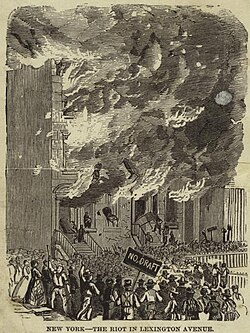
When the Emancipation Proclamation went into effect in January 1863, ex-slaves were energetically recruited to meet state quotas. States and local communities offered higher cash bonuses for white volunteers. Congress tightened the draft law in March 1863. Men selected in the draft could provide substitutes or, until mid-1864, pay commutation money. Many eligibles pooled their money to cover the cost of anyone drafted. Families used the substitute provision to select which man should go into the army and which should stay home. There was much evasion and resistance to the draft, especially in Catholic areas. The New York City draft riots in July 1863 involved Irish immigrants who had been signed up as citizens to swell the vote of the city's Democratic political machine, not realizing it made them liable for the draft.[83] Of the 168,649 men procured for the Union through the draft, 117,986 were substitutes, leaving only 50,663 who were conscripted.[84]
In the North and South, draft laws were highly unpopular. In the North, some 120,000 men evaded conscription, many fleeing to Canada, and another 280,000 soldiers deserted during the war.[85] At least 100,000 Southerners deserted, about 10 percent of the total. Southern desertion was high because many soldiers were more concerned about the fate of their local area than the Southern cause.[86] In the North, "bounty jumpers" enlisted to collect the generous bonus, deserted, then re-enlisted under a different name for a second bonus; 141 were caught and executed.[87]
From a tiny frontier force in 1860, the Union and Confederate armies grew into the "largest and most efficient armies in the world" within a few years. Some European observers at the time dismissed them as amateur and unprofessional,[88] but historian John Keegan concluded that each outmatched the French, Prussian, and Russian armies, and without the Atlantic, could have threatened any of them with defeat.[89]
The Union Navy in 1861 was relatively small but, by 1865, expanded rapidly to 6,000 officers, 45,000 sailors, and 671 vessels totaling 510,396 tons.[106][107] Its mission was to blockade Confederate ports, control the river system, defend against Confederate raiders on the high seas, and be ready for a possible war with the British Royal Navy.[108] The main riverine war was fought in the West, where major rivers gave access to the Confederate heartland. The US Navy eventually controlled the Red, Tennessee, Cumberland, Mississippi, and Ohio rivers. In the East, the Navy shelled Confederate forts and supported coastal army operations.[109]
The Civil War occurred during the early stages of the industrial revolution, leading to naval innovations, including the ironclad warship. The Confederacy, recognizing the need to counter the Union's naval superiority, built or converted over 130 vessels, including 26 ironclads.[110] Despite these efforts, Confederate ships were largely unsuccessful against Union ironclads.[111] The Union Navy used timberclads, tinclads, and armored gunboats. Shipyards in Cairo, Illinois, and St. Louis built or modified steamboats.[112]
The Confederacy experimented with the submarine CSS Hunley, which proved unsuccessful, and with the ironclad CSS Virginia, rebuilt from the sunken Union ship Merrimack.[113] On March 8, 1862, Virginia inflicted significant damage on the Union's wooden fleet, but the next day, the first Union ironclad, USS Monitor, arrived to challenge it in the Chesapeake Bay. The resulting three-hour Battle of Hampton Roads was a draw, proving ironclads were effective warships.[114] The Confederacy scuttled the Virginia to prevent its capture, while the Union built many copies of the Monitor. The Confederacy's efforts to obtain warships from Great Britain failed, as Britain had no interest in selling warships to a nation at war with a stronger enemy and feared souring relations with the US.[115]
General Scott's Anaconda Plan, featuring a tightening naval blockade, forcing rebels out of Missouri along the Mississippi River, Kentucky Unionists sit on the fence, idled cotton industry illustrated in Georgia.
By early 1861, General Winfield Scott had devised the Anaconda Plan to win the war with minimal bloodshed, calling for a blockade of the Confederacy to suffocate the South into surrender.[116] Lincoln adopted parts of the plan but opted for a more active war strategy.[117] In April 1861, Lincoln announced a blockade of all Southern ports; commercial ships could not get insurance, ending regular traffic. The South blundered by embargoing cotton exports before the blockade was fully effective; by the time they reversed this decision, it was too late. "King Cotton" was dead, as the South could export less than 10% of its cotton. The blockade shut down the ten Confederate seaports with railheads that moved almost all the cotton. By June 1861, warships were stationed off the principal Southern ports, and a year later nearly 300 ships were in service.[118]
Gunline of nine Union ironclads. South Atlantic Blockading Squadron off Charleston. Continuous blockade of all major ports was sustained by North's overwhelming war production.
The Confederates began the war short on military supplies, which the agrarian South could not produce. Northern arms manufacturers were restricted by an embargo, ending existing and future contracts with the South. The Confederacy turned to foreign sources, connecting with financiers and companies like S. Isaac, Campbell & Company and the London Armoury Company in Britain, becoming the Confederacy's main source of arms.[119][120]
To transport arms safely to the Confederacy, British investors built small, fast, steam-driven blockade runners that traded arms and supplies from Britain, through Bermuda, Cuba, and the Bahamas in exchange for high-priced cotton. Many were lightweight and designed for speed, only carrying small amounts of cotton back to England.[121] When the Union Navy seized a blockade runner, the ship and cargo were condemned as a prize of war and sold, with proceeds given to the Navy sailors; the captured crewmen, mostly British, were released.[122]
Economic impact
The Southern economy nearly collapsed during the war due to multiple factors, the most notable being severe food shortages, failing railroads, loss of control over key rivers, foraging by Northern armies, and the seizure of animals and crops by Confederate forces.[123] Historians agree the blockade was a major factor in ruining the Confederate economy; however, Wise argues blockade runners provided enough of a lifeline to allow Robert E. Lee, a Confederate general, to continue fighting for additional months, as a result of supplies that included 400,000 rifles, lead, blankets, and boots that Confederate economy could no longer supply.[123]
The Confederate cotton crop became nearly useless, which cut off the Confederacy's primary income source. Critical imports were scarce, and coastal trade also largely ended.[124] The blockade's success was not measured by the few ships, which slipped through, but by the thousands that never tried. European merchant ships could not obtain insurance for their ships and transport, and were too slow to evade the blockade, leading them to cease docking in Confederate ports.[125]
To fight an offensive war, the Confederacy purchased arms in Britain and converted British-built ships into commerce raiders, which targeted United States Merchant Marine ships in the Atlantic and Pacific oceans. The Confederacy smuggled 600,000 arms, enabling it to continue fighting for two more years.[126][127] As insurance rates soared, American-flagged ships largely ceased traveling in international waters, though some were reflagged with European flags, which allowed them to continue operating.[111] After the conclusion of the Civil War, the US government demanded Britain reimburse it for the damage caused by blockade runners and raiders outfitted in British ports. Britain paid the US$15 million in 1871, which covered costs associated with commerce raiding but nothing more.[128]
Ulysses S. Grant, a Union army general who was later elected the nation's 18th president
The primary Union forces in this theater were the Army of the Tennessee and Army of the Cumberland, named for the two rivers, Tennessee River and Cumberland River. After Meade's inconclusive fall campaign, Lincoln turned to the Western theater for new leadership. At the same time, the Confederate stronghold of Vicksburg surrendered, giving the Union control of the Mississippi River, permanently isolating the western Confederacy, and producing the new leader Lincoln needed, Ulysses S. Grant.[164]
The Army of Tennessee, which served as the primary Confederate force in the Western theater, was formed on November 20, 1862, when General Braxton Bragg renamed the former Army of Mississippi. While Confederate forces had successes in the Eastern theater, they were defeated many times in the West.[163]
Battles
The Union's key strategist and tactician in the West was Ulysses S. Grant, who led the Union to victories in battles at Fort Henry (February 6, 1862) and Fort Donelson (February 11 to 16, 1862), earning him the nickname of "Unconditional Surrender" Grant. With these victories, the Union gained control of the Tennessee and Cumberland Rivers.[165]Nathan Bedford Forrest rallied nearly 4,000 Confederate troops and led them to escape across the Cumberland River. Nashville and central Tennessee fell to the Union, leading to attrition of local food supplies and livestock and a breakdown in social organization.[citation needed]
Confederate general Leonidas Polk subsequently invaded Columbus, Kentucky, which ended Kentucky's policy of neutrality and turned it against the Confederacy. Grant used river transport and Andrew Hull Foote's gunboats of the Western Flotilla, threatening the Confederacy's "Gibraltar of the West" in Columbus, Kentucky. Although rebuffed at Belmont, Grant cut off Columbus. Confederate forces, lacking their gunboats, were forced to retreat and the Union took control of west Kentucky and opened Tennessee in March 1862.[166]
At the Battle of Shiloh, in Shiloh, Tennessee, in April 1862, Confederate forces launched a surprise attack on Union forces, pushing them back to the Tennessee River as night fell. Over that night, however, the Navy landed reinforcements, and Grant counterattacked. Grant and the Union ultimately won a decisive victory in the first battle with a high number of casualties in what proved to be the first in a series of such battles.[167] Confederate forces lost Albert Sidney Johnston, considered their finest general, before Lee emerged to assume command.[168]
In April 1862, the Union Navy captured New Orleans.[169] "The key to the river was New Orleans, the South's largest port [and] greatest industrial center."[170] US naval forces under Farragut ran past Confederate defenses south of New Orleans. Confederate forces abandoned the city, giving the Union a critical anchor in the deep South,[171] which allowed Union forces to move up the Mississippi. Memphis fell to Union forces on June 6, 1862, allowing it to serve as a key base for further Union advances south along the Mississippi. On the Mississippi River, the Union took every fortress city with the exception of Vicksburg, Mississippi. But Confederate control of Vicksburg was sufficient in preventing the Union from controlling the entire river.[172]
US naval forces assisted Grant in the long, complex Vicksburg Campaign, which resulted in Confederate forces surrendering in the Battle of Vicksburg in July 1863, which cemented Union control of the Mississippi River in one of the war's turning points.[176][177] The one clear Confederate victory in the West was the Battle of Chickamauga. After Rosecrans' successful Tullahoma Campaign, Bragg, reinforced by Lt. Gen. James Longstreet's Corps, defeated Rosecrans, despite the defensive stand of Maj. Gen. George Henry Thomas.[citation needed] Rosecrans retreated to Chattanooga, Tennessee, where Bragg was then besieged in the Chattanooga campaign. Grant marched to the relief of Rosecrans, where he led the defeat of Bragg in the Third Battle of Chattanooga,[178] eventually causing Longstreet to abandon his Knoxville Campaign and driving Confederate forces out of Tennessee and opening a route to Atlanta and the heart of the Confederacy.[179]
Nathaniel Lyon secured docks and arsenal in St. Louis, leading Union Army forces to expel the Missouri Confederate forces and government.[181]
The first major battle of the Trans-Mississippi theater was the Battle of Wilson's Creek (August 1861). The Confederates were driven from Missouri early in the war as a result of the Battle of Pea Ridge.[182]
Extensive guerrilla warfare characterized the trans-Mississippi region, as the Confederacy lacked the troops and logistics to support regular armies that could challenge Union control.[183][184] Roving Confederate bands such as Quantrill's Raiders terrorized the countryside, striking military installations and civilian settlements.[185] The "Sons of Liberty" and "Order of the American Knights" attacked pro-Union people, elected officeholders, and unarmed uniformed soldiers. These partisans could not be driven out of Missouri, until an entire regular Union infantry division was engaged. By 1864, these violent activities harmed the nationwide antiwar movement organizing against the re-election of Lincoln. Missouri not only stayed in the Union, but Lincoln took 70 percent of the vote to win re-election.[186]
Small-scale military actions south and west of Missouri sought to control Indian Territory and New Mexico Territory for the Union. The Battle of Glorieta Pass was the decisive battle of the New Mexico Campaign. The Union repulsed Confederate incursions into New Mexico in 1862, and the exiled Arizona government withdrew into Texas. In the Indian Territory, civil war broke out within tribes. About 12,000 Indian warriors fought for the Confederacy but fewer for the Union.[187] The most prominent Cherokee was Brigadier General Stand Watie, the last Confederate general to surrender.[188]
After the fall of Vicksburg in July 1863, Jefferson Davis informed General Kirby Smith in Texas that he could expect no further help from east of the Mississippi. Although he lacked resources to beat Union armies, he built up a formidable arsenal at Tyler, along with his own Kirby Smithdom economy, a virtual "independent fiefdom" in Texas, including railroad construction and international smuggling. The Union, in turn, did not directly engage him.[189] The Union's 1864 Red River Campaign to take Shreveport, Louisiana, failed and Texas remained in Confederate hands throughout the war.[190]
The lower seaboard theater refers to military and naval operations that occurred near the coastal areas of the Southeast as well as the southern part of the Mississippi. Union naval activities were dictated by the Anaconda Plan.[191]
One of the earliest battles was fought in November 1861 at Port Royal Sound, south of Charleston. Much of the war along the South Carolina coast concentrated on capturing Charleston. In attempting to capture Charleston, the Union military tried two approaches: by land over James or Morris Islands or through the harbor. However, the Confederates were able to drive back each attack. A famous land attack was the Second Battle of Fort Wagner, in which the 54th Massachusetts Infantry took part. The Union suffered a serious defeat, losing 1,515 soldiers while the Confederates lost only 174. However, the 54th was hailed for its valor, which encouraged the general acceptance of the recruitment of African American soldiers into the Union Army, which reinforced the Union's numerical advantage.[192]
Fort Pulaski on the Georgia coast was an early target for the Union navy. Following the capture of Port Royal, an expedition was organized with engineer troops under the command of Captain Quincy Adams Gillmore, forcing a Confederate surrender. The Union army occupied the fort for the rest of the war after repairing it.[193]
In April 1862, a Union naval task force commanded by Commander David Dixon Porter attacked Forts Jackson and St. Philip, which guarded the river approach to New Orleans from the south. While part of the fleet bombarded the forts, other vessels forced a break in the obstructions in the river and enabled the rest of the fleet to steam upriver to the city. A Union army force commanded by Maj. Gen. Benjamin Butler landed near the forts and forced their surrender. Butler's controversial command of New Orleans earned him the nickname "Beast".[194]
The following year, the Union Army of the Gulf commanded by Maj. Gen. Nathaniel P. Banks laid siege to Port Hudson for nearly eight weeks, the longest siege in US military history. The Confederates attempted to defend with the Bayou Teche Campaign but surrendered after Vicksburg. These surrenders gave the Union control over the Mississippi.[164]
Several skirmishes but no major battles were fought in Florida. The biggest was the Battle of Olustee in early 1864.[195]
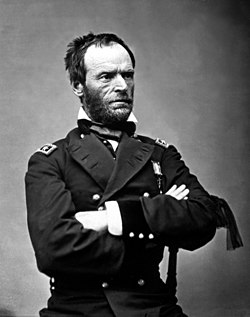
At the beginning of 1864, Lincoln made Grant commander of all Union armies. Grant made his headquarters with the Army of the Potomac and put Maj. Gen. William Tecumseh Sherman in command of most of the western armies. Grant understood the concept of total war and believed, along with Lincoln and Sherman, that only the utter defeat of Confederate forces and their economic base would end the war.[197] This was total war not in killing civilians, but in injuring the Confederacy's capacity to produce and transport the supplies needed to continue the war. Sherman, at Grant's direction, seized provisions and destroyed homes, farms, and railroads, which Grant said "would otherwise have gone to the support of secession and rebellion. This policy I believe exercised a material influence in hastening the end."[198]
Grant devised a coordinated strategy that would strike at the entire Confederacy from multiple directions. Generals Meade and Benjamin Butler were ordered to move against Lee near Richmond, General Franz Sigel was to attack the Shenandoah Valley, General Sherman was to capture Atlanta and march to the Atlantic Ocean, Generals George Crook and William W. Averell were to operate against railroad supply lines in West Virginia, and Maj. Gen. Nathaniel P. Banks was to capture Mobile, Alabama.[199]
Grant's Overland Campaign
Grant's army set out on the Overland Campaign intending to draw Lee into a defense of Richmond, where they would attempt to pin down and destroy the Confederate army. The Union army first attempted to maneuver past Lee and fought several battles, notably at the Wilderness, Spotsylvania, and Cold Harbor. These resulted in heavy losses on both sides and forced Lee's Confederates to fall back repeatedly.[200] At the Battle of Yellow Tavern, the Confederates lost Jeb Stuart.[201]
An attempt to outflank Lee from the south failed under Butler, who was trapped inside the Bermuda Hundred river bend. Each battle resulted in setbacks for the Union that mirrored those they had suffered under prior generals, though unlike them, Grant chose to fight on rather than retreat. Grant was tenacious and kept pressing Lee's Army of Northern Virginia back to Richmond. While Lee was preparing for an attack on Richmond, Grant unexpectedly turned south to cross the James River and began the protracted Siege of Petersburg, where the two armies engaged in trench warfare for over nine months.[202]
To deny the Confederacy continued use of the Shenandoah Valley as a base from which to launch invasions of Maryland and the Washington area, and to threaten Lee's supply lines for his forces, Grant launched the Valley campaigns in the spring of 1864. Initial efforts led by Gen. Sigel were repelled at the Battle of New Market by Confederate Gen. John C. Breckinridge. The Battle of New Market was the Confederacy's last major victory, and included a charge by teenage VMI cadets. After relieving Sigel, and following mixed performances by his successor, Grant finally found a commander, General Philip Sheridan, aggressive enough to prevail against the army of Maj. Gen. Jubal A. Early. After a cautious start, Sheridan defeated Early in a series of battles in September and October 1864, including a decisive defeat at the Battle of Cedar Creek. Sheridan then proceeded through that winter to destroy the agricultural base of the Shenandoah Valley, a strategy similar to the tactics Sherman later employed in Georgia.[203]
Meanwhile, Sherman maneuvered from Chattanooga to Atlanta, defeating Confederate Generals Joseph E. Johnston and John Bell Hood. The fall of Atlanta on September 2, 1864, guaranteed the reelection of Lincoln.[204] Hood left the Atlanta area to swing around and menace Sherman's supply lines and invade Tennessee in the Franklin–Nashville Campaign. Union Maj. Gen. John Schofield defeated Hood at the Battle of Franklin, and George H. Thomas dealt Hood a massive defeat at the Battle of Nashville, effectively destroying Hood's army.[205]
Leaving Atlanta, and his base of supplies, Sherman's army marched, with no destination set, laying waste to about 20 percent of the farms in Georgia on his March to the Sea.[206] He reached the Atlantic at Savannah, Georgia, in December 1864. Sherman's army was followed by thousands of freed slaves;[207] there were no major battles along the march. Sherman turned north through South Carolina and North Carolina, to approach the Confederate Virginia lines from the south, increasing the pressure on Lee's army.[208]
The Waterloo of the Confederacy
Lee's army, thinned by desertion and casualties, was now much smaller than Grant's. One last Confederate attempt to break the Union hold on Petersburg failed at the decisive Battle of Five Forks on April 1. The Union now controlled the entire perimeter surrounding Richmond–Petersburg, completely cutting it off from the Confederacy. Realizing the capital was now lost, Lee's army and the Confederate government were forced to evacuate. The Confederate capital fell on April 2–3, to the Union XXV Corps, composed of black troops. The remaining Confederate units fled west after a defeat at Sayler's Creek on April 6.[209]
This New York Times front page celebrated Lee's surrender, headlining how Grant let Confederate officers retain their sidearms and "paroled" the Confederate officers and men.[210]
News of Lee's April 9 surrender reached this southern newspaper (Savannah, Georgia) on April 15—after the April 14 shooting of President Lincoln. The article quotes Grant's terms of surrender.[211]
Lee did not intend to surrender, but planned to regroup at Appomattox Station, where supplies were to be waiting, and then continue the war. Grant chased Lee and got in front of him, so that when Lee's army reached the village of Appomattox Court House, they were surrounded. After an initial battle, Lee decided the fight was hopeless, and surrendered his Army of Northern Virginia to Grant on April 9, 1865, during a conference at the McLean House.[212][213] In an untraditional gesture and as a sign of Grant's respect and anticipation of peacefully restoring Confederate states to the Union, Lee was permitted to keep his sword and horse, Traveller. His men were paroled, and a chain of Confederate surrenders began.[214]
On April 14, 1865, Lincoln was shot by John Wilkes Booth, a Confederate sympathizer. Lincoln died early the next morning. Lincoln's vice president, Andrew Johnson, was unharmed, because his would-be assassin, George Atzerodt, lost his nerve, so Johnson was immediately sworn in as president.
Meanwhile, Confederate forces across the South surrendered, as news of Lee's surrender reached them.[h] On April 26, the same day Sergeant Boston Corbett killed Booth at a tobacco barn, Johnston surrendered nearly 90,000 troops of the Army of Tennessee to Sherman at Bennett Place, near present-day Durham, North Carolina. It proved to be the largest surrender of Confederate forces. On May 4, all remaining Confederate forces in Alabama, Mississippi, and Louisiana east of the Mississippi, under the command of Lt. General Richard Taylor, surrendered.[215] Confederate president Davis was captured in retreat at Irwinville, Georgia on May 10.[216]
The final land battle was fought on May 13, 1865, at the Battle of Palmito Ranch in Texas.[217][218][219] On May 26, 1865, Confederate Lt. Gen. Simon B. Buckner, acting for Edmund Smith, signed a military convention surrendering Confederate forces in the Trans-Mississippi Department.[220][221] This date is often cited by contemporaries and historians as the effective end date of the war.[a][b] On June 2, with most of his troops having already gone home, a reluctant Kirby Smith had little choice but to sign the official surrender document.[222][223] On June 23, Cherokee leader and Brig. General Stand Watie became the last Confederate general to surrender his forces.[224][225]
On June 19, 1865, Union Maj. Gen. Gordon Granger announced General Order No. 3, bringing the Emancipation Proclamation into effect in Texas and freeing the last slaves of the Confederacy.[226] The anniversary of this date is now celebrated as Juneteenth.[227]
The naval part of the war ended more slowly. On April 11, two days after Lee's surrender, when Lincoln proclaimed that foreign nations had no further "claim or pretense" to deny equality of maritime rights and hospitalities to US warships and, in effect, that rights extended to Confederate ships to use neutral ports as safe havens from US warships should end.[228][229] Having no response to Lincoln's proclamation, President Johnson issued a similar proclamation dated May 10, more directly stating that the war was almost at an end and insurgent cruisers still at sea, and prepared to attack US ships, should not have rights to do so through use of safe foreign ports or waters.[230] Britain finally responded on June 6, by transmitting a letter from Foreign Secretary John Russell, 1st Earl Russell, to the Lords of the Admiralty withdrawing rights to Confederate warships to enter British ports and waters.[231] US Secretary of State Seward welcomed the withdrawal of concessions to the Confederates.[232] Finally, on October 18, Russell advised the Admiralty that the time specified in his June message had elapsed and "all measures of a restrictive nature on vessels of war of the United States in British ports, harbors, and waters, are now to be considered as at an end".[233] Nonetheless, the final Confederate surrender was in Liverpool, England where James Iredell Waddell, the captain of CSS Shenandoah, surrendered the cruiser to British authorities on November 6.[234]
Legally, the war did not end until August 20, 1866, when President Johnson issued a proclamation that declared "that the said insurrection is at an end and that peace, order, tranquillity, and civil authority now exist in and throughout the whole of the United States of America".[i]
Union victory
Map of Confederate territory losses year by year
The causes of the war, reasons for its outcome, and even its name are subjects of lingering contention. The North and West grew wealthy while the once-rich South became poor for a century. The national political power of the slaveowners and rich Southerners ended. Historians are less sure about the results of postwar Reconstruction, especially regarding the second-class citizenship of the freedmen and their poverty.[235]
Historians have debated whether the Confederacy could have won the war. Most scholars, including James M. McPherson, argue Confederate victory was possible.[236] McPherson argues that the North's advantage in population and resources made Northern victory likely, but not guaranteed. He argues that if the Confederacy had fought using unconventional tactics, it would have more easily been able to hold out long enough to exhaust the Union.[237] Confederates did not need to invade and hold enemy territory to win, but only to fight a defensive war to convince the North the cost of winning was too high. The North needed to conquer and hold vast stretches of enemy territory and defeat Confederate armies to win.[237] Lincoln was not a military dictator and could fight only as long as the American public supported the war. The Confederacy sought to win independence by outlasting Lincoln; however, after Atlanta fell and Lincoln defeated McClellan in the election of 1864, hope for a political victory for the South ended. Lincoln had secured the support of the Republicans, War Democrats, border states, emancipated slaves, and the neutrality of Britain and France. By defeating the Democrats and McClellan, he defeated the Copperheads, who had wanted a negotiated peace with the Confederacy.[238]
Comparison of Union and Confederacy, 1860–1864[239][240]
Some scholars argue the Union held an insurmountable long-term advantage over the Confederacy in industrial strength and population. Confederate actions, they argue, only delayed defeat.[244][245] Historian Shelby Foote expressed this view succinctly:
I think that the North fought that war with one hand behind its back.... If there had been more Southern victories, and a lot more, the North simply would have brought that other hand out from behind its back. I don't think the South ever had a chance to win that War.[246]
A minority view among historians is that the Confederacy lost because, as E. Merton Coulter put it, "people did not will hard enough and long enough to win".[247][248] However, most historians reject the argument.[249] McPherson, after reading thousands of letters written by Confederate soldiers, found strong patriotism that continued to the end; they truly believed they were fighting for freedom and liberty. Even as the Confederacy was visibly collapsing in 1864–65, most Confederate soldiers were fighting hard.[250] Historian Gary Gallagher cites General Sherman, who in early 1864 commented, "The devils seem to have a determination that cannot but be admired." Despite their loss of slaves and wealth, with starvation looming, Sherman continued, "yet I see no sign of let-up—some few deserters—plenty tired of war, but the masses determined to fight it out".[251]
Also important were Lincoln's eloquence in articulating the national purpose and his skill in keeping the border states committed to the Union cause. The Emancipation Proclamation was an effective use of the president's war powers.[252] The Confederate government failed to get Europe involved militarily. Southern leaders needed to get European powers to help break the blockade the Union had created around Southern ports. Lincoln's naval blockade was 95 percent effective at stopping trade goods; as a result, imports and exports to the South declined significantly. The abundance of European cotton and Britain's hostility to slavery, along with Lincoln's naval blockades, severely decreased any chance that Britain or France would enter the war.[253]
Historian Don H. Doyle has argued that the Union victory had a major impact on world history.[254] The Union victory energized popular democratic forces. A Confederate victory, on the other hand, would have meant a new birth of slavery, not of freedom. Historian Fergus Bordewich, following Doyle, argues:
The North's victory decisively proved the durability of democratic government. Confederate independence, on the other hand, would have established an American model for reactionary politics and race-based repression that would likely have cast an international shadow into the 20th century and perhaps beyond.[255]
Scholars have debated what the effects of the war were on political and economic power in the South.[256] The prevailing view is that the southern planter elite retained its powerful position in the South.[256] However, a 2017 study challenges this, noting that while some Southern elites retained their economic status, the turmoil of the 1860s created greater opportunities for economic mobility in the South, than in the North.[256]
Exact casualty figures were collected for the Union, but Confederate records were poorly kept, or lost in the chaos of defeat. Thus, the casualty figures are imprecise and based on statistical extrapolation. Neither side kept a tally of civilian deaths due to the war. In the 19th century, the death toll had been estimated at a lower 620,000.[9] In 2011, the death toll was recalculated based on a 1% sample of census data, yielding approximately 750,000 soldier deaths, 20 percent higher than traditionally estimated, and possibly as high as 850,000.[12][257] The figure was recalculated to 698,000 soldier deaths in 2024 after examining newly available full census records. Mortality rates among men were as high as 19 percent in Louisiana, and 16.6–16.7 percent in Georgia and South Carolina respectively.[258][259]
The war resulted in at least 1,030,000 casualties (3 percent of the population), including an estimated 698,000 soldier deaths—two-thirds by disease.[259][9] Based on 1860 census figures, 8 percent of all white men aged 13–43 died in the war, including 6 percent in the North and 18 percent in the South.[260][261] About 56,000 soldiers died in prison camps during the War.[262] An estimated 60,000 soldiers lost limbs.[263] As McPherson notes, the war's "cost in American lives was as great as in all of the nation's other wars combined through Vietnam".[264]
Of the 359,528 Union Army dead, amounting to 15 percent of the over two million who served:[5]
110,070 were killed in action (67,000) or died of wounds (43,000).
199,790 died of disease (75 percent was due to the war, the remainder would have occurred in civilian life anyway)
24,866 died in Confederate prison camps
9,058 were killed by accidents or drowning
15,741 other/unknown deaths
In addition, there were 4,523 deaths in the Navy (2,112 in battle) and 460 in the Marines (148 in battle).[6]
After the Emancipation Proclamation authorized freed slaves to "be received into the armed service of the United States", former slaves who escaped from plantations or were liberated by the Union Army were recruited into the United States Colored Troops regiments of the Union Army, as were black men who had not been slaves. The US Colored Troops made up 10 percent of the Union death toll—15 percent of Union deaths from disease and less than 3 percent of those killed in battle.[5] Losses among African Americans were high. In the last year and a half and from all reported casualties, approximately 20 percent of all African Americans enrolled in the military died during the war. Their mortality rate was significantly higher than white soldiers. While 15 percent of US Volunteers and just 9 percent of white Regular Army troops died, 21 percent of US Colored Troops died.[265]: 16
An illustration of the war dead following the Battle of Antietam battlefield in 1862
While the figures of 360,000 army deaths for the Union and 260,000 for the Confederacy remained commonly cited, they are incomplete. In addition to many Confederate records being missing, partly as a result of Confederate widows not reporting deaths due to being ineligible for benefits, both armies only counted troops who died during their service and not the tens of thousands who died of wounds or diseases after being discharged. This often happened only days or weeks later. Francis Amasa Walker, superintendent of the 1870 census, used census and surgeon general data to estimate a minimum of 500,000 Union military deaths and 350,000 Confederate military deaths, a total of 850,000 soldiers. While Walker's estimates were originally dismissed because of the 1870 census's undercounting, it was later found that the census was only off by 6.5 percent and that the data Walker used would be roughly accurate.[12]
Losses were far higher than during the war with Mexico, which saw roughly 13,000 American deaths, including fewer than two thousand killed in battle, between 1846 and 1848. One reason for the high number of battle deaths in the civil war was the continued use of tactics similar to those of the Napoleonic Wars, such as charging. With the advent of more accurate rifled barrels, Minié balls, and (near the end of the war for the Union) repeating firearms such as the Spencer repeating rifle and the Henry repeating rifle, soldiers were mowed down when standing in lines in the open. This led to the adoption of trench warfare, a style of fighting that defined much of World War I.[266]
Deaths among former slaves has proven hard to estimate, due to the lack of reliable census data, though they were known to be considerable, as former slaves were set free or escaped in massive numbers in areas where the Union army did not have sufficient shelter, doctors, or food for them. Professor Jim Downs states that tens of thousands to hundreds of thousands of slaves died during the war from disease, starvation, or exposure, and that if these deaths are counted in the war's total, the death toll would exceed 1 million.[267]
It is estimated that during the war, of the equines killed, including horses, mules, donkeys and even confiscated children's ponies, over 32,600 of them belonged to the Union and 45,800 the Confederacy. However, other estimates place the total at 1,000,000.[268]
It is estimated that 544 Confederate flags were captured during the war by the Union. The flags were sent to the War Department in Washington.[269][270] The Union flags captured by the Confederates were sent to Richmond.[citation needed]
Emancipation
Abolition of slavery in the various states of the US over time:
Abolition of slavery during or shortly after the American Revolution (Vermont, 1777; Massachusetts [including Maine], 1783)
The Northwest Ordinance, 1787
Gradual emancipation in New York (starting 1799, ended 1827), Pennsylvania (1780–1857), New Hampshire (1783–1857), Connecticut [including the Western Reserve] (1784–1848), Rhode Island (1784–1853) and New Jersey (starting 1804; ended by Thirteenth Amendment, 1865)
The Missouri Compromise, 1821
Effective abolition of slavery by Mexican or joint US/British authority
Abolition of slavery by Congressional action, 1861
Abolition of slavery by Congressional action, 1862
Emancipation Proclamation as originally issued, 1 Jan 1863
Subsequent operation of the Emancipation Proclamation in 1863
Abolition of slavery by state action during the Civil War
Operation of the Emancipation Proclamation in 1864
Operation of the Emancipation Proclamation in 1865
Thirteenth Amendment to the US constitution, 18 Dec 1865
Territory incorporated into the US after the passage of the Thirteenth Amendment
Abolishing slavery was not a Union war goal from the outset but quickly became one.[271] Lincoln initially claimed that preserving the Union was the central goal.[272] In contrast, the South fought to preserve slavery.[271] While not all Southerners saw themselves as fighting for slavery, most officers and over a third of the rank and file in Lee's army had close family ties to slavery. To Northerners, the motivation was primarily to preserve the Union, not to abolish slavery.[273] However, as the war dragged on, and it became clear that slavery was central to the conflict, and that emancipation was (to quote the Emancipation Proclamation) "a fit and necessary war measure for suppressing [the] rebellion", Lincoln and his cabinet made ending slavery a war goal, culminating in the Emancipation Proclamation.[271][274] Lincoln's decision to issue the Proclamation angered Peace Democrats ("Copperheads") and War Democrats, but energized most Republicans.[274] By warning that free blacks would flood the North, Democrats made gains in the 1862 elections, but they did not gain control of Congress. The Republicans' counterargument that slavery was the mainstay of the enemy steadily gained support, with the Democrats losing decisively in the 1863 elections in the Northern state of Ohio, when they tried to resurrect anti-black sentiment.[275]
The Emancipation Proclamation legally freed the slaves in states "in rebellion", but, as a practical matter, slavery for the 3.5 million black people in the South effectively ended in each area when Union armies arrived. The last Confederate slaves were freed on June 19, 1865, celebrated as the modern holiday of Juneteenth. Slaves in the border states and those in some former Confederate territory occupied before the Emancipation Proclamation were freed by state action or (on December 6, 1865) by the Thirteenth Amendment.[276][277] The Emancipation Proclamation enabled African Americans, both free blacks and escaped slaves, to join the Union Army. About 190,000 volunteered, further enhancing the numerical advantage the Union armies enjoyed over the Confederates, who did not dare emulate the equivalent manpower source for fear of undermining the legitimacy of slavery.[m]
During the war, sentiment concerning slaves, enslavement, and emancipation in the United States was divided. Lincoln's fears of making slavery a war issue were based on a harsh reality: abolition did not enjoy wide support in the west, the territories, and the border states.[279][n] In 1861, Lincoln worried that premature attempts at emancipation would mean the loss of the border states, and that "to lose Kentucky is nearly the same as to lose the whole game".[n] Copperheads and some War Democrats opposed emancipation, although the latter eventually accepted it as part of the total war needed to save the Union.[280]
Lincoln reversed attempts at emancipation by Secretary of War Simon Cameron and Generals John C. Frémont and David Hunter, in an effort to retain the loyalty of the border states and the War Democrats. Lincoln warned the border states that a more radical type of emancipation would happen if they rejected his plan of gradual compensated emancipation and voluntary colonization.[281] But compensated emancipation occurred only in the District of Columbia, where Congress had the power to enact it. When Lincoln told his cabinet about his proposed emancipation proclamation, which would apply to the states still in rebellion on January 1, 1863, Seward advised Lincoln to wait for a Union military victory before issuing it, because to do otherwise would seem like "our last shriek on the retreat".[282] Walter Stahr, however, writes, "There are contemporary sources, however, that suggest others were involved in the decision to delay", and Stahr quotes them.[283]
Contrabands, who were fugitive slaves, including cooks, laundresses, laborers, teamsters, railroad repair crews, fled to the Union Army, but were not legally freed until the Emancipation Proclamation, which Lincoln signed on January 1, 1863, more than two years before the end of the Civil War.
In 1863, the Union Army accepted Freedmen; seen here are black and white teenaged soldiers who volunteered to fight for the Union.
Lincoln laid the groundwork for public support in an open letter published in response to Horace Greeley's "The Prayer of Twenty Millions"; the letter stated that Lincoln's goal was to

_(14758819816).jpg)




.jpg)


.jpg)

.jpg)