
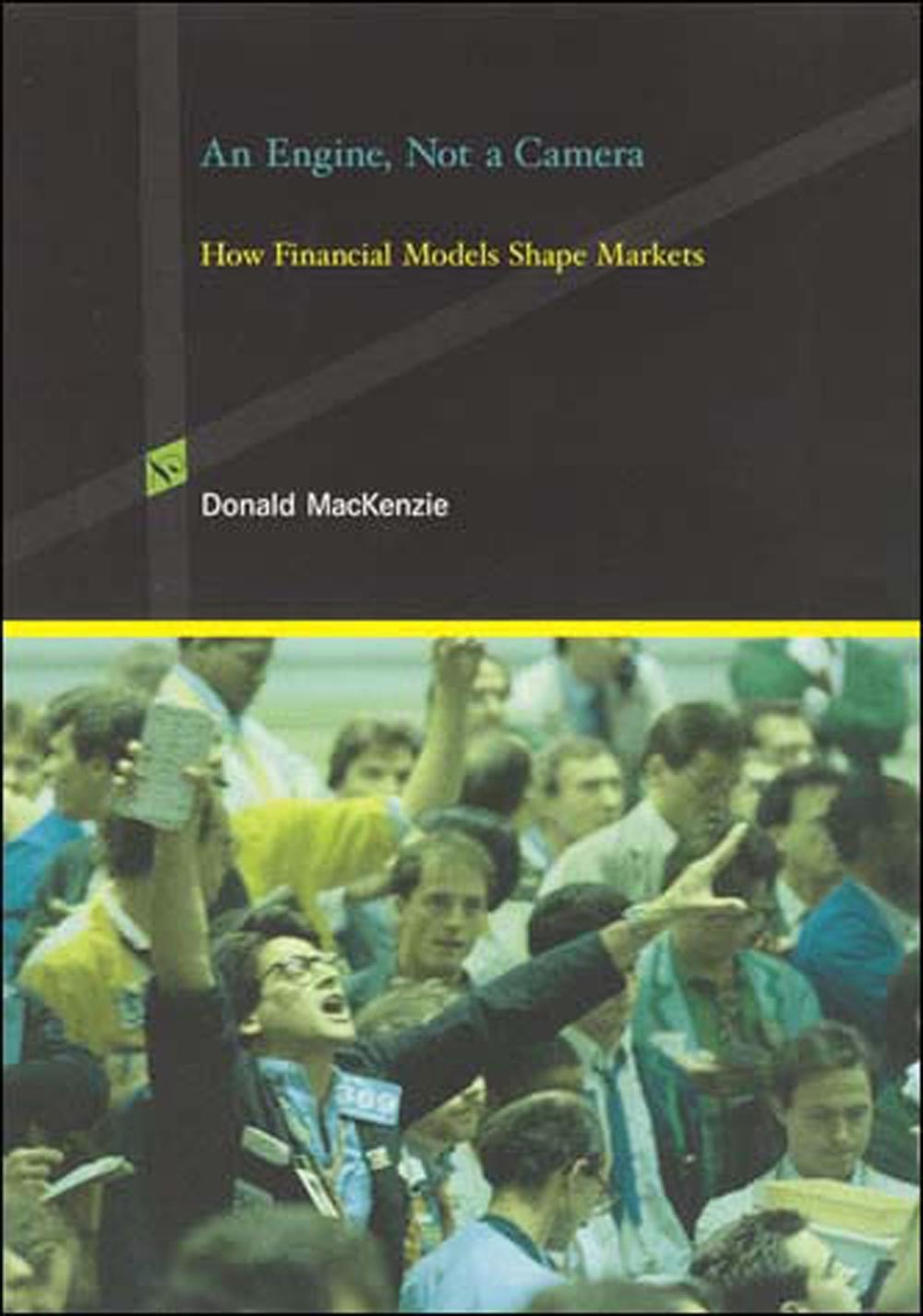
An Engine, Not a Camera
by Donald Mackenzie
A pioneering work in the social studies of finance describes how the emergence of modern finance theory has affected financial markets in fundamental ways--as an engine that shapes them rather than a camera that reproduces their every detail.
Paperback
English
Brand New
Publisher Description
In An Engine, Not a Camera, Donald MacKenzie argues that the emergence of modern economic theories of finance affected financial markets in fundamental ways. These new, Nobel Prize-winning theories, based on elegant mathematical models of markets, were not simply external analyses but intrinsic parts of economic Milton Friedman, MacKenzie says that economic models are an engine of inquiry rather than a camera to reproduce empirical facts. More than that, the emergence of an authoritative theory of financial markets altered those markets fundamentally. For example, in 1970, there was almost no trading in financial derivatives such as "futures." By June of 2004, derivatives contracts totaling $273 trillion were outstanding worldwide. MacKenzie suggests that this growth could never have happened without the development of theories that gave derivatives legitimacy and explained their examines the role played by finance theory in the two most serious crises to hit the world's financial markets in recent years- the stock market crash of 1987 and the market turmoil that engulfed the hedge fund Long-Term Capital Management in 1998. He also looks at finance theory that is somewhat beyond the mainstream-chaos theorist Benoit Mandelbrot's model of "wild" randomness. MacKenzie's pioneering work in the social studies of finance will interest anyone who wants to understand how America's financial markets have grown into their current form.
Notes
" An Engine, Not a Camera is a compelling, detailed, and elegantly written exploration of the conditions in which finance economists help to make the world they seek to describe and predict. Donald MacKenzie has long been without equal as a sociologist of how late modern futures are brought into being and made authoritative. This is his best work yet." Steven Shapin , Franklin L. Ford Professor of the History of Science, Harvard University "Maggie Mort tells the fascinating and unusual story of the development of a high-tech submarine from the point of view of workers on the project."--Michel Callon, Ecole des Mines de Paris
Review
An Engine, Not a Camera provides an insightful appreciation of the ways in which financial models influence and shape the world they seek to understand.—Anthony Hopwood, Times Higher Education Supplement
A brilliant, extremely lucid account of the connections between financial economics and the development of futures, options, and derivatives markets between the 1950s and 2001.—Neil Fligstein, American Journal of Sociology
Promotional
In one lifetime modern finance theory has revolutionized the arts of canny investing. MacKenzie knows this exciting story, and he tells it well. -- Paul A. Samuelson, MIT, Nobel Laureate in Economic Sciences Donald MacKenzie has long been one of the world's most brilliant social and historical analysts of science and technology. Here he provides an original, astute, and exhaustively researched account of the development of finance theory and the ways in which it is intertwined with financial markets. An Engine, Not a Camera is essential for anyone interested in markets and the forms of knowledge deployed in them. -- Karin Knorr Cetina, University of Konstanz and The University of Chicago An Engine, Not a Camera is a compelling, detailed, and elegantly written exploration of the conditions in which finance economists help to make the world they seek to describe and predict. Donald MacKenzie has long been without equal as a sociologist of how late modern futures are brought into being and made authoritative. This is his best work yet. -- Steven Shapin, Franklin L. Ford Professor of the History of Science, Harvard University
Prizes
Winner of Shortlisted for the 2007 British International Studies Association's (BISA) International Political Economy Group (IPEG) Book Prize 2007Winner of Winner, 2007 British International Studies Association's (BISA) International Political Economy Group (IPEG) Book Prize 2007
Review Text
"An Engine, Not a Cameraprovides an insightful appreciation of the ways in which financial models influence and shape the world they seek to understand." - Anthony Hopwood, Times Higher Education Supplement
Review Quote
An Engine, Not a Camera provides an insightful appreciation of the ways in which financial models influence and shape the world they seek to understand.-- Anthony Hopwood , Times Higher Education Supplement -- A brilliant, extremely lucid account of the connections between financial economics and the development of futures, options, and derivatives markets between the 1950s and 2001. -- Neil Fligstein , American Journal of Sociology --
Promotional "Headline"
"An Engine, Not a Cameraprovides an insightful appreciation of the ways in which financial models influence and shape the world they seek to understand." - Anthony Hopwood, Times Higher Education Supplement
Details
