
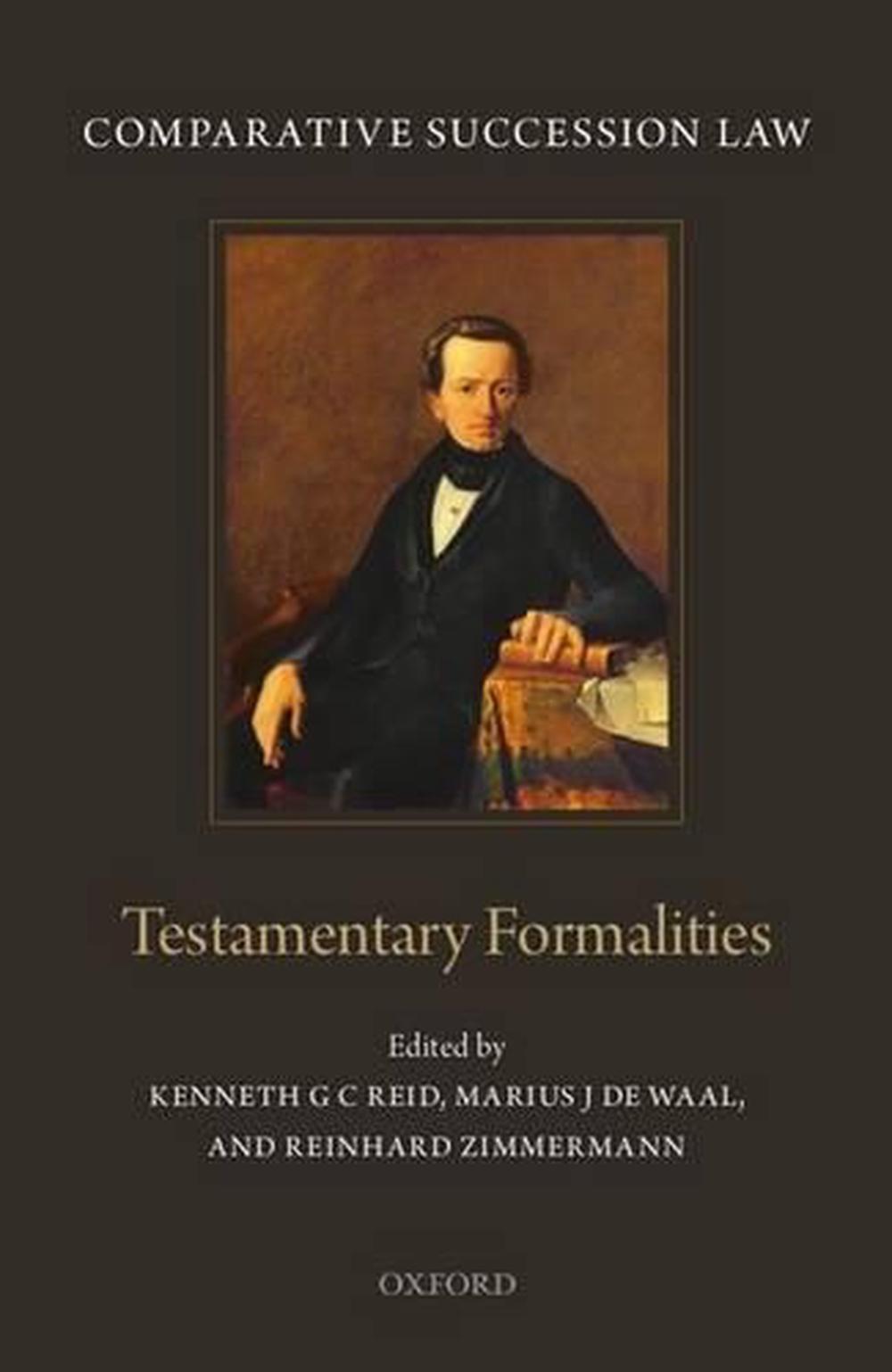
Comparative Succession Law
by Kenneth G.C. Reid, Marius J. de Waal, Reinhard Zimmermann
Launching a major new research project examining the principles of succession law in comparative perspective, this volume analyses the formalities imposed by the law on making a will across a wide range of European and international jurisdictions.
Hardcover
English
Brand New
Publisher Description
Launching a major new research project examining the principles of succession law in comparative perspective, this book discusses the formalities which the law imposes in order for a person to make a testamentary disposal of property. Among the questions considered are the following. How are wills made? What precisely are the rules - as to the signature of the testator, the use of witnesses, the need for a notary public or lawyer, and so on? Is there is a choice ofwill-type and, if so, which type is used most often and what are the advantages and disadvantages of each? How common is will-making or do most people die intestate? What happens if formalities are notobserved? How can requirements of form be explained and justified? How did the law develop historically, what is the state of the law today, and what are the prospects for the future?The focus is on Europe, and on countries which have been influenced by the European experience. Thus in addition to giving a detailed treatment of the law in Austria, Belgium, England and Wales, France, Germany, Hungary, Italy, the Netherlands, Poland, and Spain, the book explores legaldevelopments in Australia, New Zealand, the United States of America, and in some of the countries of Latin America with a particular emphasis on Brazil. It also includes chapters on two of the mixedjurisdictions - Scotland and South Africa - and on Islamic Law. The book opens with chapters on Roman law and on the early modern law in Europe, thus setting the historical scene as well as anticipating and complementing the accounts of national history which appear in subsequent chapters; and it concludes with an assessment of the overall development of the law in the countries surveyed, and with some wider reflections on the nature and purpose of testamentary formalities.
Table of Contents
Introduction1: Thomas Rüfner: Testamentary Formalities in Roman Law2: Nils Jansen: Testamentary Formalities in Early Modern Europe3: Walter Pintens: Testamentary Formalities in France and Belgium4: Sergio Cámara Lapuente: Testamentary Formalities in Spain5: Jan Peter Schmidt: Testamentary Formalities in Latin America with particular reference to Brazil6: Alexandra Braun: Testamentary Formalities in Italy7: Wilbert D Kolkman: Testamentary Formalities in the Netherlands8: Reinhard Zimmermann: Testamentary Formalities in Germany9: Christiane C Wendehorst: Testamentary Formalities in Austria10: Lajos Vékás: Testamentary Formalities in Hungary11: Frederyk Zoll: Testamentary Formalities in Poland12: Nadjma Yassari: Testamentary Formalities in Islamic Law and their Reception in the Modern Laws of Islamic Countries13: Roger Kerridge: Testamentary Formalities in England and Wales14: Nicola Peart: Testamentary Formalities in Australia and New Zealand15: Ronald J Scalise Jr: Testamentary Formalities in the United States of America16: Marius J de Waal: Testamentary Formalities in South Africa17: Kenneth G C Reid: Testamentary Formalities in Scotland18: Kenneth G C Reid, Marius J de Waal, and Reinhard Zimmermann: Testamentary Formalities in Historical and Comparative Perspective
Long Description
Launching a major new research project examining the principles of succession law in comparative perspective, this book discusses the formalities which the law imposes in order for a person to make a testamentary disposal of property. Among the questions considered are the following. How are wills made? What precisely are the rules - as to the signature of the testator, the use of witnesses, the need for a notary public or lawyer, and so on? Is there is a choice of
will-type and, if so, which type is used most often and what are the advantages and disadvantages of each? How common is will-making or do most people die intestate? What happens if formalities are not
observed? How can requirements of form be explained and justified? How did the law develop historically, what is the state of the law today, and what are the prospects for the future?The focus is on Europe, and on countries which have been influenced by the European experience. Thus in addition to giving a detailed treatment of the law in Austria, Belgium, England and Wales, France, Germany, Hungary, Italy, the Netherlands, Poland, and Spain, the book explores legal
developments in Australia, New Zealand, the United States of America, and in some of the countries of Latin America with a particular emphasis on Brazil. It also includes chapters on two of the mixed
jurisdictions - Scotland and South Africa - and on Islamic Law. The book opens with chapters on Roman law and on the early modern law in Europe, thus setting the historical scene as well as anticipating and complementing the accounts of national history which appear in subsequent chapters; and it concludes with an assessment of the overall development of the law in the countries surveyed, and with some wider reflections on the nature and purpose of testamentary formalities.
Feature
The first volume in a landmark research project examining the principles of succession law in comparative perspective
Provides a jurisdiction by jurisdiction analysis of testamentary formalities, including Islamic Law, Latin America, South Africa, Australia, England, the United States, and Germany
Chapters on testamentary formalities in Roman Law and Early Modern Europe aid comprehension of the historical background
Creates an analytical framework for understanding the subject by drawing together the development of the law in different countries at different periods
Details
