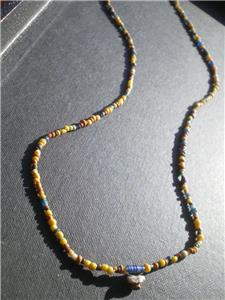
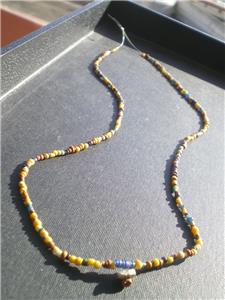
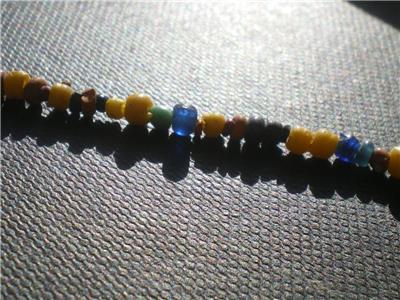
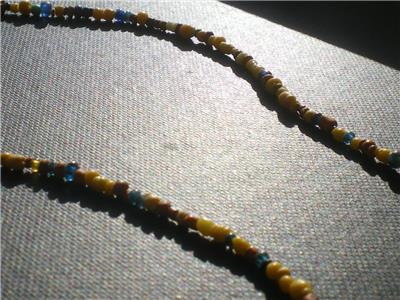
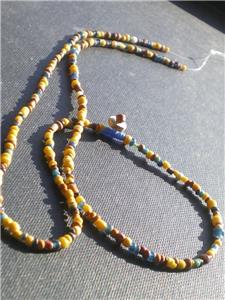
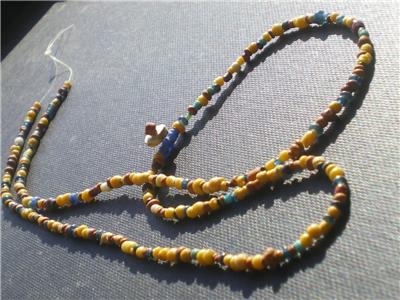
1 Extremely Rare Old Majapahit Chevron Glass Beads Necklace (Java) XVI° lukpad
|
SUPREME SPECIMEN MODERN ISLAMIC EAST JAVA / JATIM MOSAIC GLASS BEADS from INDONESIA
ISLAMIC RARE MULTICOLOR DELICIOUS CHEVRON TRADE BEADS FROM INDONESIA !!!
These extremely rare Handmade glass beadd dates from the last century and originates from the ancient Majapahit culture of Indonesia.
This beautiful Necklace was found in East Java.
The large archipelago of Indonesia is the most interesting part of island southeast Asia for bead collectors.
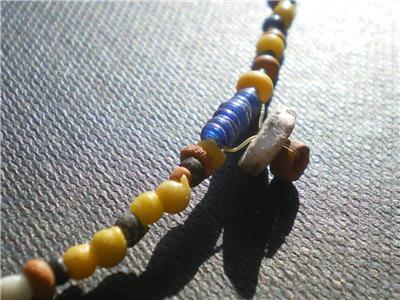
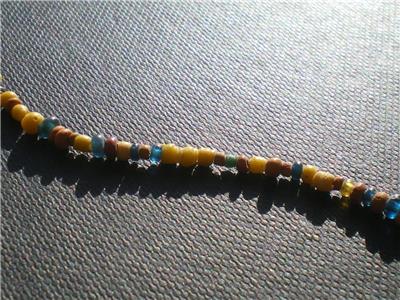
This spectacular Mosaic Glass Bead has a fascinating design and wonderful colors.
This bead shows a beautiful original patina and wear.
The quality is excellent. There are no damages and repairs.
Expected corrosion and wear are a consequence of age and extended burial.
Some original sedimentary deposition has been retained on part of the surface.
The bead Size is from 6 to 4 mm
The Necklace is 60 cms long !
JATIM Mosaic Glass Beads
Mosaic glass beads are formed in at least two operations. The glassworker begins by making various components and these preformed parts are than used to compose or decorate the desired piece. There are several types of such work, but the most popular and significant group is millefiore.
Millefiore glass beads are wound beads decorated with thin slices of multilayered or patterned drawn canes. Artistically crafted mosaic glass beads, also called millefiore (“thousand flowers in Italian”), are the product of great technical expertise in ancient times. The fine detail of the beads was achieved by laying a bundle of preformed colored glass rods in parallel rows so that the cross-section of the bundle had a pattern. The glass was than heat-softened and stretched, fusing the canes together. This miniaturized the design in such a way that the cross-sectional pattern remained unchanged.
Most Jatim Mosaic glass beads (term for Jawa = Java, Timur = East) have a thin coating of canes over a monochrome core.
HISTORY of MAJAPAHIT
The MAJAPAHIT EMPIRE (1293-1478) was the most powerful Indonesian Kingdom, with its capital at Trowulan (nearbySurabaya).
Majapahit reached its golden peak under the king Hayam Wuruk (1350) with his brilliant chief minister Gajah Mada.
At that time Majapahit kingdom embraced almost the entire territory of what is now Indonesia.
The kingdom of Majapahit flourished at the end of what is known as Indonesia's 'classical age'. This was a period in which the religions of Hinduism and Buddhism were predominant cultural influences. Beginning with the first appearance ofHinduized kingdoms in the archipelago in the 5th century A.D., this classical age was to last for more than a millennium, until the final collapse of Majapahit in the early 16th century and the establishing of Java's first Islamic sultanate atDemak.
Legend has it that Hindu civilization and culture were introduced to Java in A.D. 78 by the sage Aji Saka. This figure is often associated with Agastya, the patron saint of southern India, whose image is a common sight on the southern walls of Central Javanese Hindu temples. Not unlike the god Neptune in appearance, Agastya is also recognized as Shiwa in his form of divine teacher. When he first brought the message of Hinduism to southern India, it is said that he stood in the north and faced south.
The way in which Hindu/Buddhist culture was transmitted to Indonesia is still not yet fully understood. Older theories suggesting immigration and colonization by Indian merchants and settlers have tended to lose favour in the light of recent advances made in the fields of history and archaeology. The case seems rather to have been one in which the native Indonesians themselves played an active role in the selection and adaptation of foreign cultural forms, through which they were inspired.
The great flowering of Hindu-Javanese civilization which sprang up in Central Java during the 8th and 9th centuries may be seen as the product of a dialogue between, on the one hand, the established forms of classical Hinduism and Buddhism, and on the other, the innovative qualities of a society whose traditional beliefs and customs were already firmly entrenched.
The temple of BOROBUDUR was constructed in the Majapahit period.
The oldest datable evidence of a Hindu civilization in Indonesia comes from Kutei in eastern Kalimantan (Borneo). Stone inscriptions, written in sanskrit and dating from around A.D. 400, record the reign of a KingMulawarman. At about the same time, in West Java, there existed a kingdom named Tarumanagara, yet more than this little is known, on account of the scarcity of archaeological remains.
This is an extremely rare museum quality collector’s bead, which also could make a great center piece in a beautiful necklace.
There are no damages and no repairs.
Expected corrosion, wear, degradation, minor losses and abrasions are a consequence of wear, extended burial and age.
Some original sedimentary deposition remains on part of the inside of this bead.
Guaranteed authentic!
First Quality single bead direct from Indonesia.. Individually selected and priced for you, to complete your beautifull collection or invest for fine jewellery compositions.
One of the most intriguing aspects to these beads is how they have survived a hundred or more years of wear and the travel through at least three continents. Another mystery is who wore them before us who will have them next.......after us. We will chip to world wide, prioritar or economic as you want, contact us, we combine all additional items 0,50 euros.
Pour la France et l'europe tarif prioritaire et économiques.
Contact-me for all questions, it will be a pleasure to answer!!
|
|
|
|
|
|