Haymarket Square Boston MA Market Scene Trolley Tracks Ads Signs Postcard
Haymarket Square in Boston, Massachusetts served as a long-established open-air market adjacent to Faneuil Hall and the city's waterfront, with commercial activity dating back to the 19th century. By the early 20th century the square was characterized by cobblestone streets, permanent historic buildings lining the market blocks, and prominent advertising signs on facades that reflected Boston's growing retail and wholesale trade.
Public transit infrastructure such as streetcar lines and visible trolley tracks ran through the area, integrating horse-drawn wagons and motorized vehicles into a bustling urban thoroughfare. The market scene combined vendors, delivery wagons, and daily shoppers, making Haymarket Square a key locus of city life in Boston during the late 19th century and early 20th century.
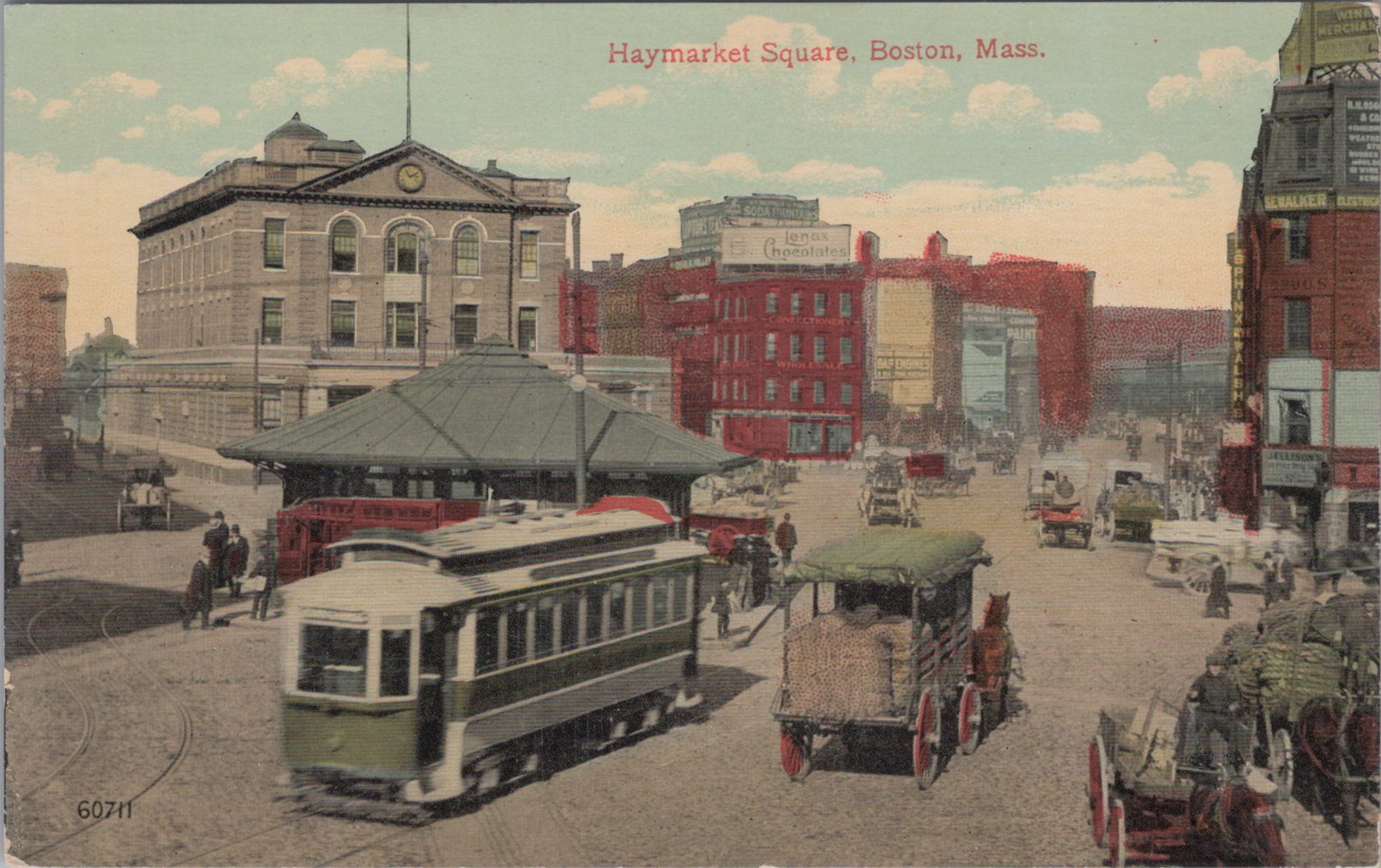
🖼️ Information on the Front of the Postcard
📝 In-Scene Text
SODA FOUNTAINS
fenax Chocolates!
CONFECTIONERY
WHOLESALE
PAINT
GAS ENGINES
WINE MERCHANT
B.B. DODGE & CO.
WEATHERS & CO.
SE WALKER ELECTRICAL
JELLISON'S
🏢 Publisher Information
60711
💬 Captions
Haymarket Square, Boston, Mass.
✍️ Messages
Not visible
📬 Information on the Back of the Postcard
📮 Address
Not visible
📅 Postmark & Stamp
Not visible.
A pre-printed rectangular box for the stamp is located in the upper right corner. Inside it reads:
PLACE STAMP HERE
UNITED STATES
AND CANADA
ONE CENT
FOREIGN -
TWO CENTS.
No actual stamp or postmark is present.
✍️ Message
Not visible
🏛️ Publisher & Postal Note
* **Publisher Mark**: In the upper left corner, there is a diamond-shaped logo containing the intertwined letters "P&C". Around the bottom curve of the diamond are the words "SUPERIOR QUALITY". This indicates the manufacturer or publisher of the blank postcard.
* **Postal Note**:
* "POST CARD" is printed prominently at the top center.
* A vertical line divides the back into two halves.
* Below the left half, it reads: "THIS SPACE MAY BE USED FOR MESSAGE"
* Below the right half, it reads: "THIS SPACE FOR THE ADDRESS"
* The stamp box itself serves as a postal note regarding the required postage rates for different destinations.
📌 Context
This postcard features a "divided back" format, which was introduced in the United States on March 1, 1907. Prior to this, only the address was permitted on the back, and messages had to be written on the front (image side). The divided back allowed space for both the message and the address on the back.
The postage rates specified in the stamp box—"UNITED STATES AND CANADA ONE CENT / FOREIGN - TWO CENTS"—were in effect from March 1, 1907, until November 2, 1917, during what is often referred to as the "Golden Age of Postcards" in the U.S. This definitively dates the blank postcard to this period.
The "P&C SUPERIOR QUALITY" logo represents the manufacturer or publisher of the postcard. Without further information, the exact identity of "P&C" cannot be determined, but it signifies a specific brand of postcard paper or printing at the time. The card is unused, meaning it was never mailed.
Note: Postcard information is read by AI and may contain errors. Please review images for accuracy.
SHIPPING INFORMATION
- Shipping: Orders ship within 24 hours of payment each business day
- Safe Packaging: Your postcard ships in a rigid EcoSwift mailer
- Questions? Please check the photos carefully for condition and message us with any questions