
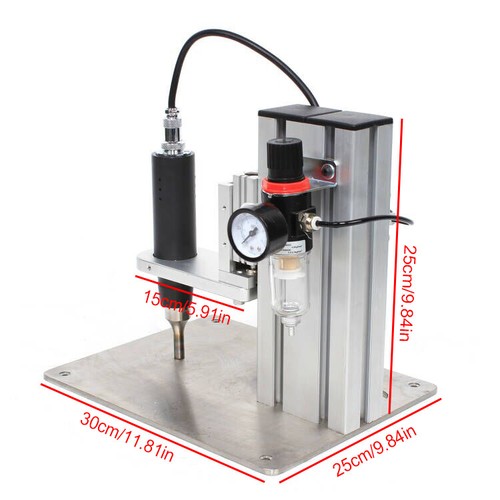
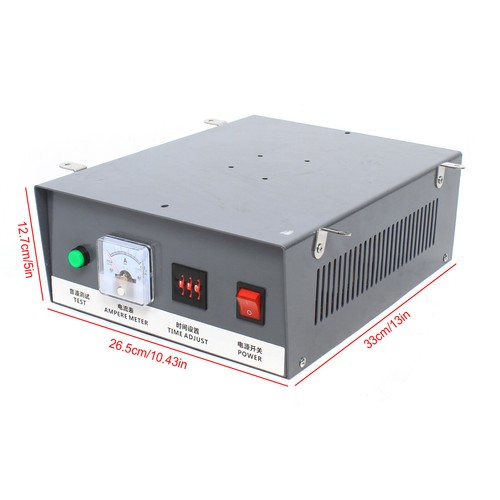


◆Net Weight: 15.3kg
◆Size: 410mm*350mm*320mm
◆Output Power: 500w
◆Welding Head Stroke: 20mm
◆Control Method: Pedal Pneumatic
◆Purpose: Sewing Equipment
◆Input Voltage: 110v
◆Targets: Swimsuits, Underwear, Masks
◆Degree of Automation: Semi-automatic
◆Oscillation System: Self-excited
◆Power Form: Ultrasonic
◆Drive Form: Portable Switch
◆Lifting Control: Electric
◆Frequency: 35 (Hz)
◆Welding Area: 2mm-10mm Optional Die
◆Welding Principle: Butt Welding
◆Vibrating Head Cooling System: Air Cool
 |  |
Features:1. Convenient Operation2. Easy Maintenance3. Higher Efficiency4. Strong Applicability
Machine Shape Diagram
Portable Ultrasonic Bonding Machine
Maintenance Guidance

Precautions, Common Sense and Routine Maintenance
- The welding head should not work directly with metal objects.
- The output force of the welding head is different for different types of shapes and sizes
- The output wire cannot be pulled with excessive force.
- The current is normally between 0.3 and 0.6 A at no load.
- FM screw set current at 0.3-0.6A when locked, can not be twisted at will (to ensure that the current is in the minimum position)
- Detect whether the no-load current is between 0.3-0.6A before work every day.
- The handle must be hung on the workbench so that it works vertically.
- Do not play freely outside the working period, and take care of the equipment.
- The greater the hand force, the greater the output force of the welding head, and vice versa if the hand force is small.
- When loading or unloading the die head, two opening wrenches must be used at the same time, one on the die head and one on the vibrator (the above action can be carried out only when the plastic nut of the handle is twisted loose and taken away first).
- Before installing the die head, wipe the face of the vibrator and die head clean, the screws should be locked in the die head and then locked with the vibrator, usually also pay attention to whether it has loosened.
- Do not collide and twist the handle with hard objects, which will break the handle and twist the wire.
- Check regularly whether the fan is functioning properly.
- For long-time use, the handle is naturally hot, please use the air gun to blow cold or natural


