|
Gordian III -
Roman Emperor
: 238-244 A.D. -
Bronze Sestertius 27mm (15.02 grams) Rome mint 240 A.D.
Reference: RIC 305a, C 244
IMPGORDINAVSPIVSFELAVG - Laureate, draped and cuirassed bust right.
PMTRPIIIICOSIIPP - Gordian III standing right, holding spear and globe; S C
across fields.
You are bidding on the exact
item pictured, provided with a Certificate of Authenticity and Lifetime
Guarantee of Authenticity.
The sestertius, or sesterce, (pl. sestertii) was an
ancient Roman
coin. During the
Roman Republic
it was a small,
silver
coin issued only on rare occasions.
During the
Roman Empire
it was a large
brass
coin.

Helmed Roma head right, IIS behind
Dioscuri
riding right, ROMA in linear frame
below. RSC4, C44/7, BMC13.
The name sestertius (originally semis-tertius) means "2 ½", the
coin's original value in
asses
, and is a combination of semis
"half" and tertius "third", that is, "the third half" (0 ½ being the
first half and 1 ½ the second half) or "half the third" (two units
plus half the third unit, or halfway between the second unit and
the third). Parallel constructions exist in
Danish
with halvanden (1 ½),
halvtredje (2 ½) and halvfjerde (3 ½). The form sesterce,
derived from
French
, was once used in preference to the
Latin form, but is now considered old-fashioned.
It is abbreviated as (originally IIS).

Example of a detailed portrait of
Hadrian
117 to 138
History
The sestertius was introduced c. 211 BC as a small
silver
coin valued at one-quarter of a
denarius
(and thus one hundredth of an
aureus
). A silver denarius was supposed to
weigh about 4.5 grams, valued at ten grams, with the silver sestertius valued at
two and one-half grams. In practice, the coins were usually underweight.
When the denarius was retariffed to sixteen asses (due to the gradual
reduction in the size of bronze denominations), the sestertius was accordingly
revalued to four asses, still equal to one quarter of a denarius. It was
produced sporadically, far less often than the denarius, through 44 BC.

Hostilian
under
Trajan Decius
250 AD
In or about 23 BC, with the coinage reform of
Augustus
, the denomination of sestertius was
introduced as the large brass denomination. Augustus tariffed the value of the
sestertius as 1/100 Aureus
. The sestertius was produced as the
largest brass
denomination until the late 3rd century
AD. Most were struck in the mint of
Rome but from AD 64 during the reign of
Nero (AD 54–68) and
Vespasian
(AD 69–79), the mint of
Lyon (Lugdunum), supplemented production. Lyon sestertii can
be recognised by a small globe, or legend stop), beneath the bust.[citation
needed]
The brass sestertius typically weighs in the region of 25 to 28 grammes, is
around 32–34 mm in diameter and about 4 mm thick. The distinction between
bronze
and brass was important to the Romans.
Their name for brass
was
orichalcum
, a word sometimes also spelled
aurichalcum (echoing the word for a gold coin, aureus), meaning
'gold-copper', because of its shiny, gold-like appearance when the coins were
newly struck (see, for example
Pliny the Elder
in his Natural History
Book 34.4).
Orichalcum
was considered, by weight, to be
worth about double that of bronze. This is why the half-sestertius, the
dupondius
, was around the same size and weight
as the bronze as, but was worth two asses.
Sestertii continued to be struck until the late 3rd century, although there
was a marked deterioration in the quality of the metal used and the striking
even though portraiture remained strong. Later emperors increasingly relied on
melting down older sestertii, a process which led to the zinc component being
gradually lost as it burned off in the high temperatures needed to melt copper (Zinc
melts at 419 °C, Copper
at 1085 °C). The shortfall was made up
with bronze and even lead. Later sestertii tend to be darker in appearance as a
result and are made from more crudely prepared blanks (see the
Hostilian
coin on this page).
The gradual impact of
inflation
caused by
debasement
of the silver currency meant that
the purchasing power of the sestertius and smaller denominations like the
dupondius and as was steadily reduced. In the 1st century AD, everyday small
change was dominated by the dupondius and as, but in the 2nd century, as
inflation bit, the sestertius became the dominant small change. In the 3rd
century silver coinage contained less and less silver, and more and more copper
or bronze. By the 260s and 270s the main unit was the double-denarius, the
antoninianus
, but by then these small coins
were almost all bronze. Although these coins were theoretically worth eight
sestertii, the average sestertius was worth far more in plain terms of the metal
they contained.
Some of the last sestertii were struck by
Aurelian
(270–275 AD). During the end of its
issue, when sestertii were reduced in size and quality, the
double sestertius
was issued first by
Trajan Decius
(249–251 AD) and later in large
quantity by the ruler of a breakaway regime in the West called
Postumus
(259–268 AD), who often used worn old
sestertii to
overstrike
his image and legends on. The double
sestertius was distinguished from the sestertius by the
radiate crown
worn by the emperor, a device
used to distinguish the dupondius from the as and the antoninianus from the
denarius.
Eventually, the inevitable happened. Many sestertii were withdrawn by the
state and by forgers, to melt down to make the debased antoninianus, which made
inflation worse. In the coinage reforms of the 4th century, the sestertius
played no part and passed into history.
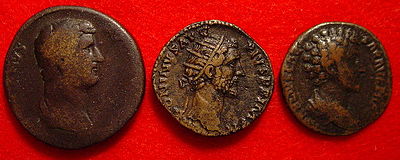
Sestertius of
Hadrian
, dupondius of
Antoninus Pius
, and as of
Marcus Aurelius
As a unit of account
The sestertius was also used as a standard unit of account, represented on
inscriptions with the monogram HS. Large values were recorded in terms of
sestertium milia, thousands of sestertii, with the milia often
omitted and implied. The hyper-wealthy general and politician of the late Roman
Republic,
Crassus
(who fought in the war to defeat
Spartacus
), was said by Pliny the Elder to have
had 'estates worth 200 million sesterces'.
A loaf of bread cost roughly half a sestertius, and a
sextarius
(~0.5 liter) of
wine anywhere from less than half to more than 1 sestertius. One
modius
(6.67 kg) of
wheat
in 79 AD
Pompeii
cost 7 sestertii, of
rye
3 sestertii, a bucket 2 sestertii, a tunic 15 sestertii, a donkey 500 sestertii.
Records from Pompeii
show a
slave
being sold at auction for 6,252
sestertii. A writing tablet from
Londinium
(Roman
London
), dated to c. 75–125 AD, records the
sale of a Gallic
slave girl called Fortunata for 600
denarii, equal to 2,400 sestertii, to a man called Vegetus. It is difficult to
make any comparisons with modern coinage or prices, but for most of the 1st
century AD the ordinary
legionary
was paid 900 sestertii per annum,
rising to 1,200 under
Domitian
(81-96 AD), the equivalent of 3.3
sestertii per day. Half of this was deducted for living costs, leaving the
soldier (if he was lucky enough actually to get paid) with about 1.65 sestertii
per day.
Perhaps a more useful comparison is a modern salary: in 2010 a private
soldier in the US Army (grade E-2) earned about $20,000 a year.
Numismatic value

A sestertius of
Nero
, struck at
Rome
in 64 AD. The reverse depicts
the emperor on horseback with a companion. The legend reads DECVRSIO,
'a military exercise'. Diameter 35mm
Sestertii are highly valued by
numismatists
, since their large size gave
caelatores (engravers) a large area in which to produce detailed portraits
and reverse types. The most celebrated are those produced for
Nero (54-68 AD) between the years 64 and 68 AD, created by some of
the most accomplished coin engravers in history. The brutally realistic
portraits of this emperor, and the elegant reverse designs, greatly impressed
and influenced the artists of the
Renaissance
. The series issued by
Hadrian
(117-138 AD), recording his travels
around the Roman Empire, brilliantly depicts the Empire at its height, and
included the first representation on a coin of the figure of
Britannia
; it was revived by
Charles II
, and was a feature of
United Kingdom
coinage until the
2008 redesign
.
Very high quality examples can sell for over a million
dollars
at auction as of 2008, but the coins
were produced in such colossal abundance that millions survive. Worn, but
recognisable, examples of common types can be found for as little as £10 or $20.
In
ancient Roman religion
, Concordia is the
goddess
who embodies agreement in marriage and
society. Her
Greek equivalent
is usually regarded as
Harmonia
, with
musical harmony
a
metaphor
for an ideal of social concord or
entente
in the political
discourse
of the
Republican era
. She was thus often associated
with
Pax
("Peace") in representing a stable
society.As such, she is more closely related to the Greek concept of
homonoia
(likemindedness),
which was also represented by
a goddess
.
Concordia
Augusta
was
cultivated
in the context of
Imperial cult
. Dedicatory inscriptions to her,
on behalf of emperors and members of the imperial family, were common.
In art
In art, Concordia was depicted sitting, wearing a long cloak and holding onto
a patera
(sacrificial bowl), a
cornucopia
(symbol of prosperity), or a
caduceus
(symbol of peace). She was often shown
in between two other figures, such as standing between two members of the
Imperial family shaking hands. She was associated with a pair of female deities,
such as
Pax
and
Salus
, or
Securitas
and
Fortuna
. Paired "Security and Luck" could also
be represented by
Hercules
and
Mercury
.[4]
Temples
The oldest
Temple of Concord
, built in 367 BC by
Marcus Furius Camillus
, stood on the
Roman Forum
. Other temples and shrines in Rome
dedicated to Concordia were largely geographically related to the main temple,
and included (in date order):
- a bronze shrine (aedicula) of Concord erected by the
aedile
Gnaeus Flavius
in 304 BC "in
Graecostasis
" and "in area Volcani"
(placing it on the Graecostasis, close to the main temple of Concord). He
vowed it in the hope of reconciling the nobility who had been outraged by
his publication of the calendar, but the senate would vote no money for its
construction and this thus had to be financed out of the fines of condemned
usurers.[5]
It must have been destroyed when the main temple was enlarged by Opimius in
121 BC.
- one built on the
arx
(probably on the east side, overlooked
the main temple of Concord below). It was probably vowed by the
praetor
Lucius Manlius
in 218 BC after quelling a
mutiny among his troops in
Cisalpine Gaul
,[6]
with building work commencing in 217 and dedication occurring on 5 February
216.
- a temple to Concordia Nova, marking the end
Julius Caesar
had brought to civil war. It
was voted by the senate in 44 BC.[8]
but was possibly never built.
- a temple built by
Livia
according to Ovid's
Fasti
VI.637‑638 ("te quoque magnifica,
Concordia, dedicat
aede
Livia quam caro praestitit ipsa viro"
- the only literary reference to this temple). The description of the
Porticus Liviae
follows immediately, and it
is probable therefore that the temple was close to or within the porticus,
but the small rectangular structure marked on the Marble Plan (frg. 10) can
hardly have been a temple deserving of the epithet "magnifica" (HJ 316).
In Pompeii
, the high priestess
Eumachia
dedicated a building to Concordia
Augusta.
Modern religion
Harmonians and some
Discordians
equate Concordia with
Aneris
.[10]
Her opposite is thus Discordia, or the Greek
Eris
.
Marcus Antonius Gordianus Pius (January
20, 225
–
February
11
, 244
),
known in
English
as Gordian III,
 was
Roman
Emperor
from 238 to 244. Gordian was the son of
Antonia Gordiana
and his father was an unnamed Roman Senator who died before
238. Antonia Gordiana was the daughter of Emperor
Gordian I
and younger sister of Emperor
Gordian II
.
Very little is known on his early life before becoming Roman Emperor. Gordian
had assumed the name of his maternal grandfather in 238. was
Roman
Emperor
from 238 to 244. Gordian was the son of
Antonia Gordiana
and his father was an unnamed Roman Senator who died before
238. Antonia Gordiana was the daughter of Emperor
Gordian I
and younger sister of Emperor
Gordian II
.
Very little is known on his early life before becoming Roman Emperor. Gordian
had assumed the name of his maternal grandfather in 238.
Rise to power
Following the murder of emperor
Alexander Severus
in Moguntiacum (modern
Mainz
), the
capital of the
Roman province
Germania Inferior
,
Maximinus Thrax
was acclaimed emperor, despite strong opposition of the
Roman senate
and the majority of the population. In response to what was
considered in Rome as a rebellion, Gordian's grandfather and uncle, Gordian I
and II, were proclaimed joint emperors in the
Africa Province
. Their revolt was suppressed within a month by Cappellianus,
governor of Numidia
and a loyal supporter of Maximinus Thrax. The elder Gordians died,
but public opinion cherished their memory as peace loving and literate men,
victims of Maximinus' oppression.
Meanwhile, Maximinus was on the verge of marching on Rome and
the Senate elected
Pupienus
and Balbinus
as joint emperors. These senators were not popular men and the population of
Rome was still shocked by the elder Gordian's fate, so that the Senate decided
to take the teenager Gordian, rename him Marcus Antonius Gordianus as his
grandfather, and raise him to the rank of
Caesar
and imperial heir.
Pupienus
and Balbinus
defeated Maximinus, mainly due to the defection of several
legions
,
namely the
Parthica II
who assassinated Maximinus. But their joint reign was
doomed from the start with popular riots, military discontent and even an
enormous fire that consumed Rome in June 238. On
July 29
,
Pupienus and Balbinus were killed by the
Praetorian guard
and Gordian proclaimed sole emperor.
Rule
Due to Gordian's age, the imperial government was surrendered
to the aristocratic families, who controlled the affairs of Rome through the
senate. In 240,
Sabinianus
revolted in the African province, but the situation was dealt quickly. In 241,
Gordian was married to Furia Sabinia
Tranquillina
, daughter of the newly appointed praetorian prefect,
Timesitheus
. As chief of the Praetorian guard and father in law of the
emperor, Timesitheus quickly became the de facto ruler of the Roman
empire.
In the 3rd century, the Roman frontiers weakened against the
Germanic tribes across the
Rhine
and
Danube
, and the
Sassanid
kingdom across the
Euphrates
increased its own attacks. When the Persians under
Shapur I
invaded Mesopotamia
, the young emperor opened the doors of the
Temple of Janus
for the last time in Roman history, and sent a huge army to
the East. The Sassanids were driven back over the Euphrates and defeated in the
Battle of Resaena
(243). The campaign was a success and Gordian, who had
joined the army, was planning an invasion of the enemy's territory, when his
father-in-law died in unclear circumstances. Without Timesitheus, the campaign,
and the emperor's security, were at risk.
Marcus Julius Philippus, also known as
Philip the Arab
, stepped in at this moment as the new Praetorian Prefect and
the campaign proceeded. In the beginning of 244, the Persians counter-attacked.
Persian sources claim that a battle was fought (Battle
of Misiche) near modern
Fallujah
(Iraq)
and resulted in a major Roman defeat and the death of Gordian III[1].
Roman sources do not mention this battle and suggest that Gordian died far away,
upstream of the Euphrates. Although ancient sources often described Philip, who
succeeded Gordian as emperor, as having murdered Gordian at Zaitha (Qalat es
Salihiyah), the cause of Gordian's death is unknown.
Gordian's youth and good nature, along with the deaths of his
grandfather and uncle and his own tragic fate at the hands of another usurper,
granted him the everlasting esteem of the Romans. Despite the opposition of the
new emperor, Gordian was deified by the Senate after his death, in order to
appease the population and avoid riots.
|

