|
<="" font="" color="#000000">
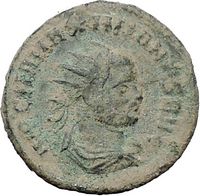
Maximian
-
Roman Emperor
: 285-305, 306-308 & 310 A.D. -
Bronze Antoninianus 23mm ( grams) Struck at the mint of Heraclea 292-295
A.D.
Reference: RIC 595, C 54
IMPCMAMAXIMIANVSPFAVG - Radiate, draped bust right.
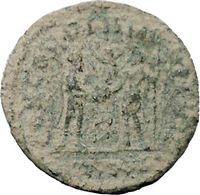
CONCORDIAMILITVM Exe: S/XXI - Maximian standing right on left, receiving
Victory
on globe from Jupiter to right, holding scepter.
You are bidding on the exact
item pictured, provided with a Certificate of Authenticity and Lifetime
Guarantee of Authenticity.
In
Roman mythology
,
Jupiter
or
Jove was the
king of the gods
, and the god of
sky and
thunder
. He
is
 the equivalent of Zeus
in the
Greek pantheon
. He was called Iuppiter (or Diespiter)
Optimus Maximus ("Father God the Best and Greatest"). As the patron deity of
ancient
Rome
, he ruled over laws and social order. He was the chief god of the
Capitoline Triad
, with sister/wife
Juno
. Jupiter is also the father of the god
Mars
with Juno. Therefore, Jupiter is the grandfather of
Romulus and Remus
, the legendary founders of Rome. Jupiter was venerated in
ancient Roman religion
, and is still venerated in
Roman Neopaganism
. He is a son of
Saturn
, along with brothers
Neptune
and
Pluto
.
He is also the brother/husband of
Ceres
(daughter of Saturn and mother of
Proserpina
),
brother of Veritas
(daughter of Saturn), and father of
Mercury
. the equivalent of Zeus
in the
Greek pantheon
. He was called Iuppiter (or Diespiter)
Optimus Maximus ("Father God the Best and Greatest"). As the patron deity of
ancient
Rome
, he ruled over laws and social order. He was the chief god of the
Capitoline Triad
, with sister/wife
Juno
. Jupiter is also the father of the god
Mars
with Juno. Therefore, Jupiter is the grandfather of
Romulus and Remus
, the legendary founders of Rome. Jupiter was venerated in
ancient Roman religion
, and is still venerated in
Roman Neopaganism
. He is a son of
Saturn
, along with brothers
Neptune
and
Pluto
.
He is also the brother/husband of
Ceres
(daughter of Saturn and mother of
Proserpina
),
brother of Veritas
(daughter of Saturn), and father of
Mercury
.
Marcus Aurelius Valerius Maximianus Herculius (c. 250 – c. July 310),
commonly referred to as Maximian, was
Caesar
(junior
Roman
Emperor
) from July 285
and
Augustus
(senior Roman Emperor) from April 1, 286
to
 May 1, 305.
He shared the latter title with his co-emperor and superior,
Diocletian
,
whose political brain complemented Maximian's military brawn. Maximian
established his residence at
Trier
but spent
most of his time on campaign. In the late summer of 285, he suppressed rebels in
Gaul known as the
Bagaudae
.
From 285 to 288, he fought against Germanic tribes along the Rhine frontier.
Together with Diocletian, he ran a
scorched earth
campaign deep into the territory of the
Alamanni
tribes in 288, temporarily relieving the Rhenish provinces from the threat of
Germanic invasion.
May 1, 305.
He shared the latter title with his co-emperor and superior,
Diocletian
,
whose political brain complemented Maximian's military brawn. Maximian
established his residence at
Trier
but spent
most of his time on campaign. In the late summer of 285, he suppressed rebels in
Gaul known as the
Bagaudae
.
From 285 to 288, he fought against Germanic tribes along the Rhine frontier.
Together with Diocletian, he ran a
scorched earth
campaign deep into the territory of the
Alamanni
tribes in 288, temporarily relieving the Rhenish provinces from the threat of
Germanic invasion.
The man he appointed to police the
Channel
shores,
Carausius
,
rebelled in 286, causing the secession of Britain and northwestern Gaul.
Maximian failed to oust Carausius, and his invasion fleet was destroyed by
storms in 289 or 290. Maximan's subordinate,
Constantius
, campaigned against Carausius' successor,
Allectus
,
while Maximian held the Rhenish frontier. The rebel leader was ousted in 296,
and Maximian moved south to combat
Moorish
pirates
in Iberia and
Berber
incursions in
Mauretania
.
When these campaigns concluded in 298, he departed for Italy, where he lived in
comfort until 305. At Diocletian's behest, Maximian abdicated on May 1, 305,
gave the Augustan office to Constantius, and retired to southern Italy.
In late 306, Maximian took the title of Augustus again and aided his son
Maxentius
'
rebellion in Italy. In April 307, he attempted to depose his son, but failed and
fled to the court of Constantius' successor,
Constantine
, in Trier. At the Council of
Carnuntum
in November 308, Diocletian and his successor,
Galerius
,
forced Maximian to renounce his imperial claim again. In early 310, Maximian
attempted to seize Constantine's title while the emperor was on campaign on the
Rhine. Few supported him, and he was captured by Constantine in Marseille.
Maximian committed suicide in the summer of 310 on Constantine's orders. During
Constantine's war with Maxentius, Maximian's image was purged from all public
places. However, after Constantine ousted and killed Maxentius, Maximian's image
was rehabilitated, and he was deified.
One of the members of the Tetrarchy, Maximianus had a
convoluted reign that started when he and Diocletian began ruling as equals in
286. Maximianus was in charge of the western portion of the empire along with
Constantius I, his junior in command, while Diocletian and Galerius ruled the
eastern half. After several years of putting down revolts and usurpers, both he
and Diocletian abdicated to let their Caesars take their place in 306. However,
this peaceful arrangement would come to an end soon when Maximianus's son
Maxentius initiated a revolt of his own. Seeing that it would lend an air of
legitimacy to his claims, Maxentius requested his father to return to assume the
high post along with him. Maximianus, although possibly reluctant initially,
took up his son's offer. He had abdicated less than voluntarily under
Diocletian's scheme and now he was caught up in the fervor of Maxentius's drive
to become sole ruler. In time, Maxentius met with failure after he lost several
key battles to Constantine and Maximianus found himself in the awkward position
of being an emperor with no rightful claim nor army willing to proceed with his
agenda. Increasingly isolated, Constantine cornered him and he was either
executed or committed suicide.
The Principate
Julio-Claudian
dynasty
|
Reign |
Incumbent |
Notes |
|
16 January 27 BC to 19 August AD 14 |
Augustus
|
|
|
19 August 14 to 16 March 37 |
Tiberius
|
|
|
18 March 37 to 24 January 41 |
Caligula
|
Murdered by Praetorian Guard |
|
24 January 41 to 13 October 54 |
Claudius
|
Poisoned by his wife Agrippina, mother of Nero |
|
13 October 54 to 11 June 68 |
Nero
|
Made a slave kill him |
Year
of the Four Emperors (Civil War)
|
Reign |
Incumbent |
Notes |
|
8 June 68 to 15 January 69 |
Galba
|
Murdered in favour of
Otho
|
|
15 January 69 to 16 April 69 |
Otho
|
Committed suicide |
|
2 January 69 to 20 December 69 |
Vitellius
|
Murdered in favour of
Vespasian
|
Flavian
dynasty
|
Reign |
Incumbent |
Notes |
|
1 July 69 to 24 June 79 |
Vespasian
|
|
|
24 June 79 to 13 September 81 |
Titus
|
Possibly assassinated by Domitian |
|
14 September 81 to 18 September 96 |
Domitian
|
Assassinated |
Nervan-Antonian
dynasty
Main article:
Five Good Emperors
|
Reign |
Incumbent |
Notes |
|
18 September 96 to 27 January 98 |
Nerva
|
Proclaimed emperor by senate |
|
28 January 98 to 7 August 117 |
Trajan
|
|
|
11 August 117 to 10 July 138 |
Hadrian
|
|
|
10 July 138 to 7 March 161 |
Antoninus Pius
|
|
|
7 March 161 to 17 March 180 |
Marcus Aurelius
|
|
|
7 March 161 to March 169 |
Lucius Verus
|
Co-emperor with
Marcus Aurelius
|
|
175 |
Avidius Cassius
|
Usurper; ruled in Egypt and Syria; murdered by his own army |
|
177 to 31 December 192 |
Commodus
|
Assassinated |
Year
of the Five Emperors &
Severan dynasty
|
Reign |
Incumbent |
Notes |
|
1 January 193 to 28 March 193 |
Pertinax
|
Proclaimed emperor by senate; murdered by Praetorian Guard |
|
28 March 193 to 1 June 193 |
Didius Julianus
|
Proclaimed emperor by Praetorian Guard; executed on orders of the Senate |
|
9 April 193 to 4 February 211 |
Septimius Severus
|
Proclaimed emperor by
Pannonian
troops; accepted by
senate |
|
193 to 194/195 |
Pescennius Niger
|
Proclaimed emperor by Syrian troops, defeated in battle by
Septimius Severus
|
|
193/195 to 197 |
Clodius Albinus
|
Proclaimed emperor by British troops, defeated in battle by
Septimius Severus
|
|
198 to 8 April 217 |
Caracalla
|
Assassinated at the behest of
Macrinus
|
|
209 to 4 February 211 |
Geta
|
Co-emperor with
Caracalla
; assassinated on orders
of
Caracalla
|
|
11 April 217 to June 218 |
Macrinus
|
Proclaimed himself emperor; executed on orders of
Elagabalus
|
|
May 217 to June 218 |
Diadumenian
|
Junior co-emperor under
Macrinus
; executed |
|
June 218 to 222 |
Elagabalus
|
Proclaimed emperor by army; murdered by his own troops |
|
13 March 222 to ?March 235 |
Alexander Severus
|
Murdered by his own troops |
Rulers during the
Crisis of the Third Century
|
Reign |
Incumbent |
Notes |
|
February/March 235 to March/April 238 |
Maximinus Thrax
|
Proclaimed emperor by the army; murdered by
Praetorian Guard
|
|
earlyJanuary/March
238 to lateJanuary/April 238 |
Gordian I
|
Proclaimed emperor in Africa; committed suicide after
Gordian II
's death |
|
earlyJanuary
March 238 to lateJanuary/April 238 |
Gordian II
|
Proclaimed emperor with
Gordian I
, killed in battle |
|
earlyFebruary
238 to earlyMay 238 |
Pupienus
|
Proclaimed joint emperor by senate; murdered by
Praetorian Guard
|
|
earlyFebruary
238 to earlyMay 238 |
Balbinus
|
Proclaimed joint emperor by senate; murdered by
Praetorian Guard
|
|
May 238 to February 244 |
Gordian III
|
Nephew of
Gordian II
; death unclear,
probably murdered |
|
240 |
Sabinianus
|
Usurper; proclaimed himself emperor; defeated in battle |
|
February 244 to September/October 249 |
Philip the Arab
|
Proclaimed emperor after death of
Gordian III
; killed in battle by
Decius
|
|
248 |
Pacatianus
|
Usurper; proclaimed himself emperor; murdered by his own soldiers |
|
248 to 249 |
Iotapianus
|
Usurper; proclaimed himself emperor in the east; murdered by his own
soldiers |
|
248? or 253? |
Silbannacus
|
Usurper; details essentially unknown |
|
249 to June 251 |
Decius
|
Killed in battle |
|
249 to 252 |
Priscus
|
Proclaimed himself emperor in the east in opposition to
Decius
|
|
250 to 250 |
Licinianus
|
Usurper; proclaimed emperor in Rome; rebellion suppressed |
|
early251
to June 251 |
Herennius Etruscus
|
Junior co-emperor under
Decius
; killed in battle |
|
251 |
Hostilian
|
Son of
Decius
; died of plague |
|
June 251 to August 253 |
Gallus
|
Proclaimed emperor by his troops after Decius's death; murdered by them
in favour of Aemilianus |
|
July 251 to August 253 |
Volusianus
|
Junior co-emperor under
Gallus
; murdered by army |
|
August 253 to October 253 |
Aemilian
|
Proclaimed emperor by his troops; murdered by them in favour of
Valerian
|
|
253 to June 260 |
Valerian
|
Proclaimed emperor by his troops; captured in battle by the
Persians
; died in captivity |
|
253 to September 268 |
Gallienus
|
Junior co-emperor under
Valerian
to 260; probably murdered
by his generals |
|
260 |
Saloninus
|
Son of
Gallienus
; proclaimed emperor by
army; murdered shortly after by troops of
Postumus
|
|
June 260 (or 258) |
Ingenuus
|
Usurper; proclaimed himself emperor after
Valerian
's capture; defeated in
battle |
|
260 |
Regalianus
|
Usurper; proclaimed emperor after
Ingenuus
's defeat; fate unclear |
|
260 to 261 |
Macrianus Major
|
Usurper; proclaimed emperor by eastern army; defeated and killed in
battle |
|
260 to 261 |
Macrianus Minor
|
Usurper; son of
Macrianus Major
; defeated and
killed in battle |
|
260 to 261 |
Quietus
|
Usurper; son of
Macrianus Major
; defeated and
killed in battle |
|
261 to 261 or 262 |
Mussius Aemilianus
|
Usurper; proclaimed himself emperor after the defeat of the Macriani;
defeated and executed |
|
268 to 268 |
Aureolus
|
Usurper; proclaimed himself emperor after
Gallienus
's death; surrendered to
Claudius II Gothicus
; murdered by
Praetorian Guard |
|
268 to August 270 |
Claudius II Gothicus
|
Proclaimed emperor by the army |
|
August 270 to September 270 |
Quintillus
|
Proclaimed himself emperor; cause of death unclear |
|
August 270 to 275 |
Aurelian
|
Proclaimed emperor by army; murdered by the
Praetorian Guard
|
|
271 to 271 |
Septimius
|
Usurper; proclaimed emperor in
Dalmatia
; killed by his own
soldiers |
|
November/December 275 to July 276 |
Tacitus
|
Appointed emperor by the Senate; possibly assassinated |
|
July 276 to September 276 |
Florianus
|
Brother of
Tacitus
, proclaimed emperor by the
western army; murdered by his troops |
|
July 276 to lateSeptember 282 |
Probus
|
Proclaimed emperor by the eastern army; murdered by his own soldiers in
favour of
Carus
|
|
280 |
Julius Saturninus
|
Usurper; proclaimed emperor by his troops; then killed by them |
|
280 |
Proculus
|
Usurper; proclaimed himself emperor at the request of the people of
Lugdunum
; executed by
Probus
|
|
280 |
Bonosus
|
Usurper; proclaimed himself emperor; defeated by
Probus
and committed suicide |
|
September 282 to July/August 283 |
Carus
|
Proclaimed emperor by Praetorian guard |
|
spring 283 to summer 285 |
Carinus
|
Son of Carus; co-emperor with
Numerian
; fate unclear |
|
July/August 283 to November 284 |
Numerian
|
Son of Carus; co-emperor with
Carinus
; probably murdered |
Gallic
Empire
260
to 274
|
Reign |
Incumbent |
Notes |
|
260 to 268 |
Postumus
|
Declared himself emperor after
Valerian
's death; killed by his
own troops |
|
268 to 268 |
Laelianus
|
Proclaimed himself emperor in opposition to Postumus; defeated and
killed by Postumus |
|
269 to 269 |
Marius
|
Proclaimed himself emperor after Postumus's death |
|
269 to 271 |
Victorinus
|
Proclaimed emperor after Marius's death |
|
270 to 271 |
Domitianus
|
Proclaimed himself emperor of the
Gallic Empire
|
|
271 to 274 |
Tetricus I
|
Nominated heir to Victorinus |
Britannic
Empire
286
to 297
|
Reign |
Incumbent |
Notes |
|
286 to 293 |
Carausius
|
Declared himself emperor; assassinated by
Allectus
|
|
293 to 297 |
Allectus
|
Declared himself emperor after
Carausius
's death; defeated by
Constantius Chlorus
|
Dominate
Tetrarchy
and
Constantinian dynasty
|
Reign |
Incumbent |
Notes |
|
20 November 284 to 1 May 305 |
Diocletian
|
Declared emperor by the army after Numerian's death; Abdicated |
|
1 April 286 to 1 May 305 |
Maximian
|
Made co-emperor ('Augustus') with
Diocletian
; abdicated |
|
1 May 305 to 25 July 306 |
Constantius I Chlorus
|
Made junior co-emperor ('Caesar') under
Maximian
; became Augustus after
his abdication |
|
1 May 305 to May 311 |
Galerius
|
Made junior co-emperor ('Caesar') under
Diocletian
; became Augustus after
his abdication |
|
August 306 to 16 September 307 |
Severus II
|
Made junior co-emperor ('Caesar') under
Constantius Chlorus
; became
Augustus after his death; executed by
Maxentius
|
|
28 October 306 to 28 October 312 |
Maxentius
|
Son of
Maximian
; proclaimed Augustus by
Praetorian Guard
; defeated in
battle by
Constantine I
|
|
de jure:
307, de facto 312 to 22 May 337 |
Constantine I
|
Son of
Constantius Chlorus
; proclaimed
Augustus by army |
|
308
-309?/311? |
Domitius Alexander
|
Proclaimed emperor in Africa; defeated in battle by
Maxentius
|
|
11 November 308 to 18 September 324 |
Licinius
|
Appointed Augustus by
Galerius
; deposed by
Constantine I
and executed |
|
1 May 311 to July/August 313 |
Maximinus Daia
|
Made junior co-emperor ('Caesar') under
Galerius
; became Augustus after
his death; defeated in battle by Licinius and committed suicide |
|
December 316 to 1 March 317 |
Valerius Valens
|
Appointed co-Augustus by
Licinius
; executed by
Licinius
|
|
July to 18 September 324 |
Martinianus
|
Appointed co-Augustus by
Licinius
; deposed by
Constantine I
and executed |
|
337 to 340 |
Constantine II
|
Son of
Constantine I
; co-emperor with his
brothers; killed in battle |
|
337 to 361 |
Constantius II
|
Son of
Constantine I
; co-emperor with his
brothers |
|
337 to 350 |
Constans I
|
Son of
Constantine I
; co-emperor with his
brothers, killed by
Magnentius
|
|
January 350 to 11 August 353 |
Magnentius
|
Usurper; proclaimed emperor by the army; defeated by
Constantius II
and committed
suicide |
|
c.
350 |
Vetranio
|
Proclaimed himself emperor against
Magnentius
; recognized by
Constantius II
but then deposed |
|
c.
350 |
Nepotianus
|
Proclaimed himself emperor against
Magnentius
, defeated and executed
by
Magnentius
|
|
November 361 to June 363 |
Julian
|
Cousin of
Constantius II
; made Caesar by
Constantius, then proclaimed Augustus by the army; killed in battle |
|
363 to 17 February 364 |
Jovian
|
Proclaimed emperor by the army after
Julian
's death |
Valentinian
dynasty
|
Reign |
Incumbent |
Notes |
|
26 February 364 to 17 November 375 |
Valentinian I
Valentinian I Coins.htm |
Proclaimed emperor by the army after
Jovian
's death |
|
28 March 365 to 9 August 378 |
Valens
|
Made co-emperor in the east by his brother
Valentinian I
; killed in battle |
|
September 365 to 27 May 366 |
Procopius
|
Usurper; Proclaimed himself emperor; defeated and executed by
Valens
|
|
24 August 367 to 383 |
Gratian
Gratian Coins.htm |
Son of
Valentinian I
; assassinated |
|
375 to 392 |
Valentinian II
Valentinian II Coins.htm |
Son of
Valentinian I
; deposed by
Arbogast
and died in suspicious
circumstances |
|
383 to 388 |
Magnus Maximus
Magnus Maximus Coins.htm |
Usurper; proclaimed emperor by troops; at one time recognized by
Theodosius I
, but then deposed and
executed |
|
c.386
to 388 |
Flavius Victor
Flavius Victor Coins.htm |
Son of Magnus Maximus, executed on orders of
Theodosius I
|
|
392 to 394 |
Eugenius
Eugenius Coins.htm |
Usurper; proclaimed emperor by army under
Arbogast
; defeated in battle by
Theodosius I
|
Theodosian
dynasty
|
Reign |
Incumbent |
Notes |
|
379 to 17 January 395 |
Theodosius I
Theodosius I Coins.htm |
Made co-emperor for the east by
Gratian
|
|
383 to 408
EAST |
Arcadius
Arcadius Coins.htm |
Appointed co-emperor with his father
Theodosius I
; sole emperor for the
east from January 395 |
|
23 January 393 to 15 August 423
WEST |
Honorius
Honorius Coins.htm |
Appointed Augustus for the west by his father
Theodosius I
|
|
407 to 411
WEST |
Constantine III
Constantine III Coins.htm |
Usurper; proclaimed emperor in Britain; defeated by
Constantius III
|
|
409 to 411
WEST |
Constans II
Constans II Coins.htm |
Usurper; made emperor by his father
Constantine III
; killed in battle |
|
409 and 414 to 415
WEST |
Priscus Attalus
Priscus Attalus Coins.htm |
Usurper; twice proclaimed emperor by
Visigoths
under
Alaric
and twice deposed by
Honorius
|
|
409 to 411
WEST |
Maximus
Maximus Coins.htm |
Usurper; proclaimed emperor in Spain; abdicated |
|
411 to 413
WEST |
Jovinus
Jovinus Coins.htm |
Usurper; proclaimed emperor after
Constantine III
's death, executed
by
Honorius
|
|
412 to 413
WEST |
Sebastianus
Sebastianus Coins.htm |
Usurper; appointed co-emperor by
Jovinus
, executed by
Honorius
|
|
408 to 450
EAST |
Theodosius II
Theodosius II Coins.htm |
Son of
Arcadius
|
|
421 to 421
WEST |
Constantius III
Constantius III Coins.htm |
Son-in-law of
Theodosius I
; appointed co-emperor
by
Honorius
|
|
423 to 425
WEST |
Joannes
Johannes Coins.htm |
Proclaimed western emperor, initially undisputed; defeated and executed
by
Theodosius II
in favour of
Valentinian III
|
|
425 to 16 March 455
WEST |
Valentinian III
Valentinian III Coins.htm |
Son of
Constantius III
; appointed emperor
by
Theodosius II
; assassinated |
Western
Roman Empire
|
Reign |
Incumbent |
Notes |
|
17 March 455 to 31 May 455 |
Petronius Maximus
Petronius Maximus Coins.htm |
Proclaimed himself emperor after
Valentinian III
's death; murdered |
|
June 455 to 17 October 456 |
Avitus
Avitus Coins.htm |
Proclaimed emperor by the
Visigoth
king
Theoderic II
; deposed by
Ricimer
|
|
457 to 2 August 461 |
Majorian
Majorian Coins.htm |
Appointed by
Ricimer
; deposed and executed by
Ricimer
|
|
461 to 465 |
Libius Severus
Libius Severus Coins.htm |
Appointed by
Ricimer
; deposed and executed by
Ricimer
|
|
12 April 467 to 11 July 472 |
Anthemius
Anthemius Coins.htm |
Appointed by
Ricimer
; deposed and executed by
Ricimer
|
|
July 472 to 2 November 472 |
Olybrius
Olybrius Coins.htm |
Appointed by
Ricimer
|
|
5 March 473 to June 474 |
Glycerius
Glycerius Coins.htm |
Appointed by
Gundobad
; deposed by
Julius Nepos
|
|
June 474 to 25 April 480 |
Julius Nepos
Julius Nepos Coins.htm |
Appointed by eastern emperor
Leo I
; deposed in Italy by
Orestes
in 475; continued to be
recognised as lawful emperor in Gaul and Dalmatia until his murder in
480 |
|
31 October 475 to 4 September 476 |
Romulus Augustus
(Romulus
Augustulus)
Romulus Augustus Coins.htm |
Son of
Orestes
; deposed by
Odoacer
; fate unknown |
Further information:
Barbarian kings of Italy
Eastern
Roman Empire
-
For
the rulers of the Eastern Roman Empire (also known as the
Byzantine Empire
) after
Theodosius II
, see:
List of Byzantine Emperors
Theodosian dynasty (395–457)
See also:
Theodosian dynasty
| Name |
Reign |
Comments |
| |
Theodosius I "the Great"
(Θεοδόσιος Α' ο Μέγας, Flavius Theodosius)Theodosius
I Coins.htm |
19 January 379 –
17 January 395 |
Born on 11 January 347. Aristocrat and military leader,
brother-in-law of Gratian, who appointed him as emperor of the East.
From 392 until his death sole Roman emperor |
| |
Arcadius
(Αρκάδιος, Flavius Arcadius)Arcadius
Coins.htm |
17 January 395 –
1 May 408 |
Born in 377/378, the eldest son of Theodosius I.
Succeeded upon the death of his father |
| |
Theodosius II
(Θεοδόσιος Β', Flavius Theodosius)
Theodosius II Coins.htm |
1 May 408 –
28 July 450 |
Born on 10 April 401, the only son of Arcadius.
Succeeded upon the death of his father. As a minor, the praetorian
prefect
Anthemius
was regent in 408–414. He
died in a riding accident |

|
Marcian
(Μαρκιανός, Flavius Valerius Marcianus)
Marcian Coins.htm |
450 – January 457 |
Born in 396. A soldier and
politician, he became emperor after being wed by the Augusta
Pulcheria
, Theodosius II's sister,
following the latter's death. Died of
gangrene
|
Leonid
dynasty (457–518)
See also:
House of Leo
| Name |
Reign |
Comments |
| |
Leo I "the Thracian"
(Λέων Α' ο Θράξ, Flavius Valerius Leo)
Leo I Coins.htm |
7 February 457 –
18 January 474 |
Born in
Dacia
in 401. A common soldier, he was
chosen by Aspar
, commander-in-chief of the army.
Died of dysentery |

|
Leo II
(Λέων Β', Flavius Leo)Leo II
Coins.htm |
18 January –
17 November 474 |
Born in 467, the grandson of Leo I. Succeeded upon the
death of Leo I. Died of an unknown disease, possibly poisoned |

|
Zeno
(Ζήνων, Flavius Zeno)Zeno Coins.htm |
17 November 474 –
9 April 491 |
Born c.425 at
Zenonopolis
,
Isauria
, originally named
Tarasicodissa. Son-in-law of Leo I, he was bypassed in the succession
because of his barbarian origin. Named co-emperor by his son on 9
February 474, he succeeded upon the death of Leo II. Deposed by
Basiliscus, brother-in-law of Leo, he fled to his native country and
regained the throne in August 476. |

|
Basiliscus
(Βασιλίσκος, Flavius Basiliscus)
Basiliscus Coins.htm |
9 January 475 –
August 476 |
General and brother-in-law of Leo I, he seized power
from Zeno but was again deposed by him. Died in 476/477 |

|
Anastasius I
(Αναστάσιος Α', Flavius Anastasius)
BYZANTINE - Anastasius
Coins.htm |
11 April 491 –
9 July 518 |
Born c. 430 at
Dyrrhachium
,
Epirus nova
. A palace official (silentiarius)
and son-in-law of Leo I, he was chosen as emperor by empress-dowager
Ariadne
|
Justinian Dynasty
Main article:
Justinian Dynasty
| Portrait |
Name |
Born |
Reigned |
Succession |
Died |

|
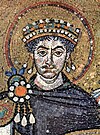
Justin I
FLAVIVS IVSTINVS AVGVSTVS |
c. 450 AD,
Naissus
|
July 9, 518 AD – August 1, 527 AD |
Commander of the palace guard under
Anastasius I)
; elected as emperor with
support of army |
August 1, 527 AD
Natural causes |
|
Justinian I
FLAVIVS PETRVS SABBATIVS IVSTINIANVS AVGVSTVS |
c. 482 AD,
Tauresium
,
Dardania
|
August 1, 527 AD – 13/14 November 565 AD |
Nephew and nominated heir of
Justin I
|
13/14 November 565 AD
Natural causes |

|
Justin II
FLAVIVS IVSTINIVS IVNIOR AVGVSTVS |
c. 520 AD, ? |
13/14 November 565 AD – 578 AD |
Nephew of
Justinian I
|
578 AD
Became insane;
Tiberius II Constantine
ruled as regent
from December 574 and became emperor on Justin's death in 578 |
Roman Late Monogram Coins.htm
Roman AE4 Coins.htm
See also
-
Roman Republic
-
Roman Empire
-
Western Roman Empire
-
Byzantine Empire
-
Britannic Empire
-
Gallic Empire
-
List of Roman usurpers
-
Roman usurper
-
Thirty Tyrants (Roman)
|