|
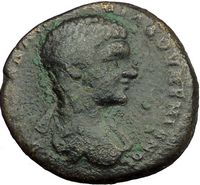
Diadumenian - Roman Caesar: 218 A.D.
Bronze 26mm (10.61 grams) of Nicopolis ad Istrum in Moesia Inferior
under Legate Statilius Longinus
K
M OΠΠЄΛ ANTΩN ΔIAΔOVMЄNIANOC, draped, bare-headed bust right.
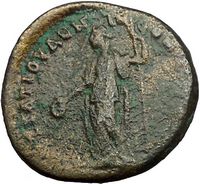
VΠ CTATIOV ΛONΓIOV NIKOΠOΛITΩN ΠPOC ICTP,
Hera standing left, holding patera and scepter.
You are bidding on the exact item pictured,
provided with a Certificate of Authenticity and Lifetime Guarantee of
Authenticity.
Hera was the wife and
one of three sisters of Zeus
in the
Olympian pantheon
of
Greek mythology
and
religion
. Her chief function was as the goddess
of women and marriage. Her counterpart in the
religion of ancient Rome
was
Juno
. The
cow
and the
peacock
were sacred to her. Hera's mother was
Rhea
and her father
Cronus
.
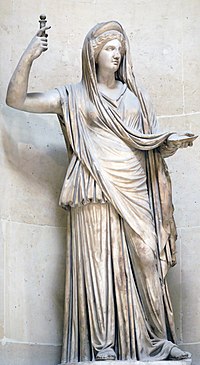 Portrayed
as majestic and solemn, often enthroned, and crowned with the
polos
(a high cylindrical crown worn by
several of the Great Goddesses
), Hera may bear a
pomegranate
in her hand, emblem of fertile
blood and death and a substitute for the narcotic capsule of the
opium
poppy. A scholar of Greek mythology
Walter Burkert
writes in Greek Religion,
"Nevertheless, there are memories of an earlier aniconic representation, as a
pillar in Argos and as a plank in Samos."
Portrayed
as majestic and solemn, often enthroned, and crowned with the
polos
(a high cylindrical crown worn by
several of the Great Goddesses
), Hera may bear a
pomegranate
in her hand, emblem of fertile
blood and death and a substitute for the narcotic capsule of the
opium
poppy. A scholar of Greek mythology
Walter Burkert
writes in Greek Religion,
"Nevertheless, there are memories of an earlier aniconic representation, as a
pillar in Argos and as a plank in Samos."
Hera was known for her jealous and vengeful nature, most notably against
Zeus's lovers and offspring, but also against mortals who crossed her, such as
Pelias
.
Paris
offended her by choosing
Aphrodite
as the most beautiful goddess,
earning Hera's hatred.
Nicopolis ad Istrum was a
Roman
and Early
Byzantine
town founded by Emperor
Trajan
around
101–106, at the junction of the Iatrus (Yantra)
and the Rositsa
rivers, in memory of his victory over the
Dacians
. Its
ruins are located at the village of
Nikyup
, 20 km north of
Veliko Tarnovo
in northern
Bulgaria
.
The town reached its apogee during the reigns of Trajan,
Hadrian
, the
Antonines
and the
Severan dynasty
.
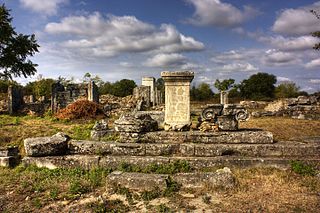
The classical town was planned according to the orthogonal system. The
network of streets, the forum surrounded by an Ionic colonnade and many
buildings, a two-nave room later turned into a basilica and other public
buildings have been uncovered. The rich architectures and sculptures show a
similarity with those of the ancient towns in Asia Minor. Nicopolis ad Istrum
had issued coins, bearing images of its own public buildings.
In
447 AD
, the town was destroyed by
Attila's
Huns
.
Perhaps it was already abandoned before the early 400s.
In the 6th century, it was rebuilt as a powerful fortress enclosing little more
than military buildings and churches, following a very common trend for the
cities of that century in the Danube area.The largest area of the extensive ruins (21.55 hectares) of the classical
Nicopolis was not reoccupied since the fort covered only one fourth of it (5.75
hectares), in the southeastern corner.
The town became an episcopal centre during the early Byzantine period. It was
finally destroyed by the Avar invasions at the end of the 6th century. A
Bulgarian medieval settlement arose upon its ruins later (10th-14th century).
Nicopolis ad Istrum can be said to have been the birthplace of
Germanic
literary tradition. In the 4th century, the
Gothic
bishop,
missionary and translator
Ulfilas
(Wulfila)
obtained permission from Emperor
Constantius II
to immigrate with his flock of converts to Moesia and settle
near Nicopolis ad Istrum in 347-8.
There, he invented the
Gothic alphabet
and translated the
Bible
from
Greek
to
Gothic
.
Marcus Opellius Antoninus Diadumenianus or Diadumenian
(208–218) was the son of the Roman Emperor Macrinus, and served his father
briefly as Caesar (May 217–218) and as Augustus (in 218). Diadumenian was born
in 14th of September 208 a.C or according to Historia Augusta in 19th of
September 208 a.C because he shared the same birthday with the emperor Antoninus
Pius. His mother was Empress Nonia Celsa, although her existence remains
dubious, because she was only mentioned by the Historia Augusta. He was born
Marcus Opellius Diadumenianus, but his name was changed and added Antoninus to
solidify connection to the family of Marcus Aurelius as done by Caracalla.
Diadumenian had little time to enjoy his position or to learn anything from its
opportunities because the legions of Syria revolted and declared Elagabalus
ruler of the Roman Empire. When Macrinus was defeated on June 8, 218, at
Antioch, Diadumenian followed his father's death.
|