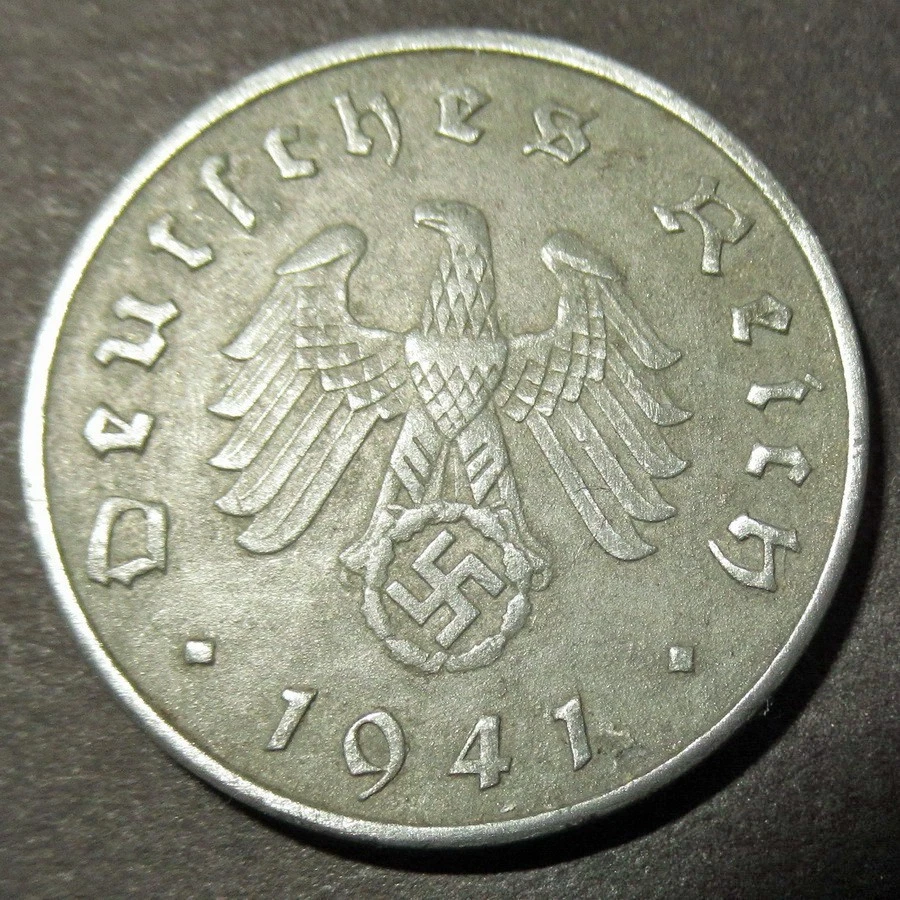
Denomination: 10 Reichspfennig
Obv: The arms - the eagle with
the open wings holds in paws a wreath from oak
leaves with a swastika. In the
bottom - there is an semicircular
conventionalized Gothic inscription:
DEUTSCHES REICH 1942.
Deutſches Reich
· 1942 ·
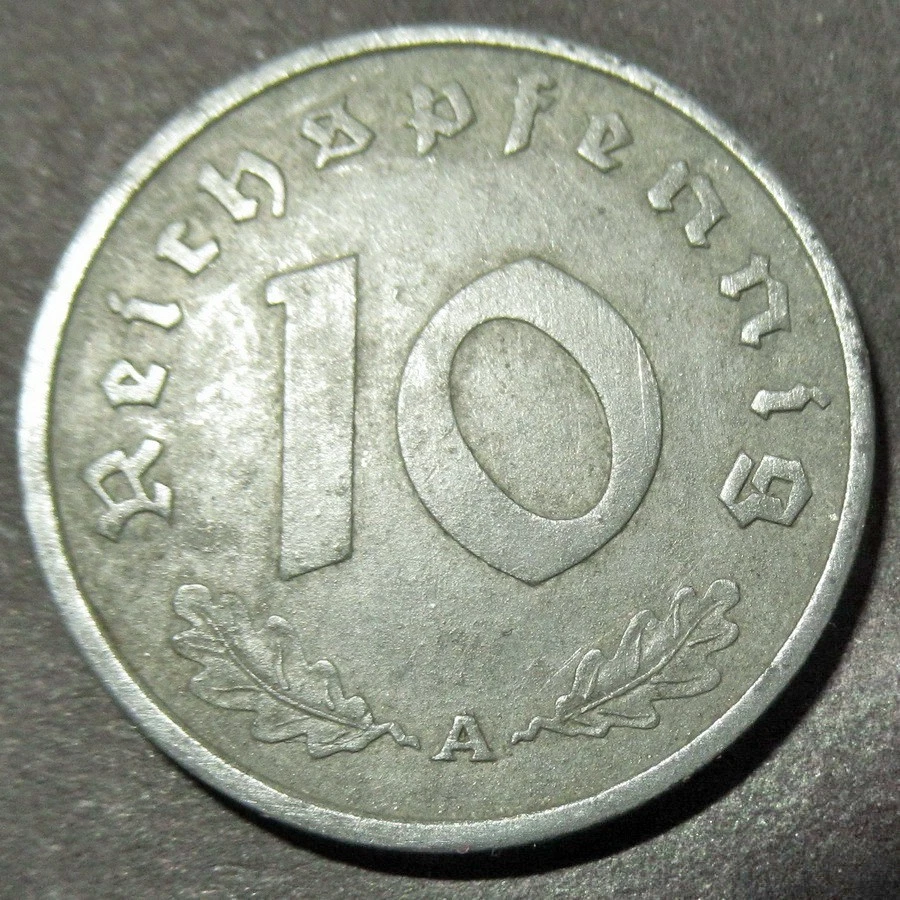
Rev:
Face value '10' with oak leaves,
between leaves there is mint mark 'A'
(variants: A, B, D, E, F, G, J). Above it there
is the semicircular conventionalized Gothic
inscription: REICHPFENNIG
Reichspfennig
Material: Zinc
Size: 21
mm, Weight: 4 grams,
Edge:
incised (90 corrugations), thickness: 1.8
mm
Mint mark: A
= Berlin
This type of
coin have been struck in 1940 - 1945.
Reichsmark and
Reichspfennig
Nazi Reichspfennig Coins!
Nazi German coins were produced in various
metals. In later years, all Third Reich German
coins were to feature the Nazi eagle with
swastika. The Reichsmark (English: Realm Mark;
symbol: RM) was the currency in Germany from
1924 until June 20, 1948. The Reichsmark was
subdivided into 100 Reichspfennig.
In 1924, coins were
introduced in denominations of 1, 2, 5, 10 and
50 Reichspfennig, and 1 and 3 Mark (not
Reichsmark). The 1 and 2 Reichspfennig were
struck in bronze, with the 5, 10 and 50
Reichspfennig in aluminium-bronze and the two
highest denominations in .500 fineness silver.
In 1925, .500 fineness silver 1 and 2 Reichsmark
coins were introduced for circulation, along
with the first commemorative 3 and 5 Reichsmark
coins. In 1927, nickel 50 Reichspfennig coins
were introduced along with regular-type 5
Reichsmark coins, followed by 3 Reichsmark in
1931.
4 Reichspfennig coins were
issued in 1932 as part of a failed attempt by
the Reichskanzler Heinrich Br¨¹ning to reduce
prices through use of 4 Reichspfennig pieces
instead of 5 Reichspfennig coins. Known as the
Br¨¹ningtaler or Armer Heinrich ("poor
Heinrich"), they were demonetized the following
year. See Br¨¹ningtaler (German).
Production of silver 1 Reichsmark coins ended in
1927. In 1933, nickel 1 Reichsmark coins were
introduced, and new silver 2 and 5 Reichsmark
coins were introduced which were smaller but
struck in .625 and .900 fineness so as to
maintain the amount of silver. Production of the
3 Reichsmark coin ceased altogether. In 1935,
aluminium 50 Reichspfennig coins were
introduced, although nickel was again used in
1938 and 1939. From 1936, all coins except the 1
Reichsmark and the first version 5 Reichsmark
Paul von Hindenburg (1935-36) bore the Nazi
insignia.
During the Second World War,
bronze and aluminium-bronze coins were replaced
by zinc and aluminium, with the 2 Reichspfennig
and denominations over 50 Reichspfennig no
longer issued. The last production of coins
bearing the swastika was in 1944 for the 5 and
50 Reichspfennig and 1945 for the 1 and 10
Reichspfennig.
After the war, the Allies issued coins in
relatively small numbers between 1945 and 1948.
1 Reichspfennig were struck in 1945 and 1946), 5
Reichspfennig in 1947 and 1948, and 10
Reichspfennig between 1945 and 1948. The coins
were issued with designs very similar to those
of the Third Reich. Only the swastika was
removed from beneath the eagle on the obverse.
1 Reichsmark bzw. Rentenmark (RM) = 100
Reichspfennig bzw. Rentenpfennig (Rpf.)
Mit der Währungsreform vom 20. Juni 1948 wurde
die Reichsmark gleichzeitig mit den letzten
Rentenmarkbanknoten ung¨¹ltig und in den drei
Westsektoren Deutschlands die Deutsche Mark, in
der Sowjetischen Zone die Deutsche Mark (dann
MDN = Mark der deutschen Notenbank und zuletzt M
= Mark der DDR) eingef¨¹hrt.
Umrechnungshinweise (Kaufkraft) laut Hamburger
Staatsarchiv und Statistischem Bundesamt bezogen
auf das Jahr 2000:
- 1 Reichsmark (1924-1936) = 3,32 Euro
- 1 Reichsmark (1937/38) = 3,58 Euro

Nazi 3rd Reich Mint Marks
The 3rd Reich had a number of mints (coin
factories). Each mint location had its own
identifiable letter. It is therefore possible to
identify exactly which mint produced what coin
by noting the mint mark (letter) on the coin.
Not all mints were authorised to produce coins
every year. The mints were also only authorised
to produced a set number of coins with some
mints allocated a greater production than
others. Some of the coins with particular mint
marks are therefore scarcer than others. With
the silver 2 and 5 Reichsmark coins, the mint
mark is found under the date on the left side of
the coin (see scans below). On the smaller
denomination Reichspfennig coins, the mint mark
is found on the bottom center of the coin.
A = Berlin
B = Wien (Vienna)
D = Munchen (Munich)
E = Muldenh¨¹tten (Dresden)
F = Stuttgart
G = Karlsruhe
J = Hamburg
|