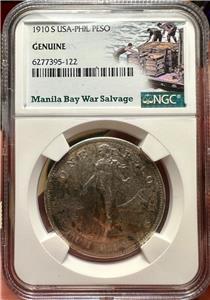
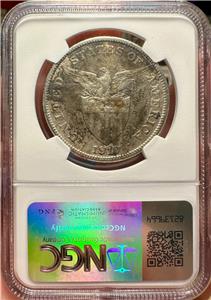
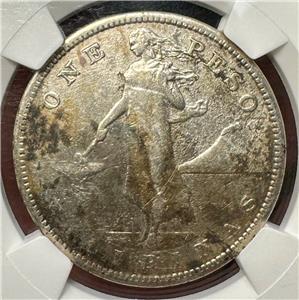
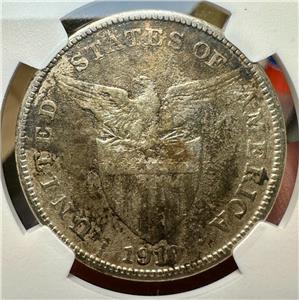
1910-S USA-Philippines
1 Peso (80% Silver)
Manila Bay War Salvaged
NGC Geniune
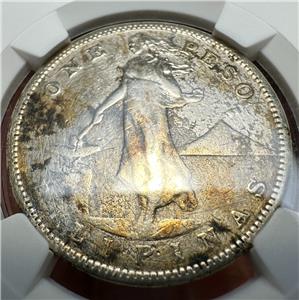
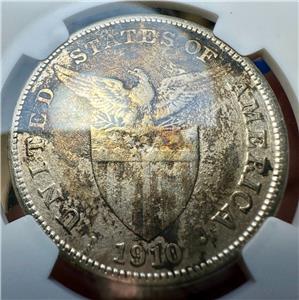
These Manila Bay War Salvaged pesos aren't rare by any stretch of the imagination, but those with 1910-S dates are. The vast majority of these are 1907-S, 1908-S, and 1909-S, whereas the 1910-S is the toughest date to find. This coin not only shows the black silver sulfide corrosion (saltwater effect), but also has spectacular gold toning and fantastic remaining details on the obverse and reverse. This is one of the nicest Manila Bay War Salvaged pesos I've come across.
The Back Story on the WWII Manila Bay War Salvaged Pesos:
The Manila Bay war salvage refers to the recovery of millions of silver pesos deliberately dumped by U.S. and Filipino forces into Manila Bay in early 1942. This desperate measure was executed to prevent the wealth from falling into the hands of the advancing Imperial Japanese Army during the Philippines campaign.
The 1942 Dumping - In the weeks leading up to the fall of Manila and the surrender of Corregidor, the military and treasury officials loaded millions of dollars in bullion, silver coins, and paper money onto ships. While some paper currency and valuables were destroyed or stored in the Malinta Tunnel network, approximately 17 million Philippine silver pesos were dumped into the waters of Manila Bay and Caballo Bay.
Japanese Recovery Efforts - During their occupation of the Philippines, the Japanese military eventually discovered the general location of the silver dump. They forced American POWs who were experienced divers to retrieve the coins from the bay. The divers reportedly sabotaged these efforts by deliberately hiding coins in the mud, slowing the work, and faking equipment failures, allowing the Japanese to recover only about 2 million pesos
Post-War American Salvage - After the liberation of the Philippines, systematic salvage operations were launched by the U.S. Navy's Seventh Fleet and specialized clearance groups to clean the Pasig River, approach channels, and the bay itself. Between 1945 and 1948, several recovery missions managed to bring up roughly 7 to 8 million silver pesos. The recovered coins were often recognized by the black silver sulfide corrosion they developed while sitting in saltwater.
|
|
|
|
|