Alexander the Great !! 325-323 BC.
wearing lion skin headdress Lifetime issue
Orichalcum Æ Tetrachalkon


Ancient Greek Coin
Kingdom
of Macedonia, Alexander the Great
Macedonian Mint, c.335-323 BC, lifetime issue.
Obv:
Head of Hercules
right, wearing lion skin knotted at base of neck.
Rev: ALEXANDROU
above
bow,
below club.
Mueller 541, SNG Cop. 1057.
Weight: 7.2 grams Size: 17
mm Material:
Orichalcum
This coin is accompanied by a Certificate of Authenticity!

|
Alexander the
Great Greek hero and his Lion skin headdress
Lion
was symbolic of irresistible might or
supernatural power. The Macedonian kings
also wore the lion’s skin.
“I am not afraid of an army of lions led by
a sheep; I am afraid of an army of sheep led
by a lion” - Alexander III.
 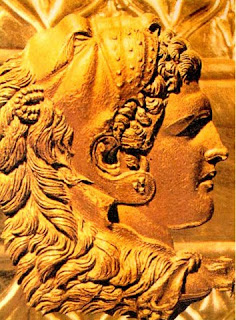
Statue
of Alexander the great wearing a lion skin
just like his ancestor Hercules. The
Macedonians considered themselves as
descendants of the Heraclidae kings and the
Dorians. Here we see in the left Hercules
wearing his lion skin (525-500BC) and from
the right we see Alexander the great wearing
also a lion skin. This was done in
Macedonian art in order to emphasize their
Greek Dorian roots.
|
|
I
Maccabees 1:1-7 After Alexander (the
Great) son of Philip, the Macedonian... had
defeated Darius (III),
king of the Persians..., he succeeded him as king.
(He had previously become king of Greece.)
He fought many battles, conquered strongholds, and put
to death the kings of the earth. He advanced to the ends
of the earth, and plundered many nations. When the earth
became quiet before him, he was exalted, and his heart
was lifted up. He gathered a very strong army and ruled
over countries, nations, and princes, and they became
tributary to him. After this he fell sick and perceived
that he was dying.
When
Alexander conquered territories, he looted the conquered
kingdoms precious metals, gold and silver (i.e.,
plunder). He, and his successors, minted coins in his
name with that plunder. These coins are the plunder of
Alexander the Great.
|
|
Alexander the
Great
Alexander the Great (356-323 BC), king of
Macedonia, conqueror of the Persian Empire.
Born in Pella, the ancient capital of
Macedonia, Alexander was the son of Philip
II, king of Macedonia. Greek philosopher
Aristotle was Alexander's tutor, instructing
him in rhetoric and literature and
stimulating his interest in science,
medicine, and philosophy.
In 336 BC Philip was assassinated, and
Alexander ascended to the throne. He quickly
solidified his rule at home and then
attacked Thessaly to restore Macedonian rule
there. In 335 BC he defeated the Thracians,
penetrating to the Danube River. On his
return he crushed the Illyrians before
hastening to Thebes, which had revolted. He
razed the city, sparing only temples and the
house of Pindar, a Greek lyric poet of the
5th century BC. Other Greek states promptly
submitted to Alexander's rule.
Alexander began his war against Persia in
the spring of 334 BC, defeating a Persian
army near the ancient city of Troy.
Subsequently, all the states of Asia Minor
submitted to him. Advancing southward,
Alexander defeated the main Persian army,
commanded by King Darius III, at Issus, in
northeastern Syria in 333 BC. He then took
Tyre in 332 BC. Alexander next captured Gaza
and traveled into Egypt. He secured control
of the entire eastern Mediterranean
coastline and founded, at the mouth of the
Nile River, the city of Alexandria, which
later became the literary, scientific, and
commercial center of the Greek world.
Alexander next reorganized his forces and
started for Babylon. In 331 BC he again
defeated Darius, and Babylon surrendered.
Alexander then forced his way to Persepolis,
the Persian capital, and plundered it. By
327 BC his domain extended along and beyond
the southern shores of the Caspian Sea, into
much of central Asia.
In 326 BC Alexander invaded the Punjab. At
this point the Macedonians rebelled and
refused to go farther. Alexander spent about
a year organizing his dominions and
completing a survey of the Persian Gulf in
preparation for further conquests. He
arrived in Babylon in the spring of 323 BC,
but then he contracted a fever and died.
Alexander was noted as a brilliant military
tactician and troop leader. He founded a
number of cities, most of them named
Alexandria. These cities were well located
and settled by Greek veterans from his army.
Thus, Greek culture was spread and the Greek
language became widely known.
|
*** AUTHENTICITY GUARANTEED FOR LIFE ***
Shipping policy:
Economy Regular mail shipping: 3.99 Euro worldwide (buyer's risk for
lost by post!)
If the total value is above 50 Euro, Registered mail is required for
safety reasons.
Registered mail shipping:
11.99 Euro within Europe, 14.99 Euro worldwide, Combined
shipping accepted. |