|
weight: 2.91 grams size: 23 mm
IRON ~!!
Kuu ni note that the "ni" is on
the bottom Hitachi Ota (1774) 23mm wide x 1mm thick
 
|
2. Iron or Copper Alloy
All old Kan'ei coins made for
circulation are made of copper alloy. New Kan'ei coins
are mostly made of copper alloy as well. However, in the
early 1700's copper mines began running out in Japan and
copper became more scarce. It gradually became more
expensive to manufacture copper coins than they were
worth. One of the responses to this problem included
making coins of iron which was cheaper. The government
first authorized the manufacture of iron coins in 1739.
Copper alloy coins continued to be manufactured but
frequently of less weight and lower quality than those
of the late 17th century. Eventually copper alloy coins
were mainly minted in higher denominations of 4 mon(from
1768) or 100 mon (from
1835).
The best that can be said for
the iron coins is that they have a primitive beauty.
Iron is difficult to cast with the fine features of
coins and script. The surfaces of the coins are rough.
The characters are often unclear in appearance and the
inner and outer coin edges are often unfiled and jagged.
Furthermore, the iron coins rust easily. From 1866, just
about the time of the collapse of the feudal order and
during a time of civil war and high inflation, iron
coins of 4 mondenomination were
manufactured.
|
|
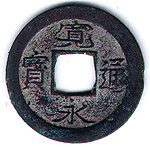
A copper alloy coin
Hirano Shinden, tiger's tail kan (1739)
23mm wide x .9 mm thick
|
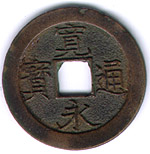
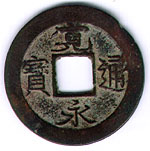
A copper alloy coin
Naniwa, fine character (1728)
25mm wide x 1.2mm thick
|
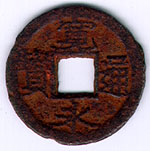
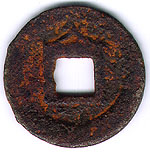
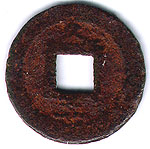
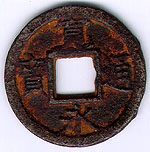
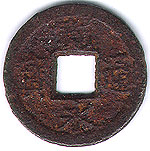
An iron coin
Kamedo, small size (1765)
24mm wide x 1mm thick
note the old style legs even thugh this is a new
Kan'ei coin. This is the single exception to the "legs"
rule.
|
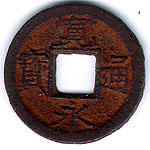
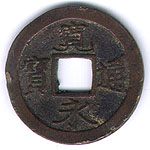
An iron coin
Ishinomaki, small character, haisen (1768)
23mm wide x 1mm thick
|
|
 |
 |
 |
 |
|
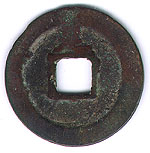
Kuu
Hitachi Ota (1768)
23mm wide x 1mm thick
|
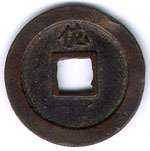
Kuu ni
note that the "ni" is on the bottom
Hitachi Ota (1774)
23mm wide x 1mm thick
|
Ashi
Ashio, small character (1741)
23mm wide x 0.7mm thick
|
Sa (1714 version)
Sado (1714)
|
 |
 |
 |
 |
 |
 |
 |
 |
Reference:
https://www.history.ucsb.edu/faculty/roberts/coins/Kaneibasics.html
 Travel
back in time to storied feudal Japan - to the land of samurai, daimyo
(warlords) and shoguns! This much-mythologized period has been widely
celebrated in the popular media and arts. From NBC's Heroes to
the novel and miniseries Sh¨gun to
the Tom Cruise big-screen epic The
Last Samurai, feudal Japan has
captured our collective imagination for decades. The original kanei tsuho
coins were made at the Edo mint, which was most likely inside Edo Castle
proper, the main stronghold of the shogunate in Tokyo. Travel
back in time to storied feudal Japan - to the land of samurai, daimyo
(warlords) and shoguns! This much-mythologized period has been widely
celebrated in the popular media and arts. From NBC's Heroes to
the novel and miniseries Sh¨gun to
the Tom Cruise big-screen epic The
Last Samurai, feudal Japan has
captured our collective imagination for decades. The original kanei tsuho
coins were made at the Edo mint, which was most likely inside Edo Castle
proper, the main stronghold of the shogunate in Tokyo.
Japanese Numismatics
The mon was
the main unit of currency in Japan until 1870, when it was replaced by the yen.
It resembles and was derived from the Chinese wenor
cash coin. The coins have a square hole in the middle, which allowed them to
be produced using less metal than a solid coin, but which more importantly
allowed them to be strung together on a piece of string, for easy transport
and payment.
The "bun" mint mark is the kanji character
on the reverse of the coin (ÎÄ). It indicates that this coin was cast in Edo
(modern-day Tokyo). The coins are sometimes called bunsen,
because of the "bun" character. The term "bun" is the second syllable of the
Japanese word kanbun (Japanese:
ŒˆÎÄ). The Kanbun era is the name for the Japanese era spanning the years 1661
to 1673, during which the coins were made.
Kanei Tsuho coins are named after the era in which they were introduced.
Kanei (often written "Kan'ei" (Japanese: ŒˆÓÀ)) is the name of the Japanese
era spanning the years 1624 through 1643. Thus the term kanei
tsuho literally
means "money of the Kan'ei era". Even though the Kan'ei era ended in 1643,
the term for the 1 Mon coins remained in use for over two hundred years!
Despite their high grade and attractive appearance, these coins are not
reproductions. Each coin is guaranteed to be an original, solid copper
1668-Bun Square Hole 1 Mon, cast in Edo (Tokyo) and grading a very nice very
fine. A little bit of verdigris is typical on these coins, but they are much
nicer than usually found (when they can be found at all!).
For a more detailed exploration of the Tokugawa Shogunate, as well as the
city of Edo and the culture of the Floating World, please see the article
further down in this presentation.
*** AUTHENTICITY GUARANTEED FOR LIFE ***
Authenticity: All items are
guaranteed to be authentic (unless stated otherwise) and as
described. There is no time limit on this guarantee - if you
will find that the item sold is not authentic, or is not as
described, you may return it any time.
Shipping and Handling:
Worldwide: Normal priority airmail: 3.99 Euro,
buyer's risk.
Registered Mail: 11
Euro within EU, 16 Euro worldwide, recommended!
Paypal for
outside Europe!! Combined shipping accepted!!
|
 二 on reverse;
Hitachi Ota Mint
二 on reverse;
Hitachi Ota Mint
