|
Dutch
Colonial Silver New York Shilling
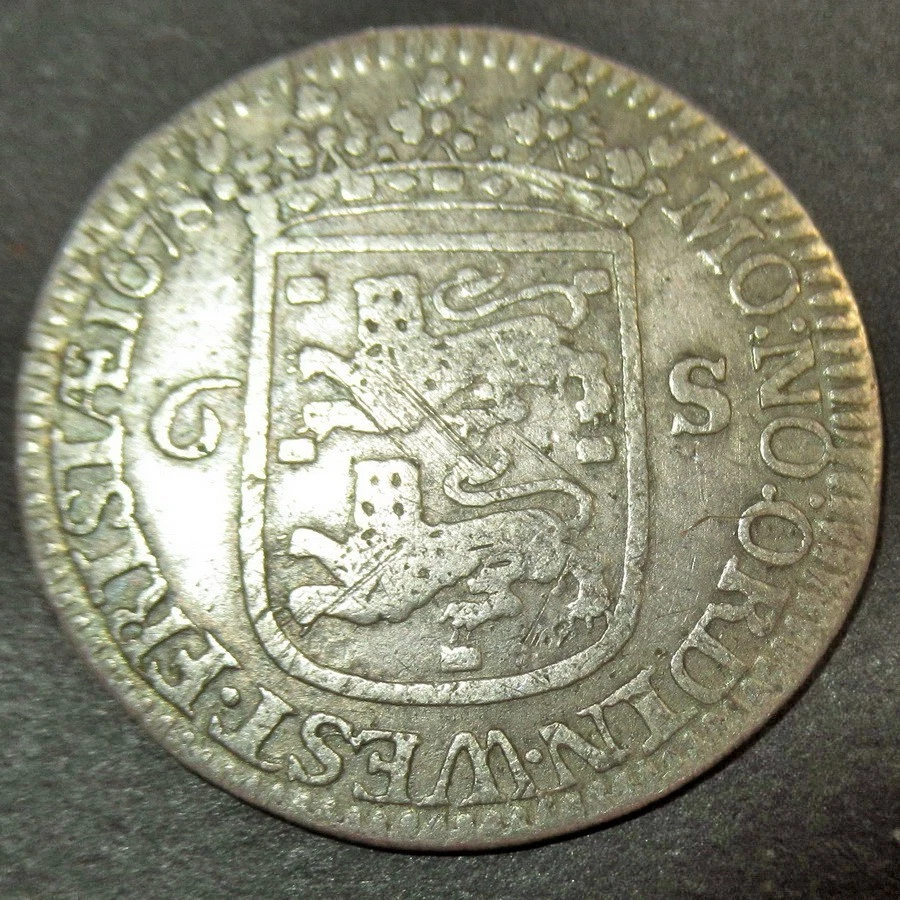
Silver Ship Shilling 1678,
Provincial Mint
West Friesland
|
HENRY HUDSON
DISCOVERED MANHATTAN ON SEPTEMBER 11, 1609 AND EXPLORED
MAINE, CAPE COD AND SAILED SOME DISTANCE UP THE HUDSON
RIVER, WHICH NOW BEARS HIS NAME. THE DUTCH WOULD LATER CLAIM
THIS AREA AND ESTABLISH A COLONY AS NEW AMSTERDAM, THOUGH IT
IS SAID THAT HUDSON HIMSELF GAVE THE NAME STATEN ISLAND
(DUTCH: STAATEN EYLANDT) TO THAT PART OF WHAT IS NOW NEW
YORK, IN HONOR OF THE STATES-GENERAL OR PARLIAMENT OF THE
NETHERLANDS. |
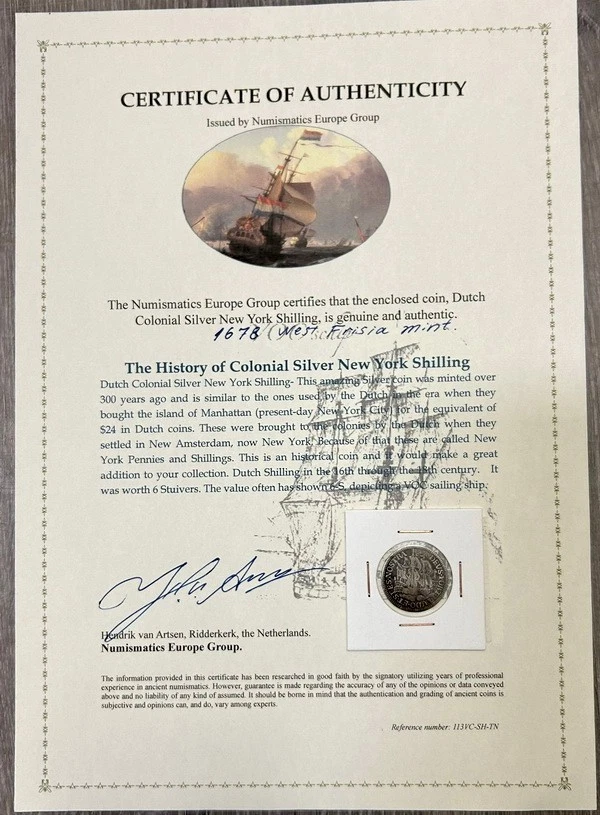
This coin is accompanied by a Certificate of Authenticity!

|
Dutch
Colonial Silver New York ship Shilling
This amazing Silver coin was minted
over 350 years ago and is similar to the ones used by the
Dutch in the era when they bought the island of Manhattan
(present-day New York City) for the equivalent of $24 in
Dutch coins. These were brought to the colonies by the Dutch
when they settled in New Amsterdam , now New York. Because
of that these are called New York pennies and dimes. This is
an historical coin and it would make a great addition to
your collection.
Roughly a silver Quarter in colonial America. |
|
Silver Ship Shilling 1678
Weight: 3 grams; Size:
24 mm; Material: Silver |
|
OBVERSE:
|
Obv: VOC Sailing Ships in Ocean
Latin legend: DEVS . FORTITVDO . ET . SPES . NOSTRA.
Which in English: "Our
strength and Hope Is God"
|
|
REVERSE :
|
Crown above Province arms of Friesland two lions between 6 and S
MON : NO : ORDIN : WEST. FRISIAE : 1678.
in English: "New Money of Province West Friesland" |
|
Produced by the private mint of Dirk Bosch in Enkhuisen.
Colonial New York Ship Shilling
West Frisia Mint
|
In the 1600’s, the
“Golden Age” of Dutch history, the Netherlands became a
great sea and colonial power. This was due, in no small
part, to the Dutch East India Company (Vereenigde
Oostindishche Compagnie, or VOC, in Dutch). The VOC was the
first company in the world to issue stock, and by 1669, it
had become the richest private company the world had ever
seen, with over 150 merchant ships, 40 warships, 50,000
employees, and a private army of 10,000 soldiers. The VOC
assumed many of the functions of the government of the
Netherlands, including minting coins, which circulated
wherever the Dutch settled or traded.
Manhattan was discovered in 1609 (believe it or not, on
September 11, 1609) by Henry Hudson, commander of the VOC
ship, the Half Moon. The province of New Netherland (which
later became the State of New York) was created in 1624. Its
capital was New Amsterdam, which lay on the southern tip of
Manhattan— “purchased” from the Indians by Peter Minuit for
$24 in trade goods. Of course, the Indians had no concept of
land ownership, and only later discovered what the Dutch had
in mind when they were handing out trinkets.
Because
the Dutch were instrumental in the early development of New
York, Dutch coinage joined the Spanish, Portuguese, and
British coins that were used for daily transactions all over
the American colonies. One of the coins used in old New York
was the VOC Silver Ship shilling, now popularly known as the
original New York ship shilling.
These coins are all in Very Fine condition for the type,
with nice clear dates ranging from the 1670’s to the 1790’s,
which makes them all over 350 years old. This is a terrific
opportunity to acquire some interesting examples of an
important early American colonial coin type— at an extremely
low price. |
Silver Ship Shilling - Scheepjesschelling
|
Dutch Silver coin of 6
stiuvers, named "Scheepjesschelling" in recognition of the
ship depicted. Issued in the Dutch provinces from 1670 to
1793), in West-Friesland from 1673 to 1771 and in Utrecht
from 1700 to 1794. The weight remained fixed at 4,95 g
(583/1000 fineness). The first Scheepjesschellingen minted
in West-Friesland from 1673 to 1679 were produced by the
private mint of Dirk Bosch in Enkhuisen. |
West Friesland (historical region)
|
West Friesland (also
West Frisia; Dutch: West-Friesland; West Frisian language:
West-Fryslân) is a historical region in the northern part of
the Netherlands. It was located in parts of what now is
Noord-Holland and the Waddenzee. The region was bordered by
the rivers Vlie and IJ. Within this historical region is the
contemporary region of West Friesland, which is a smaller
area based on the Westfriese Omringdijk, a dyke system that
lay in West Friesian district (gouw) of Westflinge
For about 300 years, West Friesland operated as an
autonomous area as the West Frisians did not want to be
subjected to authorities from Holland. Floris V, Count of
Holland attempted to unite Holland and West Friesland during
his reign, but it was his successor John I who finally
defeated the West Frisians in 1297. However, even though
West Friesland formed a united province with Holland in the
Dutch Republic, it was recognized a separate region and the
parliament of said province, commonly known as Holland, was
formally known as the States of Holland and West Friesland,
showing that West Friesland was still recognized in its own
right. During the time of the United Provinces, West
Friesland had its own independent Admiralty of the Northern
Quarter and any admiral serving with that admiralty or the
two other Hollandic admiralties, those of Amsterdam and the
Maas (Rotterdam), had the title of Admiral of Holland and
West Frisia. |
 
The frame is not included!
If you want it to be delivered with a frame, please place a bid on item 335776932387 for the additional frame service. https://www.ebay.com/itm/335776932387
International shipping from the Netherlands — please be aware that delivery may take a few extra days to weeks!
*** AUTHENTICITY GUARANTEED FOR LIFE ***
Shipping policy:
Economy Regular mail shipping: 3.99 Euro worldwide (buyer's risk for
lost by post!)
If the total value is above 50 Euro, Registered mail is required for
safety reasons.
Registered mail shipping:
11.99 Euro within Europe, 16.99 Euro worldwide, Combined
shipping accepted. |