|
Hiero II of
Syracuse
Hiero II (c. 308 BC - 215 BC) was the Greek
Sicilian king of Syracuse from 270 to 215
BC, and the illegitimate son of a Syracusan
noble, Hierocles, who claimed descent from
Gelon. He was a former general of Pyrrhus of
Epirus and an important figure of the First
Punic War.
On the departure of Pyrrhus from Sicily (275
BC) the Syracusan army and citizens
appointed him commander of the troops. He
strengthened his position by marrying the
daughter of Leptines, the leading citizen.
In the meantime, the Mamertines, a body of
Campanian mercenaries who had been employed
by Agathocles, had seized the stronghold of
Messana, and proceeded in harassing the
Syracusans. They were finally defeated in a
pitched battle near Mylae by Hiero, who was
only prevented from capturing Messana by
Carthaginian interference. His grateful
countrymen then made him king (270).
In 264 BC he again returned to the attack,
and the Mamertines called in the aid of
Rome. Hiero at once joined the Punic leader
Hanno, who had recently landed in Sicily;
but fighting a battle to an inconclusive
outcome with the Romans led by the consul
Appius Claudius Caudex, he withdrew to
Syracuse. Pressed by the Roman forces, in
263 he concluded a treaty with Rome, by
which he was to rule over the south-east of
Sicily and the eastern coast as far as
Tauromenium.
From this time until his death in 215 BC he
remained loyal to the Romans, and frequently
assisted them with men and provisions during
the Punic war. He kept up a powerful fleet
for defensive purposes, and employed his
famous kinsman Archimedes in the
construction of those engines that, at a
later date, played so important a part
during the siege of Syracuse by the Romans.
According to a story told by Vitruvius,
Hiero suspected he was being cheated by the
goldsmith to whom he had supplied the gold
to make a votive crown for a temple. He
asked Archimedes to find out if all the gold
had been used, as had been agreed.
Archimedes, on discovering the principle of
displacement needed to measure the density
of the crown is said to have shouted
"eureka, eureka!" while running naked
through Syracuse. Vitruvius concludes this
story by stating that Archimedes' method
successfully detected the goldsmith's fraud;
he had taken some of the gold and
substituted silver instead.
A picture of the prosperity of Syracuse
during his rule is given in the sixteenth
idyll of Theocritus, his favourite poet.
In The Prince (VI), Machiavelli cites Hiero
as an exceptionally virtuous man and a rare
example of someone who rose to princehood
from private station.
List of tyrants of Syracuse
Syracuse was an ancient Greek city-state,
located on the east coast of Sicily. The
city was founded by settlers from Corinth in
734 or 733 BC, and was conquered by the
Romans in 212 BC, after which it became the
seat of Roman rule in Sicily. Throughout
much of its history as an independent city,
it was governed by a succession of tyrants,
with only short periods of democracy and
oligarchy. While Pindar in his odes had
addressed the Sicilian tyrants
(chariot-racing winners) in Olympic and
Pythian games as kings, in 304 BC Agathocles
himself adopted the absolute title of king
(basileus).
Tyrants of Syracuse
In the aftermath of the devastating Roman defeat at the Battle of Cannae,
Hieronymus entered into an alliance with Hannibal, which would ultimately decide
the city's fate politically. As a result of Syracuse's support for Carthage, the
Romans under Marcus Claudius Marcellus began besieging the city in 214 BC. The
city held out until 212 BC, when it is believed that the Romans were
accidentally admitted to the city by a Syracusan peace party.
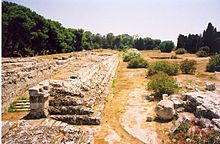
Grave monument of Hiëro II in Syracuse
|