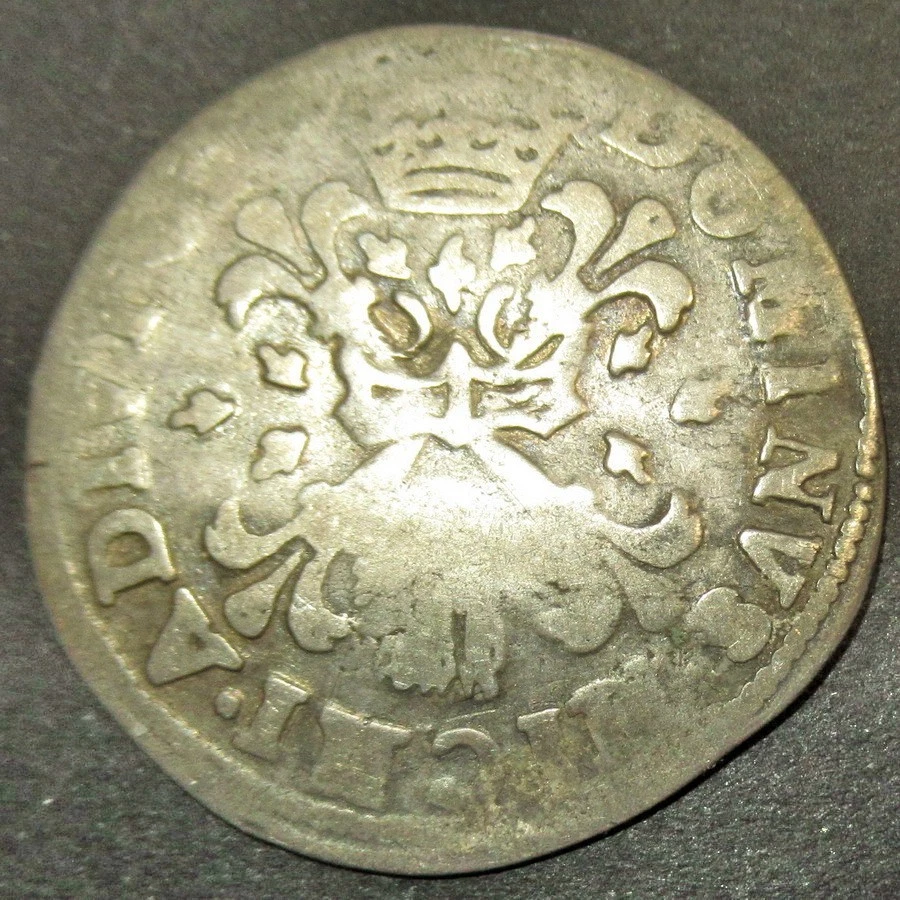
1571 King Philip II of Spain 1/10 Philips Silver Dollar Lordship of Utrecht Spanish Netherlands

King Philip II of Spain
1571 Silver Tenth Philips Dollar (⅒ Philipsdaalder)
Spanish Netherlands, Lordship of Utrecht

This coin is accompanied by a Certificate of Authenticity!

King Philip II of Spain, One Tenth Philips Dollar, Lordship of Utrecht 1571

Obv: Bust of Philips II to the right.  PHS · D · G · HISP · Z · REX · DNS · TRAIE 1571

in English:  Philip, by God's grace King of the Spaniards, Lord of Utrecht

Rev: Crowned Burgundian cross with firesteel at center and jewel of Golden Fleece below.

Latin: DOMINVS. MIHI. ADIVTOR.  in English: The Lord is my helper

Weight: 3.4 grams, Material: Silver 833, Size: 31 mm

Mint marks: ⬕ Utrecht


King Philip II of Spain 1572-1598

Philip II (Spanish: Felipe II; Portuguese: Filipe I ; 21 May 1527 -13 September 1598) was King of Spain, Portugal, Naples, Sicily, and, while married to Mary I, King of England and Ireland. He was lord of the Seventeen Provinces from 1556 until 1581, holding various titles for the individual territories such as duke or count.
Also known as Philip the Prudent, he ruled one of the world's largest empires which included territories in every continent then known to Europeans.
Philip was born in Valladolid, the son of Charles V of the Holy Roman Empire, and his consort, Isabella of Portugal. During his reign, Spain was the foremost Western European power. Under his rule, Spain reached the height of its influence and power, directing explorations all around the world and settling the colonization of territories in all the known continents.
He was described by the Venetian ambassador Paolo Fagolo in 1563 as "slight of stature and roundfaced, with pale blue eyes, somewhat prominent lip, and pink skin, but his overall appearance is very attractive." The Ambassador went on to say "He dresses very tastefully, and everything that he does is courteous and gracious."


Spanish Silver in New World

For centuries Spanish silver coinage was famous throughout the world as the standard by which other coinages were measured, due to its consistent weight and purity. The ascendancy of Spanish coinage dates from 1537 when Charles I, revising an act of 1479, promulgated exacting standards for Spanish silver and gold coins. The Spanish eight reales coin was set at a weight of 423.9 grains (27.47 grams) of .9305 fine silver. From that date the coin only depreciated some 4.4% over the next 250 years! In addition to its stability, Spanish coinage was abundant. Spanish regulated coinage was not only minted throughout Spain but was also produced in Spain's colonial possessions. As early as 1536, a year before the coinage reform, Spanish colonial silver coins were minted in Mexico City. With the discovery of major silver and gold deposits throughout the Viceroyalty of Peru (which included all of Spanish South America from what is now Panama down to Venezuela) major mints were opened in Lima, Peru (1568-1589 then reopened in 1684), Potos??, Bolivia (from 1575) and Santa Fe de Bogot??, Columbia (from 1620). Later, additional mints were located in Guatemala City (from 1733), Santiago, Chile (from 1750), and Popayan, Columbia (from 1758). From these locations, and to a lesser extent from Spain, a number of coins made their way into the English colonies.


*** AUTHENTICITY GUARANTEED FOR LIFE ***

Shipping policy:
Economy Regular mail shipping: 3.99 Euro worldwide (buyer's risk for lost by post!)

If the total value is above 50 Euro, Registered mail is required for safety reasons.
Registered mail shipping:
11.99 Euro within Europe, 15.99 Euro worldwide, Combined shipping accepted.