VINTAGE ERNST LEITZ WETZLAR PETROGRAPHIC POLARIZING (POL) MICROSCOPE WITH HARDWOOD CASE & POLARIZING ACCESSORIES - 1934
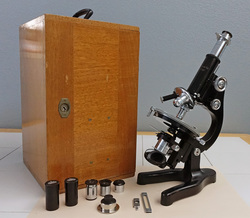
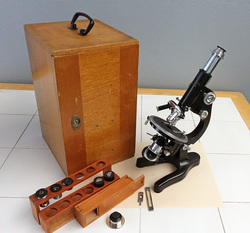
You are invited to purchase a very nice vintage Ernst Leitz Wetzlar Petrographic Polarizing (POL) Microscope. Included with the microscope stand is a set of polarizing accessories consisting of two (2) compensators, three (3) objective lenses, four (4) eyepieces, an extra aperture stop holder, and a very nice dovetailed hardwood case that houses the instrument and its accessories.
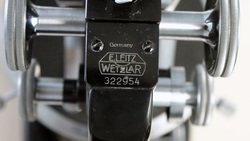
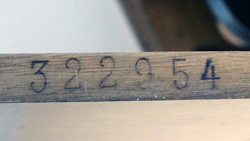
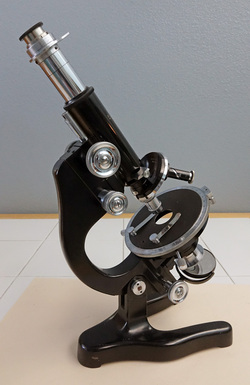
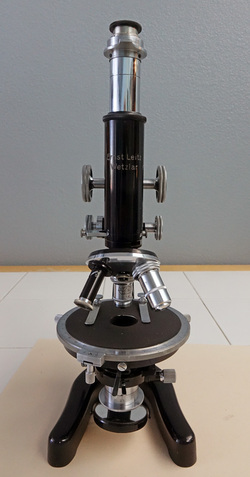
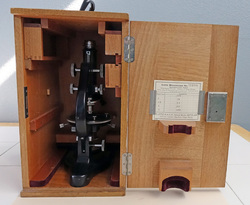
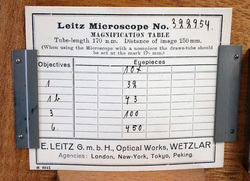
This microscope bears the name of the manufacturer on the front face of the body tube, "Ernst Leitz Wetzlar." It also bears the same name of the manufacturer along with a serial number, No. 322954, located on the top of the upper limb of the instrument (See image). This serial number dates the instrument to the year 1934. This same serial number is also found engraved into the top of the door to the hardwood case, indicating that the wood case is original to the microscope (See image).
As is mentioned in the 2003 publication entitled, "The Petrographic Microscope: Evolution of a Mineralogical Research Instrument" by Daniel E. Kile, petrographic microscopes and accessories are comparatively rare. For every 100 biological microscopes manufactured, perhaps only one was made for petrographic use. In addition, petrographic microscopes are much more complicated than biological microscopes. Although the magnifying powers used are comparable and not so great, there are attached appliances for special examination of mineral or chemical substances that require very careful adjustment.
This instrument is equipped with several special features such as an indexed Cap Analyzer Support at the top of the body tube for an optional Cap Nicol Analyzer to rest on, a Nicol prism analyzer on a dovetail slider, a large rotating circular stage with peripheral vernier scale, a tube slit arranged at a 45 degree angle to the optical axis for the insertion of compensators and a flip-top substage condenser/iris diaphragm on a dovetail slider with rotating Ahrens prism polarizer. These special features are designed for the detailed observation and analysis of thin sections of rocks and minerals and chemical substances under polarized light.
Petrographic polarizing microscopes first made their appearance in Europe and the UK in the latter decades of the 19th Century. Such prominent microscope manufacturers as Nachet, Fuess, Lietz, Leiss, Zeiss, Reichert, Siebert, Swift, Watson and others all produced their own versions of this specialty instrument. American microscope manufacturers such as Bausch & Lomb and the Spencer Lens Company were soon to follow suit with their own versions of this specialty microscope.
By the second decade of the 20th Century, E. Leitz Wetzlar in Germany had developed a sophisticated line of petrographic polarizing microscopes that consisted of a total of 7 POL models, plus an "ore microscope" called the MOP. The POL line included, in decreasing order of complexity, the models SY, AM, CM, GM, KM, IIIM, and the VIM.
So, which model polarizing microscope is featured here? The microscope stand appears to match that of the model KM, which features a large robust and heavy stand equipped with a 120mm diameter rotating stage and a medium illuminating apparatus Model "b" in the substage. The Model "b" illuminator has a three element condenser with a built-in iris diaphragm and includes a "flip-top" upper condenser element - all of which is mounted on dovetail slider. The model KM was classified among the large working stands of greater complexity, suitable for use with the Fedorow Method and as an ore microscope, in addition to normally having a wide body tube that allowed for a wide field of view. However, in this particular case, the body tube of the featured instrument has a standard width for acceptance of standard diameter eyepieces and does not include a Bertrand lens on a dovetail slider at the upper end of the body tube. On the other hand, the body tube is equipped with an optional Cap Analyzer Support and an optional rotating objective holder. So, bottom line, the featured instrument appears to be a Leitz custom model KM.
For the antique /vintage microscope collector this Leitz Petrographic Polarizing Microscope represents one of several significant advances in the evolution and design of this specialty microscope offered by Ernst Leitz Wetzlar of Germany. As such, it will be a most welcome and valuable addition to any antique / vintage microscope collection, especially one that centers on the petrographic polarizing microscope. Don't miss this opportunity to add this excellent German-made Leitz petrographic polarizing microscope to your collection!
DETAILED DESCRIPTION:
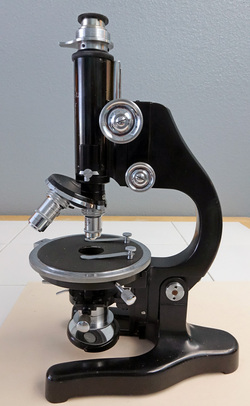
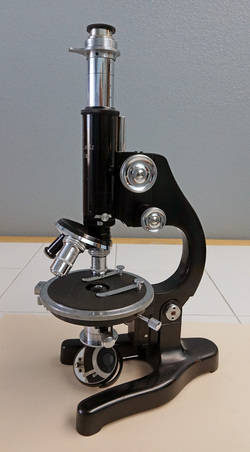
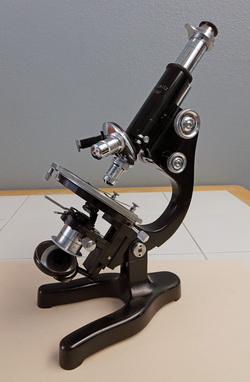
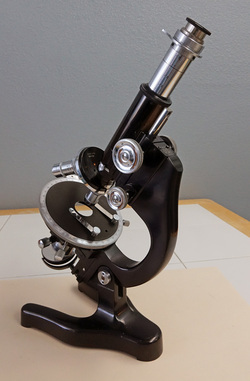
This microscope is built upon a very heavy Y-shaped base with an integral rectangular pillar that terminates in a compass joint. This joint supports the rest of the microscope, including a nicely sculpted wide sweeping continental style arm, the stage, the body tube and the substage illumination assembly. The compass joint allows the microscope to be tilted at any angle from the vertical to the horizontal to allow for the comfortable viewing of specimen slides mounted atop the stage.
Coarse focus is by angled rack and pinion. Fine adjustment is by a pair of micrometer knobs mounted on the side of the limb just below and slightly behind the coarse focus knobs. The fine focus drum is divided for readings of 0.002mm per increment.
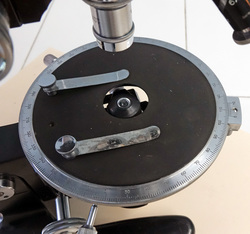
The microscope is equipped with a 120 mm diameter, rotatable circular stage with an engraved vernier scale on the periphery and a clamp on the front of the stage for arresting the rotation. There is also a pair of adjustment screws on the side of the stage that are used to center it to the optical axis. The stage circumference is graduated in single degrees with each tenth line numbered allowing one to read the stage orientation within 0.1 degree. Included on the top of the stage is a pair of slide clips.
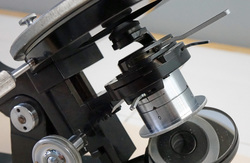
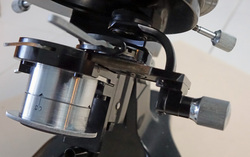
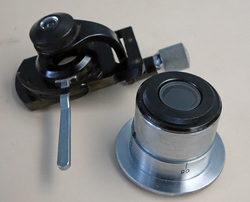
Below the stage is the illuminating apparatus on a rack and pinion mount allowing it to be raised or lowered towards or away from the stage using a hand knob located on the right side of the microscope. This instrument is equipped with an upgraded medium size type "b" substage apparatus. At the top of the illumination apparatus is a 3-lens condenser assembly with a built-in iris diaphragm. The condenser has a flip-in/flip-out NA 1.0 lens that can be put in action or out of action with the flip of a lever found on the left side of the apparatus. The entire condenser assembly is mounted on a dovetail bar allowing it to be exchanged for other illumination devices (See images).
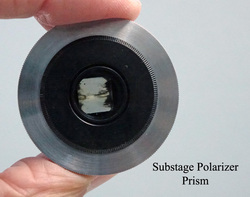
Below the condenser assembly is cylindrical holder that has a slide-in polarizer containing an Ahrens prism. This unit fits snugly, but still can be rotated by hand. The outer periphery of the substage polarizer is graduated in degrees with the 0, 90, 180, & 270 degree positions marked. Under the polarizer is a yoke-mounted 50mm plano-concave mirror that is mounted in a fixed receptacle located at the distal end of the substage apparatus mounting. There is also one additional accessory provided for the substage illumination apparatus - a simple aperture stop holder that can be used with the instrument in lieu of the substage polarizer. This allows the microscope to be used for conventional bright field observations.
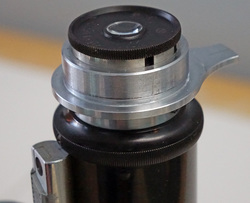
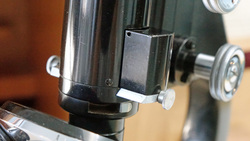
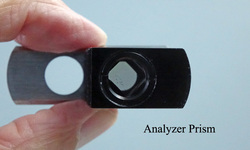
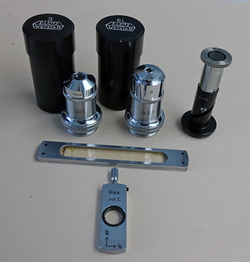
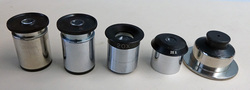
The standard diameter body tube of this microscope is relatively complex with several special features. The body tube includes a sliding draw tube marked in mm with the 170mm tube length marked with an engraved ring. At the top of the body tube is an ocular holder with two slots in its upper edge set a few degrees apart. This feature is designed for fixing the azimuth of a cross hair eyepiece. Also included and integral with the ocular holder is an indexed Cap Analyzer Support bar for an optional Cap Nicol to rest on (Cap Nicol not included). A pair of Leitz 10x focusing Huyghens eyepieces are included with the microscope - one with internal cross hairs and one without. Also included are a B&L 15x eyepiece and a B&L 20x Wide Field eyepiece. At the lower end of the body tube is an analyzer box slider containing an anastigmatic type Nicol prism analyzer that slides in or out of the optical path. Under the box slider is a tube slit arranged at an angle of 45 degrees to the light path for the insertion of compensators. Two (2) Leitz compensators are included: A gips rot 1 slider and a quartz wedge slider (See images).
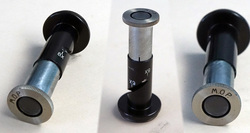
This microscope is equipped with a triple position rotating objective holder at the distal end of the body tube. Two (2) Leitz "P" objective lenses are included - a P3 10x and a 6L 45x. A pair of appropriately marked metal canisters are used to store these objectives when not in use on the microscope (See images). There is also a curious third Leitz objective marked "M.O.P." This lens is equipped with a standard RMS thread and a narrow diameter central aperture on one end and an optical lens on the other end. The lens is adjustable from 5x to 6x to 8x using a slider mechanism marked on the side of the lens (See composite image of this lens). The exact purpose of this lens is unclear.
NOTE: I just received a message from a knowledgeable collector that informed me that this MOP lens is designed to be threaded into the field lens of a 6x ocular, which converts it into a Bertrand lens.
This very handsome instrument stands about 13.5 inches tall and it weighs 12 pounds - a relatively heavy vintage Petrographic POL microscope.
HARDWOOD CASE:
Included with the microscope stand is a very nice dovetailed hardwood case equipped with a carrying handle and lock mechanism. However, the key to the lock is missing. As indicated by the microscope serial number engraved into the top of the case door, this is the original case for the microscope. Inside the case are slide-in/slide-out wood racks for both the objective lenses in their canisters and for the eyepieces. A third small supplemental wood case with sliding lid is provided for storage of the compensators and for the M.O.P. lens. The exterior dimensions of the wood case are 14.5 inches tall by 8.5 inches wide by 10 inches deep.
STATEMENT OF CONDITION:
NOTE: The accompanying images are a part of this statement of condition. CLICK ON THE IMAGES FOR A LARGER VIEW. Please take the time to view all of the images so you can confirm the condition of the instrument and so you will know exactly what you will be getting should you prove to be the proud new owner of this very fine vintage Leitz Petrographic Polarizing microscope with case and accessories.
In summary, this microscope is in very good to excellent cosmetic, optical and mechanical condition. More details are found below:
As the accompanying images attest, the black lacquered metal parts of this instrument are in very good to excellent condition with just a few minor blemishes especially found on the inner surface of the curved limb.
The optics and optical elements associated with this microscope are of very high quality. The four eyepieces and the three objective lenses are free of any optical defects and are cosmetically in good condition. The analyzer prism is in very good condition with only faint hint of the start of "black line disease." The polarizer prism on the other hand shows evidence of "black line disease" at the outer edges of the prism, but the central area of the prism is free from this defect (Please see the close-up images of these components). However, in the end, the noted prism defects do not appreciably affect the optical quality of thin mineral specimens viewed under polarized light. The optics in the substage condenser are in near perfect condition with no defects evident. In addition, both sides of the substage plano-concave mirror are in perfect condition and provide excellent illumination to the stage.
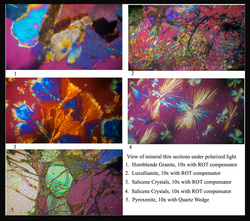
Views of thin mineral sections or chemical substances at the eyepiece of this microscope are quite impressive. In proof thereof, included with this listing is a composite image of several thin mineral specimens and crystals captured under polarized light with this very microscope. These images are proof positive of the fact that this instrument is not only a nice vintage collectible, but of the fact that it can still be used for serious microscopic investigations of mineral and chemical specimens to this day.
Mechanically, the coarse and fine focus mechanisms on this instrument work smoothly and flawlessly. The rotating stage works smoothly. The rack and pinion focus mechanism for the substage illumination assembly works smoothly.
The hardwood case that houses this instrument is in very good to excellent cosmetic and structural condition. However, as is noted above, the key to the lock mechanism in the case is missing.
Overall, this is a very nicely preserved example of a vintage Leitz Polarizing Microscope from the 1930s era. It is most certainly worthy of any antique / vintage microscope collection. And, if desired, it still can be used to this day for serious microscopical investigations and analyses of minerals and crystals under polarized light.
PURCHASE:
THE MONTANA LOGGER is very pleased to offer this fine vintage Leitz Petrographic Polarizing Microscope with case and accessories for a very reasonable Buy-It-Now cost. We will also entertain reasonable offers for this instrument.
NOTE: WE WARMLY WELCOME INTERNATIONAL BIDDERS/BUYERS. WE SHIP WORLDWIDE.
PAYMENT: Payment is due within 3 days of purchase. Prompt payment is always very much appreciated.