RESTORED NICOLAUS AMATUS ANTIQUE 4/4 (FULL SIZE) GERMAN TRADE VIOLIN, AMATI COPY, WITH CASE & BOW - CIRCA 1900
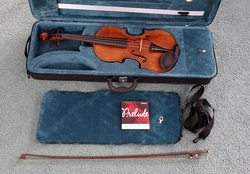
You are invited to purchase a very nice antique handcrafted 4/4 (full size) German trade violin internally labeled "Nicolaus Amatus fecit in Cremona." This antique violin, which is a Nicola Amati copy, has been repaired, updated and fully restored to playability. Included with the violin is new rectangular carrying case and a used bow marked "GERMANY."
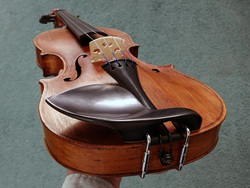
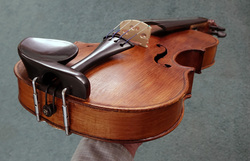
We have completed a series of repairs and restorative actions associated with this antique violin as detailed below. In addition, the violin has been upgraded and modernized with a new Ebony chin rest, new Ebony tailpiece, reconditioned original Ebony fingerboard, new Ebony saddle, nut and endpin, and a reconditioned original Maple bridge. We also modernized and set up the instrument with new D'Addario modern steel strings and new Wittner geared pegs making it ready to be played and enjoyed by its new owner.
VIOLIN INTERIOR LABELS & REPAIR LABEL:
This violin has an interesting and unusual labelling history, which we discovered during the restoration process.
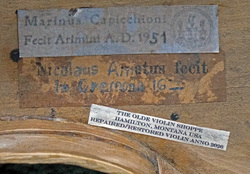
When we opened the top of the violin to complete some needed repairs (see below for details), we discovered that a more modern label was pasted over an older original label. We carefully removed the top label to find an original underlying label which reads as follows (See accompanying image of internal labels):
"Nicolaus Amatus fecit
in Cremona 16__"
Note: Despite exercising care in removing the top label, some of the wording in the lower label was partly compromised, but was easily reconstructed based on the remaining undamaged text that survived the upper label removal process.
The upper more modern label, reads as follows:
"Marinus Capicchioni
Fecit Arimini AD 1951"
Note: See more details below on these two violin makers mentioned in the labels.
Why would someone place a more modern label over an older one? Our best guess is that it was to give this instrument an elevated prestige over the older trade level instruments by falsely assigning it to a relatively famous more modern maker, Rimini, Italy's Marino Capicchioni, whose violins command very high prices (See below). In fact, in comparing published images of some of Capicchioni's violins with the physical appearance of the restored instrument, we can see a superficial resemblance that may have driven this labelling action.
So, in an effort to preserve the labelling history, we re-installed the Capicchioni label above the original Amati label on the inside of the back plate (See label image). So now, both labels are now visible under the left f-hole.
Finally, in addition, this violin now bears a repair label from our workshop also found inside the violin under the left f-hole (See accompanying image):
"THE OLDE VIOLIN SHOPPE
HAMILTON, MONTANA USA
REPAIRED/RESTORED VIOLIN ANNO 2026"
VIOLIN ORIGIN & ESTIMATED DATE OF MANUFACTURE:
As indicated by the older label found inside this instrument, which is considered to be a Nicola Amati copy, this violin was most likely made by an unknown cottage trade violin maker based in Mittenwald, Germany. It is unclear when the newer Capicchioni label was placed in the violin, but this may have been done by an unknown individual at a much later date, likely sometime after the year 1951, as is indicated by the date on the label.
The exact date of manufacture of this particular violin is unclear. However, based in part on its overall condition upon receipt, the nature of the needed repairs, and the nature of the wood used for the top and bottom plates, we can conservatively date this instrument to circa-1900.
KEY PHYSICAL FEATURES:
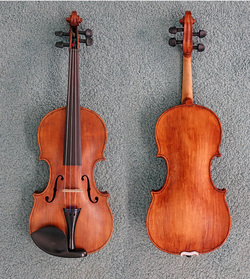
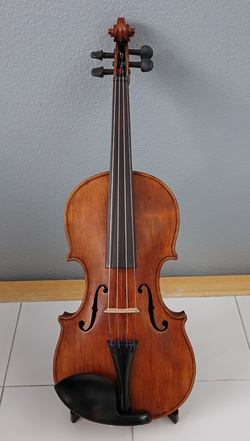
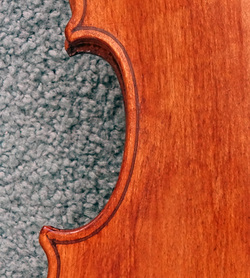
* A warm, very attractive brown spirit varnish over a golden ground.
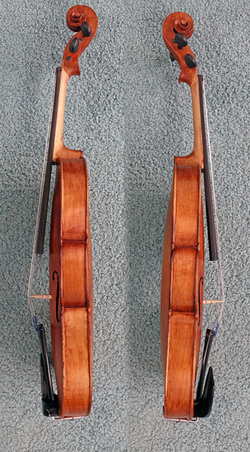
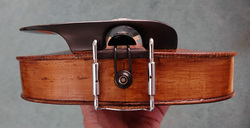
* A one piece Maple back with ribs of Maple to match the back (See images).
* Two piece Spruce top with a relatively consistent grain pattern.
* Top plate has a moderate arch.
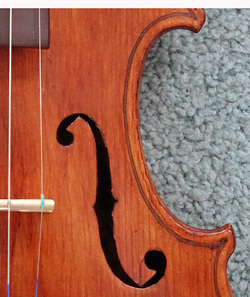
* Relatively narrow and delicately formed f-holes.
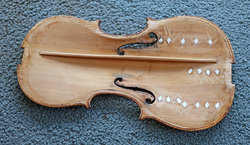
* Smooth interior finish with a nicely formed, properly designed, and correctly placed glued-in bass bar. These physical characteristics are a good indication of a well-made trade violin (See images of the violin interior).
MEASUREMENTS:
* Length Overall (LOA): 23 1/2"
* Length of the body (LOB): 14 1/4"
* Rib Height: 1 1/8"
* Max Width of Upper Bout: 6 1/2"
* Avg. Width at Waist or C-Bout: 4 1/4"
* Max. Width of Lower Bout: 7 7/8"
NATURE OF REPAIRS & RESTORATION:
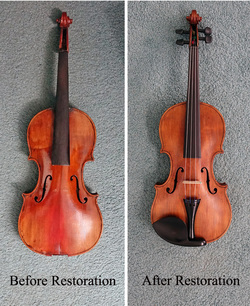
This antique violin was received by us in overall apparently good structural condition, but with some obvious age cracks in the top plate that required attention. The violin's neck was also loose requiring a reset (See image of violin before and after restoration). this instrument was also in need of a good external and internal cleaning and a spirit varnish touchup.
Following is a summary of the actions taken by us to repair and restore this antique trade violin to full playability:
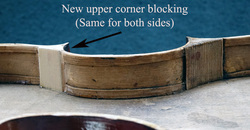
1. The top plate was removed from the violin in order to repair the identified age cracks and to clean the inside of accumulated dust. At this point it was discovered that the violin was very well made with internally smoothly carved top and bottom plates. In addition, we found a very nicely formed, properly designed and correctly placed bass bar glued-into the underside of the top plate. We also found that the original maker had nicely blocked the lower two (2) corners of the violin, but failed to block the upper two corners. At the same time, we also discovered the unusual layered labelling that is described in detail above.
2. We cleaned, glued and internally cleated the age cracks in the top plate (See image of the interior of the top plate).
3. We added new blocking to the upper corners of the ribs (See image that shows this). Now all four corners of the violin are properly blocked.
4. The loose neck was removed from the violin body and the neck with its attached fingerboard was set to the proper height and orientation and re-glued to the body using Hide glue.
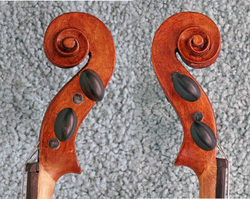
5. The exterior surfaces of the top and bottom plates as well as the pegbox, scroll and ribs were found to have a coating of a polyurethane type system. Note: This type of relatively rigid coating would likely restrict the proper flexing and resonance of the top and bottom plates and so needed to be removed. This coating was removed by scraping and wet sanding these surfaces with 600 grit sandpaper. The surfaces were then cleaned with denatured alcohol and all of these surfaces were touched up with Golden Ground stain. Brown stain was then added to areas needing it followed by any required touch-up Brown Spirit Varnish applied to areas that needed it. Finally, a coating of French Polish was added to all exterior surfaces of the violin as a final cosmetic treatment.
6. Before we restored the top plate to the violin using Hide Glue, we glued-in our shop's repair label to the bottom plate.
7. We planed and sanded the surface of the fingerboard to achieve a smooth surface. In addition, a new Ebony nut was added to the violin and properly trimmed in size and height. Grooves for the strings were set in concert with standard design specifications.
8. We installed a new Ebony saddle and endpin onto the violin. In addition, a new full-size Guarneri-style Ebony Chinrest was added to the violin along with a new Ebony tailpiece.
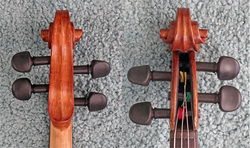
9. The pegbox was fitted with Wittner Finetune geared Pegs (Made in Germany). These geared pegs negate the need for fine tuners on the tailpiece as they are permanently set within the pegbox and have an 8:1 gear ratio, making for very precise tuning. Only the central knurled spool segment of the peg rotates so peg slippage is prevented. So once the Wittner pegs are set, they are not designed to be removed from the pegbox. The geared pegs are also unaffected by temperature and humidity changes.
NOTE: Conventional wood peg slippage is a big problem with most violins, something that a player definitely does not want to happen in the middle of a concert solo in front of a large audience. Wittner geared pegs totally eliminate peg slippage so one can play the violin even with vigor without worry.
10. Finally, we completed the setup of the violin by properly fitting a reconditioned original Maple bridge, re-installing the original Spruce sound post along with a new set of D'Addario medium tension modern metal strings.
All of the aforementioned repairs have resulted in a completely restored, repaired and upgraded violin that has significantly improved the overall tonal response and sound quality of this instrument. Thus, this antique instrument that could have easily been lost to time has been fully repaired, improved and reborn to live a second life in the present.
CASE & BOW:
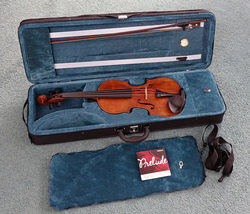
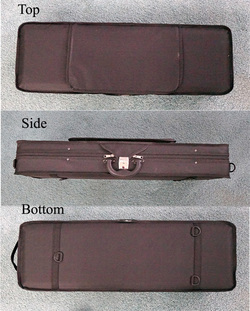
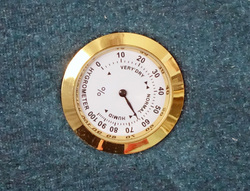
Included with the violin is a very nice new rectangular cloth covered internally foam formed carrying case with side and end carrying handles, dual zipper closure, lock with key and a set of additional shoulder straps for the back. Also included inside the case are dual racks for bows, a Hygrometer (humidity meter), a soft cloth cover for the violin, a pocket for accessories and a formed niche for an optional shoulder rest (Note: A shoulder rest is not included with this violin). In addition, there is a zippered pocket on the top of the case for carrying sheet music. The case measures 31 inches long by 10 inches wide and 5 inches deep. This case is suitable for safe shipping of the violin to its new owner and for ongoing use by the new owner for both storing and transporting the violin after it is received.
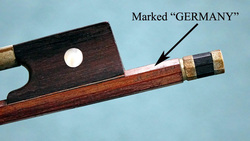
Also included with the violin is a used bow marked "GERMANY" (See accompanying image that shows this). This bow is in nominal playing condition, but is in need of re-hairing.
IMAGES:
The accompanying images are considered a part of this description. Click on each of the images for an enlarged view.
ABOUT NICOLA AMATI & MARINO CAPICCHIONI, VIOLIN MAKERS:
Nicola Amati (1596 -1684) was born in Cremona, Italy and is considered to be one of the most well-known luthiers from the house of Amati. He was the teacher and mentor of the illustrious Cremonese School of luthiers that included such greats as Andrea Guarneri and Giovanni Battista Rogeri. While no clear documentation exists for their being apprentices in his shop, Amati may also have apprenticed Antonio Stradivari, Francesco Rugeri, and Jacob Stainer, as their work is heavily influenced by Amati.
The Nicola Amati style of violins were expressed in what is now known as the "Grand Amati Pattern." This pattern is generally characterized by 14 inch long backs and 8 1/4 inch widths, which allow for a large sound. Well curved, long-cornered and strongly and cleanly purfled, his instruments represent perhaps the height of elegance in violin making. They were characterized by mathematically derived outlines and transparent amber-colored varnish. His style was widely imitated and copied by other makers including late 19th Century and early 20th Century prolific cottage makers in several areas of Germany and Saxony.
Marino Capicchioni (1895 - 1977) was a self-taught violin maker who took up the trade after working in a French guitar factory for a year and settled in Rimini, Italy in 1929. His style evolved somewhat over the course of his 30-year career. His earlier instruments display a studied but impersonal precision, while his more mature works are personal interpretations of classical models, especially del Gesu. Archings are rather high, and his varnishes range from yellowish-orange to brownish-red. Capicchioni chose excellent materials, and his instruments show a particular drama in wide flaming Maple backs and very regular medium-large grain Spruce top plates. Many of the sharper edges of the head are intentionally worn, which gives his instruments a lived-in feel unusual among the work of his contemporaries. Capicchioni's work is appreciated equally for its elegance and superior sound quality, making it a favorite of soloists. His violins command very high prices, with a recent violin selling for $120,000 in May of 2024.
PURCHASE:
The Montana Logger is very pleased to offer this professionally repaired, upgraded and completely restored Nicola Amati German-made trade violin along with the listed case and bow for a very reasonable buy-it-now price. We will also entertain reasonable offers for this very well made refurbished antique German violin that dates from circa 1900.
PAYMENT: Payment is due within 3 days of purchase. Prompt payment is always very much appreciated.