|
Colonial Copper
Commemorative Penny
1660 Jean-Baptiste Larchier Spanish Netherlands, King Philip IV of
Spain
This coin is accompanied by a Certificate of
Authenticity!
1660 the Spanish Netherlands
|
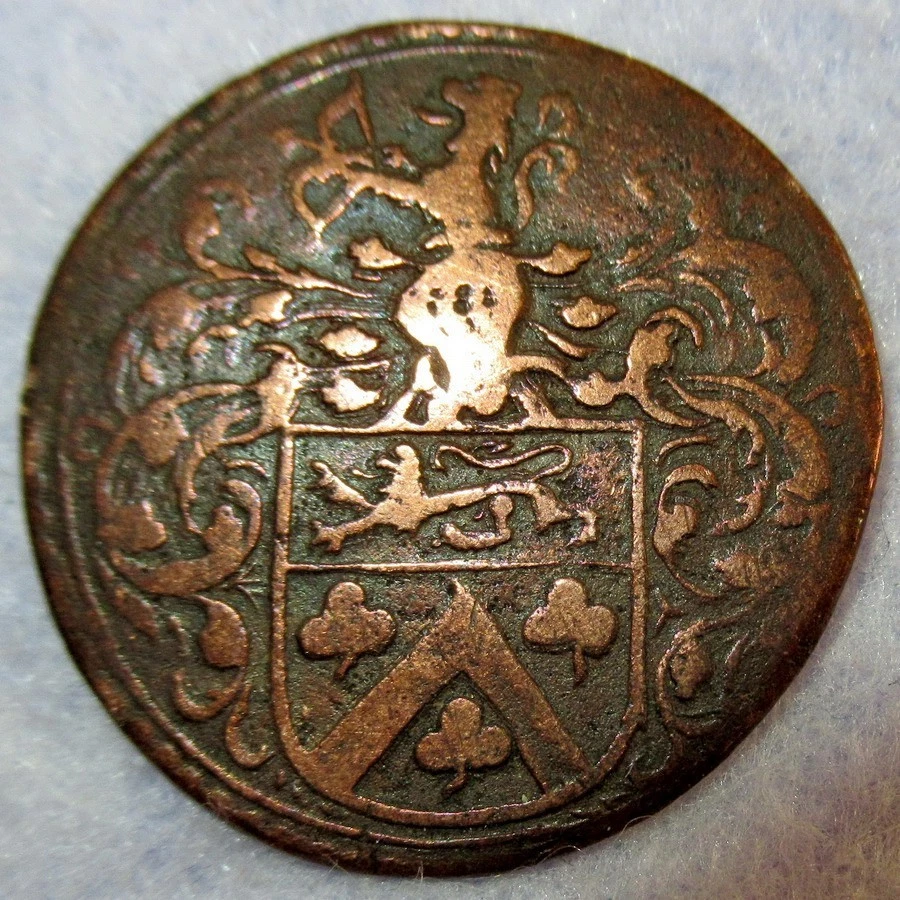
Obverse: Coat of Arms of
Sieur Cocquiel. Namely - Emblazonment per fess, in
chief: Gules, to the lion passant Or, crowned of the
same antique, the forked tail; and, in base: Argent,
three trefoils Vert.
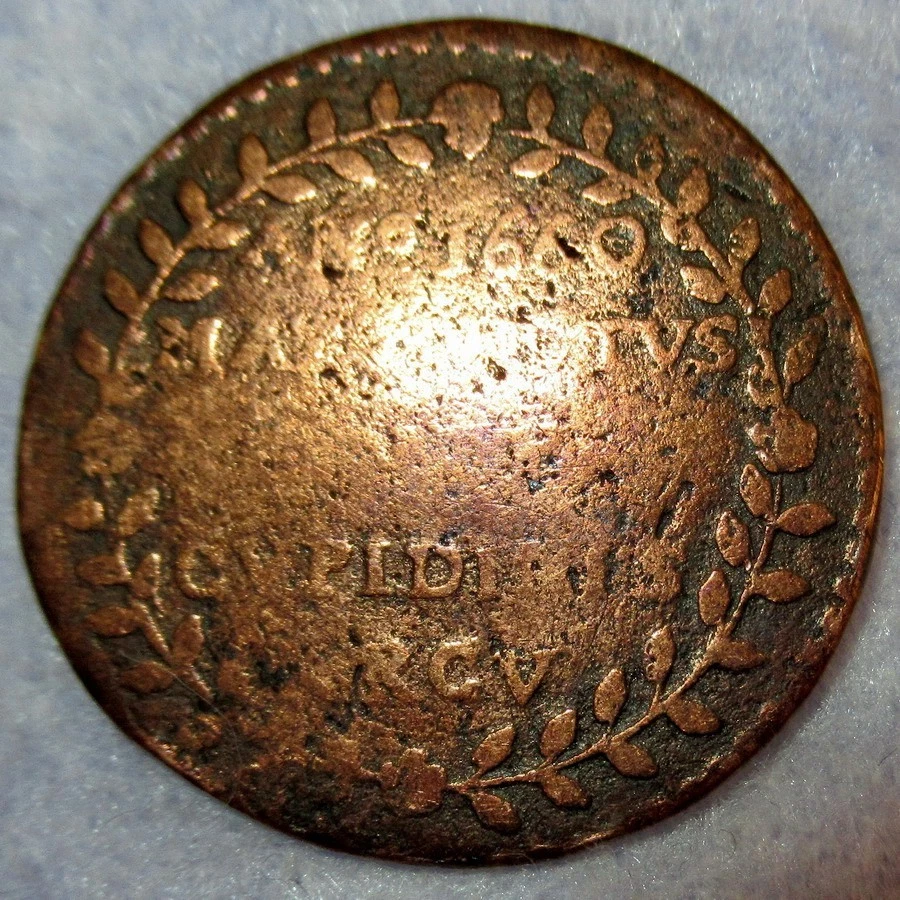
Reverse: A wreath of
Myrtle, containing inscription on five lines.
Latin Script: ANO 1660 / MARS
VICTVS / FVIT / CVPIDINIS / ARCV
Translation: In the year 1660 Mars
has been fed by the bow of Cupid |
Material: Copper; Measurement: 29 mm; Weight: 6 gr.
|
The
Seventh offers the Arms of Sieur Cocquiel to
the eyes. When this Family was honored with
Nobility by Emperor Charles V, in the
persons of the two Brothers Michel & Nicolas
Cocquiel, these Arms were given to him in
Toledo on January 10, 1539. On the Reverse
we read, in the middle of a Crown of Myrtle,
the Inscription.
- - - - - - - - -
History: The Cocquiel family (Coquiel),
known as Le Merchier, is from Tournaisis.
The Emperor Charles V ennobled the brothers
Michel and Nicolas de Cocquiel, sons of
Caron Cocquiel and Jehenne Carpentier dit du
Bos, by letters patent registered in Toledo
on January 10, 1539.
A branch was established in Antwerp at the
beginning of the sixteenth century and
another in London.
Louis Charles Joseph de Cocquiel (1765-) and
Eugène-Arnould de Cocquiel de Terherleir
(1798-1844) obtained recognition of
hereditary nobility under the United Kingdom
of the Netherlands in 1822, with the title
of knighthood for them and all their male
descendants, and with permission to add de
Terherleir to the surname for
Eugène-Arnould. |
Spanish
Coins in New World
|
For
centuries Spanish silver coinage was famous
throughout the world as the standard by
which other coinages were measured, due to
its consistent weight and purity. The
ascendancy of Spanish coinage dates from
1537 when Charles I, revising an act of
1479, promulgated exacting standards for
Spanish silver and gold coins. The Spanish
eight reales coin was set at a weight of
423.9 grains (27.47 grams) of .9305 fine
silver. From that date the coin only
depreciated some 4.4% over the next 250
years! In addition to its stability, Spanish
coinage was abundant. Spanish regulated
coinage was not only minted throughout Spain
but was also produced in Spain's colonial
possessions. As early as 1536, a year before
the coinage reform, Spanish colonial silver
coins were minted in Mexico City. With the
discovery of major silver and gold deposits
throughout the Viceroyalty of Peru (which
included all of Spanish South America from
what is now Panama down to Venezuela) major
mints were opened in Lima, Peru (1568-1589
then reopened in 1684), Potos¨ª, Bolivia
(from 1575) and Santa Fe de Bogot¨¢,
Columbia (from 1620). Later, additional
mints were located in Guatemala City (from
1733), Santiago, Chile (from 1750), and
Popayan, Columbia (from 1758). From these
locations, and to a lesser extent from
Spain, a number of coins made their way into
the English colonies. |
Commemorative Penny/ Jeton Penny / Rekenpenning
|
During
the Dutch Revolt (1568 - 1609) this pattern
changed and by both parties, the North in
front, about 2,000 different, mostly
political, jetons (Dutch: Rekenpenning) were
minted depicting the victories, ideals and
aims. Specifically in the last quarter of
the 16th century, where "Geuzen" or
"beggars" made important military
contributions to the Dutch side and
bookkeeping was already done without
counters, the production in the North was
just for propaganda.
The mints and treasuries of the big estates
in Central Europe used their own jetons and
then had a number of them struck in gold and
silver as New Year gifts for their employees
who in turn commissioned jetons with their
own mottoes and coats-of-arms. In the
sixteenth century, the Czech Royal Treasury
bought between two and three thousand pieces
at the beginning of each year.
Use as
Money
It is
clear that an important part of a nicety by
the frost given early count pennies as
currency in circulation was brought, and the
subsequent annual excess computational
tokens of the clerks - and perhaps even the
"bosses" - or in the case of silver
specimens processing by silversmiths or the
mint's products. Which this is demonstrated
by the large numbers of heavily worn and
therefore not collectable count pennies left
in the soil found or that have been
preserved, after at least after our currency
reform in the mid-19th century no longer pay
could be used. Using an abacus, or put on
the cloth would not use a few years of wear.
As an example below, a heavily worn token of
1620 from the Southern Netherlands. This
token was about as heavy and as big then as
a "groot", a copper coin from two doits.
Also the picture of Albert and Isabella
became a sort of authorization to use money
as suggested.
The
jetons described in this chapter just give a
small impression of more than a thousand
different Dutch jetons. After 1600
increasingly less Dutch jetons were struck.
The change from the counters to
pen-reckoning was not the only reason, for
France and the Spanish Southern Netherlands
just went on striking jetons for collectors.
In Holland the interest in buying and making
presents of jetons disappeared because a new
kind of medal appeared on the market, the
big silver history-medal. The Dutch name for
jeton, legpenning (laid-penny) remained to
indicate a small history-medal.
The jetons of the Netherlands were, just
like in France, struck in the official mints
by government order. The moneyer had to
stick to the design appointed by the
government. However, there were no
objections against using old dies again in
order to meet the needs of collectors. |

***
AUTHENTICITY GUARANTEED FOR LIFE ***
Shipping
policy:
Economy Regular mail shipping: 3.99 Euro
worldwide (buyer's risk for lost by post!)
If the total value is above 50 Euro, Registered
mail is required for safety reasons.
Registered mail shipping:
11.99 Euro within Europe, 14.99 Euro worldwide, Combined
shipping accepted. |