|
TIPO: B-263-5 Valor: 4
MARAVEDÍS |
| Ceca: SEGOVIA
Año: 1776
Material: Cobre
Peso: 5 gr. Medida: 25
mm. |
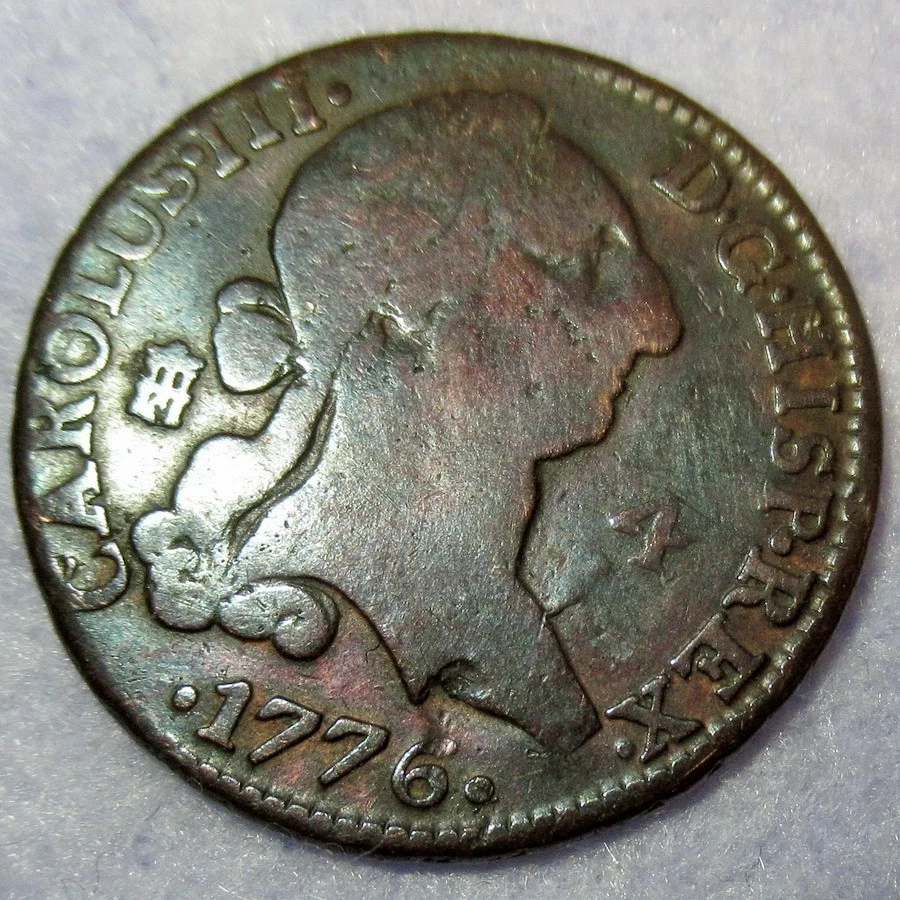
Anverso: CAROLUS
III D G HISP REX 1776 (Charles
III King of Spain by the Grace of God) alrededor del busto del rey a
derechas entre acueducto (ceca)
y valor 4.
|
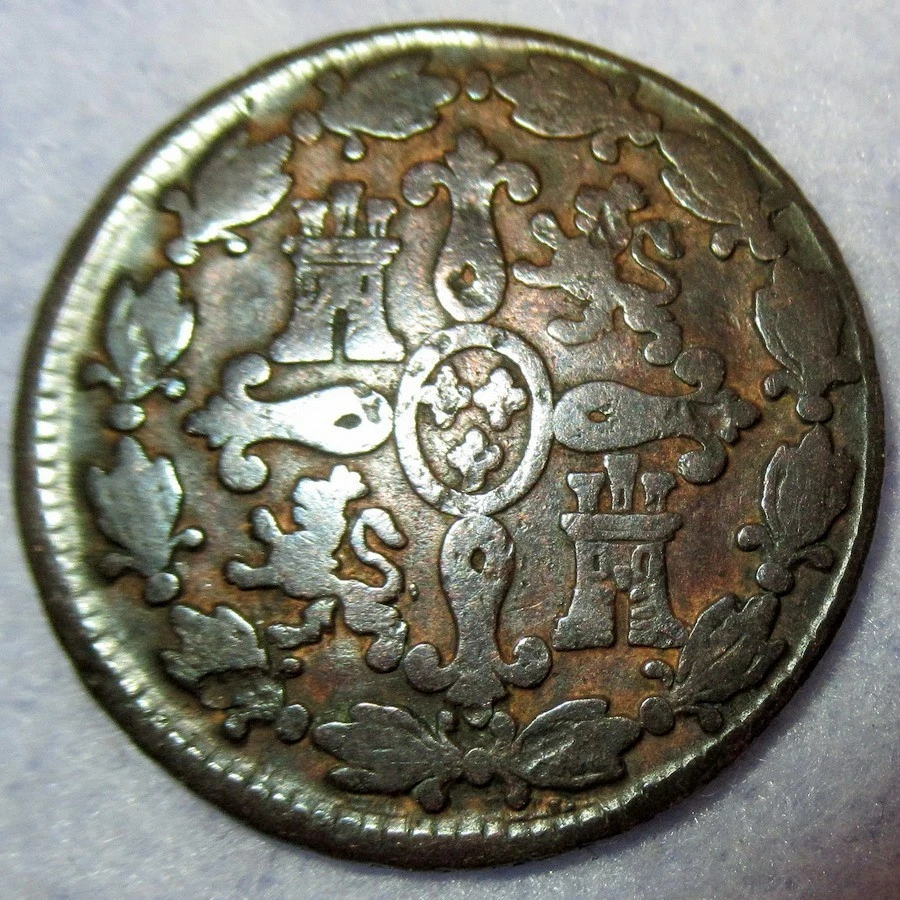
| Reverso :
Cruz de don
Pelayo cantonada de castillos y leones
con escusón de los Borbones en el centro,
todo rodeado por una corona de laurel. |
| Mint: Royal
Mint of Segovia (Real Ingenio de Segovia), Spain |
Spanish Coinage in New World
For centuries Spanish silver coinage was famous throughout the world as the
standard by which other coinages were measured, due to its consistent weight and
purity. The ascendancy of Spanish coinage dates from 1537 when Charles I,
revising an act of 1479, promulgated exacting standards for Spanish silver and
gold coins. The Spanish eight reales coin was set at a weight of 423.9 grains
(27.47 grams) of .9305 fine silver. From that date the coin only depreciated
some 4.4% over the next 250 years! In addition to its stability, Spanish coinage
was abundant. Spanish regulated coinage was not only minted throughout Spain but
was also produced in Spain's colonial possessions. As early as 1536, a year
before the coinage reform, Spanish colonial silver coins were minted in Mexico
City. With the discovery of major silver and gold deposits throughout the
Viceroyalty of Peru (which included all of Spanish South America from what is
now Panama down to Venezuela) major mints were opened in Lima, Peru (1568-1589
then reopened in 1684), Potosí, Bolivia (from 1575) and Santa Fe de Bogotá,
Columbia (from 1620). Later, additional mints were located in Guatemala City
(from 1733), Santiago, Chile (from 1750), and Popayan, Columbia (from 1758).
From these locations, and to a lesser extent from Spain, a number of coins made
their way into the English colonies.
Colonial Milled (Pillar) Coinage 1732-1821
With inferior quality cobs
being minted at most mints in the Viceroyalty of Peru, laws were finally passed
in 1728 and 1730 mandating modern minting techniques be employed. Possibly to
make up for the added costs associated with acquiring and sustaining the new
more expensive technology, the coinage was slightly devalued with the eight
reales reduced in weight and fineness to 417.6 grains at .9166 fineness. In 1732
the Mexican mint came into compliance with the new regulations and stopped
producing hammer struck cobs. They began minting an improved product on a screw
press. The use of a screw press required the production of milled or finished
blank planchets. The large screw press worked by rotating a weighted lever that
pressed an upper and lower die together with a blank planchet between them.
Under the intense and even pressure of the press the planchet would be evenly
and fully struck. Also, all coins would be of the same thickness. To insure
quality, production was supervised by two assayers, with both adding their
initial to each coin, unlike the cobs that were supervised by only one assayer.
Additionally, for the eight reales coin a special collar was used to produce an
edge design, in this case the coin was given a protective corded edge consisting
of a design resembling a tulip. Any clipping or filing would be immediately
evident as it would mar the edge design. Pillar coins were a great improvement
over cobs in that they were of a uniform size and weight without cracks or
uneven edges. They had a deep full strike with all information clearly visible
and were difficult to clip or counterfeit. Denominations for this new coinage
included the one half, one, two, four and eight reales coins.
The obverse of this new series displays the crowned arms of Castile and Leon
with the assayer's initial to the left of the shield and the denomination to the
right. The legend would give the monarch's name and title, such as PHILIP V D.
G. HISPAN. ET IND. REX (Philip V by the Grace of God King of Spain and the
Indies). The reverse depicts two orbs with a crown above (representing the Old
and the New Worlds). The orbs are over the Straits of Gibraltar, flanked by two
crowned pillars, representing the Pillars of Hercules, with PLUS VLTRA (More
Beyond) on banners wrapped around the columns. The legend reads VTRAQUE VNUM
(One on Both Sides). Below is the date, with the mintmark displayed both before
and after it. Following Mexico's lead (in 1732), this new series was minted in
Santiago, Chile (1751), Lima, Peru (1752), Guatemala City (1754), Santa Fe de
Bogotá, Columbia (1759) and Potosí, Bolivia (1767). During the production of
these coins some minor modifications were made in the location of the mintmark
and assayer's initials. Also, on the eight reales denomination the design of the
crown on top of the left pillar was changed in 1754. Prior to that time both
crowns were identical, representing the royal Spanish crown. In 1754 the left
crown was changed to the Imperial design.
Although mints had begun production of the new milled coinage, the old style
cobs continued to be made throughout the Viceroyalty of Peru until mid-century,
with the final cobs being produced at the Potosí mint in Bolivia in 1773.
Once again, in 1772 the Spanish government reformed their coinage. This time the
weight remained the same but the fineness of the silver was lowered to .90278.
In order that coins made at the new standard could be identified from the
earlier pillar coins the design was modified. On the obverse they replaced the
the arms of Leon and Castile with a bust of the king and a legend giving the
king's name and title as, CAROLUS III DEI GRATIA (Charles III by the Grace of
God) with the date. The reverse was also modified. The coins continued to
display the two Pillars of Hercules with the motto PLUS VLTRA (More Beyond) on
banners, but the two orbs between the columns were replaced with the crowned
shield of Leon and Castile. The legend reads, HISPAN. ET IND. REX (King of Spain
and the Indies) followed by the mintmark, the denomination and the assayer's
initials. The corded edge of the eight reales was also replaced with an edge
design comprised of alternating circles and rectangles. These coins, which
continued to be minted through 1821, are known as the "portrait" or "modified
pillar" series.
|