RESTORED ANTIQUE COPY OF JACOBUS STAINER 4/4 CONSERVATORY TRADE VIOLIN MADE IN GERMANY - CIRCA 1900
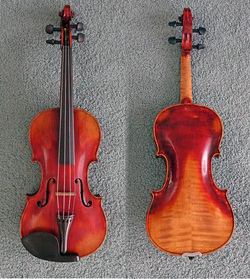
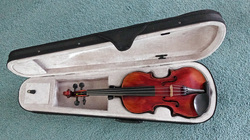
You are invited to purchase a very nice antique handcrafted 4/4 (full size) copy of a Jacobus Stainer Conservatory trade violin, made in Germany. This violin has been repaired, updated and fully restored to playability. Included with the violin a very nice internally padded cloth carrying case that will be used to safely ship the instrument and for ongoing future use by its new owner for safe transport and storage of the instrument.
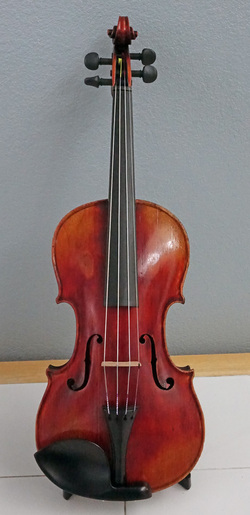
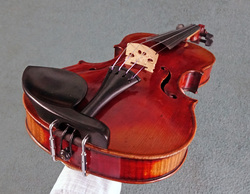
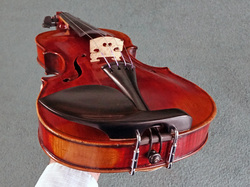
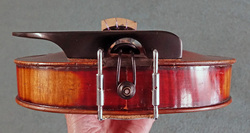
We have completed a series of repairs and restorative actions associated with this Stainer Conservatory trade violin as detailed below. In addition, this antique violin has been upgraded and modernized with a new Ebony chin rest, new Ebony tailpiece, reconditioned original Ebony fingerboard, new Ebony saddle, reconditioned original Dresden Maple bridge, and a new Ebony nut and endpin. We also modernized and set up the instrument with new modern steel strings from the Fiddlershop and new Wittner geared pegs making it ready to be played and enjoyed by its new owner.
Note: We have included several images of this restored violin along with images of the repairs. Please click on the images for a larger view.
VIOLIN MAKER'S STAMPS, INTERIOR LABEL & REPAIR LABEL:
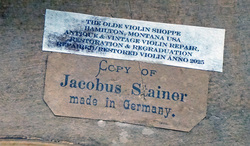
There is the following printed pasted-in paper label found inside the violin under the left f-hole (See accompanying image):
"Copy of
Jacobus Stainer
Made in Germany"
NOTES:
* This label identifies this violin as a Jacobus Stainer copy.
* The label identifies the source of the violin as Germany. Thus, this label was likely added by one of the many cottage violin makers in Mittenwald, Germany who produced copies of Stainer's violins over the period of the late 1700s to the early 1900s (See Stainer history below).
This violin also bears a repair label from our workshop found inside the violin under the left f-hole (See accompanying image):
"THE OLDE VIOLIN SHOPPE
HAMILTON, MONTANA USA
ANTIQUE & VINTAGE VIOLIN REPAIR,
RESTORATION & REGRADUATION
REPAIRED/RESTORED VIOLIN ANNO 2025"
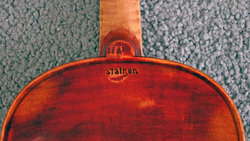
In addition to these internal labels, the violin is also stamped on the top of the back plate under the button (See accompanying image):
"Stainer"
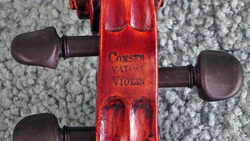
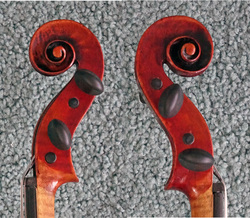
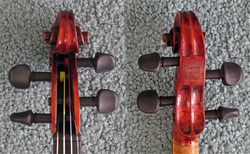
There is also another stamp on the back of the pegbox (See accompanying image):
"CONSER-
VATORY
VIOLIN"
Note: This stamp is partly faded due to age.
VIOLIN ORIGIN & ESTIMATED DATE OF MANUFACTURE:
This violin was most likely produced by one of several Klotz family luthiers based in Mittenwald, Germany. The dynasty of Klotz family luthiers is known to have consisted of some 25 individuals who were members of the Klotz Family Guild or empire, which operated in Mittenwald from the late 18th Century on through the early years of the 20th Century. This family cottage industry violin making enterprise is best known for the production of Stainer violin copies.
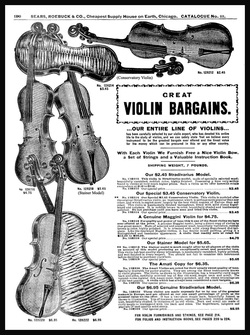
This violin is also identified as a "Conservatory Violin" from the engraved stamp on the underside of the pegbox. Conservatory violins were produced in large quantities especially during the period from 1900 to the 1930s, exported to the USA and were generally sold in individual retail shops or via mail order catalogues. Included with this listing is an extract from the Sears & Roebuck & Co. Catalogue No. III dating from 1902 that features several of these trade violins (See accompanying image). This catalogue cut features a Conservatory Violin and also a Stainer model similar to the one featured here.
The label "Conservatory" mainly suggests suitability for advanced students. In general they were considered to be good quality instruments made from good materials and were generally known for their superior tone, often enhanced by aging wood. They were also recognized for loudness of projection and remarkable tone and depth and were often praised for their playability and sound quality. In general they tended to represent good craftsmanship. In addition, they were famous for the unique way they were marketed to consumers via mail order catalogues during the early decades of the 20th Century.
In summary, these copies of Stainer violins have a reputation of being of good to excellent quality with a very pleasing tone.
Note: For more on the history of Stainer violins, please see below.
The exact date of manufacture of this particular violin is unclear. However, based in part on its overall condition and the nature of the wood used for the top and bottom plates, we can date this instrument to circa-1900.
KEY PHYSICAL FEATURES:
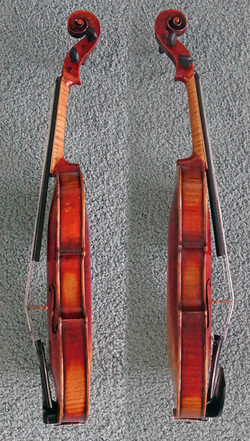
* A warm, very attractive reddish Walnut-brown spirit varnish over a golden ground. The maker has added an antique pattern to the varnish (See images).
* Two piece flamed Maple back with ribs of flamed Maple to match the back (See images).
* Two piece Spruce top with a relatively consistent grain pattern.
* Top plate has a moderately high arch, which is generally typical of Stainer copies.
* Smooth interior finish with a nicely formed, properly designed, and correctly placed glued-in bass bar.
MEASUREMENTS:
* Length Overall (LOA): 23 1/4"
* Length of the body (LOB): 14"
* Rib Height: 1 1/4"
* Max Width of Upper Bout: 6 1/2"
* Avg. Width at Waist or C-Bout: 4 1/8"
* Max. Width of Lower Bout: 8"
NATURE OF REPAIRS & RESTORATION:
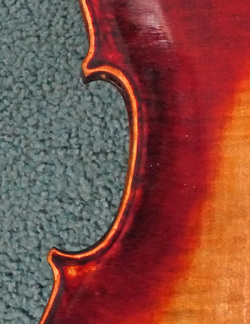
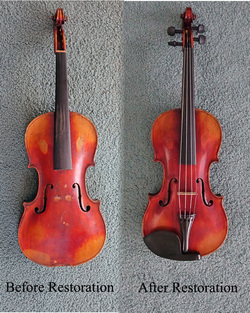
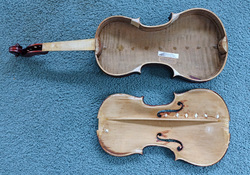
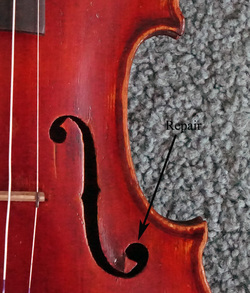
This antique violin was received by us with its body in relatively good structural condition, but with the lower block and part of the attached ribs loose from the bottom plate. There was a small piece of the right f-hole that was missing and in need of replacement. There was also an age crack on the left side of the lower bout that needed to be cleaned, re-glued and stabilized (See images of violin before and after restoration and images of internal repairs). The violin was also in need of a good external and internal cleaning and a spirit varnish touchup.
Following is a summary of the actions taken by us to repair and restore this antique Stainer Conservatory trade violin to full playability:
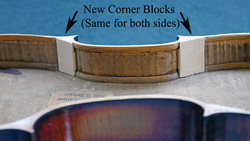
1. The top plate was removed from the violin in order to clean the inside of accumulated dust. At this point it was discovered that the violin was well made with internally smoothly carved top and bottom plates. In addition, we found a very nicely formed, properly designed and correctly placed bass bar glued-into the underside of the top plate. In addition, the center seam of the bottom plate was "cleated" with drops of Hide Glue, which was apparently effective and something that we had not seen before in a trade violin. However, none of the corners were blocked by the maker. So, we added proper blocking to all four of the corners (See accompanying image that shows this). Thus, all four corners are now properly blocked.
2. While the top plate was off of the violin we re-glued the lower block and associated sections of the ribs to the bottom plate. We also cleaned, glued and cleated the crack in the right side of the lower bout of the top plate (See image of internal repairs). Finally, we added the missing piece to the lower segment of the right f-hole in the top plate (See image that shows this repair)
3. Before we restored the top plate to the violin, we glued-in our shop's repair label to the bottom plate (See images of the internal labels).
4. We re-glued the top plate to the ribs using Hide Glue.
5. The fingerboard was found to be loose. We removed it and cleaned it and the top of the neck of old dried glue. We also took this opportunity to plane and sand the surface of the fingerboard to achieve a smooth surface. In the process of dry fitting the fingerboard to the violin we noted that it was too low with respect to the top plate. Thus we added a shim to the neck in order to achieve the correct height above the top plate and re-glued the fingerboard to the neck.
6. At this time, the exterior surfaces of both the top and bottom plates as well as the exterior of the ribs were wet sanded with successive grades of sandpaper (400, 600 followed by 1,000 git) thereby removing most age related surface imperfections. The surfaces were then cleaned with denatured Alcohol and reddish Walnut Brown stain was added to areas needing it. In a similar fashion, the pegbox and scroll were sanded and touched up with reddish Walnut Brown varnish to match the rest of the violin. Finally, a coating of French Polish was added to all exterior surfaces of the violin as a final cosmetic treatment.
7. We installed a new Ebony saddle and added a new Ebony endpin onto the violin. In addition, a new full-size Guarneri-style Ebony Chinrest was added to the violin along with a new Ebony tailpiece.
8. The pegbox was fitted with Wittner Finetune geared Pegs (Made in Germany). These geared pegs negate the need for fine tuners on the tailpiece as they are permanently set within the pegbox and have an 8:1 gear ratio, making for very precise tuning. Only the central knurled spool segment of the peg rotates so peg slippage is prevented. So once the Wittner pegs are set, they are not designed to be removed from the pegbox. The geared pegs are also unaffected by temperature and humidity changes.
NOTE: Conventional wood peg slippage is a big problem with most violins, something that a player definitely does not want to happen in the middle of a concert solo in front of a large audience. Wittner geared pegs totally eliminate peg slippage so one can play the violin even with vigor without worry.
9. Finally, we completed the setup of the violin by properly fitting the original Dresden Maple bridge, installing a new Spruce sound post along with a new set of modern metal strings offered by the Fiddlershop. This string set is equal in design and performance to Dominant strings.
All of the aforementioned repairs have resulted in a completely restored, repaired and upgraded Stainer trade violin that has significantly improved the overall tonal response and sound quality of this instrument. Thus, this antique instrument that could have easily been lost to time has been fully repaired, improved and reborn to live a second life in the present.
CASE:
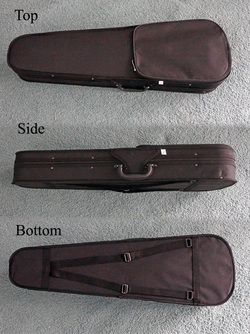
Included with the violin is a very nice modern internally padded soft carrying case. The case has twin zippers, carrying handle, a top zippered pocket for sheet music and adjustable straps on the back should one wish to carry the violin over one's shoulder instead of by the handle. The case is new (See accompanying images of the case). This case is suitable for the safe transit of the violin to its new owner and for subsequent use by the new owner for both proper storage and transport of the violin.
ABOUT JACOB STAINER, EARLY AUSTRIAN-GERMAN VIOLIN MAKER:
Jacob Stainer (circa 1617 -1683) was the earliest and best known Austrian-German luthier. In fact, he was one of the most famous luthiers of his time in Europe even before Stradivari of Cremona, Italy came to dominate the violin making profession later in the 18th Century.
Stainer was born in Absam near Innsbruck in present-day Austria. During his early years, many historians believe that he was associated with the luthiers of Cremona, Italy, in particular the Amati family. His initial violin productions, which date from as early as the 1630s, bear a strong resemblance to Amati's productions.
After his early work in Italy, Stainer eventually settled in his birthpllace in Absam, Austria in 1856, where he began to produce some of his finest instruments, which appear to be inspired by Amati's Grand Pattern. It was during this period that Stainer gradually moved away from the high arching designs of his early career, and for much of the remainder of the 17th Century he produced exceptional instruments that rivaled or even surpassed the works of his Italian Cremonese contemporaries.
In 1658 Ferdinand Charles, Archduke of Austria, awarded Stainer the honor of "Servant of the Archduke." This lasted until 1662 when the Archduke died. Then, in 1669, Leopold I, Holy Roman Emperor, appointed Stainer as his "Imperial Servant." However, in the same year, Stainer was arrested in Innsbruck, Austria, having been found in possession of books concerning Lutheranism. In 1680, probably due to ongoing persecution as a heretic that included a court trial, he fell into deep depression. Stainer later died in Absam in 1683.
Even after his death, Stainer's violins were highly sought after by famous 17th and 18th Century musicians including such notables as Johann Sebastian Bach and Wolfgang Amadeus Mozart. Archangelo Corelli was one of several musicians/composers who was also known to have owned and played a Stainer violin.
Late in the 18th Century, changing performance conditions in the classical music world led many musicians to seek a different sound than that afforded by Stainer's violins. Instruments produced by Antonio Stradivari and others of the Cremonese school were flatter and broader in design and produced a more powerful sound than those made by Stainer. As a result, this became THE Sound preferred by musicians of the day as orchestras in large concert halls gradually replaced baroque chamber ensembles in more intimate settings. Thus, for a time, Stainer's violins tended to fall out of favor.
Jacob Stainer employed no apprentices and so had no one to carry on his work after he died. He is believed to have produced well over 300 instruments during his career as a violin maker. Surviving original Stainer violins are comparatively rare today and relatively few of his violas, cellos and basses are known to exist. However, his surviving instruments made by his own hand are highly sought after by modern musicians who perform early music on period instruments as they have that very intimate classic sound.
However, Stainer's ultimate legacy seems to have survived changing music preferences over time. Stainer was widely imitated after his death, most notably by acclaimed Mittenwald, Germany maker Matthias Klotz (1653-1743), who produced countless Stainer copies, many of them so perfect that they have been mistaken for genuine Stainers for centuries. Later, the tradition of producing Stainer copies was continued by several members of the Klotz Family.
There are at least 25 known violin makers in the Klotz family, many of whom worked at the same time as each other. Many of these makers did not use their own labels and this in conjunction with the sheer enormity of the production has given rise to the term "Klotz School," a catch-all phrase that usually indicates that the instrument was made in Mittenwald and is modelled after Stainer's designs.
In general, Stainer trade violins are known as superb playing instruments which remain very affordable in comparison to their Italian or English counterparts. Many contemporary musicians prefer the more intimate sound and tone of a Stainer Trade violin.
PURCHASE:
The Montana Logger is very pleased to offer this professionally repaired, upgraded and completely restored German made Stainer Conservatory trade violin for a very reasonable buy-it-now price. We will also entertain reasonable offers for this refurbished antique German-made violin that dates from circa 1900.
PAYMENT: Payment is due within 3 days of purchase. Prompt payment is always very much appreciated.